
Two questions, one answer: how much do you leave out?
TL;DR
- LLMs do know what good demos look like — they have read every B2B sales book ever written. What they don't know is your deal, your stakeholders, or your product.
- Zero-context prompts produce coin-flip advice. "Focus on the economic buyer" is excellent counsel in a commercial deal and useless the morning you run an end-user session.
- Build the context once, then keep feeding it. Who you are, who you sell to, what happened in your last call — upload the transcript and let the model score you across sessions.
- On portfolio breadth, our default is land and expand. Solve one problem you and the customer agreed is real. The harbor cruise through all twelve modules is wasted time.
- Do the CAC math before you pick a side. Hours of AE plus SE time per closed deal, against average deal size, tells you more than any opinion — including ours.
"Give me a good tip to improve my demo performance." One sentence. No context. Dropped into Claude.
What came back: point the demo at the decision maker, put their priorities in the center, keep the conversation at business level, and don't let end-user feature questions dilute your time — those people don't control the budget and they don't sign.
Max Lüpertz posted the screenshot and asked a clean question: good advice or bad advice? Twenty-nine comments later, almost nobody had answered it. Most people said the same thing — the model needs more context. Natasja Bax of Great Demo! took a sharper position: LLMs don't understand what good sales demos look like. We disagree, and the disagreement turns out to be about the same thing that decides whether you demo one module or twelve. Focus.
Is "focus on the economic buyer" good demo advice?
Yes — for a specific kind of deal, and that qualifier is the whole story.
Read what the model actually said. Aim at the most important person in the room. Make it benefit-centric for that person. Stay out of a feature debate with people who can't sign. There's nothing wrong in there. As Tim put it on the podcast: "I could imagine much worse answers."
It also barely touches the demo itself. None of that advice is about craft — how you narrate, when you shut up, how you handle the third "can it also do…". It's organizational thinking that happens before you open the product: who do I win first, do I plan for the C-level walking out after 20 minutes, does the user crowd deserve its own deep-dive session next Tuesday.
That's worth something. But if you're delivering a pure end-user demo tomorrow, the advice is dead on arrival. The model didn't know that, because nobody told it. A single-line prompt about a five-stakeholder enterprise demo can only be right or wrong by accident.
So do LLMs know what a good demo looks like?
They do. These models have read every sales book, every B2B software playbook, every demo methodology that ever made it into text. Ask about persuasion — and a demo is nothing but proof that you can solve a problem — and there's real substance in there.
The gap isn't knowledge. It's retrieval without context. Which means the fix isn't a better model, it's a better setup on your side.
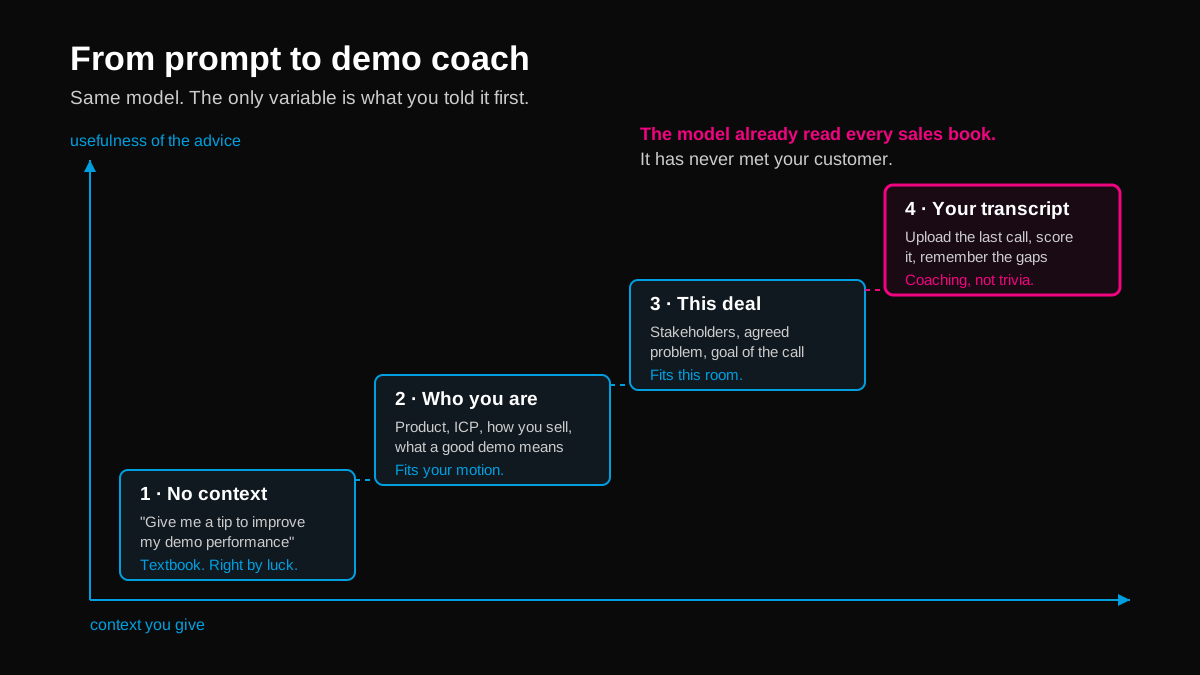
Same model, four different answers — the only variable is what you told it first.
Build it in this order. First, a persistent skill or project that knows who you are: your product, your ICP, how you sell, what you consider a good demo. Then per-deal context: who is in the room, which problem you both agreed is urgent, what the meeting is supposed to achieve. Then the part almost nobody does — take the recording of your last demo, upload the transcript, and ask for a score against your own criteria. Tell it to remember the weak spots. Feed it the next transcript and see whether anything moved.
That is a coach. A one-line prompt is a fortune cookie.
Is the economic buyer really never in the room?
Helga Wandel made that argument in the comments: the economic buyer usually isn't present, so advice built around them doesn't help. We'd push back — it depends entirely on the segment you sell into.
Sell to DAX-sized enterprises and no, the CFO is not sitting in your discovery calls. Sell commercial or mid-market and the picture inverts. In companies with 50 to 100 employees, the managing director or the owner is frequently in every single session. Sometimes they're the person who clicked "book a demo" in the first place. One example from real life: the managing director of a roughly 100-person nut processing plant personally ran her company's ERP purchase, start to finish.
So the honest version of the advice is: when the economic buyer is in the room, build the session around them. That doesn't mean ignoring users. It means giving users their own slot — "let's set up a user deep-dive for all your questions" — instead of letting an unstructured feature interrogation consume the one hour the person with budget authority gave you.
Should you demo the whole portfolio or the one thing they asked about?
Our default answer is the narrow one. Show what solves the problem you and the customer have both agreed exists, is acute, and needs fixing now. Prove you can fix it. Stop.
Max also brought a second question: SEs are being told to keep demos as simple as possible, skip roadmap teasers, and show nothing the customer didn't ask for — so deals close faster. Meanwhile the other camp deliberately goes wide, positioning three extra modules and two extra departments to widen the deal.
Start earlier than the demo. Discovery is where you separate what the customer thinks they need from what they actually need. Sometimes those are identical. Sometimes a question you ask opens up a problem they hadn't consciously framed yet — that's a good reason to ask it. But finding a second and third use case doesn't obligate you to put them on screen. You can know about them and still decide, on purpose, to land use case one and phase the rest.
What we won't defend is the reflex bundle. A customer comes to you with a commission calculation problem, and in the same breath you're pitching CPQ because they probably configure complex products too. Nobody asked. Discovery didn't surface it. The customer also has finite implementation capacity — they can't absorb your entire catalog in quarter one anyway.
"Focus is a wonderful thing." — Jan-Erik Jank
Roadmap has a legitimate use here: if discovery surfaced something you genuinely can't solve today, a short vision and a phase plan is honest work. Reading out the full feature pipeline so nobody can accuse you of hiding anything is cover-your-ass behavior with a slide deck.
What do your customer acquisition costs say about that choice?
This is where PreSales leadership goes quiet, and it shouldn't. Customer acquisition cost is treated as a marketing metric — cost per lead, CAC payback — but in B2B software a large chunk of it is your team's time.
Run the numbers for one segment. A typical 100k deal takes, say, three discovery calls, five demos, three technical deep-dives. Multiply by the loaded hourly cost of the AE and the SE, add environment and infrastructure cost, and you have the acquisition cost of that logo. Now compare two paths. Path one: smaller, faster deals, then expand — because selling use case two to an existing customer takes one meeting instead of three, which is remarkably cheap net-new ARR. Path two: a bundle that needs five meetings instead of two but lands 300k instead of 100k.
Both can win. Which one wins for you is arithmetic, not ideology. Tim's frustration on the podcast was blunt: "I'm still waiting for the SE who can give me a clear answer on that."
One caveat that CAC alone won't show you. Land and expand carries its own risk — if adoption of module one stalls, module two never gets bought, and your cheap expansion motion evaporates. And a discounted bundle module that nobody logs into buys you revenue this quarter and a retention conversation next year. Consumption and credit-based pricing is quietly ending that game anyway. Some of our clients sign initial contracts worth almost nothing; the money only moves once usage ramps — e-commerce volume, payment transactions, invoice throughput. HCM, CRM and ERP vendors are drifting the same direction. When billing follows adoption, you have to deliver constantly as a vendor. Which is the most honest arrangement in the room.
Frequently asked questions
Can ChatGPT or Claude actually coach me on sales demos? Yes, if you stop treating it like a search box. Give it a persistent context layer — your product, your ICP, your definition of a good demo — then per-deal specifics, then transcripts of your actual calls. At that point you get useful, situation-specific feedback and a way to track whether you're improving. A context-free prompt gets you textbook generalities that may or may not fit your next meeting.
Is it good practice to focus a demo on the economic buyer? When they're in the room, yes: lead with their priorities, keep it at business level, and don't let the session collapse into a feature debate. Whether they're in the room depends on your segment. Enterprise deals often run without the budget holder present; in the 50–100 employee range the owner or managing director is frequently the main contact from day one.
Should we show our whole product portfolio in the first demo? No. Show what solves the problem discovery confirmed is real and urgent, prove it, and phase the rest. Prospects already understand you sell more than one thing. Extra modules on screen dilute the story, extend the sales cycle, and consume implementation capacity the customer doesn't have.
When does a bundle deal beat land and expand? When the additional need is verified in discovery, the customer can actually implement it, and your own math says the bigger deal justifies the longer cycle. Calculate acquisition cost per closed deal against average deal size for both paths, then check adoption and retention on bundled modules. If bundled modules show low usage, you're borrowing revenue from next year's renewal.
What is customer acquisition cost in a PreSales context? The total cost of winning a customer, including SE and AE hours across every discovery call, demo, deep-dive and POC, plus environment and infrastructure cost. Most SE organizations never calculate it, which is why debates about deal breadth stay opinion-driven. Once you know your cost per won deal per segment, you can decide where SE capacity is worth spending.
If your team's demos still start with the harbor cruise through every module, that's a discovery and structure problem, not a product problem — and it's exactly what we fix in the Trusted Advisor Academy. Book a discovery call with us, or join the conversation in our PreSales Leader Community.
Tim Brömme & Jan-Erik Jank are the co-founders of SE Rockstars, with 30+ years in enterprise PreSales and 350+ SEs coached.
Listen to the full episode
The German-language conversation, including Tim's take on why the CAC question never comes up in SE leadership meetings: PreSales Unleashed: Geben LLMs gute Demo Tipps? (270)