
You're ten minutes into a demo, the account executive is waiting for the product tour to create urgency, and the buyer is asking questions nobody prepared for. You move quickly through features, recover when the workflow doesn't match the buyer's process, and finish with a polite “we'll follow up.” The recording looks polished. The technical win still doesn't happen.
That outcome usually gets labeled a demo problem. Often, it started earlier with weak qualification, a shallow discovery call, or a handoff that contained a company name and a list of requested features but no buyer-defined success criteria. No discovery, no demo is a useful operating rule because discovery quality decides whether your demo can carry a real business conversation.
Demo skills training works when it treats the demo as a measurable PreSales system. You need a curriculum tied to the workflow, practice that forces decisions, feedback that changes observable behavior, and inspection that connects demo execution to the technical win.
Why Most Demo Skills Training Fails Before the Demo Starts
A sales team books a meeting with a prospect that has downloaded technical content and asked for a product demonstration. The AE sends the calendar invite to an SE shortly before the call. The only context is a CRM note: “Interested in automation. Show integrations and reporting.”
The SE builds a sensible tour. They explain the architecture, demonstrate the main workflow, answer questions about security, and leave time for a short Q&A. The buyer likes several capabilities, but nobody confirms which operational problem matters most, who owns the decision, what must be proven technically, or what would make the evaluation acceptable.
The next step becomes “send materials.” The opportunity drifts.
Many demo skills training programs start in the wrong place. They teach voice control, slide design, objection handling, and product storytelling while leaving qualification and discovery handoff untouched. An SE can improve every delivery habit and still run an irrelevant demo.
Operating rule: A polished demo of the wrong workflow is still the wrong demo.
The PreSales role spans discovery, demos, proposals or RFPs, proof-of-concepts or pilots, and customer training or solution validation. The Certified Sales Engineer credential framework lists those activities as qualifying presales work. Training should therefore prepare SEs for the complete sequence, not isolate presentation performance from the decisions that come before and after it.
Audit the system before redesigning the training
Review your current program against these questions:
- Entry criteria: Does an SE know what information must exist before accepting a demo request?
- Discovery handoff: Does the handoff include business impact, current process, stakeholders, technical constraints, and desired outcomes?
- Relevance: Can the SE explain why each demo moment belongs in the meeting?
- Buyer participation: Does the format create room for the buyer to react, test assumptions, and describe their process?
- Follow-through: Does the demo produce agreed evaluation criteria and a specific next step?
If the answer is “no,” adding another presentation workshop won't solve the underlying issue. Start by defining what a qualified demo request looks like and what the AE and SE must agree before the meeting is scheduled.
A useful internal reference is the discussion on why most meetings are already lost before the demo. The point isn't that demos don't matter. It's that the demo inherits the quality of the commercial and discovery work around it.
The practical mental model is simple:
- Qualify the opportunity.
- Discover the buyer's situation and desired change.
- Define technical success.
- Build a focused demo around the highest-value outcome.
- Validate the outcome with the right stakeholders.
- Inspect the result and improve the system.
Demo excellence is therefore stage presence plus operating discipline. Training that ignores the discipline creates SEs who can perform a tour, but not consistently earn a technical win.
Designing a Demo Curriculum That Maps to the PreSales Workflow
Build the curriculum around the work your SEs must complete, not around a catalog of presentation topics. A strong program follows the buyer's evaluation path and gives each stage a clear output.
The PreSales workflow can be structured around distinct stages with different deliverables. Qualification and go or no-go produce a qualification memo. Discovery and scoping produce a requirements document. Demo and proof of concept produce a demo script or POC plan with acceptance criteria. Those outputs give managers something concrete to inspect and give SEs a reason to practice each skill.
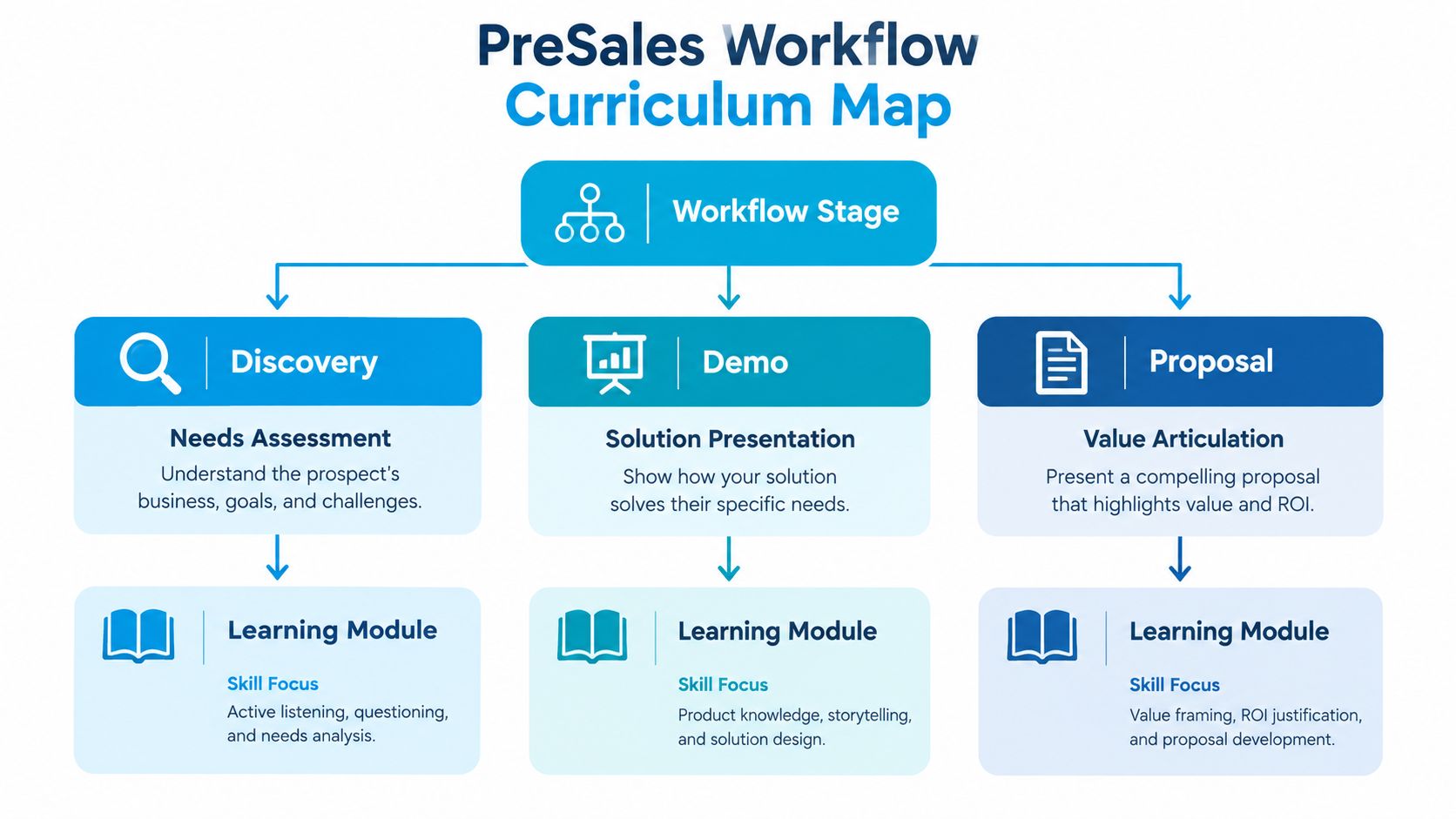
Use the workflow as the curriculum backbone
| Workflow stage | Required output | Training focus |
|---|---|---|
| Qualification | Qualification memo | Fit, risk, go or no-go judgment |
| Discovery and scoping | Requirements document | Business problem, current state, stakeholders, constraints |
| Demo preparation | Demo script | Outcome sequence, proof points, questions, recovery paths |
| Demo delivery | Buyer validation | Conversation control, relevance, technical credibility |
| Proposal or RFP | Value articulation | Mapping requirements to outcomes and evidence |
| POC or pilot | POC plan with acceptance criteria | Test design, ownership, measurement, exit conditions |
| Solution validation | Confirmation of technical fit | Risks, gaps, decisions, next action |
This structure prevents a common training mistake, which is teaching “demo skills” as if every SE needs the same presentation. A new SE may need help with discovery questioning and environment control. An experienced SE may need to improve executive framing, multi-threaded validation, or POC boundaries. The workflow shows where the gap sits.
Sequence the value before the feature
Every demo flow should identify the highest-value buyer outcome and put it early. The buyer should understand the relevance before you ask them to follow a long product sequence.
A gold-standard flow might look like this:
- Confirm the business and technical outcomes from discovery.
- Restate the current process and the friction it creates.
- Demonstrate the outcome that matters most.
- Ask the buyer to compare the demonstrated workflow with their current state.
- Prove supporting capabilities only when they reinforce the primary outcome.
- Surface risks, constraints, and open questions.
- Agree on technical acceptance criteria and the next evaluation step.
Standardization doesn't mean memorizing every sentence. It means standardizing the logic, order, and decision points. SEs should adapt the language and examples to the account while preserving the flow that keeps the conversation tied to buyer value.
The guide to choosing PreSales training is useful when you're comparing programs. Look for training that connects learning to active opportunities, includes practice and feedback, and gives managers observable artifacts to review.
A curriculum is working when an SE can produce the right output at each stage and explain how that output supports the technical win. If the only assessment is whether the demo looked confident, the curriculum is measuring theater instead of PreSales execution.
Building Roleplays That Rehearse Real Buyer Decisions
Most roleplays fail because they ask an SE to perform a complete demo for an imaginary audience. The exercise becomes theater. The SE speaks for too long, the observer gives general feedback, and everyone moves on without practicing the decision that caused difficulty.
Design roleplays around choice under constraint. The SE should have to decide what to show, what to defer, what to ask, and when to stop.

Write scenario cards that create pressure
A useful roleplay includes four elements:
- Buyer situation: The current workflow, visible pain, desired change, and reason for evaluating now.
- Stakeholder perspective: The economic buyer, end user, technical evaluator, security lead, or operations owner each has different concerns.
- Known gaps: Missing discovery information, unclear authority, conflicting priorities, or an untested integration.
- Decision condition: What the buyer must believe, see, or validate before agreeing to the next step.
Give the role-player private information that the SE can discover only by asking. For example, a hypothetical end user might care about adoption and workflow speed, while a hypothetical economic buyer cares about operating risk and business impact. The SE must choose whether to lead with the user experience, the control model, or a question that resolves the tension.
Timebox the rep around one behavior, such as:
- Recovering when the buyer says the demonstrated workflow doesn't match their process.
- Handling a request for a feature that isn't relevant to the agreed outcome.
- Moving from a technical answer back to the buyer's business consequence.
- Stopping a feature tour and asking for confirmation.
- Defining acceptance criteria before proposing a POC.
Short reps create more learning than one long performance. A ten-minute practice focused on sequencing is easier to observe, correct, and repeat than a full demo that contains too many variables.
Preserve the flow while allowing adaptation
Give every SE the same gold-standard skeleton, then let the scenario determine the language and evidence. The observer should score behaviors, not personal style.
| Keep standardized | Allow adaptation |
|---|---|
| Outcome-first opening | Account language and examples |
| Discovery confirmation | Follow-up questions |
| Primary workflow sequence | Data, use case, and roles |
| Validation checkpoints | Depth of technical detail |
| Next-step definition | POC or evaluation path |
Use call transcripts, discovery notes, and closed opportunities to write scenarios. Remove identifying information, then preserve the actual tension: a missing stakeholder, a vague requirement, a security concern, or a buyer who wants proof before sharing process details.
Practice should make the SE choose. If every answer is obvious, the scenario is too easy.
The lessons from 100 roleplays reinforce a point managers often learn slowly: repetition only helps when the rep receives specific correction and has another chance to apply it.
Use this media example as a prompt for facilitator discussion. Ask observers to identify the moment where the presenter could have paused, tested relevance, or changed sequence.
After the rep, collect feedback in this order: what the buyer needed, what the SE assumed, which behavior helped, which behavior created risk, and what the SE will retry. Don't let the group turn the review into a product debate. The point is to improve the decision process.
Feedback Loops and Deliberate Practice That Actually Change Behavior
A workshop can create awareness without creating ability. SEs often leave knowing that they should ask better questions or lead with outcomes, then return to live deals and repeat the same habits under pressure.
Deliberate practice is narrower. It requires a target skill, an explicit gap, immediate correction, and another attempt. The deliberate practice guide from Farnam Street describes this as focused work on a specific performance gap rather than generic repetition.
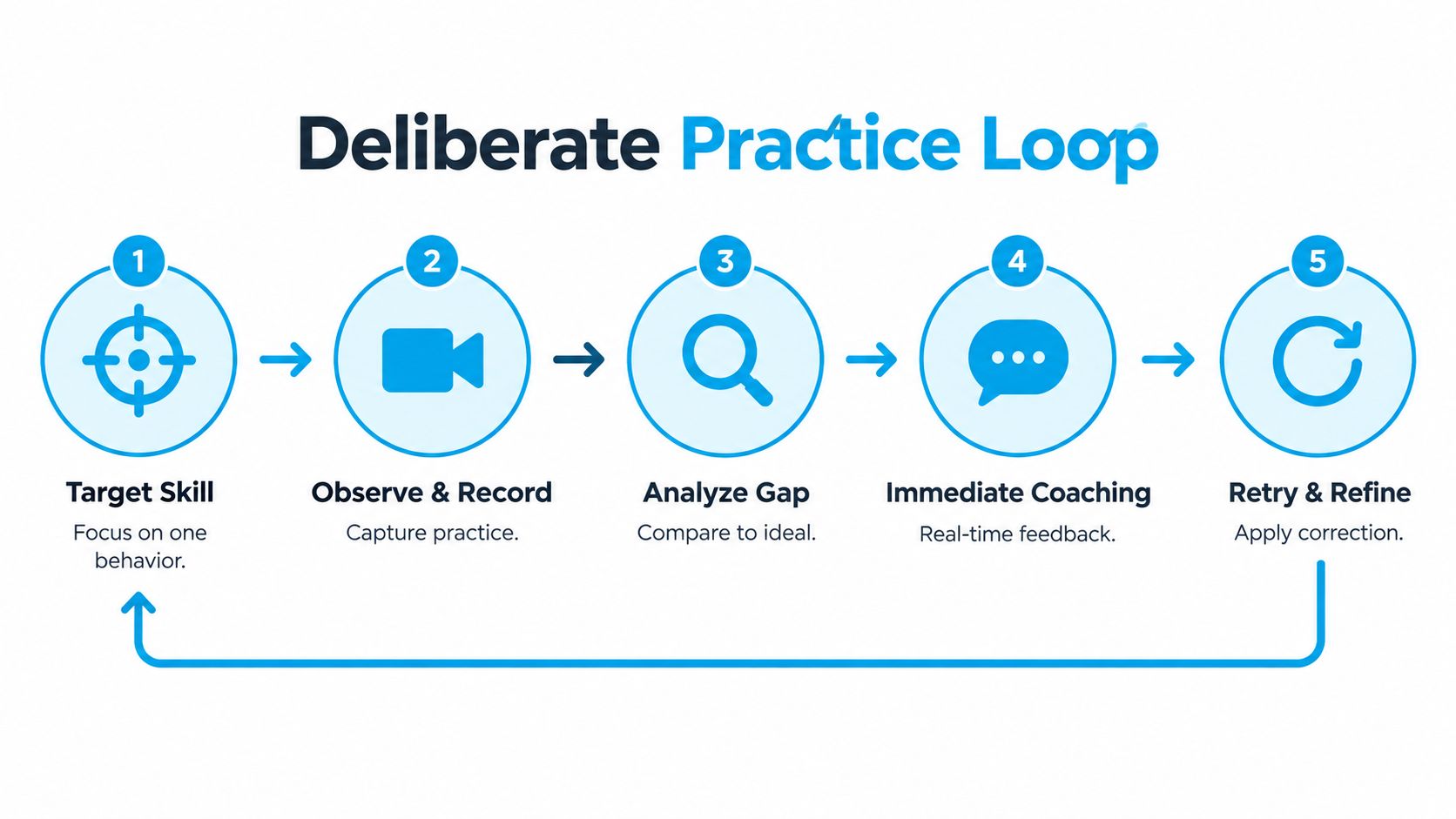
Narrow the target
Don't coach “be more consultative.” Coach a behavior someone can hear or see.
Examples include:
- Ask one question that connects the workflow to business impact.
- State the buyer outcome before opening the product.
- Pause after a proof point and invite the buyer to assess fit.
- Name an assumption before demonstrating around it.
- Close each major sequence with a validation question.
Record the practice when your policies allow it. Review the moment against the gold-standard flow, identify the gap, correct one thing, and retry immediately. The second attempt matters because it tests whether the SE can apply the correction, not whether they can agree with it.
Build a repeatable manager rhythm
A practical cadence includes 10 to 15 minutes of rehearsal before each demo, a baseline recommended by Great Demo workshop guidance. Use that time for the account-specific opening, the highest-value workflow, anticipated questions, and one recovery path.
A weekly rhythm can look like this:
- Before the demo: The SE rehearses the target behavior and confirms the buyer outcome.
- During the demo: The manager or peer observes the agreed behavior instead of scoring everything.
- Immediately after: The SE records what happened, what changed, and what remains uncertain.
- During the next practice: The SE retries the same behavior in a new scenario.
- During team review: The group shares patterns without exposing sensitive customer information.
Feedback should be specific and close to the moment. “You talked too much” is weak. “After the buyer mentioned the approval process, you opened the reporting screen. Ask what approval evidence they need before showing the screen” gives the SE a correction they can use.
Track behavior change with evidence, not invented scores. Keep a simple record of the target behavior, observed example, coaching action, retry result, and whether the behavior appeared in a live opportunity. Managers can then discuss progress without pretending that a subjective rating proves revenue impact.
Community practice helps maintain the rhythm between manager sessions. Peer observers hear different approaches, SEs encounter unfamiliar buyer objections, and leaders see recurring gaps across the team. The important design choice is continuity. One workshop may introduce the standard, but repeated practice makes the standard usable under pressure.
Choosing the Right Demo Format and Keeping Assets Current
A buyer who needs to validate a complex workflow should not receive the same experience as someone sharing an early-stage overview with colleagues. Format affects discovery quality, buyer participation, and the evidence an SE can collect for a technical win. Choose it based on the decision the buyer must make and the stage of evaluation.
| Format | Best For | Trade-off to Manage |
|---|---|---|
| Live | Discovery-led evaluation, complex workflows, stakeholder questions, technical validation | Requires preparation, coordination, and strong facilitation |
| Recorded | Early education, repeated explanations, stakeholder sharing, asynchronous review | Limited context and no immediate correction when the buyer misunderstands |
| Interactive | Self-serve exploration, modular proof points, distributed buying groups, focused validation | Requires asset maintenance, analytics, and clear paths through the experience |
A live demo offers the richest conversation, but its value depends on the SE's ability to adapt without losing the agreed outcome. Recorded demos extend access and support internal sharing, while interactive demos let buyers test focused proof points on their own. Each format creates a different training requirement. Practice live facilitation, concise recorded explanations, and guided interactive paths rather than treating them as interchangeable assets.
Timing also affects the quality of the opportunity. Verified benchmark data associates demos delivered within the first 14 days of deal creation with a 72% win rate versus 59% without demo touches, as reported by Walnut's interactive demo data. Use that finding as a planning signal, not as permission to rush an unqualified product tour. Early relevance matters more than early activity.
The same reported data shows interactive demos producing 32% higher conversion rates than static or live-only approaches. Check how the source defines conversion, then compare the result with your own funnel before setting a team target. A format can increase access while still failing to prove the buyer's technical requirements.
Make modular assets easy to update
Build assets from small, reusable moments:
- A problem and outcome explanation.
- A workflow proof point.
- A technical analysis.
- A security or governance response.
- A role-specific path for a user, administrator, or executive.
- A clear next-step prompt.
Modular design lowers the cost of replacing one outdated element. It also helps an SE select evidence for the buyer's stated priorities instead of presenting the entire product on every call. Gold-standard flows should show which modules belong together, which discovery answers trigger them, and where the SE must stop to confirm relevance.
Assign each module an owner, a review trigger, and a place to record buyer questions. Teams that update demos weekly or monthly report higher impact than those that refresh only at major releases. Tie maintenance to observed confusion, product changes, repeated objections, and closed-lost findings, not only to the release calendar.
If you're evaluating how intelligence can support pitch review and buyer-facing preparation, you can watch the pitch intelligence demo from PitchSmart. Use it to identify evidence your team should collect, including where buyers pause, which questions recur, and which proof points move the conversation toward technical validation.
Measuring Demo Skills and Proving the Technical Win
A demo skills program needs two layers of measurement. The first tests whether the SE performed the required behaviors. The second tests whether those behaviors support the technical win rate, which SE Rockstars describes as the PreSales north star in its guide to technical win rate.
Start with a gold-standard flow and inspect performance against it. Then review lost deals with a structured post-mortem. Great Demo's assessment guidance recommends a repeatable demo environment, a standardized talk track, and closed-lost reviews that ask whether the demo contributed to the loss. The source also reports that about 45% of opportunities end in no decision and roughly 30% of demos are wasted, which makes qualification and relevance important control points.
Assess four evidence types:
- Preparation evidence: Discovery notes, qualification memo, requirements, and acceptance criteria.
- Delivery evidence: Outcome-first sequencing, buyer participation, accurate technical answers, and recovery from gaps.
- Evaluation evidence: Agreed proof points, stakeholder alignment, and a defined next step.
- Business evidence: Technical win rate, lost-deal reasons, POC progression, and patterns by segment or use case.
Don't claim causation from one improved call. Compare patterns over time, inspect the opportunities where the demo followed the standard, and separate demo execution from product fit, pricing, competition, and qualification. Leadership gets a more credible report when you show the evidence trail rather than a single presentation score.
Sustain the system through continuous enablement. A program such as the Trusted Advisor Academy from PreSales Unleashed GmbH combines structured learning, live practice, roleplays, feedback, and application to active deals. For internal teams, the same principle can be implemented through recurring manager coaching, shared assets, peer practice, and a clear review of technical win outcomes. The enablement as a service model offers another way to think about ongoing support when managers need help maintaining the operating rhythm.
Start this week by selecting one gold-standard demo flow, one observable behavior, and one recently lost opportunity. Rehearse the behavior, inspect the deal, and make the next demo prove a buyer-defined outcome rather than a longer feature list.
PreSales Unleashed GmbH helps Solution Engineers and PreSales leaders build demo capability through structured learning, live roleplays, deliberate practice, and coaching tied to active opportunities. Visit PreSales Unleashed GmbH to explore the Trusted Advisor Academy, or book a discovery call to discuss a demo skills training system connected to your technical win rate.