
PreSales training teaches Solution Engineers the skills that win the technical decision in a B2B sale: discovery, demos, proof-of-concept management, working with sales, and building a business case. It comes in three formats — a one-off workshop, a self-paced course, or continuous training — and the format matters more than the curriculum, because most programmes teach good content and few change what people do on the next call.
TL;DR
- Most presales training content is good. The delivery model is what differs. Decide on format first, provider second.
- Three formats: workshop with certification, self-paced course, continuous programme. Each is right for a different problem.
- One-off events fade. Within 90 days, most people forget 84–90% of what they learned in a one-shot training event — so ask every provider what happens after the workshop.
- Five questions separate the offers: scope, reinforcement, who actually teaches, what there is for the team's leader, and how behavior change is measured.
- Full disclosure: we run one of the programmes discussed here. We name where the others are the better choice.
What does PreSales training cover?
The full job, in a good programme — and only the demo, in many. The role runs from qualification through discovery, demo, proof of concept and technical validation to the handover (we lay out the stages in What Is PreSales?). Training offers cluster around the middle of that sequence:
- Demo skills — structure, storytelling, handling questions. The most trained skill in the profession.
- Discovery — getting from the symptom a customer describes to a quantified business problem. Less often trained, more often the reason deals are lost. See our discovery call guide.
- Sales alignment and qualification — working with the account executive, frameworks such as MEDDPICC.
- POC management and technical validation — success criteria, scope, security reviews.
- Value and executive communication — the business case, conversations with budget holders.
- Leadership — KPIs, hiring, coaching, capacity. Rarely covered at all.
Before comparing providers, write down where your team actually loses deals. Many teams don't lose them in the demo. They lose them in a discovery that never reached the business problem, or in a proof of concept without success criteria. A demo programme doesn't fix that, however good it is.
What formats exist — workshop, self-paced, continuous?
Three, and they solve different problems.
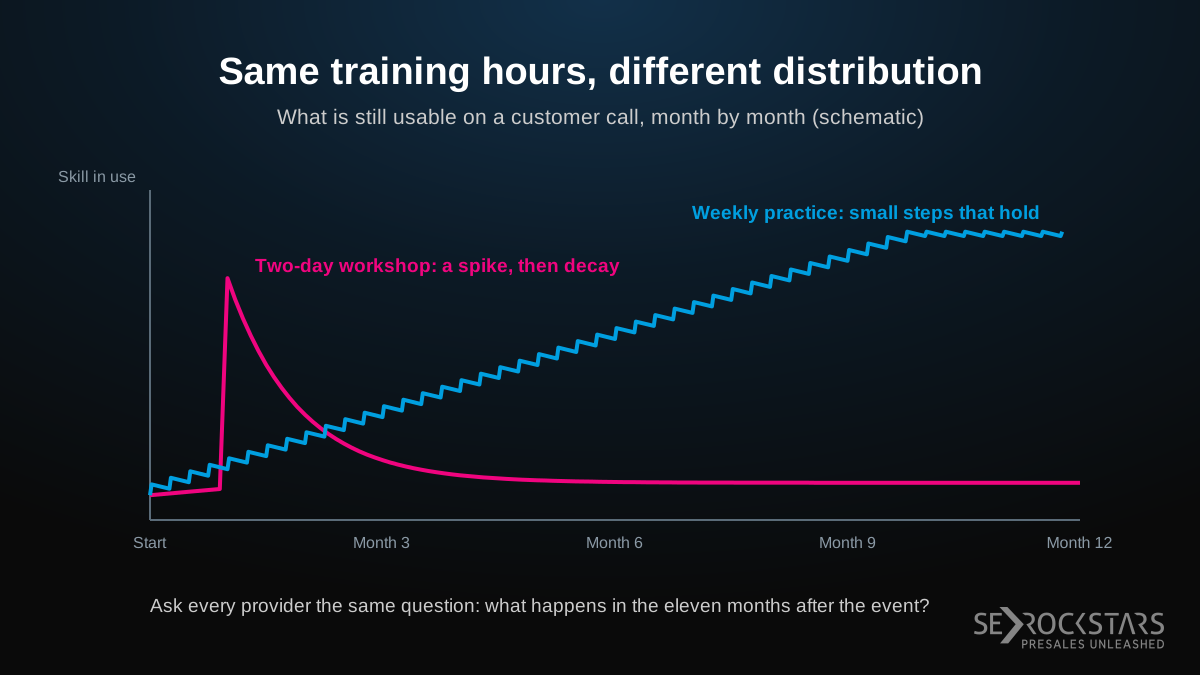
Same training hours, different distribution. The distribution decides what is still there in month six.
| Format | What it is | Strong when | Weak when |
|---|---|---|---|
| Workshop + certification | One to five days, virtual or onsite, often ending in an assessed certification | You need one standard across a large or global organization, fast | It is the only thing you do that year |
| Self-paced course | Recorded lessons and exercises, taken individually | Individuals entering or levelling up in the role; small teams; tight budgets | The goal is behavior under pressure — there is no coach watching |
| Continuous programme | Weekly live sessions, practice and coaching over months, plus on-demand material | You want behavior to change and stay changed | You need everyone certified by next quarter |
The reason format matters is the forgetting curve: knowledge that isn't retrieved and used decays quickly. A two-day workshop can be excellent and still be largely gone a quarter later if nothing reinforces it. Professional athletes train daily and perform weekly. Most SEs perform daily and train once a year.
How do you compare PreSales training providers?
By what each one is built for. The established names are not interchangeable, and each is a sound choice for a specific situation. What follows is taken from the providers' own websites; we compare them in more depth in Demo Training for Solution Engineers: Who Should You Actually Pay?
Demo2Win! (2Win! Global) — the enterprise standard for demo skills. A 5-day virtual workshop or 2-day onsite intensive with a live-assessed certification, a structured methodology (Limbic Opening, Tell-Show-Tell, Value Close), delivery across North America, EMEA, LATAM and APJ, and an AI coaching agent for practice afterwards. 2Win! reports more than 100,000 presales professionals trained. Choose it if you need one certifiable demo standard across continents. More in our Demo2Win! alternatives comparison.
Great Demo! — the canonical demo methodology, from the person who defined the category. Peter Cohan's "Do the Last Thing First" remains one of the best demo ideas ever articulated, and it is paired with a discovery method. Delivered as short workshops. Choose it if you want the original method and will organise reinforcement yourself. More in Great Demo! alternatives.
PreSales Academy (PreSales Collective) — the clearest route into the profession. An on-demand, 10-week part-time programme with job search support, open to people without a sales or tech background, from the largest presales community in the world. PreSales Collective publishes its price — $479 for the complete programme at the time of writing — which almost nobody in this market does. Choose it if you want to become a Solution Engineer. It isn't designed for training a working team; see PreSales Academy alternatives.
Six Habits / DemoDoctor (Chris White) — a self-paced certification built on The Six Habits of Highly Effective Sales Engineers, covering the SE behavior model more broadly than demos alone. Choose it if you are an individual SE or a small team that needs flexibility. The trade-off of any recorded course applies: nobody watches you demo.
SE Rockstars Trusted Advisor Academy — that's us. A 12-month membership with four live sessions a week (deal sparring, Q&A, content sessions, role-plays) run by the founders, on-demand content, and the full SE lifecycle from discovery to POC management, plus a separate track for the team's leader. Choose it if you've concluded that one-off workshops aren't moving your numbers. Don't if brand recognition is your main criterion — we are newer and smaller than 2Win!, and better known in Europe than outside it.
Which questions should you ask a provider?
Five. They work on us as well as on anyone else.
| Question | Why it matters | A weak answer sounds like |
|---|---|---|
| What does it cover beyond the demo? | Deals are lost in discovery and in POCs as often as in demos | "Discovery is part of demo preparation" |
| What happens in the months after the event? | Without reinforcement, most of a one-off event is forgotten within 90 days | "Participants keep access to the materials" |
| Who will actually teach my team? | Methodologies are consistent; facilitators aren't. Many programmes are delivered through networks of certified trainers | "One of our expert coaches" — ask for the name, and to meet them |
| What is there for the team's leader? | The first-line manager decides whether training sticks. If the lead isn't in the programme, the programme is a line item | "Leaders are welcome to join the sessions" |
| How will we know whether behavior changed? | Attendance is not impact | "Satisfaction scores are very high" |
Do one-off workshops change behavior?
On their own, rarely — and that is not a criticism of the workshops. Within 90 days, most people forget 84–90% of what they learned in a one-shot training event. The content was fine. Nothing made anyone use it.
What decides whether training sticks is the person in the manager's chair. Tobias Stölkler, who scaled a PreSales team from three to thirty, didn't sign the contract for his team's training and walk away — he joined the role-plays and sat through the live sessions, and pushed his team leads to do the same. "I find it hard to demand something of a team if I haven't done it myself. If I'm not in the sessions, what discussions am I going to lead in the next team meeting?" His playbook is in Scaling a Sales Engineering Team from 3 to 30.
If you do buy a workshop, buy the reinforcement with it: a fixed weekly team-learning slot of 30 to 45 minutes, managers who coach to the method, and real calls reviewed against it.
How do you measure whether training worked?
Not with attendance, and not with a satisfaction survey. Measure what people do on calls, then what happens to deals.
- Adoption — are people showing up and using the material? A necessary condition and nothing more.
- Behavior — score real discovery calls and demos against a rubric before and after. A Discovery Quality Score that climbs on a fixed 10-point rubric is a change you can see long before the win rate moves; the rubric is in Qualitative Metrics.
- Impact — technical win rate, SE-attached win rate, deal size with and without SE involvement. These lag by months, which is why you need step 2.
Agree this with the provider before you sign. A provider who can't tell you how you'll know it worked is selling an event.
Should sales-skills training be internal or external?
Both, for different things. Keep product, demo environments and tooling internal — nobody outside knows your release. Buy sales craft externally.
The argument for the second half comes from Tobias Stölkler again. He runs a small internal enablement team of ex-SEs and deliberately doesn't ask it to teach sales skills: "Everything they would teach is, in principle, just whatever we already think is right. We'd just be reinforcing our own bubble." External training puts your people next to peers from other companies and keeps them on the industry standard. Cut either pillar and the model collapses inward.
Frequently asked questions
What is presales training? Training for Solution Engineers, Sales Engineers and Solutions Consultants in the skills that win the technical side of a B2B deal: discovery, demos, proof-of-concept management, sales alignment and value communication. It is delivered as workshops, self-paced courses or continuous programmes.
How much does sales engineer training cost? Most providers don't publish prices, and they vary with team size and format — ask for a quote and compare cost per person per year, including reinforcement. One exception is PreSales Collective's PreSales Academy, a self-paced course for people entering the profession, which lists $479 on its website at the time of writing.
Is there a sales engineer certification? There is no industry-wide certification for the role. Several providers certify their own method — Demo2Win! and the Six Habits programme, for example. These show that someone completed and passed that programme; they are not a licence to practise, and hiring managers tend to look at evidence of how you work instead.
What is the best presales training for a team? It depends on the problem. For one demo standard across a global organization: Demo2Win!. For the classic demo method: Great Demo!. For individuals entering the profession: PreSales Academy. For a working team whose behavior should change and stay changed across discovery, demos and POCs: a continuous programme such as the Trusted Advisor Academy.
What is presales enablement? The ongoing work of making a PreSales team effective: onboarding, product and demo enablement, skills training, coaching and the metrics behind it. Training is one part of it. We explain the continuous model in Enablement-as-a-Service for PreSales.
How long does it take to see results from presales training? Behavior on calls can change within weeks if it is practised and coached. Win rates and deal sizes follow months later, because sales cycles are long. That gap is the reason to score behavior directly rather than wait for the revenue numbers.
If you've decided that two days a year isn't moving your numbers, book a discovery call and we'll tell you honestly whether the Trusted Advisor Academy fits your team — or whether one of the programmes above is the better choice for where you are.
Tim Brömme & Jan-Erik Jank are the co-founders of SE Rockstars, with 30+ years in enterprise PreSales and 350+ SEs coached.