
MEDDPICC is a qualification framework for complex B2B deals. The letters stand for Metrics, Economic Buyer, Decision Criteria, Decision Process, Paper Process, Identify Pain, Champion and Competition. It answers one question — is there a real deal here, and what do we still need to learn to say yes or no — and it only works when the entries describe the customer's business rather than the seller's hopes.
TL;DR
- MEDDPICC is qualification, not discovery. It tells you what you need to know about a deal. It doesn't tell you how to find it out — that's discovery, and in enterprise deals the Solution Engineer usually leads it.
- MEDDIC, MEDDICC and MEDDPICC are one framework at three sizes. MEDDICC adds Competition, MEDDPICC adds the Paper Process.
- Solution Engineers materially strengthen four letters: Metrics, Identify Pain, Decision Criteria and Champion. Most rollouts train only the account executives and leave that on the table.
- It usually fails on execution, not design. Roughly half of a team stops filling the fields properly within six months, because nobody defined what a good entry looks like.
- AI can fill the fields. It can't fix the conversation. Auto-populating from a transcript removes admin work; a shallow discovery call still produces a shallow Metrics field.
What is MEDDPICC and what does each letter stand for?
MEDDPICC is a checklist of eight things a seller needs to understand before forecasting a complex deal. It was built for enterprise software sales, where buying committees are large, cycles run for months, and "they loved the demo" has never closed anything.
| Letter | Stands for | The question it answers |
|---|---|---|
| M | Metrics | What measurable business result does the customer expect — how much, how often, how fast? |
| E | Economic Buyer | Who can release the budget, and what do they care about? |
| D | Decision Criteria | By which technical, commercial and legal criteria will vendors be compared? |
| D | Decision Process | Which steps, people and dates lead from evaluation to a decision? |
| P | Paper Process | What has to happen before a purchase order or signature is possible — legal, procurement, security review? |
| I | Identify Pain | Which problem is big enough that it should be solved now? |
| C | Champion | Who inside the account has influence, gains personally from the change, and sells for you when you're not in the room? |
| C | Competition | Who or what else could win — another vendor, an internal build, or doing nothing? |
What is the difference between MEDDIC, MEDDICC and MEDDPICC?
They are the same framework with a growing letter count. MEDDIC is the original six: Metrics, Economic Buyer, Decision Criteria, Decision Process, Identify Pain, Champion. MEDDICC adds a second C for Competition. MEDDPICC adds the P for Paper Process.
The original came out of the sales organization of PTC in the early 1990s. According to the MEDDIC Academy's account of its history, it was the work of a team rather than a single inventor — sales leaders including John McMahon, and an internal training group with Jack Napoli and Dick Dunkel. The longer variants are later additions, popularised among others by Andy Whyte's book and training company MEDDICC.
Which version you use matters less than people argue about. The two added letters exist because deals kept dying in places the original six didn't look: a competitor nobody had asked about, or a procurement process nobody had mapped. If your deals die there, use the longer version. If you need two extra fields of your own to capture what discovery produces, add them. It is still MEDDPICC, still analyzable, still useful.
Is MEDDPICC a sales methodology or a qualification framework?
It is a qualification framework, and treating it as a complete sales methodology is where much of the disappointment starts. MEDDPICC describes what you need to know. It says nothing about how to run the conversation that gets a CFO to share a real number.
That second part is discovery. We don't think the two can be cleanly separated in practice: qualification is a subset of discovery with a fluid transition. Early in a cycle, qualification dominates — do we want to invest more time, capacity and resources here? Once you're convinced there is business to be done, discovery takes over and defines the problem in depth. The output of that discovery is what belongs in the MEDDPICC fields. We make the longer argument in The Problem With MEDDICC.
For the same reason it is often overkill below enterprise. In mid-market or commercial segments with short cycles and one decision-maker, eight fields per opportunity is cannons at kittens.
Which MEDDPICC letters should the Solution Engineer own or strengthen?
Four of them: Metrics, Identify Pain, Decision Criteria and Champion. When a company says "Sales just rolled out MEDDPICC", the right reflex is to ask where PreSales was. A common rollout trains only the account executives. The SEs weren't in the room, don't share the language, and can't contribute — which wastes the people with the most technical and domain depth in the deal.
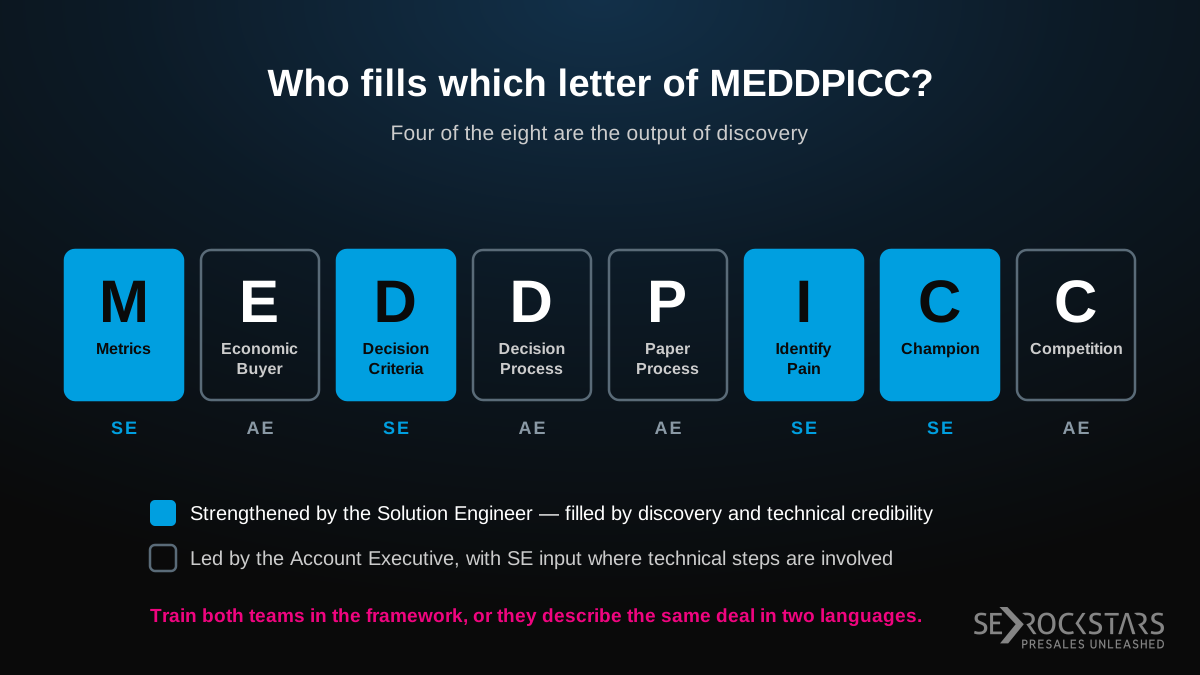
Four of the eight letters are filled by discovery — which the Solution Engineer usually leads in enterprise deals.
| Letter | Led by | What the SE adds |
|---|---|---|
| Metrics | AE and SE together | The domain depth to push past vague claims to hard numbers: how much, how often, how slow. |
| Economic Buyer | AE | Translating the technical case into the terms the budget holder cares about. |
| Decision Criteria | SE | Low-maturity teams record what the customer says they need. A strong SE helps shape the criteria toward what the customer actually needs. |
| Decision Process | AE | Knowing which technical steps — security review, POC, architecture board — sit inside it, and how long they really take. |
| Paper Process | AE | Usually little; flag early if a security or data-protection review will block signature. |
| Identify Pain | SE and AE | Driving from the symptom to the business consequence. Customers are excellent at describing symptoms and poor at explaining pains. |
| Champion | AE and SE | Credibility with technical stakeholders, which is often where champions are made. |
| Competition | AE | An honest read on where the product is stronger and weaker, so criteria can be shaped accordingly. |
There is also a structural reason to involve the SE. With coverage ratios of 1:3, 1:4 or 1:5, one SE sees far more deals than one AE — sometimes 20 or 30 in a quarter against a strategic AE's handful of named accounts. That breadth lets SEs recognise patterns across industries and judge what a good metric looks like for a given type of customer.
What does a good Metrics or Identify Pain entry look like?
A good entry could only have been written about this one deal. That is the whole test. Open two opportunities, read the Metrics field on each, and if they sound identical — efficiency gains, better visibility, faster processes — nobody has done the work.
Value comes down to three things: reducing cost, increasing revenue, or favourably shifting risk. Identify Pain is the qualitative case: start with the symptom the customer describes, ask what negative consequence it creates, and keep going until you reach the business level — this hurts cost, this hurts revenue, this raises risk. Metrics quantifies it. This is where cost of inaction and ROI live. If your solution costs €1M and the cost of inaction is €500K, pack up. If it costs €1M and solves a €50M problem, you're in business.
Notice that you can't write a real Identify Pain entry without having done discovery first. The content of that field is the output of good conversations, which is why we treat the discovery and demo quality of a team as something you can score, not a matter of taste.
Why does MEDDPICC fail in most sales organizations?
Because it is treated as a process to complete rather than a standard to meet. The pattern repeats: a rollout, a thirty-minute onboarding, and the assumption that everyone now understands it and does it forever. Adherence collapses fast — roughly half the team stops filling in the fields properly within six months — and what remains is a CRM exercise. Fields get populated the night before the forecast call, not while working the deal.
The fix is to define what great looks like before rollout: a blueprint of an ideal entry for Metrics and for Identify Pain, per industry or segment if needed. People then have something to aim at and reviewers have something to hold the line against. After that, use the rhythms that already exist. Forecast calls, deal reviews and one-on-ones are where entry quality goes up, deal by deal — and where a framework becomes a habit instead of a form.
Can AI fill in MEDDPICC fields?
Technically yes, and it changes less than vendors suggest. Conversation-intelligence tools such as Gong can pass a call transcript to a language model and populate the fields in one click. By our estimate only 10–20% of sales organizations work at that level today.
Automation removes the administrative burden. It does nothing for quality. If the discovery call was shallow — no probing, no challenge, nothing that gets a customer to share a real number — the Metrics field will contain the same surface-level noise, delivered faster. The same logic applies to demos, as we found when we tested whether LLMs give good demo advice: the output is only ever as good as the context that went in.
Frequently asked questions
What does MEDDPICC stand for? Metrics, Economic Buyer, Decision Criteria, Decision Process, Paper Process, Identify Pain, Champion and Competition. It is a qualification framework for complex B2B deals, most common in enterprise software sales.
Who invented MEDDIC? It was developed in the sales organization of PTC in the early 1990s. The MEDDIC Academy describes it as the work of a team — including sales leader John McMahon and the internal trainers Jack Napoli and Dick Dunkel — rather than of one person. MEDDICC and MEDDPICC are later extensions.
Is MEDDPICC only for account executives? No, although it is usually rolled out that way. Solution Engineers strengthen at least four letters — Metrics, Identify Pain, Decision Criteria and Champion — because those are filled by discovery and by credibility with technical stakeholders. If PreSales isn't trained in the framework alongside Sales, the two teams end up without a shared language for the same deal.
What is the Paper Process in MEDDPICC? Everything that has to happen between a verbal yes and a signed contract: legal review, procurement steps, security and data-protection assessments, signature authority. It was added because deals that were won in every other sense kept slipping a quarter on paperwork nobody had mapped.
When is MEDDPICC the wrong tool? In transactional or mid-market business with short cycles and a single decision-maker. Eight fields per opportunity cost more time than they save there. It earns its keep in deals with a buying committee, a formal evaluation and a cycle measured in months.
What questions should you ask to fill in MEDDPICC? Not the letters read aloud. Start from the symptom the customer brings, ask what it causes, and keep asking until you reach cost, revenue or risk — then quantify it. Those answers fill Identify Pain and Metrics. Decision Criteria follow from asking how the customer will know the problem is solved, rather than which features they want.
If you want your SEs to run the discovery that makes MEDDPICC entries worth reading — pain chains, quantified impact, criteria shaped instead of recorded — that is the core of the Trusted Advisor Academy. If you lead the team and want the measurement side, that is the Trusted Leader Academy.
Tim Brömme & Jan-Erik Jank are the co-founders of SE Rockstars, with 30+ years in enterprise PreSales and 350+ SEs coached.