
Forward deployed engineer vs solutions engineer: the textbook answer is timing. A solutions engineer works before the contract to prove that a product fits: discovery, demos, proofs of concept, the technical win. A forward deployed engineer usually works after it, building and deploying the product inside the customer's environment until it delivers value. The SE is typically paid partly on team quota and supports several account executives; the FDE typically has no quota and stays with one or two accounts. Those are the differences that hold up. The overlap is larger than either title admits: both jobs are won or lost in the customer conversation, not in the code.
TL;DR
- Timing is the cleanest split. SEs own the technical win before signature; most FDEs own adoption after it. Some FDE teams, including OpenAI's and Anthropic's, start with discovery before a deal exists.
- FDEs ship production code; SEs build proof. An FDE's output runs in the customer's systems. An SE's output is a demo, a POC or a business case.
- Quota and reporting line differ. SEs usually carry a share of team quota and report into sales. In an analysis of about 1,000 FDE postings, none carried a quota, and only 14% sat in a sales organisation.
- Account load differs. One SE covers three to five AEs and dozens of deals a year. An FDE at a large vendor goes deep on one or two customers.
- The title alone tells you little. Read the posting for reporting line, pay structure and pre- or post-sale scope. Some "FDE" jobs are SE jobs; some are professional services.
What is the difference between a forward deployed engineer and a solutions engineer?
The solutions engineer's job ends where the forward deployed engineer's begins. The SE proves, before the contract, that the product solves the customer's problem, and hands a signed deal to delivery. The FDE picks up from there and makes the product work in the customer's real environment, writing whatever code the gap requires.
That is the textbook version, and it is broadly right. Bloomberry's analysis of about 1,000 FDE postings states the contrast this way: "Sales Engineers are sales-first with technical capability. They're optimized for sales velocity – get technical validation done, close the deal, move to the next opportunity." FDEs, in the same analysis, are engineering-first with customer skills. Wikipedia notes that FDE responsibilities "overlap with those of solutions architects, sales engineers, customer engineers, professional services engineers, systems integrators, and information technology consultants", which tells you how blurred the borders are in practice.
If you need the roles defined on their own first: What Is a Forward Deployed Engineer? and What Does a Sales Engineer Do?
Forward deployed engineer vs solutions engineer: where do the roles differ?
On five dimensions. Everything else is either shared or varies by company more than by title.
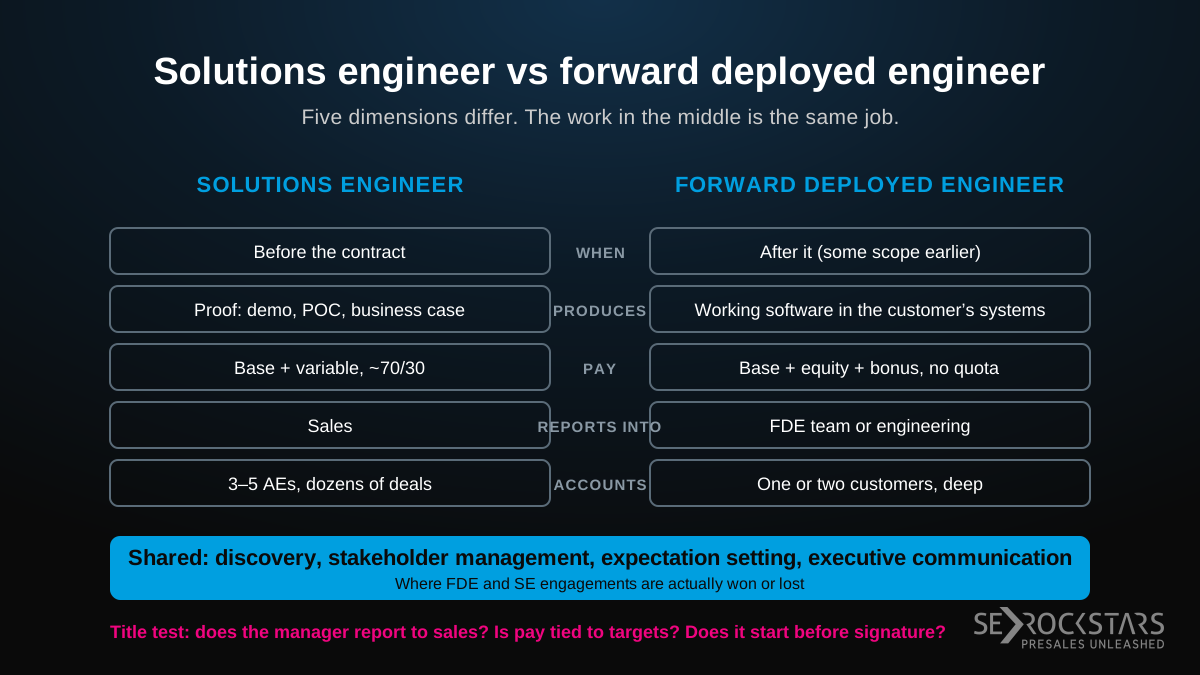
Five dimensions separate the roles. The work in the middle, finding out what the customer needs and managing the people around it, is the same job.
| Solutions engineer | Forward deployed engineer | |
|---|---|---|
| When in the deal | Before the contract: qualification support, discovery, demo, POC, technical validation | Mostly after it: deployment, integration, production rollout. Some FDE teams also scope before signature. |
| What they produce | Proof: demos, POCs on the customer's data, the technical part of the proposal, the business case | Working software in the customer's environment, plus patterns fed back to the product team |
| Pay structure | Base plus variable, often 70/30, tied to team or territory attainment | Base plus equity and bonus. 0% of analysed postings carried a quota. |
| Reports into | Sales, in most companies | A dedicated FDE team (45%), engineering (38%), sales or GTM (14%), customer success or services (7% each) |
| Account load | Three to five AEs; 20 to 30 deals in a quarter is normal | One or two customers at a time at Palantir or OpenAI; more at startups |
| Time on site | Occasional | Palantir plans about 25%, some companies up to 50% |
| Outcome owned | The technical win | Adoption, time to first value, consumption |
Three of those rows deserve a closer look.
Timing is less clean than the table suggests. OpenAI's FDE posting has the FDE "own discovery, technical scoping, system design, build, and production rollout", and Anthropic is hiring a pre-sales program lead for its FDE team, measured on pipeline and conversion. An FDE at the startup Lleverage lists "a pre-sales call with a prospect trying to figure out if what they want is even possible" in a normal week. Where the product only shows value once it is integrated, FDEs get pulled forward into the sale, which is exactly the ground SEs stand on.
The quota line has exceptions. Tailscale's FDE role is paid on on-target earnings with "variable compensation tied to the attainment of quarterly sales targets", reports into customer success engineering, and runs quarterly reviews to find "horizontal expansion". Whatever the title says, that is a commercial role.
Reporting line predicts behaviour. Palantir's original FDEs sat in business development. The Alexander Group, a revenue consultancy, now recommends the opposite: FDEs should report to the chief customer officer or head of post-sales, so that they focus on adoption and lifetime value rather than bookings. Their boundary between the roles is the one we would draw too. The SE owns technical validation and the initial win. The FDE owns the consumption roadmap and early adoption, and "should not be credited for the initial land."
What do the two roles have in common?
The part that decides whether either of them succeeds.
Both spend most of their time with customers rather than with code. In Bloomberry's sample, "working directly with customers" was the FDE's number one responsibility, in 55% of postings, and customer-facing ability the most required skill, at 47%. Milos Mandic's FDE week at Lleverage is "roughly 50% meetings and 50% building", and his summary of the job could be lifted from an SE handbook: "less about building AI systems and more about understanding businesses well enough to know what to build."
Both run discovery. Anthropic's FDE posting asks for "strong communication skills to conduct discovery with customers". Mandic names the core skill as "seeing what's actually blocking a client, which is rarely what they say is blocking them." That is the discovery ladder SEs climb in every deal: from the stated symptom to the real problem to a number.
Both manage stakeholders and expectations. Nabeel Qureshi, writing about his time as a Palantir FDE in Reflections on Palantir, says success "required an unusual sensitivity to social context" and the ability to "partner with your corporate (or government) counterparts at the highest level and gain their trust." His account of a typical failure has nothing to do with engineering: "You'd have a company buying an 8-12 week pilot, and we'd spend all 8-12 weeks just getting data access, and the final week scrambling to have something to demo." Any SE who has run a proof of concept knows that story.
And both are hired from the same pool. In Bloomberry's data, 22% of FDEs came from solutions engineer or solutions architect roles, and Anthropic's posting names "a technical, customer facing role such as Forward Deployed Engineer, or as a Software Engineer with consulting experience" as the required background.
Is a forward deployed engineer just a solutions engineer with a new title?
Sometimes. It depends on which of two jobs the posting describes.
The rebrand argument is well supported. Andreessen Horowitz has called the title "title arbitrage" for roles previously called solutions or integration engineers, and describes the work at complex AI companies as "often filled by a professional services employee, sometimes rebranded as a forward deployed engineer" in its essay on services-led growth. Practitioners on the presales side agree from the other direction: in a thread among sales engineers, the consensus was that "FDE is more like PS", delivering what the SE sold. We hold a similar view. Most SE leaders we work with see the title as a rebrand of work presales and services already do, and the underlying pattern of vendor engineers inside customer organisations predates the title by decades.
The distinct-role argument rests on one thing: production code that becomes product. Flybridge's Daniel Porras Reyes separates the FDE from sales engineers because the FDE "ships production-grade code directly into the customer's live environment." Where that code then feeds a product loop, the role is not an SE's job and not a consultant's either.
A practical test, from the same Bloomberry analysis: ask whether the manager reports to sales. If yes, the job is a solutions engineer's, whatever the title. Add two more questions: is pay tied to sales targets, and does the role start before the contract? Two or three yeses and you are reading an SE posting.
Should a company have both roles?
Only if the product needs both jobs done. The SE's job exists wherever a buyer needs proof before committing. The FDE's job exists where the product cannot show value until an engineer has integrated it into the customer's systems, and where the account is large enough to pay for that engineer.
That second condition is the expensive one. Flybridge puts a fully loaded FDE at "$220k to $400k per year" and argues that on smaller accounts "a strong customer success or solutions engineer" could do the work at "one-third the cost". The Alexander Group finds direct FDE coverage "economically unfeasible" below the enterprise tier. So the sensible sequence for most B2B software companies is SEs first, then FDEs only for the accounts and products that need them.
For an SE leader, the more useful question is what the FDE trend says about the SE role. It says the market is paying engineer salaries for people who can run discovery, manage stakeholders and hold a customer's trust through a difficult deployment. Those are the skills that decide deals in PreSales as well, and they are trainable. We go through them in the skills a forward deployed engineer needs.
Frequently asked questions
What is the main difference between an FDE and a solutions engineer? Timing and output. A solutions engineer works before the contract and produces proof: demos, POCs and the business case that win the technical decision. A forward deployed engineer usually works after it and produces working software in the customer's environment. The FDE typically has no quota and stays with one or two accounts; the SE usually carries a share of team quota across many deals.
Do forward deployed engineers carry a quota? Usually not. In an analysis of about 1,000 postings, none were quota-carrying, and compensation data shows base, equity and bonus without commission. Exceptions exist: Tailscale pays its FDEs on on-target earnings tied to quarterly sales targets. Solutions engineers, by contrast, are commonly paid around 70% base and 30% variable.
Which role is more senior, FDE or solutions engineer? Neither by definition. FDE pay at the AI labs ($185K to $320K base) is high because those companies pay engineers well, not because the role outranks an SE. Pave's data puts FDE compensation about 9% below a generalist software engineer. Seniority depends on the company's levels, not on the title.
Can a solutions engineer become a forward deployed engineer? Yes, and many do: 22% of FDEs in one analysis came from solutions engineer or solutions architect roles. The gap to close is usually production coding ability, since FDEs ship code that runs in customer systems. The discovery, stakeholder and expectation-management skills transfer directly.
Is a forward deployed engineer the same as a solutions architect? Close, but not the same. OpenAI distinguishes the two by hands-on work: its FDEs write code on customer infrastructure and tolerate more ambiguity, while solutions architects are advisory and rarely write code in the customer's environment. In many companies a solutions architect is simply the more technical grade of the presales team; see our guide to solutions engineer, sales engineer and solutions consultant titles.
Do FDEs replace solutions engineers? No. They address a different point in the customer lifecycle, and only for products and accounts where integration work is needed to show value. Companies that have both typically hand the deal from the SE, who owns the technical win, to the FDE, who owns adoption.
Whichever title your team carries, the work that decides the outcome is the same: discovery that reaches the real problem, and stakeholders who trust you enough to act on it. That is what the Trusted Advisor Academy trains, weekly, on live deals. If you lead the team, the Trusted Leader Academy covers how roles like these fit together.
Tim Brömme & Jan-Erik Jank are the co-founders of SE Rockstars, with 30+ years in enterprise PreSales and 350+ SEs coached.