
A forward deployed engineer (FDE) is a software engineer employed by a product vendor who works inside a customer's organisation, often on site, to get that vendor's product delivering value in the customer's real environment. Unlike a sales engineer, an FDE ships production code into the customer's systems. Unlike a consultant, the FDE's job is also to feed what they learn back into the vendor's product. The title was popularised by Palantir and spread through AI companies from 2024 onward.
TL;DR
- FDEs are vendor engineers embedded with customers. They build and deploy the vendor's product in the customer's own environment, then carry what they learned back into the product.
- The job is more customer-facing than the title suggests. In an analysis of about 1,000 postings, "working directly with customers" was the number one responsibility, ahead of building anything.
- Most FDEs carry no quota. Pay is base, equity and bonus; median US total compensation is around $210K. A few companies attach sales targets, so read the posting.
- Whether it is a new role is contested. a16z calls the title "title arbitrage"; practitioners on the presales side call it professional services with a better name. Both have a point.
- The role only pays off on large, expandable accounts. A fully loaded FDE costs $220K to $400K a year, so the economics need a path from pilot to seven-figure contract.
What is a forward deployed engineer?
A forward deployed engineer is "a customer-facing software engineer who works for a company that makes a product and helps implement that product within a client company", as Wikipedia puts it. Gergely Orosz's Pragmatic Engineer definition adds the other half of the loop: "a software engineer who alternates between being embedded with customer teams and core product engineering teams."
That second half matters. What separates an FDE from an implementation consultant, at least in the original model, is that the FDE's employer expects the work at the customer to become product. Solve the problem for one customer, then generalise it for the next.
The "forward deployed" phrase is military jargon. It was chosen by Palantir, which used the title by 2009.
Where does the FDE role come from?
From Palantir, where the model ran at scale for a decade before anyone else copied it. Palantir split its engineers into two tracks. Forward deployed engineers, internally called Deltas, worked from the customer's offices for much of the week. Product development engineers rarely visited customers. Palantir's own framing, quoted by Orosz: Deltas "deploy our software platforms to customers", focusing on "one customer, many capabilities", while a product developer's focus is "one capability, many customers". Until about 2016, Palantir employed more FDEs than conventional software engineers.
Two details from that era shape how the role works today. First, Palantir's Deltas sat in business development, not engineering. Second, the FDE-to-product loop was deliberate. Nabeel Qureshi, a former Palantir FDE, describes it in Reflections on Palantir: "FDEs tend to write code that gets the job done fast, which usually means hacky workarounds. PD engineers write software that scales cleanly. One key secret: generating deep enterprise value requires both." Palantir's Foundry platform came out of that loop.
The term left Palantir with its alumni. From 2024, AI companies whose products needed heavy integration to show value adopted it: OpenAI built an FDE team in 2025, Anthropic hires FDEs into its Applied AI group, and Databricks sells "Forward Deployed Engineering" as a packaged professional service. Job postings for the title grew 1,165% year over year between January to October 2024 and the same period in 2025, according to Bloomberry's analysis of about 1,000 postings. Growth from a tiny base, though: Pave's compensation data showed only 1.24% of roughly 9,000 companies employing anyone with the title as of September 2025.
What does a forward deployed engineer actually do?
Less building and more finding out what to build than the title implies. Three sources, three angles:
The postings. In Bloomberry's sample, "working directly with customers" is the number one responsibility, named in 55% of postings, ahead of building AI and machine-learning systems (37%) and integrations (32%). Customer-facing ability is the most frequently required soft skill, at 47%.
A working FDE. Milos Mandic, an FDE at the startup Lleverage, logged his week: "roughly 50% meetings and 50% building." His list includes client status calls, internal planning and "a pre-sales call with a prospect trying to figure out if what they want is even possible." His summary of the job: "less about building AI systems and more about understanding businesses well enough to know what to build."
The hiring companies. OpenAI's FDE posting has FDEs "own discovery, technical scoping, system design, build, and production rollout" and measure success "through production adoption, measurable workflow impact, and eval-driven feedback". Anthropic's posting describes an engineer who "embeds directly with our most strategic customers to drive transformational AI adoption" and asks for "strong communication skills to conduct discovery with customers".
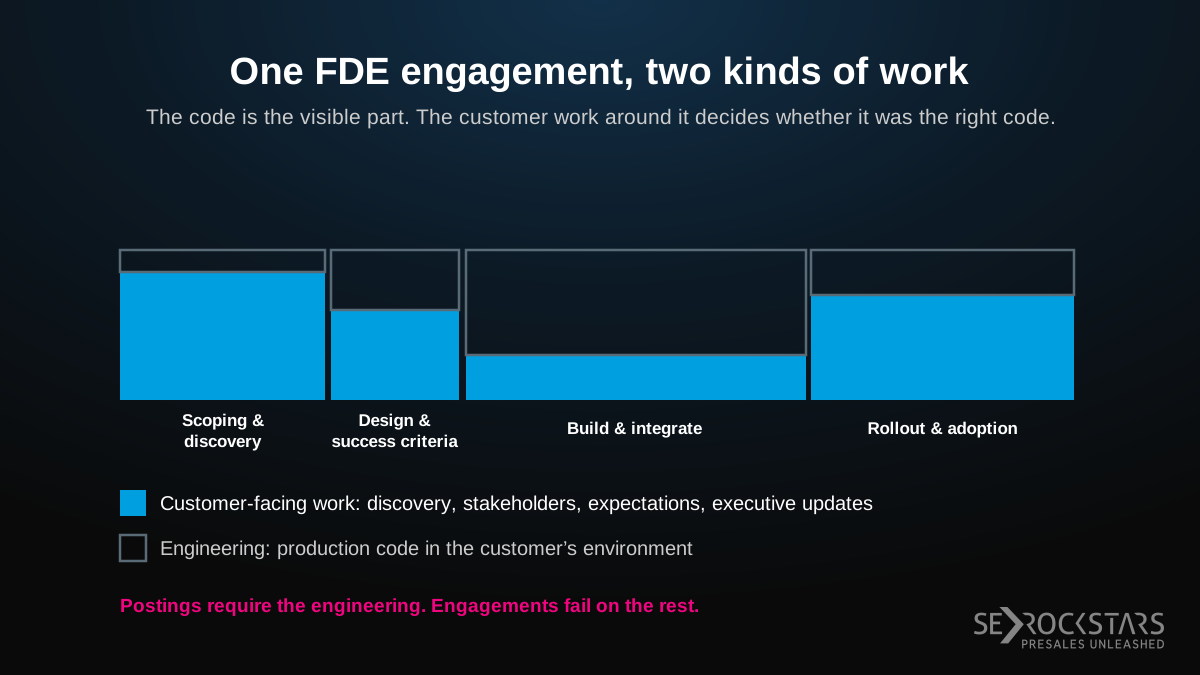
The building is the visible part. The discovery and the stakeholder work around it decide whether the build was the right one.
How deep the embed goes depends on the company. At Palantir and OpenAI an FDE typically works with one or two customers at a time, on site for a quarter to half of their time. At a startup, Mandic reports "running parallel deployments across many clients simultaneously", which looks a lot like a solution engineer's deal portfolio.
How much does a forward deployed engineer earn?
In the United States, a median total compensation of about $209,500, according to Levels.fyi as of September 2026, with the 25th to 75th percentile running from $176K to $288K. Bloomberry's posting data puts the median advertised salary at $173,816. The frontier labs pay above that band: Anthropic lists $280K to $320K base, OpenAI $185K to $300K plus equity.
Two things about the pay structure are more telling than the level. Levels.fyi files the FDE under software engineering and reports base, stock and bonus, with no commission component. And in Bloomberry's sample, "exactly 0% are quota-carrying roles." Pave's data puts FDE pay about 9% below a generalist software engineer and 16% above a technical account manager, which is roughly where the role sits: an engineer's salary for a job with a large customer-facing component.
There are exceptions. Tailscale's FDE role is paid on on-target earnings with "variable compensation tied to the attainment of quarterly sales targets", reports into customer success engineering, and runs quarterly reviews to "identify opportunities for deeper engagement and horizontal expansion". When a posting says FDE, check the pay section before assuming which kind of job it is.
Is "forward deployed engineer" a new role or a rebrand?
Both sides have evidence, and the honest answer is that the title covers two different jobs.
The rebrand case. Andreessen Horowitz has described the title as "title arbitrage", a way to signal new importance for roles previously called solutions engineers or integration engineers. In the same firm's essay on services-led growth, Joe Schmidt writes that at complex AI companies the work is "often filled by a professional services employee, sometimes rebranded as a forward deployed engineer or an implementation/solutions specialist." Practitioners on the presales side put it more plainly. The consensus in a discussion among sales engineers was that "FDE is more like PS": post-sale delivery of what the SE sold. Most SE leaders we work with see it as a well-paid rebrand of work presales and professional services already do, a view we set out in What Skills Will Solution Engineers Need in the Age of AI?. The role itself is not new either. IBM was placing its engineers inside customers in the 1980s, and SAP built a business on it.
The new-role case. The original Palantir model was different from professional services in one respect: the deployment work was supposed to become product. Flybridge's Daniel Porras Reyes places the FDE "at the intersection of product management, software engineering, and strategic consulting" and separates it from sales engineers because the FDE "ships production-grade code directly into the customer's live environment." A best-practices piece on Latent Space draws the line the same way: an FDE function that solves customer problems without sending the signal back into the product "is a services/consulting team with a better title."
Our reading: the title is doing two jobs. Where the FDE reports into product and every deployment produces reusable capability, it is a distinct role. Where the FDE reports into sales or customer success, carries adoption or revenue targets and works many accounts, it is a solution engineer or professional-services role with a new name. The comparison of FDE and solutions engineer roles goes through the differences that hold up.
When does hiring FDEs make economic sense?
Only on accounts large enough to justify an expensive engineer. Flybridge estimates a fully loaded FDE at "$220k to $400k per year" and argues that on smaller accounts the same work could be done by a strong customer success or solutions engineer at "one-third the cost". The test they propose: "a path from a fifty thousand dollar pilot to a seven figure contract." Without it, the field work never compounds into product and the company has built a services business with software margins expected of it.
The revenue consultancy Alexander Group reaches the same conclusion from the go-to-market side: direct vendor FDE coverage "becomes economically unfeasible" below the enterprise tier, where partners and system integrators have to fill the gap. a16z's counter-argument is that the margin worry is "shortsighted" while the market is being won, citing ServiceNow and Workday, both of which started services-heavy and reached 79% and 75% gross margins by 2024.
For a PreSales leader, the practical question is narrower: which parts of the customer lifecycle does your product need a human engineer for, and who should own them? We look at how the role relates to the SE's in the FDE vs solutions engineer guide, and at what the job demands beyond code in the skills a forward deployed engineer needs.
Frequently asked questions
What does FDE stand for? Forward deployed engineer. The phrase is borrowed from military usage, where forward-deployed units are stationed close to where they operate. Palantir applied it to engineers stationed at customer sites, and used the title by 2009.
Is a forward deployed engineer a sales role? Usually not in the formal sense. In an analysis of about 1,000 postings, none carried a quota, and compensation data shows base, equity and bonus with no commission. But the role is heavily customer-facing, often begins before the contract is signed, and is frequently measured on adoption, which drives what the customer spends. Some companies, Tailscale among them, do attach sales targets.
Who hires forward deployed engineers? Palantir, where the role originated; the AI labs, including OpenAI and Anthropic; data and infrastructure companies such as Databricks, which sells FDE engagements as a professional service; and a growing number of AI application startups. As of September 2025, about 1.24% of companies in one compensation dataset employed anyone with the title.
How is an FDE different from a solutions engineer? An FDE typically works after the sale, ships production code into the customer's environment, carries no quota and stays with one or two accounts. A solutions engineer works before the sale, builds demos and proofs of concept, is often paid partly on team quota, and supports several account executives at once. The full comparison is in our FDE vs solutions engineer guide.
How much do forward deployed engineers make? Median US total compensation is about $209,500 (Levels.fyi, September 2026), with advertised salaries clustering around $174K and the frontier AI labs paying $185K to $320K base. Pay is typically base plus equity and bonus, without commission.
Is forward deployed engineering just consulting? It is when the work at the customer never becomes product. The original Palantir model differed from consulting because product engineers generalised what FDEs built for one customer into features for all. Where that loop exists, the role is distinct; where it does not, the professional-services label fits.
If your team already does the customer-facing half of this job, the discovery, the scoping, the expectation management, and you want it done well regardless of the title on the door, that is what the Trusted Advisor Academy trains every week. For leaders working out where FDEs fit next to their SE team, the Trusted Leader Academy is the room to have that conversation in.
Tim Brömme & Jan-Erik Jank are the co-founders of SE Rockstars, with 30+ years in enterprise PreSales and 350+ SEs coached.