
A sales engineer is the technical seller on a B2B software deal. They run discovery to find out what the customer is actually trying to fix, design and deliver the demo that proves it, answer security and architecture questions, scope and run proofs of concept, and build the business case underneath the price. The account executive owns the commercials.
Everything below answers what does a sales engineer do in B2B SaaS specifically. The same job title exists in industrial and manufacturing sales, where it usually means applications engineering for machines — different work, different week.
TL;DR
- The sales engineer owns the technical side of the deal: discovery, solution design, demo, proof of concept, security and architecture review, handover to delivery. Price stays with the AE.
- A real week is not demos. With one SE typically covering three to five account executives, most hours go into preparation, scoping, internal alignment and technical validation. Demo delivery is the visible tip of the job, not the mass of it.
- The value of the role has moved. Demo prep that used to take two or three days is collapsing toward zero. The discovery conversation that decides which demo to build is the part that still pays.
- Most sales engineers earn commission. A 70/30 base-to-variable split is the common shape — and it only works if the SE can see what deals are worth.
- There is no degree and no certification for this job. Hiring panels screen for evidence and for what you do with feedback.
What is a sales engineer?
A sales engineer is a technical specialist who sells alongside a quota-carrying salesperson. The US Bureau of Labor Statistics classifies the occupation as selling products and services that require technical expertise and puts the median annual wage at $124,900 (May 2025) — in software, base plus variable typically runs higher.
The title varies more than the job does:
- Sales Engineer (SE) — the default in US SaaS. "Sales" signals that you carry deal outcomes, not tickets.
- Solution Engineer / Solutions Consultant / Solution Architect (presales) — same work, usually at companies where the solution spans several products or a platform.
- PreSales Consultant — common in European enterprise software and at implementation partners.
- Forward Deployed Engineer — newer, currently well paid, and in the view of most SE leaders we work with, largely a rebrand of work presales already does.
All of these sit under PreSales as the function. Here's where we disagree with the standard description: the job is not "the technical person who does the demo." That definition made sense when product knowledge was scarce. It doesn't survive contact with a buyer who has already asked an AI assistant for a feature comparison before your first call.
What does a sales engineer do day to day?
Most of it happens before and after the meeting the customer sees. A working week for an enterprise SE — typically covering three to five account executives, which can mean 20 or 30 deals in a quarter — looks roughly like this:
| Block | What it actually is | How it shows up in the week |
|---|---|---|
| Discovery and follow-up calls | 30–60 minutes each with technical buyers, process owners, sometimes the CIO for fifteen minutes | Most days |
| Demo prep and delivery | Building a scenario against two or three use cases, dry-running it, delivering it, debriefing | The visible part — far less of the calendar than people expect |
| Technical validation | POC setup and check-ins, security questionnaires, integration and architecture questions, RFP sections | The unglamorous half |
| Internal work | Deal reviews with the AE, qualification, handovers to delivery, product feedback | Daily, in fragments |
| Everything else | Enablement, new release ramp-up, mentoring, building reusable demo assets | Whatever survives |
The pattern that surprises people new to the role: context switching is the job. You may touch six different industries in one day, and each buyer expects you to sound like you've worked in theirs. That's why the prep-to-airtime ratio is brutal — and why the SEs who thrive are the ones who build reusable assets instead of rebuilding every deck from scratch.
The second pattern: you rarely finish anything alone. A technical win is a chain of small agreements with different people — the admin who has to run the thing, the security lead who can veto it, the VP who has to fund it. Chasing that chain is what fills the calendar.
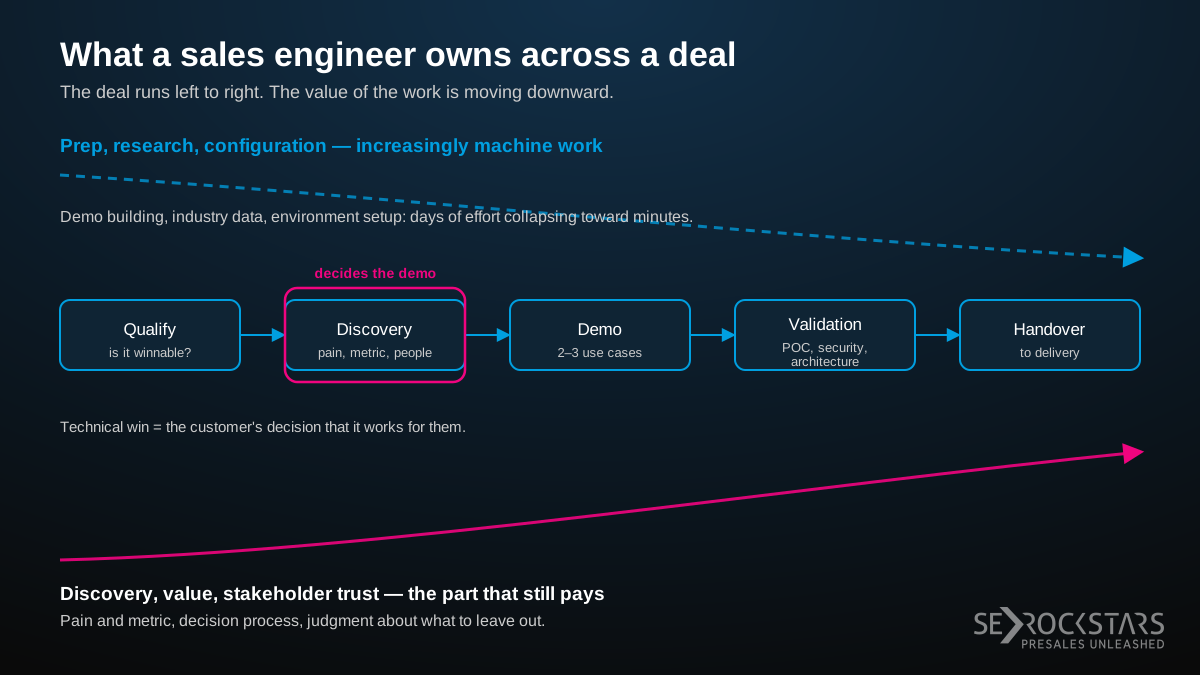
The deal runs left to right; the value of the sales engineer's work is moving downward — out of preparation, into the conversation.
What are a sales engineer's responsibilities across a deal?
Sales engineer responsibilities are easiest to read as a sequence, because they are one:
- Qualification. Pressure-test whether the deal is real and technically winnable before you spend two days on it. An SE who never says "this isn't a fit" is a demo dispenser, not an advisor.
- Discovery. Find the pain, the metric attached to it, the compelling event, and who has to say yes. This is where the deal is won or lost. MEDDPICC is the usual scaffolding.
- Solution design and demo. Turn what you heard into a narrative the buyer recognizes as their own problem. Two or three use cases, not a harbor tour through the product.
- Technical validation. POC or pilot with success criteria agreed in writing, security review, integration and data questions, architecture alignment.
- Business case support. Feed the value story that justifies the number the AE is about to quote.
- Handover. Give delivery or customer success what they need so the promise made in the demo survives implementation. Skipping this is how "the SE oversold it" becomes a permanent internal story about you.
The outcome an SE actually owns across all of that is the technical win — the customer's decision that your solution works for them — which is why it deserves its own metric rather than being folded into the commercial win rate.
What skills does a sales engineer need?
Five, in the order they pay off. Product knowledge is the price of entry, not the differentiator.
Discovery and questioning. The craft of asking the question that changes the room. It is the single most-cited skill among the enterprise SE leaders we've put in a room together — one of them described spending two years deliberately working on his questioning technique, and said that one very good question can turn a whole meeting.
Business acumen. This is where European SEs lose deals to Americans. One SE leader who runs global teams put it bluntly to his own engineers: "Stop the bus. Do you actually work for us as a company? Are we trying to earn a profit here, or are you arguing like we're a charity?" He flew out to walk his team through the Rule of 40 — growth rate plus profit margin — and watched pricing and product strategy suddenly make sense to them.
Value translation. Push every feature one step right: Feature → Capability → Outcome → Metric. "More efficient" is not an outcome. 27.5% faster close, measured against last quarter, is. Tim Brömme traces his own turn as a seller to one training in South Africa: "If we ask our customer for €100,000, he has to get something in return. It sounds trivial when I say it now, but that lamp hadn't really turned on until then."
Stakeholder management. Multi-threading, reading a room where half the people would prefer the status quo, keeping a champion active when they go quiet.
Presentation and demo craft — last on the list on purpose. It's the most trained skill in the profession and the fastest depreciating. More on that below.
How is a sales engineer different from an account executive?
The AE owns the commercial outcome; the SE owns the technical one. In practice:
| Account Executive | Sales Engineer | |
|---|---|---|
| Owns | Pipeline, forecast, price, contract | Technical win, solution fit, POC |
| Quota | Individual revenue number | Often team or territory attainment |
| Typical ratio | 1 AE | 1 SE covers 3–5 AEs, depending on motion |
| In the room | Commercial pressure, next steps, decision process | Credibility, technical depth, the demo narrative |
| Price | Quotes it | Must know it, shouldn't quote it |
That last row causes more internal arguments than anything else. Our position: a spoken price becomes an anchor nobody can retract, so customer-facing pricing belongs to the AE — but an SE who can't say whether a deal is €20k or €2M can't build a business case, can't prioritize their week, and can't be motivated by variable pay. Most organizations have those two backwards.
Do sales engineers get commission?
Yes, in most B2B software companies. The common structure is a base salary plus a variable component tied to revenue attainment, with 70/30 base-to-variable the most frequently cited split for presales individual contributors (Sales Engineering Org); 80/20 and 75/25 are also normal, and SEs rarely sit at 60/40 the way AEs do.
What the variable is attached to varies more than the split: team quota, territory attainment, individual attach to closed deals, sometimes an MBO slice for enablement or demo assets. Accelerators and President's Club are common in US-headquartered vendors.
Real numbers from one German career, since almost nobody publishes them: €48,000 as a trainee in 2010, roughly €80,000 on a local contract as a solution architect in South Africa, and about €185,000 at peak in SaaS. Moving from a hardware-heritage corporate into a US software company meant a lower base — the variable made the package attractive.
One caveat worth saying out loud: a commission plan built on deal sizes the SE isn't allowed to see is decoration, not an incentive.
How do you become a sales engineer?
There is no certification, no degree and no apprenticeship for this job anywhere. Nobody can gatekeep you with a qualification you don't have — and nobody can tell you the next step either. That makes the path evidence-driven rather than credential-driven.
What actually works:
- Come from adjacent work. Support, consulting, implementation, product, QA, or a technical degree. Any role where you've explained a system to someone who had to decide something.
- Learn one commercial framework properly — consultative or value selling — before you learn a second demo technique.
- Build proof. A demo recording, a business case you wrote, a customer problem you solved. Panels believe artifacts.
- Prepare for the panel, then prepare to be corrected. A good hiring process gives you a dry run with feedback. Jan-Erik Jank ran it that way as a hiring manager for exactly one reason: the quality of the dry run barely mattered, what mattered was what the candidate did with the input. Candidates who absorbed feedback got offers. Candidates who didn't were genuinely surprised by the rejection.
A polished application still separates you from the pile. Tim spent days on his — that's what got him read.
Will AI replace sales engineers?
No — but it is deleting half of what the job used to be, and that half is the one most SEs built their identity on.
Demo preparation that took two or three days is collapsing toward an instant operation: MCP servers, API-driven provisioning and demo automation now generate tailored environments. Research that once justified a domain specialist takes a frontier model seconds. If your value is defined by your ability to prepare and run a demo, that value is heading toward zero — and vendors selling AI agents that give personalized demos around the clock are saying so publicly.
What goes up in value is the conversation that decides which demo to build: the pain uncovered, the metric attached to it, the stakeholder map, the judgment about what to leave out. Automation only works if the input is right. That's also why the skills SE leaders now hire for are stubbornly human ones — and why one of them closed a roundtable with the line every SE manager should keep: "There's a massive difference between 'I know something' and 'I can do something.'"
So the honest answer to what a sales engineer does in 2026: less clicking, more asking. If that trade sounds bad to you, the role is about to get uncomfortable. If it sounds like the interesting part, this is the best time in twenty years to be in it.
Frequently asked questions
What is sales engineering? Sales engineering is the function inside a B2B software sales organization responsible for the technical side of winning a deal: discovery, solution design, demos, proofs of concept, security and architecture questions, and the technical handover after signature. It sits under the PreSales umbrella and partners one-to-many with account executives.
Do you need to code to be a sales engineer? Usually not. You need enough technical fluency to be believed by an engineer and to reason about APIs, integrations, data and security. Scripting helps in infrastructure and developer-tools companies; in most application SaaS, configuration skill plus architecture literacy is enough. What you can't fake is curiosity about how the customer's system actually works.
What's the difference between a sales engineer and a solutions architect? In many companies, nothing — the title just reflects heritage. Where both exist, the sales engineer works pre-contract and owns the technical win, while the solutions architect designs the implementation and often stays involved after signature. At implementation partners the line moves again, because the same person may do both.
How many deals does a sales engineer work on at once? Far more than an account executive. With coverage ratios of one SE to three, four or five AEs, a single SE can see 20 or 30 deals in a quarter, with a handful active in any given week. That's precisely why deal value has to be visible: if one deal is worth €2M and another €20k, they should not get equal slices of your calendar.
Is sales engineering a good career? The pay is strong — the US median for the occupation sits at $124,900 per BLS (May 2025), and SaaS packages with variable pay commonly run higher — and the role is one of the few that stays close to both product and customer. The ceiling is real, though: as a senior IC your income and your influence both cap out, which is when people move into leadership, product, or out on their own.
If you want your SEs to own the discovery conversation rather than just the demo, that's the whole point of the Trusted Advisor Academy — weekly training on real deals, not a workshop people forget by Friday. Book a discovery call and we'll tell you honestly whether your team needs it.
Tim Brömme & Jan-Erik Jank are the co-founders of SE Rockstars, with 30+ years of enterprise PreSales experience and 350+ SEs coached.