
Twenty-five years in B2B software sales, and the one thing nobody ever handed over was a curriculum.
TL;DR
- PreSales has no formal training path — no apprenticeship, no degree. That means nobody can screen you on a credential, so hiring managers screen you on evidence instead.
- Vague ambition produces vague careers. The turning points all look the same: someone else states a concrete goal out loud, you copy the mechanic, you attach a number to it.
- One consultative value-selling training reset an entire sales worldview — from selling SIM cards at 20–40 cents to defending €100,000+ software deals.
- Skill sometimes beats title. Dropping a leadership ambition for two years to learn value selling from scratch was the highest-return move in the whole story.
- Money follows scope, then caps out. €48,000 as a trainee, ~€80,000 as a solution architect, ~€185,000 at peak — and then a ceiling that no promotion removes.
"By the way, you just inherited a forest. What are you going to do with it?"
That was the opening line of a consulting interview for a fresh electrical engineering and computer science graduate from TU Berlin. How big is the forest? How much timber is in it? Can you monetize it? Tim Brömme had spent six and a half years learning how a CPU is built from NAND gates and how silicon gets burned. He had never once thought about forest management. He got taken apart.
He also learned more from that hour than from most of the interviews he passed. Because the useful part of a career in PreSales is rarely the part that goes well.
This article pulls the transferable mechanics out of one Solution Engineering career — school to trainee program to South Africa to American SaaS to founding a company — and hands you the parts you can run yourself. Not the biography. The engine underneath it.
Why is there no clean career path into PreSales?
Because the role isn't a trade. In Germany you can be certified as a Bürokaufmann. You cannot be certified as a Solution Engineer, and no university offers a PreSales degree. Sales has the same problem. People arrive sideways — from engineering, from support, from product, from consulting — and they arrive at wildly different ages with wildly different toolkits.
That cuts both ways. Nobody can gatekeep you with a qualification you don't have. But nobody can tell you what the next step is, either. You get no syllabus and no exam schedule. You get a job market that quietly rewards people who can show evidence of judgment.
So the question stops being "what qualification do I need?" and becomes "what experience do I need to have survived?" Very different question. Much better one.
What actually moves a PreSales career forward?
A loop, repeated. Put yourself somewhere unfamiliar, find someone there who has a concrete goal, copy the mechanic, turn it into a number you own, deliver it — then notice the new ceiling and go again.
The first turn of that loop was a six-month internship in 2006 in an IT department at a Volkswagen plant near Shanghai. The technical work was interesting. The other interns were the real payload. They were business students in ties who talked openly about building a CV, about credentials, about deliberately choosing this internship because of the name on it. Tim was the tech nerd in a T-shirt who went because someone asked if he fancied living in Shanghai for half a year.
One evening, one of them explained his plan: a traineeship, specific goals, a shaped life. That conversation did more damage — the productive kind — than any lecture.
Back at university, the same pattern showed up again: students who reverse-engineered which grade they needed in which subject to finish with distinction. Tim ran the calculation for himself, decided it was reachable, and finished with distinction. Not because someone told him to. Because he saw the mechanic and borrowed it.
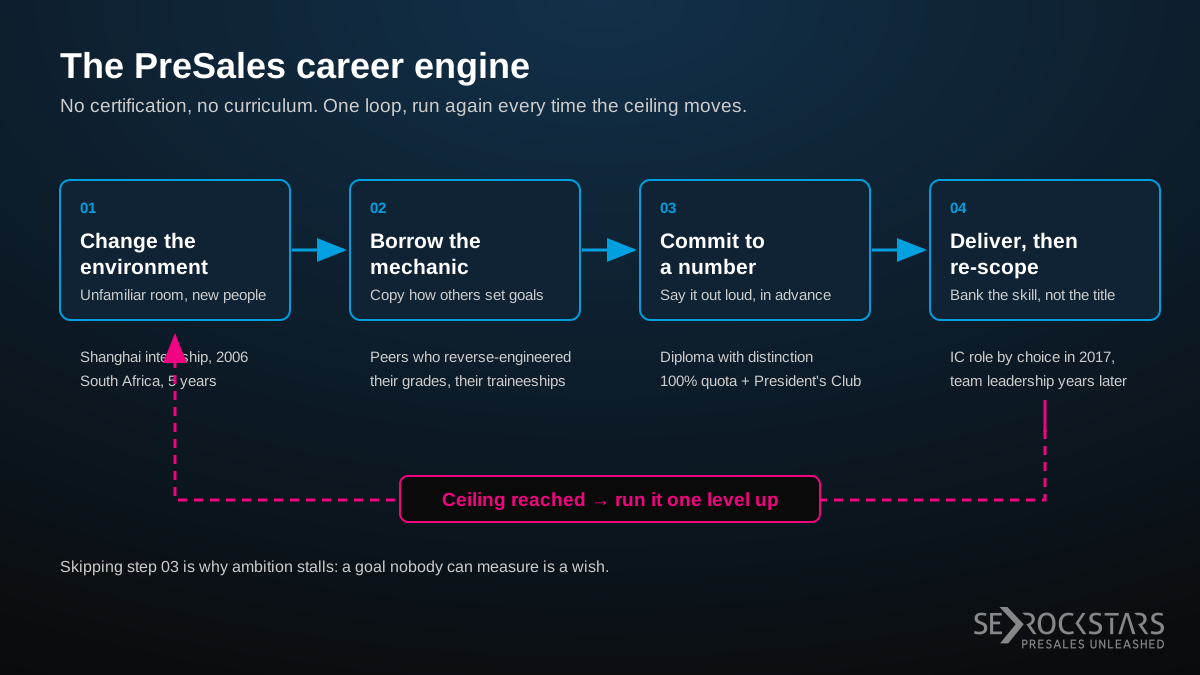
The engine: unfamiliar room, borrowed goal, committed number, delivery — then the ceiling moves and you run it again.
The same loop produced everything that followed. A three-day assessment center at Giesecke+Devrient — chosen partly because a company that invests three days in evaluating a trainee probably works seriously. An 18-month trainee program across product management, project management and sales, including six months in South Africa where the head of sales sat down for half an hour to tear apart a single customer email, line by line, and made him rewrite it. First deal closed inside six weeks. Bell rung.
And on the application side: 20 to 30 applications out of university, including for jobs he didn't want, specifically because every interview process taught him something. Reps as training. If you find that excessive, note that the person who ran those reps has never had trouble getting hired since.
What does one sales training actually change?
Everything, if it lands at the right moment. G+D's South African subsidiary was the pilot for a consultative value-selling program before it rolled out group-wide. Two blocks of roughly three days, four weeks apart. It was the first sales training of Tim's career.
The unlock was arithmetic. G+D's core business was chip cards: a SIM card costs 20 to 40 cents, you sell millions, margins are thin, and the differentiator is price and production efficiency. The newly acquired software business worked nothing like that. Now the number on the table was €100,000, €200,000, €400,000 — and nobody in the region had an established playbook for defending it.
"If we ask our customer for €100,000, he has to get something in return. It sounds trivial when I say it now, but that lamp hadn't really turned on until then." — Tim Brömme (translated from German)
That's the whole discipline in two sentences: discovery, business case, value. It also became a career decision. Once you know how you want to sell, working somewhere that can't sell that way becomes intolerable. Tim stayed three more years, then concluded a 10,000-person hardware-heritage company wasn't going to change its selling model on his timeline, and went looking for American software companies — because that's where the craft was concentrated.
Should you chase the title or the skill?
The skill, when the two conflict. This is the least popular advice in this article and the highest-yield.
By 2016 Tim had run a PreSales team in South Africa for roughly two to three years. Coming back to Europe, the obvious move was leader-to-leader. He hired a coach at €300 an hour to think it through, and concluded that changing continent, company type, industry logic and level at once was too much — and that his value-selling foundations were thinner than his title suggested. So he dropped the leadership requirement and applied for an individual contributor Solution Engineering role. He also turned down an internal offer of a leadership position in product management in Munich, because it pointed away from selling.
He got the leadership role anyway, seven years later, at Miro, running the German and French teams. The detour cost a title for a while. It bought the foundation that made everything after it work.
What does an SE hiring panel actually test?
Not your demo. Your response to feedback.
The process at CallidusCloud — the sales performance software company later acquired by SAP — had a panel with a presentation, a demo and a pitch, which is standard. What wasn't standard: a dry run first, with detailed feedback from the hiring manager, before the real thing.
Jan-Erik Jank's logic as that hiring manager was blunt. The quality of the dry run barely mattered. What mattered was what the candidate did with the input: did they listen, did they take it, could they implement it, did they use the creative freedom they were given. HR hated it — giving candidates feedback creates exposure. He did it anyway, and it worked as a filter. Some candidates absorbed everything and improved visibly. Others didn't understand the feedback at all, and were then genuinely surprised by a rejection.
Two practical notes for anyone applying. First, the application documents mattered before anyone spoke: Tim spent days designing his, inspired by a fellow intern in Shanghai whose CV made his own look amateurish. That is what got him to the top of the pile. Second, the first conversation ran one to two hours with the hiring manager directly — not 20 sober minutes with a recruiter. If a company's process feels like the work, that's a signal. Read it.
What does a PreSales career pay — and where does it stop?
Real numbers, since almost nobody publishes them. Trainee at G+D in 2010: €48,000 gross. Solution architect in South Africa around 2011: roughly €80,000 equivalent on a local contract, in a market with far lower living costs. Then years of raises, then the jump into SaaS — where the base was actually lower than his last German salary, but the variable component made it attractive. First encounter with a quota-carrying comp plan.
He set a target on day one: hit 100% and make President's Club. Year one, missed. Year two, hit 100% — and qualified for President's Club just as the SAP acquisition changed the rules. Annoying. The habit still worked: state the number, then work toward it.
Peak came later, around €185,000 at Xactly. He then took a pay cut to join Seismic, because a team he already knew and trusted was there — and that turned out to be the better year.
Then the ceiling. Two of them, actually. Your influence caps out because you're one gear in a bigger system, and your income caps out because a salary is a salary. When you keep having ideas that reach beyond your role — how sales and marketing should actually work together — the frustration compounds from both directions. In mid-2023 the two of us went independent and cut our incomes to roughly a quarter. Family reactions were exactly what you'd expect. Three years in, neither of us regrets it, and neither of us pretends the first three years were financially rational.
One detail worth stealing: the podcast you're reading a spin-off of started years before the company did, because Tim spent his South African commutes burning personal finance podcasts onto CDs and noticed that the people making them were building profile, market value and expertise in public. So he suggested recording one. One MacBook, one office in Munich, one episode a month. No business plan. That asset compounded quietly for years before it paid anything.
Frequently asked questions
Do I need a technical degree to work in PreSales? No. There is no required degree and no certification for Solution Engineering anywhere. A technical background helps you earn credibility fast, but the career described here ran through electrical engineering, product management, project management and a sales rotation before anyone called it PreSales. What you actually need is enough technical depth to be believed and enough commercial thinking to justify a price.
How do I move from a hardware or on-prem company into SaaS PreSales? Assume the selling philosophy is the real gap, not the product knowledge. The move that worked was learning consultative value selling first, then deliberately targeting American software companies because that's where the discipline is strongest — and being willing to accept a lower base in exchange for a variable component and a steeper learning curve.
Should I take a Solution Engineering IC role if I've already led a team? Sometimes, yes. If your foundations in discovery, business case and value selling are thin, a stint as a senior IC in a company that sells well is worth more than holding onto a title. Tim gave up a leadership level in 2017 and got a bigger one back later at a company he'd never have qualified for otherwise.
What do PreSales interviews test that candidates underestimate? Coachability. Expect a case study, a demo and a pitch — and expect a good hiring manager to give you feedback mid-process specifically to see what you do with it. Rehearse taking input and rebuilding, not just delivering a polished artifact. Also: make your application documents look like someone cared. That's still a differentiator.
If you're mid-career and can't tell whether your next step is a title, a skill or an entirely different room, that's exactly the conversation we have in the Trusted Advisor Academy — or book a discovery call and we'll be blunt about it. If you already lead a solutions team, the PreSales Leader Community is free and full of people one step ahead of you.
Tim Brömme & Jan-Erik Jank are co-founders of SE Rockstars, with 30+ years of enterprise PreSales experience and 350+ SEs coached.
Listen to the full episode
The full career story, in German, including the salary numbers and the forest question:
PreSales Unleashed: Wie man im PreSales Karriere macht: Tims Story & Learnings (277)