
There is no apprenticeship for Solution Engineering. So what do the moves that actually matter look like from the inside?
TL;DR
- There is no curriculum for PreSales. Jan-Erik Jank went from Germany's lowest secondary school track to VP with 30 reports to individual-contributor SE to co-founder. The only constant across all of it was translating between business need and technical reality.
- Reps beat pedigree. His apprenticeship forced a presentation at the end of every rotation. Classmates at smaller employers presented zero times in three years — same exam, same trade, wildly different preparation.
- Knowing what to stop investing in is a career skill. Six months of writing code was enough to conclude he'd never be great at it — and that conclusion pointed him at the thing he was great at.
- Trading a VP title for an IC SE seat cost him nothing that mattered. A lateral move only reads as a demotion if titles are your scoreboard.
- First-time leaders fail on status, not on skill. The fix is a phase plan and one experienced person sitting beside them, not a bigger company car.
In 2013 a freshly minted VP with just over 30 people reporting to him, P&L responsibility and an Audi A5 in the car park sat down for a job interview at Salesforce. Thirty minutes in, the hiring manager switched the conversation to German — because the candidate's English, by his own description, didn't exist. The manager's summary afterwards: he had just met two different people, the one who spoke German and the one who didn't speak English.
The candidate got the offer anyway. He took it, handed back the title, the team and the org chart, and started over as an individual contributor Solution Engineer.
That candidate was Jan-Erik Jank, now co-founder of SE Rockstars. His path is useful precisely because it's crooked: there is no straight line into PreSales, so the interesting question isn't which steps to copy but what made each step work. Below are the mechanics — the effort-to-reward loop, the skill-pruning filter, the lateral move, and the leadership reset — in a form you can apply to your own next decision or to the SE you're about to promote.
Why is there no straight path into PreSales?
Because nobody teaches it. There's no vocational qualification for Solution Engineering and no degree program that outputs an SE. Most SEs in the German-speaking market arrive with some academic background — computer science, engineering, business informatics — and then learn the actual job on the floor.
Jan didn't even have that. He left school with a Hauptschulabschluss, the lowest of Germany's three secondary certificates, after a move to Bavaria in third grade broke up everything familiar and his grades settled at a comfortable mediocre. Then he went back for two more years to earn a mid-level certificate, for one strategic reason: it raised his odds of landing a competitive apprenticeship as an IT systems electronics technician.
The unlock before that was smaller and more embarrassing. He wanted a PC to game on. His father agreed — on condition that his grade average improved. He missed it the first time, having assumed talent would carry him. The second time he actually studied, hit the number, and got the machine.
Incentive, effort, outcome. He's been running that loop ever since. The lesson isn't about grades; it's that he'd found the cheapest available experiment to prove that deliberate investment changes results. Most SEs never run that experiment on their own skills.
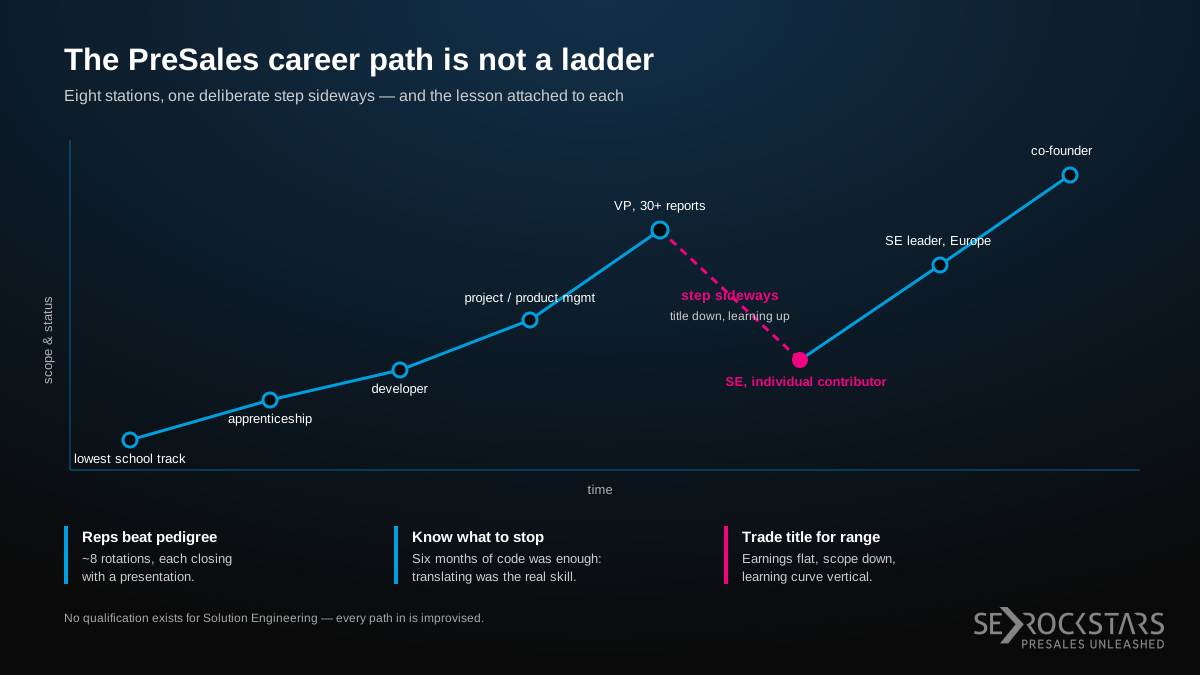
Eight stations, one deliberate step sideways — and the lesson attached to each.
What does a three-month rotation teach that a degree doesn't?
Deliberate practice, if the employer builds it in. Jan's apprenticeship at Deutsche Telekom (2001–2004) rotated him through roughly eight units in two-to-three-month blocks — field service, the exchange, a retail store, a development team. Every rotation ended with a presentation to peers about what he'd done and learned.
That wasn't pastoral care. The final trade exam was built around a presentation, so Telekom engineered dozens of low-stakes reps before the high-stakes one. Apprentices from smaller employers sat in the same vocational school class and, in some cases, had never once presented in three years. Same exam. One group had been coached into it; the other showed up and hoped.
The retail block did the rest. Three months on the floor of a T-Punkt store, advising walk-ins on mobile contracts and closing them on the spot, and he finished top of the store's seller list — as an apprentice, with no quota. It also produced his first hostile customer conversation: a father insisting the premium-SMS charges on his bill weren't his son's, with the son standing right there. Jan learned to read out what the record said, offer what he could actually do, and stop taking the fallout personally.
There's a hiring lesson buried in how he got there. He sent five to seven applications and received exactly one offer. The rejections came from processes built around stopwatches and multiple-choice pattern tests, thirty seconds a page. Telekom spent half a day talking with candidates, ran a group exercise they then presented, served cake, and closed with a feedback conversation so everyone went home knowing where they stood. He walked out of one building certain he'd never work there and out of the other convinced.
"They really put the people at the centre." — Jan-Erik Jank, on the only assessment day that produced an offer
If your SE hiring loop feels like the stopwatch version, you're selecting for test-taking and losing candidates who'd have been great at the job.
How do you know which skills to stop investing in?
Fast, if you're honest. After the apprenticeship Jan chose the internal development team, because building something and seeing it work was fun. Within six months he'd concluded he would never be good at it. Not sentiment — evidence: he needed enormous amounts of input, struggled to hold structures in his head, and sat next to people who took a problem, wrote a function and moved on.
He kept the parts that paid off. SQL stayed a daily tool; understanding the data stayed non-negotiable. What he dropped was the ambition to be the person writing the backend.
Because the team built software for internal business units, the gap was obvious and someone had to stand in it: understand what the department actually wanted, translate it into something engineers could build, then translate the engineers' "that won't work because one, two, three" back into something the business could decide on. Someone told him that was called project management, so he became a project manager.
Read that job description again. It's PreSales, ten years before he'd heard the word.
The filter he still uses is two questions, in this order: will I ever be genuinely good at this — and does it give me energy even if I am? Both must be yes before you spend another year on it. Apply it to the technical specialisation you've been half-pursuing for eighteen months. One qualifier: dropping a skill is not the same as dropping the literacy. He stopped coding, not understanding.
Is going back to an IC role a step backwards?
Only if titles are how you keep score. When Jan joined Salesforce in 2013 he gave up the VP title and 30 reports for a DACH Solution Engineer seat. He describes it not as a step back but as a step sideways, and the numbers support him: on-target earnings just over €90,000, and his first room in a shared flat in Munich cost less than the rent he'd been paying in rural Bavaria. No financial penalty. What he bought was an entirely new commercial world — the AE/SE split, discovery, demo, formal sales methodology, constant training, lunch-and-learns, a team where most members are SE leaders today.
One question from his manager rewired how he worked: so what? He asked it so persistently that he got on the AEs' nerves — an AE would arrive with a "great deal, let's do a demo," two or three questions later the deal looked different. In a booked meeting room with a whiteboard and a dial-in, he'd map challenges on one side and the demo flow on the other, then test whether the demo actually paid off anything on the challenge list. That's it. That's the whole technique.
Note what the hiring manager did with the English problem: he pulled from Jan's education budget and hired him a teacher. Hire for what you can't teach, then fund the thing you can. His head of sales wasn't convinced; he pushed it through anyway.
What makes a first-time leader fail?
Getting the job for the wrong reason, and then getting no scaffolding. Jan's first big promotion — VP of an e-business unit at a mid-sized software company, 30-plus people, revenue and margin responsibility, a variable comp scheme paying a share of the year-over-year profit gap — came to him because he was the loudest candidate and the internal favourite. His own verdict on his mindset at the time: he wanted the money, the title and the car. Responsibility came fourth.
He was, in his words, massively out of his depth — and good enough at presenting to hide it. He put every problem in the company on his own desk, believing that's what a chief does. He planted himself between his people and the board whenever things went badly, which came from the right instinct and burned him out anyway. Communication that had worked beautifully across a retail counter failed across 30 personalities with 30 agendas.
He doesn't blame the promotion. He blames the long leash. What he'd wanted, looking back: a phased plan and one experienced person sitting next to him while he executed it. Not "here's how you should do it, now go do it."
That person eventually showed up — a senior consultant his board wanted to bring in, whom Jan insisted on interviewing himself, partly on price, mostly because he wanted the decision to be his. The man had already achieved everything, so status meant nothing to him; he was empathetic, calm, funny, and could talk to anyone in the building. Over dinners Jan could finally say the sentence he'd never have said to his board: I don't understand this, explain it to me. He calls the environment where you can't say that toxic, and he's right. If your SEs can't say it to you, you're running that environment.
Two things then reset his values harder than any training. His mother nearly died — a herpes virus reached her brain and put her in a coma — and his grandfather died in the same period. A personality assessment he'd taken shortly before and one shortly after read like two different people; the psychologist told him something drastic must have happened. Around the job change itself his body sent the bill: renal colic, once when the Salesforce offer arrived by email, once when the signed contract came.
What survived was a different definition of leadership. It shows up in the most ordinary artefact of SE management — the call from a customer asking you to swap out the SE. His routine: ask the customer to describe their perspective, take it to the SE, work out together why it happened and what changes, then go back to the customer with a plan and a second chance instead of a replacement. Swapping the person is rarely the fix. Most of the time it turned out fine.
At CallidusCloud he stated his leadership ambition in the hiring conversation and had a European SE team inside a year. After the SAP acquisition he inherited a 14–15 person team spread across countries and product lines with almost no overlap — plus two or three people who had wanted a manager role and hadn't got one. His approach was transparency first: what drives you, where do you want to go, on what timeline, and what's realistically possible here. He'll tell you he'd do parts of it differently today.
Frequently asked questions
Do you need a degree to become a Solution Engineer? No. There's no formal qualification for PreSales anywhere in the German-speaking market, and hiring managers know it. The real entry requirement is the translation skill: understanding a business problem well enough to explain it to engineers, and understanding the technology well enough to explain it back to a buyer. Jan-Erik Jank reached SE leadership with a vocational apprenticeship and no degree. A technical background helps; a credential mostly signals that you can learn.
Is moving from a management role back to an individual contributor SE role a career mistake? It's a mistake if you do it to escape something and a good trade if you do it to acquire something. Jan gave up a VP title and 30 reports for an IC SE seat with no drop in earnings, and used the 18 months to learn how modern enterprise software selling actually works — knowledge he converted straight back into a leadership role at the next company. Be clear in advance about what you're buying, and say out loud in the hiring process that you intend to lead again.
How do you prepare someone for their first PreSales leadership role? With a phased plan and a named person alongside them. Most first-time SE managers are promoted for visible strength — presenting well, winning deals — and then left to discover strategy, budget ownership and difficult conversations on their own. Put the phases in writing, pair them with someone experienced who has no stake in their status, and make it safe to say "I don't understand this." A management training course alone won't do it.
What's the fastest way to get better at discovery? Ask "so what?" until the answer is a business consequence, then check your demo against the list. Draw the customer's challenges on one side of a whiteboard and your planned demo flow on the other, and delete every screen that doesn't pay off a challenge. It's uncomfortable for the AE and it changes forecasts.
Do I have to be a strong coder to succeed in PreSales? No, but you can't be illiterate either. Jan stopped trying to be a developer after six months and kept SQL and data fluency for the rest of his career. Use two questions on any technical skill you're considering: will I ever be genuinely good at it, and does it give me energy? If the answer to either is no, learn enough to be credible and spend the rest of your time on the skill that pays you.
If you're leading a solutions team and there's nobody in your company who does what you do, our PreSales Leader Community is free, peer-reviewed and now runs Europe-wide. If you want your SEs building business cases instead of feature tours, the Trusted Advisor Academy is where we do that work.
Tim Brömme (LinkedIn) & Jan-Erik Jank (LinkedIn) are the co-founders of SE Rockstars, with 30+ years of enterprise PreSales experience and 350+ SEs coached.
Listen to the full episode
The full career conversation — school breaks, the apprenticeship, the VP years, the values reset — runs in German on Spotify and here: PreSales Unleashed: Wie man im PreSales Karriere macht: Jan's Story & Learnings (278)