
Community isn't a nice-to-have for SE leaders. It's the only place the job gets calibrated.
TL;DR
- Peer density is the core problem. A software engineer at a 2,000-person SaaS company has 300–400 peers in the building. Their SE leader has two or three in all of Europe.
- The entry bar makes the room. Restricting membership to leaders with disciplinary responsibility is what lets people talk openly about comp bands, headcount, and KPIs.
- Three formats, no more. Compact online sessions (50–55 minutes, member-led), three to four on-site events a year in member-hosted offices, and one always-on WhatsApp channel.
- A €49 commitment fee cut no-shows to under 5%. The community itself is free; the fee exists purely to make a seat mean something.
- From 1 September the community runs in English across Europe — with London (~500 SE leaders), Paris, Madrid, Munich, Amsterdam and Milan as the map for 2027.
The first online session ran on 24 September 2024. One member, John Upton, took the mic with a title that was designed to start a fight: Why Post Sales doesn't belong in PreSales. Two years later that argument is still unresolved — it comes up at conferences, in WhatsApp threads, in one-on-ones with SE leaders who inherited a support queue nobody asked for.
That's the tell. The questions SE leaders carry around don't get answered inside their own company, because inside their own company there's almost nobody at their level to answer them. So they get answered slowly, expensively, by trial and error, quarter after quarter.
We spent roughly two years building the PreSales Leader Community to shorten that loop, and it now sits at close to 250 SE leaders. This is what we learned about why the gap exists, which formats create real exchange, and what you can lift for your own team or region.
Why does SE leadership feel lonelier than it should?
Because the peer math is genuinely bad. Tim's last operating role was at Miro — a 2,000-employee company where maybe two or three people in Europe did roughly the same job he did. A developer in that same company could look sideways and find 300 or 400 peers. Same building, same badge, a hundredfold difference in professional company.
Now add the second problem: every other go-to-market function already had somewhere to go. Marketing had events. Sales had groups. Even customer support had its circuit. PreSales had scraps, and in the German-speaking market it had essentially nothing.
The practical cost of that isn't loneliness. It's calibration. You set SE-to-AE ratios, comp structures, POC policies and technical win criteria against a sample size of two — one of whom is you. Then you defend those decisions to a CRO who has benchmarked their side of the house against forty companies.
What's the entry bar, and why does it matter so much?
Only leaders with disciplinary responsibility get in. That was deliberate from day one, and it's the single design decision we'd defend hardest.
Local PreSales meetups exist. International PreSales communities exist. They're useful. But the moment a room mixes ICs, leaders, vendors and the curious, the conversation drifts to the safe middle: demo tips, tooling, career advice. Nobody says out loud what they're paying their senior SEs, how they handled a performance case, or why they killed a metric their VP loves.
Put 20 people in a room who all carry the same responsibility and the conversation starts three levels deeper. The recurring topics in our community are exactly the ones that never make it onto a conference stage: compensation structures, KPIs, forward-deployed engineering models, where post-sales work belongs. Jan-Erik puts the goal plainly: a place where others understand your topics the moment you start describing them.
Which formats actually produce exchange?
Three. We've resisted adding a fourth.
Online sessions, 50–55 minutes. A ten to fifteen minute impulse talk on one sharp topic, ending in one sharp question. That question goes into virtual breakouts in small groups, then everyone comes back to plenary to compare notes. Tight, low-ceremony, no keynote theatre. The detail that makes it work: in about 90% of cases the impulse comes from a member, not from us. We orchestrate; the community sets the agenda.
That design has a side effect worth noting. The speakers consistently say they got more out of it than the audience did — the chat comments and breakout pushback become free peer review on a topic they're still working through. It doesn't have to be finished to be worth sharing.
On-site events, three to four times a year. Düsseldorf, Berlin, Frankfurt twice, Munich twice. Start at 15:30 or 16:00, two or three short keynotes, in-person breakouts on topics members voted for in advance, then food, drinks and networking until nine or ten. The best moment of the evening is always the same: telling a room that dinner has arrived and hearing people groan because they're mid-conversation.
One WhatsApp group. Unglamorous, and about 50% of members opt in — which is fine. Roughly once a week a topic pops, and a decent question pulls 20 answers. It's the fastest pulse check available to an SE leader who wants to know how eight other companies handle the thing that landed on their desk this morning. WhatsApp won because it's the lowest common denominator in Europe. The phone is already in your hand.
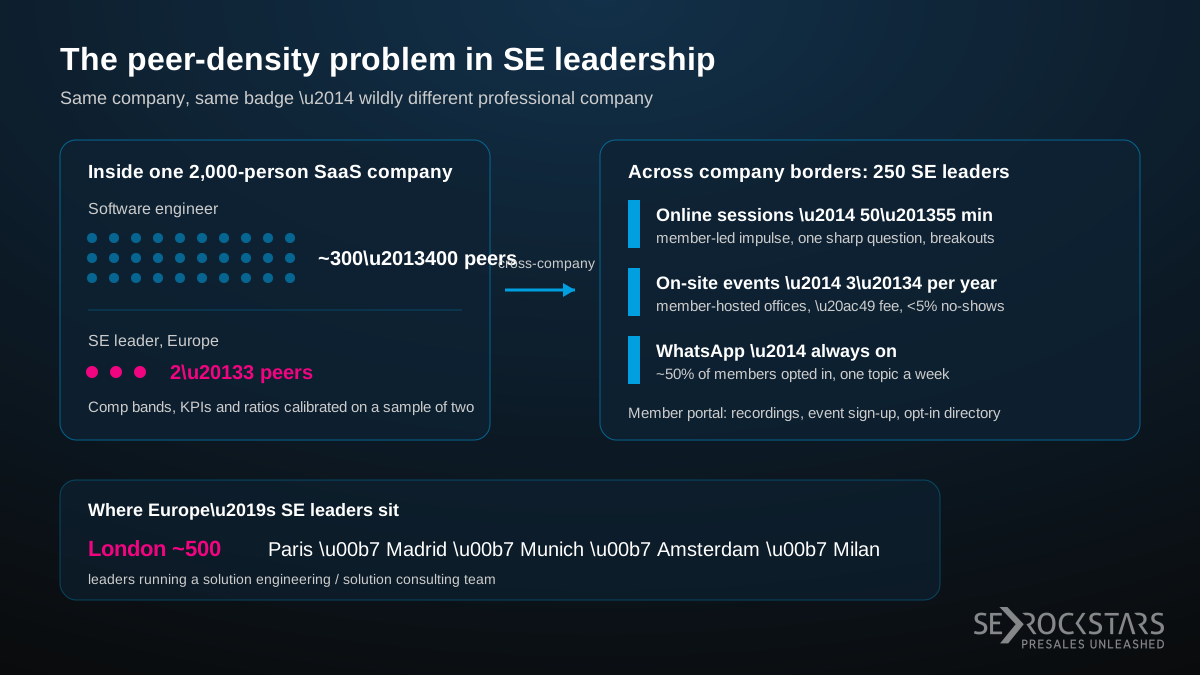
The peer-density problem on the left; the three formats that fix it on the right.
Why charge €49 for something that's free?
Because scarce seats need skin in the game. Membership, the online sessions and every piece of our content cost nothing. On-site events carry a €49 commitment fee, and that fee dropped the no-show rate to under 5%. When a venue holds 40 people and 12 don't show, you've locked out 12 leaders who would have come. The goodie bag alone is worth more than the fee — this was never a revenue line.
The venues are the other economic trick, and they're a community effect in themselves. ServiceNow, Personio and Cornerstone in Düsseldorf have all opened their offices to us because a member offered. No venue cost, better rooms than we'd ever rent, and a host who gets to show off their space.
Everything else now runs through a member portal we built ourselves: registration with real authentication, recordings of past sessions, event management with calendar invites for both online and on-site formats, and an opt-in member directory. The directory is granular on purpose — you decide what you share, minimum first name, last name and LinkedIn, and you can switch yourself out entirely. There's a map view, which sounds like eye candy until you realise what members actually ask us: where are these people? Finding out there are seven other SE leaders in Stockholm changes what's possible for you next quarter.
Where are Europe's SE leaders actually sitting?
London, by a distance — close to 500 people running a solution engineering or solution consulting team. Then Paris. Then Madrid, Munich, Amsterdam, with Milan close behind. Munich lands fourth, which surprises most Germans we tell.
That distribution is why the community opened up beyond DACH on 1 September. English becomes the primary language, a German-language channel stays for those who want it, and the events take an international turn: kick-off on 13 October in London at the Zscaler office, hosted by Gregor, who leads an SE team there and is a member himself — the day before Consensus DEMOFEST London, so you can do both on one flight. Then 22 October in Munich at the Personio office. Seats at on-site events go fast; the last Munich round filled within days of opening.
Six cities with real SE leadership density is a roadshow list for 2027, not a hypothesis.
How would you build this inside your own company or region?
Steal the mechanics, they're not complicated. Define the room by responsibility, not by job title or seniority theatre. Time-box the online format hard and put the small-group discussion in the middle, not at the end where people have already dropped off. Source content from participants and accept work-in-progress thinking — polished keynotes generate applause, half-finished thinking generates conversation. Rotate hosting so the cost stays near zero. Charge a token fee for anything with limited seats. And make every directory or profile feature opt-in and granular, because leaders will not share where they work and what they earn in a system they don't control.
One caveat from our own experience: when you ask members what they want built next, expect near-silence. We ask often and get little back. Build from what people actually show up to, not from what they tell you in a survey.
If you run an SE team in Europe, join the PreSales Leader Community — it's free, and the next on-site seats are already moving. If your challenge is the leadership craft itself rather than the network, book a discovery call and we'll talk about the Trusted Leader Academy.
Tim Brömme & Jan-Erik Jank are co-founders of SE Rockstars, with 30+ years of combined enterprise PreSales experience and 350+ SEs coached.
Frequently asked questions
Who can join the PreSales Leader Community? Solution engineering, solution consulting and PreSales leaders with disciplinary leadership responsibility. That restriction is the point: it keeps the conversation at peer level, which is what makes topics like compensation, headcount and KPI design discussable at all. From 1 September the community runs across Europe with English as the primary language, plus a German-language channel.
What does membership cost? Membership, the online sessions, the member portal and all our content are free. On-site events carry a €49 commitment fee, which exists to protect limited seats — it pushed no-shows below 5%. Food, drinks and the goodie bag are worth more than the fee.
What actually happens at an on-site event? Afternoon start around 15:30–16:00 in a member-hosted office, two or three short keynotes, in-person breakouts on topics members voted for beforehand, then dinner, drinks and networking until roughly 21:00–22:00. Past hosts include ServiceNow, Personio and Cornerstone; October 2026 runs London (Zscaler) and Munich (Personio).
Which European cities have the most solution engineering leaders? By our count London leads with close to 500 SE and solution consulting leaders, followed by Paris, Madrid, Munich and Amsterdam, with Milan not far behind. That ranking drives where community events go next.
Can I propose a topic or speak? Yes, and roughly 90% of the online impulse talks come from members. If you're wrestling with something unfamiliar — a new operating model, a metric that isn't landing, a structure you're mid-way through designing — bring it. Odds are high someone in the room has already been there, and presenters consistently report learning more than the audience.
Listen to the full episode
The behind-the-scenes version, in German, including the argument about whether on-site events were worth the money: PreSales Unleashed: [Special] Behind the Scenes: Darum bauen wir eine SE Leadership Community für Europa (276)