
A CRO's job is to hit a number in a world that refuses to hold still. Here's how the good ones are doing it.
TL;DR
- Macro only matters to the extent it hits your ICP. Narrow the target market deliberately — even artificially — and most of the world's chaos becomes someone else's problem.
- A second growth ICP is insurance, not luxury. Germany's China export gap got filled by Czechia, Poland, Romania and Hungary. Companies that had already built there absorbed the shortfall.
- Return on Token beats "AI strategy." Tokens, learning curves and process rework all cost money. Pick one quick win — time-to-demo, admin time — and measure it.
- Somebody has to own the stack. Without a Go-to-Market Engineer, every AE and SDR runs their own tools and you get chaos with a subscription bill.
- The pre/post split is the next thing to go. The skill set in your PreSales team is wasted if it stops at signature.
Eddy Frey has a line about forecasting in 2026: we all went to the flea market and bought ourselves a crystal ball. It gets a laugh in a room of revenue leaders because everyone in that room is expected to commit to a number twelve months out while the inputs — energy prices, tariffs, raw material availability, interest rates, whatever a given government does next — move weekly.
And yet the Chief Revenue Officer is supposed to be the calm one. Carry the vision internally, carry it to partners, carry it to customers who are supposed to believe enough to sign. Panic is not in the job description.
Eddy has done the full route — Siemens apprenticeship, key account management at BEA Systems and JBoss, twelve years at Adobe, SAP, then CRO at Spryker. Today he advises founders through Edventure Capital and co-founded the CRO Community, a peer group for GTM leaders. What follows is the working model he and his peers use to translate macro noise into things you can actually do on a Monday — and what it means for your PreSales org.
Why does macro noise only matter through your ICP?
Because without a filter, every headline is your problem. With a filter, most of them aren't.
The filter is the Ideal Customer Profile, and Eddy sees it half-finished almost everywhere he advises. B2B or B2C. Which industries. Which countries. Which company sizes. Most portfolios could technically sell to anyone, so nobody chooses — and then the whole world's volatility lands in the forecast.
"Cut it down deliberately, even artificially, so you get into a focus where you can test yourself." — Eddy Frey
Once the ICP is tight, macro becomes arithmetic. Selling into automotive suppliers? Then energy costs, tariffs, raw material scarcity and falling vehicle sales are your macro, and you can name the consequence: budgets get cut across the board, and anything that doesn't fix margin or revenue doesn't get funded. Selling into pharma or retail? Different set, different consequence.
That gives you two honest options rather than a vague sense of dread. Option one: keep the ICP and change the narrative — if the customer's problem is margin and efficiency, sell margin and efficiency. That's value selling, and it works precisely when budgets are tight. Option two: be bold enough to admit the industry will not buy what you solve, and open a second or third vertical where product-market fit is better.
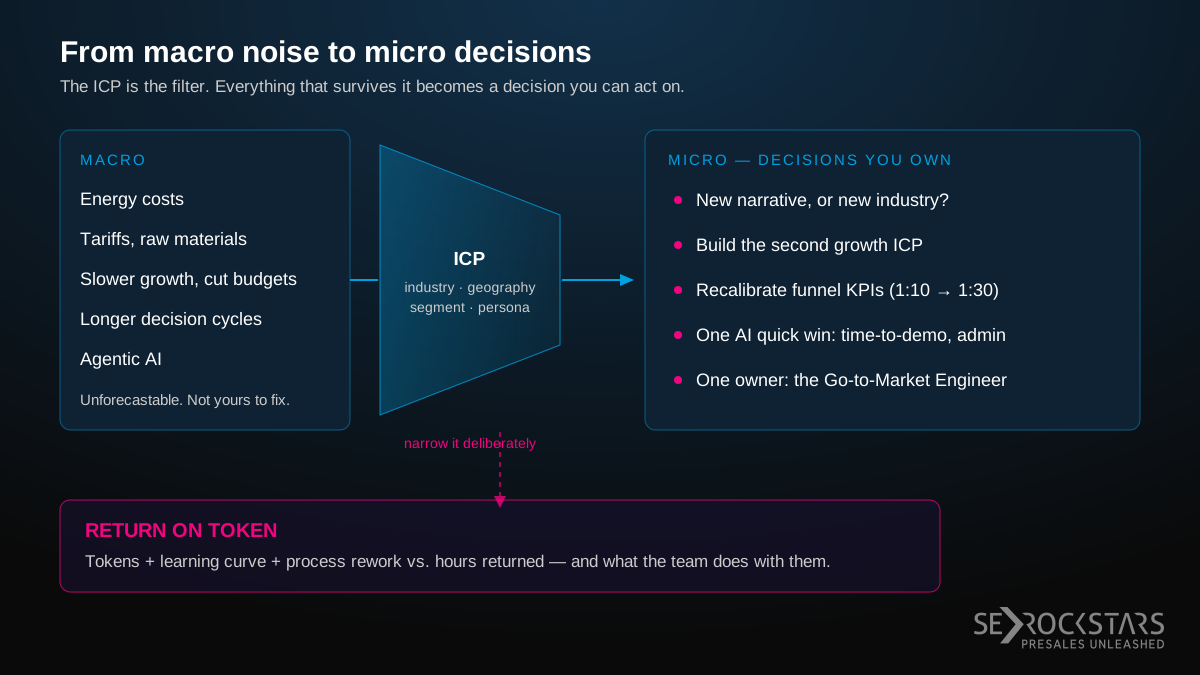 The only useful thing macro data does is force a decision on the right-hand side.
What actually breaks when you shift your ICP?
Two things, and neither is the deck.
First, the product has to differentiate in the new segment, not merely function there. Commodity products get punished on price, and then sales — including PreSales — gets blamed for discounts that were baked in at the strategy level. "Why aren't you selling more?" is often a product-market-fit question wearing a performance-review costume.
Second, your people have to speak the new industry's language. Not "be on eye level" — actually use the right terminology in a demo, in a business case, in a closing conversation. HR is relatively portable; HR teams look similar across verticals. Deep automotive supply chain expertise does not transfer to retail because someone shipped a few features in half a year. AI makes it fast to build the feature. It does nothing for your solution consultant's vocabulary.
Which is why Eddy's standing advice to founders is to carry a second growth ICP from the start — a second industry, or failing that, a second geography. Germany's China export gap got compensated through Eastern Europe: Czechia, Poland, Romania, Hungary. Companies that had already been working those markets in parallel could offset a shortfall. Companies standing on one leg could not.
If you're listening to this with a knot in your stomach about your single vertical: start the second one now. It takes product work, messaging work, enablement work, and it does not happen from one day to the next.
Which KPIs move when the market stops pulling?
All of the conversion ratios, and usually in the wrong direction.
This is where the CRO Community spends real time: what's the actual industry standard from lead to MQL to SAL to SQL to close, right now, in this market? Smaller budgets and longer decision processes mean the top of the funnel has to get wider. Where cold-to-MQL used to run at roughly 1:10, and MQL-to-SAL another 1:10, peers now report 1:20 or 1:30 at the front end simply because there's less real interest to find.
One caveat that gets ignored constantly: don't benchmark against companies with a different sales cycle. A two-to-three-month cycle produces a completely different KPI pattern than a 12–18 month enterprise cycle. Comparing them tells you nothing except that you like numbers.
The uncomfortable part is channels. LinkedIn, which everyone discovered during Covid and then flooded with AI-assisted outreach, no longer performs the way it did. A connection request is not a lead — most people accept to run up their follower count, not to hear from you. Eddy is blunt that the community has no clean answer yet; the conversations now include whether Substack or Reddit become real channels alongside it. If you're waiting for someone to publish the playbook, you'll be waiting a while.
What is "Return on Token" and why should you care?
Because "30% efficiency gain through AI, no additional budget" showed up in a lot of annual plans, and almost nobody costed it.
Eddy's term for the missing math is Return on Token — the tokens, yes, but also the learning curve, the tools you install, the processes you rewrite. Only spend it where you can see a return. He's seen per-person tooling costs of €5,000–6,000 a month. There were 5,000 marketing tools before AI arrived, and every new hire brought a favourite; now it's the same argument with a model name on top.
The deeper problem is that the underlying process gets skipped entirely. AI is fantastic at intent, signals, buying propensity — but only on top of work you were supposed to do anyway: define the ICP, derive target accounts, identify the personas, build the list. Nobody's tool infers a strategy you never had. Shit in, shit out: if your team can't quantify a business case in a discovery call today, adding a model produces a better-written version of the same weak business case.
And without a process owner it degrades fast. The AE runs their own tools, the SDR runs different ones, the SC brings a third — Eddy's word for the result is Babylon.
So: stop boiling the ocean and pick the short quick win. For solution consultants, that's time-to-demo; teams that used to spend days building an environment now have agents that assemble one from the CRM record. For sellers, it's documentation — meeting notes, the follow-up email that creates accountability and next steps, the internal debrief for the account team. That's one to two hours a week of work people hate and often skip, and it can drop to five minutes. Do that honestly and you also get better documentation quality than a human ever produced from handwritten notes.
Then answer the question that matters: what happens to the reclaimed time? More demos in the same week, or deeper value work and cleaner messaging? If you don't measure what the AE does with the hours you gave back, you didn't create efficiency. You created free time.
Who owns the AI stack — and does that role pay for itself?
A Go-to-Market Engineer, and yes, it should pay for itself out of the efficiency it creates.
The term has settled well, and the job is specific: connect the tool stack to the process end to end, be genuinely AI-native (understand what agentic systems can and can't do, not just what a copilot does), provide the MCP integrations that the AE, the SDR and the sales leader need, and be the person who answers "how does this actually work" for enablement. Add artifact-based reporting and revenue leaders finally get the dashboards they were always last in line for.
The business case is arithmetic. If four AEs, an SDR and a solution consultant each drop 20–30% of admin time, you're quickly at €100,000+ of recovered capacity — roughly the cost of the role. Compare that with trial-and-error across six people burning tokens and weekends on tools nobody else can reuse. If you already have RevOps, this may be one hire away. If you have nothing, hire someone who has solved this before.
Related: the Forward Deployed Engineer job postings everywhere. The role is not new — IBM was doing it in the 1980s and SAP perfected it. Jan-Erik's verdict on the hype is unprintable in polite company; "buzzword bullshit bingo" is the clean version. Underneath the label sits a real question: which profiles do you need across the customer lifecycle to get your solution to the point where it earns money, especially as pricing moves from seat-based to consumption-based?
What do CROs expect from PreSales in 2026 that they didn't in 2023?
Change readiness. That's the whole answer, and it's harsher than it sounds.
"We've always done it this way, it's always worked" is, in Eddy's words, grounds for dismissal. Buying personas are shifting demographically as boomers leave procurement, diversity in buying groups has changed, and what makes a customer move keeps moving. So the expectation on the PreSales leader is: bring what you're hearing from your peers to the table, run experiments, propose something new. Stop treating every problem as a nail because you happen to own a hammer — check whether the thing in the wall is a screw.
The concrete version of this is the pre/post boundary. Once AI gives your team capacity back, the honest question is whether "PreSales" is still the right frame. Does the split still make sense? Can that skill set contribute to renewals, upsell and cross-sell instead of treating them as an annoyance to hand off to customer success? Some teams are building value engineering functions out of exactly this reasoning.
Eddy's preferred term is Solution Consultant — deliberately, because it doesn't distinguish between pre and post. In SaaS, where growth increasingly comes from net revenue retention rather than new logos, the installed base needs the same technical credibility as a first deal. He quoted a line he couldn't source but never forgot: you don't want to put your farmer against somebody else's hunter.
The title on the org chart is the least interesting part. The question is whether this group of people, with the skills they have, is making the maximum contribution to the company — and whether the answer is still "only before signature." It probably isn't.
Frequently asked questions
What is a Go-to-Market Engineer? A dedicated role that connects the go-to-market tool stack to the sales process end to end: owning integrations and MCP setups, being AI-native enough to judge what agentic tooling can really do, producing reporting that revenue leaders can use, and supporting enablement on the stack. It typically sits next to or inside RevOps. The business case is the admin time recovered across the AE, SDR and SC population — around 20–30% per person adds up fast.
How do you measure ROI on AI in a sales organisation? Start by pricing the full cost, not just the subscription: tokens, learning curve, tool sprawl, process rework. Eddy Frey calls it Return on Token. Then tie it to one narrow use case with a measurable before-and-after — time-to-demo for solution consultants, or CRM and follow-up admin time for sellers — and measure what the team does with the hours you returned. Recovered time that doesn't turn into pipeline or depth isn't efficiency.
When should a company change its Ideal Customer Profile? When the industry you sell into has stopped funding the problem you solve, not when a quarter goes badly. The test: can you re-frame your value in the language your buyers currently care about — usually margin and efficiency — and still win? If yes, change the messaging, keep the ICP. If no, open a second vertical, and expect it to take product differentiation, new messaging and real enablement, not a rebranded deck.
Should PreSales support post-sales too? In SaaS, increasingly yes. When growth shifts toward renewals, upsell and cross-sell, the installed base needs the same technical credibility as a new-logo deal. The practical move is to stop drawing the line at signature and treat the solution consultant as the person who explains the product to a customer or prospect whenever that's needed — which is also why some teams rename the function value engineering.
Why are LinkedIn outbound results getting worse? Everyone discovered the platform during Covid, then AI-assisted outreach flooded it, and the lead path broke. Accepted connections don't correlate with interest. Peers report front-of-funnel conversion moving from roughly 1:10 to 1:20 or 1:30. There's no consensus replacement yet — the current experiments include Substack and Reddit alongside genuinely personalised, signal-based outreach.
If you're the person who has to translate all of this into an SE team that can carry a business case and a renewal conversation, that's what we train. Start with the PreSales Leader Community or book a discovery call and bring your org chart.
Tim Brömme & Jan-Erik Jank are co-founders of SE Rockstars, with 30+ years in enterprise PreSales and 350+ SEs coached.
Listen to the full episode
The full conversation with Eddy Frey, in German: PreSales Unleashed: Makro, Mikro, KI: Sales im Wandel, mit Co-Host Eddy Frey (274)