
The spread in AI adoption across B2B sales teams right now is absurd. Here's what the far end looks like, and what it takes to get there.
TL;DR
- The adoption spread is the story. Some teams just started recording calls. Individual sellers are running ten agents that prospect and dial. Both are in the same market, selling to the same buyers.
- Most AI strategies sit in one department. Product AI, legal AI and go-to-market AI are different animals — and go-to-market is usually last in line.
- Build a setup you own, not a vendor's. Skills plus markdown in a central repo, connected through open standards, means you can switch models without rebuilding.
- Token burn is not a KPI. ROI on token is. And nothing an agent hands you is finished — contracts come back with duplicated and contradictory clauses.
- Block one hour a week for learning. Leaders who don't schedule it fall four weeks behind between every team meeting.
Eddy Frey's newest car showed up through agents. He told the system which used BMW he wanted on the German market. It scanned the platforms, tracked for two weeks which listings came and went to understand the price trend, shortlisted cars near him, then emailed the salesperson in Augsburg to book an appointment. His entire human-in-the-loop contribution was saying yes a few times and showing up.
At the same time, in plenty of B2B software companies, a Solution Engineer is being told that transcribing customer calls is against policy. Not illegal — against policy. Meanwhile a conversational intelligence setup that satisfies European data protection law has been buildable for years.
That's the range we're working with. This article is about what the leading edge actually does differently, why the gap keeps widening inside companies rather than between them, and what a go-to-market leader should decide in week one.
How wide is the AI gap in B2B sales right now?
Wider than any tooling gap we've seen in 25 years of enterprise selling. At one end: teams recording calls, running a transcript, skimming the summary. At the other end: individuals with agents that source accounts, place calls, and file everything afterwards. In between, a large middle that has ChatGPT-style dialogue down and nothing else.
Eddy — Founder & Managing Partner of Edventure Capital and co-founder of the CRO Community, after 30+ years through Siemens, BEA Systems, JBoss, twelve years at Adobe, SAP, and the CRO seat at Spryker — sees the same split at the leadership table. Two factions. One has been deep in it since the beginning. The other is waiting for it to blow over, the way people once waited out the internet because their customers were catalog customers.
The pressure on the first group isn't strategy, it's supply. LinkedIn sells them a new tool and a new blueprint every day while their own company says: Copilot or Gemini only, agentic off, governance pending.
Some of that corporate braking is fair. A transcription setup that breaks the law is worse than no transcription. The EU AI Act has obligations most sellers haven't read — in a CRO Community poll, 90% of respondents didn't know that AI-generated images and text need to be flagged. But "we haven't figured out governance" as a permanent state is a self-inflicted competitive disadvantage. If you wanted it, you'd find a way.
Why does the AI strategy keep missing go-to-market?
Because it lives in one department, and that department is rarely yours. Eddy's read — a gut estimate, not data — is that roughly 80% of companies are working on an AI strategy. The problem is where it sits. AI for building product is not AI for contract review is not AI for go-to-market. Different tools, different risks, different rules.
Which leads to an uncomfortable question: who owns AI in your company, and where do they sit? Every function arguably needs its own specialist. For go-to-market, RevOps is the obvious candidate — close enough to the tooling, close enough to the process.
What we see instead is departments going rogue in the best possible way. PreSales teams build genuinely impressive things: discovery agents, demo agents, prep and follow-up pipelines. Then it stays inside the PreSales silo. Sales doesn't benefit, partner managers don't benefit, and nobody outside the team knows the skill exists.
That's the actual leadership gap. Not "should we use AI" — but how one person's work becomes everyone's capability, and how that survives the next model release. Waterfall it (strategy, then governance, then rollout) and you'll ship a framework that's twelve months stale on day one.
What does an AI setup look like that survives the next model?
One you own. The most useful thing Eddy took out of the CRO Community's build workshops was architectural, not clever: don't build for one vendor. Keep a central repository — a shared drive, not your laptop — and build a clean skills and markdown structure there. Your projects, your context, your instructions, encapsulated.
Then the model is just a consumer of that. The major providers have converged on a shared standard for agent plug-ins, and MCP — Model Context Protocol, essentially USB-C for AI — is the connector layer underneath. Write the skill once, point whichever model is currently best at it. "Do you have an MCP server?" has become a purchasing question for us, right next to pricing.
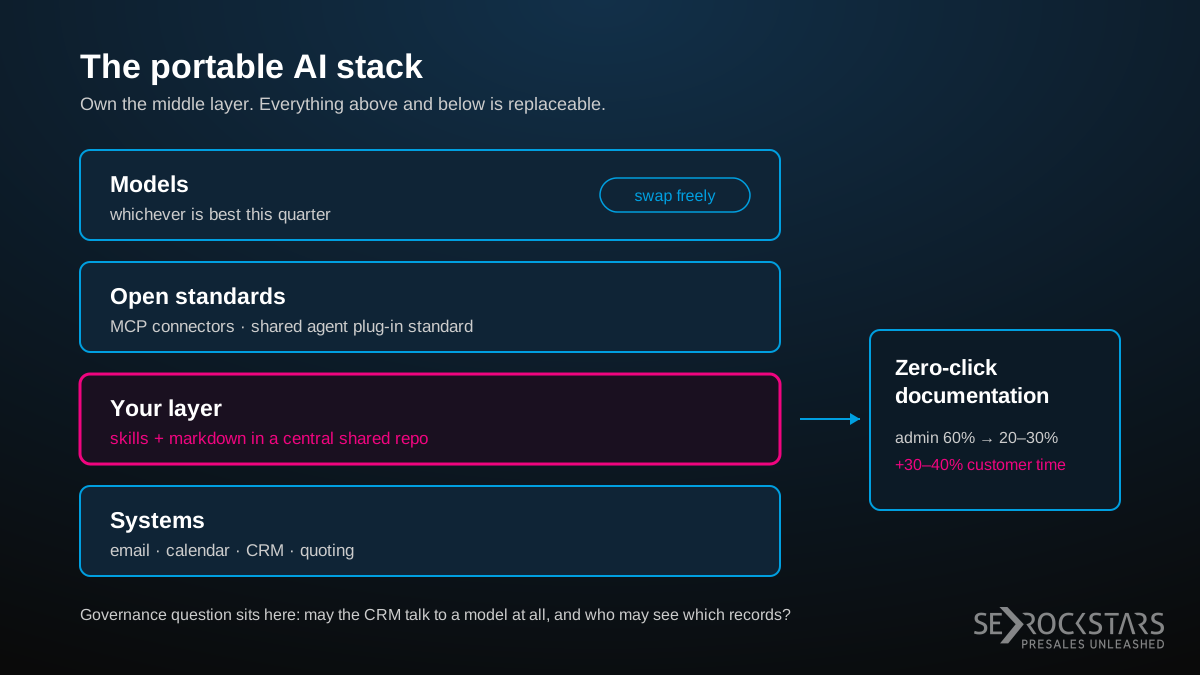
The only layer worth investing in is the one you keep when you switch models.
Eddy's advice for everything above this line is two words: just do it. Twenty CROs sat open-mouthed in a community session watching Tim sketch a transcript-to-everything flow on a whiteboard — offer, email, follow-up meeting, CRM documentation. It looked impossibly complex. It wasn't. Nobody explained to his system how to buy a car either.
If you're a mid-sized company without a dev team: you don't need to code, you need to be able to describe the business outcome. Talk through your ICP, your efficiency problem and your existing stack in dialogue first, turn that into a plan, align it with your stakeholders, then build iteratively. Put two people on it — one who understands the tech and can translate business, one who understands compliance — and let security checks run before anything gets deployed. That combination gets you further in a month than a governance workstream does in a quarter.
Is token burn a KPI or a warning sign?
A warning sign. Large SaaS companies now run token dashboards with rankings — who consumes the most — and in some cases the usage number is incentive-relevant. If your token spend is too low, you feel it in your wallet.
We've seen this movie. It's SDRs paid on meetings booked with nobody checking quality. Eddy's parallel goes back further: banks being valued on IT spend when the internet arrived, followed by the inevitable slapback. According to Handelsblatt reporting he cites, SAP has introduced token budgets and is trimming them. The metric that matters is ROI on token — did an outcome with value come out of the other end?
Experimenting counts as an outcome, by the way. Getting lost for a weekend does not.
The second cost is judgment, and it doesn't go away. Contracts are where Eddy sees it most: ask the model to soften clause 3 and it happily loses the whole-document context. Now you have redundant paragraphs, and sometimes contradictory ones. His routine is to keep asking — is this contract still coherent, can it be shorter, are there redundancies left. If that happens in contract text, assume it happens in code you can't read.
Jan writes playbooks for the Trusted Advisor Academy with Claude Code, and comes out of a few hours genuinely wrecked. You're holding the whole structure, the internal consistency, the language, the connections between modules. What comes out of a cold "write me a playbook on X" prompt isn't good, because 15 years of doing the work is the input the model doesn't have. The upside is real — formatting, drafting, graphics for someone with no eye for graphics — but the thing is not yet independently viable.
What does zero-click CRM mean for PreSales?
It means the documentation problem inverts. Eddy's current flow: calls transcribed with customer consent, emails and calendar in reach, a skill that adjusts the offer and contract based on what was actually said, the opportunity created, the entries written into the CRM. He touches neither the CRM nor the quoting tool. Tim has gone one step further and cancelled our CRM — what we needed was faster to build and better than the standard.
Most companies are not there, and the blockers are governance, not capability: may the CRM talk to an LLM over MCP at all, may customer records be used, who's allowed to see what. But the direction is clear. A seller walks out of a call and the draft email is in the folder while the contract is already in approval.
Run the math on that. Take a rep at 60% admin and get them to 20–30%, and you've bought 30–40% more customer-facing time. That's not a headcount reduction story — it's more punch on the sales side.
So what would Eddy decide in week one back in a CRO seat? One standardized environment, chosen for enterprise controls rather than hype. MCP access to email, calendar and CRM — cleared with legal and the data protection officer first — because that's where the effect is. Then a full-day bootcamp for the entire go-to-market team: half on using it for yourself, half on using it inside the company. Then a bi-weekly 30-minute call with the AI owner in RevOps in a hot seat, open dialogue, everyone at the table with equal standing: PreSales, partner managers, partner companies. Swarm intelligence beats a policy document.
And for you personally: block one hour a week, hold it sacred, with your sources already chosen so the hour is learning and not searching. Community members who skip it show up four weeks later having absorbed nothing, and the first 20 minutes of every session get spent catching them up. The delta compounds in both directions.
One last data point. In a Leader Academy AI session, Jan asked the group what they'd built — the Miro board filled up with sticky notes. Then he asked what they did with the time they saved. He expected "finished earlier," "ice cream with the family." Nobody wrote that. Every answer was some version of: I built more cool stuff with AI. Meanwhile, when we ask our community what they want most, the answer is meeting in person. The better the AI gets, the louder that demand seems to get.
Frequently asked questions
Is AI in B2B sales a leadership responsibility or an individual one? Both, and the leadership half is the one being skipped. Individuals can build agents on their own; only a leader can standardize the environment, clear MCP access with legal, fund a go-to-market bootcamp, and make sure a skill one person builds becomes available to the whole team. Refusing to participate as a leader guarantees a productivity gap you can't coach your way out of.
What's the highest-value first AI use case for a sales team? The transcript-to-everything flow. Record the call with consent, then derive the follow-up email, the offer or contract adjustment, the next meeting and the CRM documentation from what was actually said. It hits the biggest time sink (admin), it's measurable, and it finally gives reps a reason to keep the system of record current instead of nagging them about hygiene.
How do I avoid vendor lock-in when building AI workflows? Keep your own layer separate from the model. Store your skills, prompts and context as markdown in a central shared repository rather than locally in one vendor's app, and connect systems through open standards like MCP. When a different provider becomes better for your use case, you switch the model and keep the work.
How much time should an SE or sales leader spend on AI learning per week? One hour, blocked and protected, two if you can. The condition: pick your sources in advance so the hour goes to content and not to searching, and check what you can do after the hour that you couldn't before. Leaders who leave it to "when things calm down" never do it.
If you're the one who has to turn this into a team capability rather than a personal hobby, that's leadership work — and it's exactly what we run in the Trusted Leader Academy with SE leaders every week. Want to talk it through first? Book a discovery call, or join the PreSales Leader Community. Eddy is reachable on LinkedIn.
Tim Brömme & Jan-Erik Jank are the co-founders of SE Rockstars, with 30+ years in enterprise PreSales and 350+ SEs coached.
Listen to the full episode
The full conversation with Eddy Frey, in German: PreSales Unleashed: KI im B2B-Vertrieb: Warum KI längst Chefsache ist, mit Co-Host Eddy Frey (273)