
The most dangerous promotion in B2B software is the one everybody applauds.
TL;DR
- Two routes lead into first-line leadership, and they produce two very different managers. Planned progression with training and KPIs at every step — or the ultimatum: promote me or I leave. The second one arrives with an AE's toolkit and zero preparation.
- An unprepared first-liner is a seven-figure line item. Eddy Frey puts it at 25–50% wasted output across the team, the promoted rep's own contribution dropping from 200% to 50%, and roughly €400,000 for every person who quits under them.
- If the motivation is money, keep them in the IC seat. Comp flattens with every layer up — expect it to halve on the way to third-line or the board.
- Management is inspect, control, manage. Leadership is outcome-based. The test: disappear for four weeks and see whether anything breaks.
- First-line Sales and PreSales only reach eye level when PreSales can vote a deal down. Watching rights beat goodwill.
Eddy Frey threatened his way into his first management job. Years of 200–300% attainment, real money in the bank, and one thing he wanted: the next step. So he pushed until the company gave in — biggest quota, a team underneath, now deliver.
Six months later a delegation flew in from the US and told him he was there too early. The offer: step back for half a year, take the training, then come back into the role. He took it. More than €30,000 in training and coaching budget later, he went back up — and he still calls that one-week leadership program the thing that reset his understanding of the job. What matters in that story isn't the demotion. It's that somebody looked, said it out loud, and paid for the fix. Most companies promote and pray, then quietly part ways three months later.
Eddy has done the full run — Siemens apprenticeship, inside sales at BEA, JBoss, twelve years at Adobe, SAP, then Chief Revenue Officer at Spryker — and now advises 14+ B2B companies through Edventure Capital while running the CRO Community for German-speaking GTM leaders. Below: what to check before you hand someone a team, what the wrong hire costs, where management ends and leadership starts, and how first-line Sales and PreSales stop working against each other.
Why do the best individual contributors fail as first-line managers?
Because the toolkit that made them great doesn't transfer, and nobody tells them. A young, hungry AE does whatever the deal needs. Roadblocks get bulldozed. There's shouting, pushing, pulling. It works — 200% of target proves it. And the conclusion the top performer draws is: I can do this at scale, just give me the job.
Eddy sees two paths into the role. One is planned progression: you hit defined training milestones and KPIs, and each proven layer earns you the next slice of leadership responsibility. That path is more common in large organizations, and it produces a noticeably different first-liner. The other is the ultimatum — promote me or I go. The manager above doesn't want to lose a producer, gives in, and now an AE with the biggest quota is running people using deal-making instruments. "The first dilemma is born right there," as Eddy puts it.
PreSales arrives from the opposite direction. Jan-Erik has watched teams promote the strongest SE simply because no other development path existed — sometimes knowing the person wasn't ready. And the SE's stated motivation usually isn't the quota. It's the process: the way we work is broken, I can make it better for the team, don't be the demo dolly, someone has to be the counterweight to Sales pushing.
Then the two of them sit in the same forecast call. One is wired to push, the other to resist the pushing. Eddy calls it a Clash of Titans: both want the best outcome, both are as far apart as they could possibly be, and the second-line above them ends up refereeing instead of scaling.
What does an unprepared first-liner actually cost?
More than the P&L shows, which is exactly why it survives. Revenue may still land in year one, so the damage hides. What surfaces first is a team that no longer rows in the same direction, and a manager who never learned to delegate. He's the best, right? So he grabs every deal himself.
Eddy's arithmetic is uncomfortable. Somewhere between 25% and 50% of the team's output becomes blind spend. The person who delivered 200% now delivers 50% of their own number, because half their time goes to people who — micromanaged into passivity — no longer own their results. Add frustration, add the exits: he prices a single employee departure at roughly €400,000. Give a failing first-liner the usual one-to-two-year runway and you're comfortably into seven figures.
There's a second bill, paid by the person you promoted. Miss the number for a year or two as a new first-liner and the leadership career is over, no matter how good the training around it was. Which makes timing part of the selection: sometimes the honest answer is not this year — wait for the next opening.
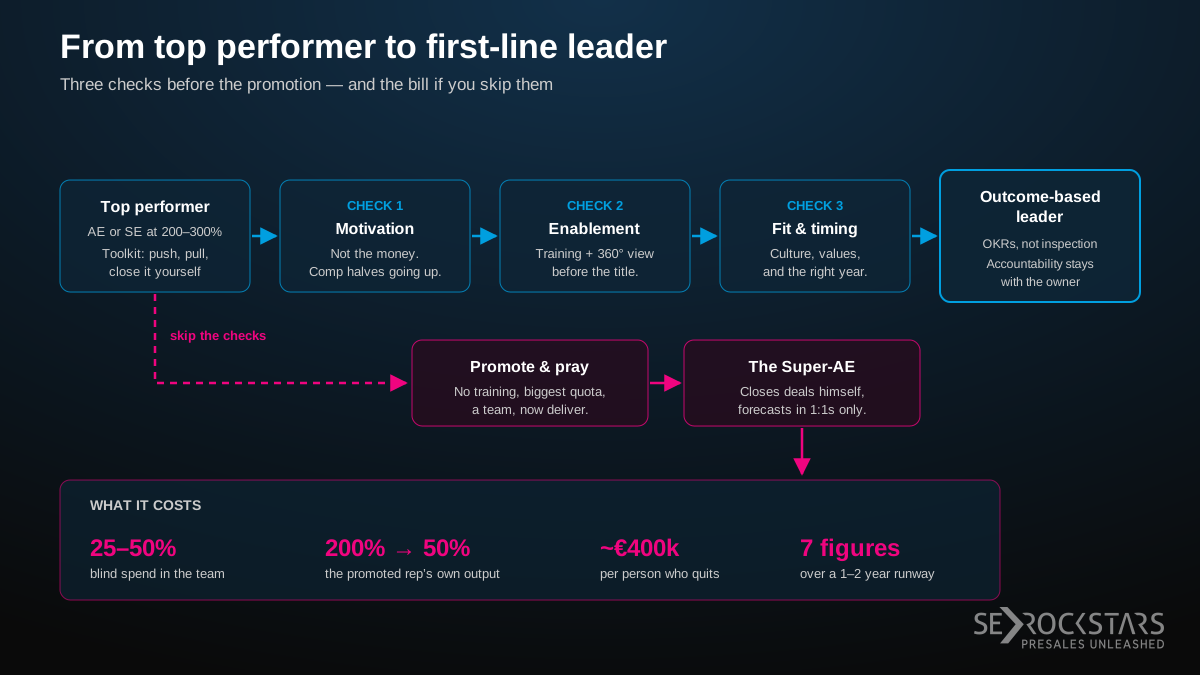
Three gates before the promotion. Skip them and the cost shows up in the team's output long before it shows up in the forecast.
Is money a red flag when someone asks for the manager job?
Yes, and it's the fastest screen you have. Eddy runs motivation exercises with the companies he advises, often without knowing which department he's talking to. He can spot the sales floor within minutes: money is the answer, at every level.
"If you want to earn more money, stay an AE." — Eddy Frey
He means it literally. First-line and second-line sales management is where you earn the least relative to effort: no 200% attainment (if there is, someone set the target wrong), flatter kickers, a third of your five to ten headcount unfilled and covered by you, plus every neighboring problem — marketing, solution design, hiring, people issues. His standing promise to aspirants: your take-home halves until you reach third-line or the board. The reckoning usually lands after twelve months at 80% of expected comp on a 50/50 or 60/40 split.
So what should you look for instead? Eddy's point is that every good AE already leads without authority — they run the RFP, orchestrate PreSales, SDRs, marketing, partners, customers. Watch that, document it, and you know the answer. Can they hand over responsibility without pulling it back? Is there empathy? Do they steer by outcomes rather than by pressure? He recommends 360-degree views across departments and levels — including customers and partners — for everyone in the company, not just candidates. And then the question most hiring panels skip: does this person fit the leadership culture you want to have next year? If not, let them become a manager somewhere else. Eddy has seen people leave for exactly that reason and thrive.
His advice to the ambitious side of the table is blunt too. Be vocal — in fast-growing US-style organizations, the leader who doesn't state the ambition gets a new boss hired over them every year. But demand the enablement along with the title, not just the quota. Training during and after the step up. Honest 360 feedback, and the open mindset to hear it. His standing recommendation for anyone stepping into a new role: The First 90 Days by Michael Watkins.
Management or leadership — what's the difference in practice?
Management is inspect, control, manage. You iterate, you check what the other person is doing, and when it isn't what you wanted, you correct it. Useful, necessary, and it does not scale.
Leadership, in Eddy's definition, sits one level above: you agree the outcome, the resources and the clock, then you track progression — not the how and not the who. Accountability stays with the person doing the work. OKRs make it measurable; you get involved when something is actually stuck. And this is where it gets misread. Leadership is not "I said what I wanted, goodbye." When quality or timing slips and nobody noticed, trust evaporates and everything gets managed again.
Jan-Erik draws the line differently, and the two versions fit together. Management is the business — the CRM dashboard, the process, the numbers. Leadership is the work with the people. It's August, and someone's quota attainment reads 33%. You cannot ignore that number. But your first question in the next one-on-one is either "why is this only at 33% and what are you doing about it?" or "how are you actually doing right now?" — and that choice is the whole difference.
Eddy's practical test: go on vacation for four weeks. If everything runs and nothing changed when you're back, you built something. He spent three weeks on Borneo without internet while at SAP, with four management levels and 38 countries under him, and it held. Manage a structure that size instead of leading it and you'd need more than 24 hours a day. Or, in football terms: a coach screaming and gesturing on the touchline for 90 minutes isn't leading. He's managing.
What are the early warning signs of a first-liner who isn't developing anyone?
Watch the forecast call — it's where the wheat separates from the chaff, well before the number moves. How is it set up? Who speaks, who asks, who explains? And first of all: who is even invited?
An inclusive first-liner has PreSales in the room, partner management, sometimes marketing, because there's nothing to hide and the shortest path to a fix runs through the people in the call. A forecast run exclusively in one-on-ones is a red flag for Eddy: that's not a manager, that's a Super-AE issuing next steps until next week's call.
The second signal is rhetoric. Everyone's a problem except me. Never my fault. When you're two or three levels up you're no longer in those calls, so it reaches you as email traffic — the CC escalation, the look-how-hard-I'm-pushing thread. Both are coachable, and both need someone above to actually look instead of waiting a year and firing the person.
There's a cultural precondition Jan-Erik insists on: a first-liner who walks into the forecast call already braced for a beating will not tell you the truth. Eddy grew up in a leadership generation where shouting on the forecast call and monthly threats of termination were normal, and he's clear that it belonged to a labor market where 200 people applied for one job. Today you have to apply for your people, and be interested in them. Jan-Erik's verdict on the old style: that has nothing to do with leadership at all.
How do first-line Sales and PreSales actually work at eye level?
On the org chart they're peers. In reality, Sales sits closer to the fire — first under pressure, first to touch headcount, first to go, because their outcome is the fastest and most measurable one in the company. If the deal doesn't come, it doesn't come. Pretending that asymmetry doesn't exist is what makes the peer relationship fake.
Two things fix it. First: the tandem. Sit down together before every deal and before every customer meeting — one owns the technical stakeholders and the IT-side account management, the other owns the commercial track and the partner landscape, both documented in the CRM so neither is guessing what phase things are in, with a real call cadence on top. Eddy built exactly that at Spryker, and he describes it as the version that also happened to be fun.
Second, and this is the one most organizations won't do: give PreSales a vote to walk away. Watching rights. A gatekeeper role at eye level with Sales, where both sides can say we don't believe we can win this, and the deal gets qualified out. Because the alternative is the one everybody has lived through — the SE who says "we can't win this" and then goes in with half an effort. Self-fulfilling prophecy, plus friction that outlasts the deal and poisons the next ten. Eddy's rule: the moment you hear "he never thinks we can win" or "with that SE I never close," you shut the sentence down and rebuild the eye-level.
And for the SEs convinced they could sell better than the AE next to them: Eddy has watched several make the jump. More than one was back in PreSales within six to eight months. Sales is a craft too.
Frequently asked questions
Should we promote our best sales rep or best SE to first-line manager? Only if the reasons hold up beyond performance. Top attainment says nothing about the ability to delegate, coach or build a team — quite often the opposite, because the behaviors that closed those deals (push through, do it yourself) are the ones that break a team. Test the three things Eddy screens for: motivation that isn't primarily money, demonstrated leadership without authority in cross-functional deals, and fit with the leadership culture you want. Then fund the training before, during and after the step up.
How much does a failed first-line manager cost a company? Hard to isolate, because revenue often still lands in year one — which is why it goes unnoticed. Eddy's working estimate: 25–50% of the team's output turns into blind spend, the promoted top performer's own contribution can fall from 200% to 50%, and each resignation triggered by bad leadership costs roughly €400,000. Over a typical one-to-two-year runway, that's a seven-figure number.
What is the difference between management and leadership in sales? Management is inspect, control, manage — you check the work and correct it. Leadership is agreeing an outcome, resources and a deadline, then leaving accountability with the person who owns it and tracking progression instead of activity. OKRs are a decent scaffold. The practical test is the four-week vacation: if nothing breaks while you're gone, you're leading; if everything stalls, you're managing.
What are the warning signs of a weak first-line manager? The forecast call tells you first. Forecasting only in one-on-ones, no PreSales or partner management in the room, a manager who dictates next steps instead of asking what's blocking the deal, and blame rhetoric where everyone is the problem except them. Two levels up you see the same pattern in the CC-heavy escalation emails. All of it is visible months before the quarter goes wrong.
How can first-line PreSales and Sales managers collaborate better? Build the tandem into the process, not into people's goodwill: joint deal prep, clear split between technical stakeholder management and commercial ownership, shared CRM documentation, a fixed call cadence. Then give PreSales a formal vote to disqualify deals. When both sides can say no, both sides own the yes.
If you lead a PreSales team and you're figuring out this transition without a manual, you're the reason our PreSales Leader Community exists — 200+ Solution Engineering leaders from companies like SAP, Ivanti, Cornerstone and IFS, no AEs, no SEs, free to join. Want to talk about your own first-line bench and how you'd develop it? Book a discovery call.
Tim Brömme & Jan-Erik Jank are the co-founders of SE Rockstars, with 30+ years in enterprise PreSales and 350+ SEs coached.
Listen to the full episode
The full conversation with Eddy Frey — in German, including his own demotion-and-comeback story: PreSales Unleashed: First-Line Leadership: Zwischen Top-Performer und Teamplayer, mit Co-Host Eddy Frey (272)