
Five provocations, one CRO, and very little diplomacy.
TL;DR
- Nobody should lie — but the reflex to answer everything, fully and instantly, loses more deals than silence does. Ask why the question exists before you answer it.
- PreSales sits in the P&L as a cost center. Accept it, then manage it like one — cloud bills for demo environments included.
- The ratio debate is usually a qualification problem in disguise. A useful gate: no SE time below roughly 25% win probability.
- The technical win is a sales stage, not a trophy. Two or three vendors stay on the shortlist until the final day, and there is no silver medal.
- "I don't have a dashboard" is no longer an excuse. You can build one against your CRM in an afternoon and walk into the headcount conversation with numbers instead of a feeling.
Ask Edmund "Eddy" Frey what the difference between Sales and PreSales is and you get one sentence back: PreSales knows that he's lying. He follows it with a second, older piece of sales-floor folklore — never make the AE smart, you'll never get him dumb again. Same, he says, for the customer.
It's deliberately overcooked. But Eddy has spent 30 years earning the right to say it: Siemens apprenticeship, key account management at BEA Systems and JBoss, twelve years at Adobe, SAP, then Chief Revenue Officer at Spryker. Today he runs Edventure Capital and co-founded the CRO Community, a peer network for GTM leaders. When someone who has signed off on PreSales budgets for three decades tells you your favourite KPI is theatre, it's worth sitting with the discomfort for a minute.
What follows are the four arguments worth stealing from that conversation: where the line between truth and selling actually runs, how to stop being the first line item cut in a margin squeeze, why your ratio complaint gets dismissed, and what the technical win is really worth.
Is there lying in PreSales, or just strategic silence?
There shouldn't be lying — but there is a gray zone, and pretending otherwise is how SEs walk into it unprepared. Eddy's point isn't a licence to mislead. It's that the SE is often the only person in the room who knows exactly where the product bends, and volunteering every one of those spots, unprompted, is not honesty. It's a lack of filter.
He's seen it worst with consultants pulled into a customer meeting without any sales training. Brilliant people who live with their code and their team, suddenly delighted to explain everything, including the three architecture caveats nobody asked about. Meanwhile the AE is out there swinging acronyms around, the SE's face is doing something involuntary, and the customer is reading both of you.
The real risk isn't the big lie. It's the late-stage question barrage — the one that arrives two weeks before signature, full of items that never came up in ten weeks of conversation. Yes, no, maybe, I'd have to check. Eddy puts the odds at 70–80% that something surfaces at the end that was never a topic before, and grows into an elephant that tramples the deal. Often it isn't the customer's question at all. It's a competitor's, planted through someone in the account who is quietly against you.
So don't answer at speed. Answer at depth. "Why is that important to you? What exactly are you doing with the API today?" Nine times out of ten the answer changes, because the gap you were about to confess to turns out to be irrelevant to the use case you already solved. As Jan-Erik puts it: sometimes you take one step back to take two forward. And if you're the SE who was parachuted in for one meeting, you have no obligation to resolve anything live — take it home, fix it by email, and tell your AE afterwards where he oversold.
Is PreSales a cost center or a profit center?
In the P&L, it's a cost center. Both Jan-Erik and Eddy agree, and the more useful move is to stop arguing about the label and start managing the money. PreSales is part of cost of sales, which makes it part of customer acquisition cost — and almost no PreSales leader we meet has CAC anywhere near their KPI list.
The cost isn't only salaries. Eddy's biggest surprises came from the infrastructure: demo environments running on AWS, high-availability clusters kept warm for weeks, a load test in commerce that fires tens of thousands of transactions and lands on someone's cloud bill. Add the ancient discipline of rebuilding a physical demo shop with cameras for an automotive prospect and you can see why he thinks the cost block is drastically reducible — through what-you-see-is-what-you-get demo surfaces, repeatable T-shirt-size estimates, customer self-service, and an AE enabled to run the first three or four meetings alone.
The flip side is the number nobody produces. If you own a €1M PreSales budget, what's the return? SE-attached revenue. Win rate with an SE versus without. Opportunity size with and without. Number of demos to close. Eddy keeps only two hard measures at the top: time spent with customers and AEs, and revenue produced by the team — everything else, he says, is trust, proximity and culture, and no balance sheet has a column for those. We'd argue you can go further than that, and we ran the thought experiment in PreSales als Profit-Center (217).
The reason this matters isn't intellectual. It's the day someone says "cut 20%." Then the question gets ugly fast: do we really need this many SEs, wouldn't half do, can't they type with both hands? If you've never made yourself measurable, you lose that argument on vibes. Eddy has watched companies keep two extra AEs over one SE on a product that genuinely needs explaining — and then wonder six months later why deals stopped closing.
What's the right AE-to-SE ratio?
There isn't one, and anyone who quotes you a universal number is selling something. Eddy has seen 1:1 work for top target accounts where the AE carries five logos and each is expected to produce around €2.4M a year — there the P&L holds. He's also seen fast-moving business where one ten-minute demo closes it and 1:10 or 1:20 is perfectly healthy.
What he won't accept is the ratio as an explanation for exhaustion. His sharpening of the thesis: the ratio debate isn't only an excuse for bad prioritisation, it's an excuse for bad qualification. If your SE is in the first or second qualification call, something is broken in the sales methodology, not in the headcount plan. Gate it: PreSales enters when win probability is past roughly 25%. Below that you're funding 75% waste with your most expensive non-quota resource.
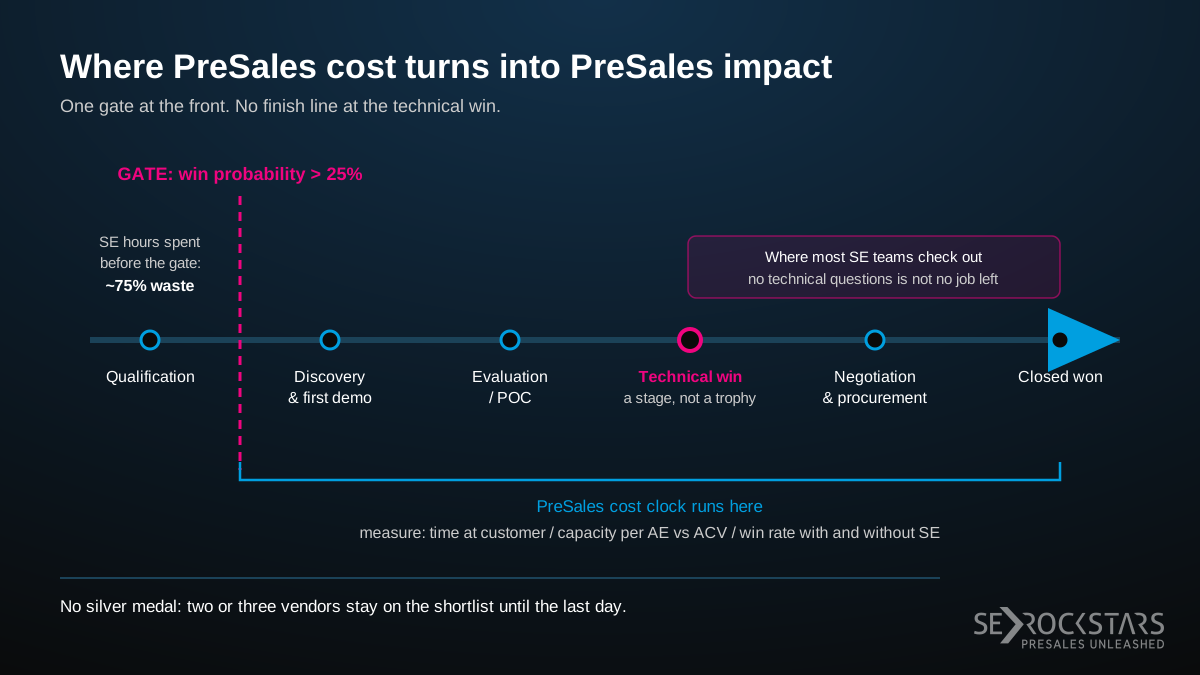
One gate at the front, no finish line at the technical win — that's the whole capacity argument in a picture.
The old defence — "I have no dashboard, BI resources are booked by the CFO" — is gone. Connect a model to your CRM via MCP and you have a working dashboard artifact in five minutes. Eddy's words: that excuse is off the table. Build it, then look at where your people actually go, at which stage, at what probability.
The other dial is personalisation. Every additional customised demo burns SE hours that show up nowhere. Take 10–20% of the personalisation out of your standard demo and you've bought back capacity you were about to hire for.
How do you actually win the headcount argument?
With data you collected before you needed it. Jan-Erik ran activity capture in one of his teams — not to line people up against a wall, but to answer one question: where does our capacity go, and which part of the sales org allocates the most SE time relative to ACV? The effect wasn't a report. It was that he never had to argue from gut feeling again. He could walk into the quarterly with "here's what I learned last quarter, now let's talk about what we change next quarter."
Eddy saw the same thing at Adobe, and calls it the moment everything shifted: they discovered a single AE was consuming 70% of the PreSales resource. That one number let them reallocate capacity and redesign the ratio for everyone.
"Measurability creates manageability. If I measure, I can manage." — Eddy Frey
Walk into a CRO's office with "we're all overworked" and the first question back is: what have you done about it? Most leaders break there, because there's no plan, only a culture of complaint. Build the internal business case instead — cost, capacity, expected impact — and it becomes very hard for a CEO to simply say no.
Is the technical win worth celebrating?
For Eddy, it's a sales stage. Nothing to celebrate until the deal is in. He remembers a time when a technical win meant you walked through untouched to signature; that world is largely gone. Most deals now carry two or three vendors on the shortlist to the very end, and AI-assisted RFP processes have made selection fields wider, not narrower. Winning the technical evaluation means you're one of three. Then it's contract design, partner fit, price point — and in automotive supply, possibly a reverse auction where your technical superiority is worth exactly nothing.
Jan-Erik pushes back on one point, and it's the point that matters for how you run the metric. Tracking technical win as a signal — does our solution resonate, are we repeatedly confirmed as able to solve the problem we identified — is a legitimate checkpoint in the cycle. The damage comes from the mindset: technical win secured, job done, SE checks out.
Don't. Ask the AE "how can I help?" Sometimes the answer is a last call with the technical stakeholder, or a short video for the buying committee. You can win every technical evaluation in the pipeline and still end the quarter with nothing. There's no silver medal in sales.
What would a CRO change in PreSales first?
Asked what he'd do on day one back in the CRO seat, Eddy named three moves in order.
One: CRM hygiene, with PreSales measurement points built in — the same discipline expected of SDRs and AEs, so the data actually exists. Two: a capacity model built on that data, with MBOs derived from it, so "who gets how much SE" is a decision rather than a scramble. Three: later involvement — enable the AE to run unpersonalised first demos so the deal is properly qualified before the cost center steps in — and, where it counts, no more hopping. The SE assigned to a deal stays on it to the end, instead of whoever happens to be free that week.
His verdict on the combination: brutally game-changing for the quality, the customers and the time you get back.
Frequently asked questions
What is a good AE-to-SE ratio in B2B SaaS? There's no universal figure — it depends on product complexity, segment and go-to-market. Ratios of 1:1 exist for top target accounts where each account is expected to produce seven-figure annual revenue, while fast-moving, lightweight products run comfortably at 1:10 or 1:20. Decide it per segment, based on measured capacity and quality gating, not on how tired the team feels.
At what point should an SE join a deal? A practical gate is a win probability above roughly 25%, with the AE running discovery and a standardised first demo before that. If your SEs are sitting in first qualification calls, the problem is qualification discipline, not headcount.
Is PreSales a cost center or a profit center? Accounting-wise it's a cost center inside cost of sales, and pretending otherwise doesn't help you in a budget review. What changes the conversation is managing it like an investment: track customer acquisition cost, SE-attached revenue, win rate with and without SE involvement, and demos required per close.
Does the technical win predict whether you'll close? Less than PreSales teams like to think. Most competitive deals keep two or three vendors on the shortlist to the end, and the final decision turns on commercial terms, partner fit and price. Use the technical win as a checkpoint on whether your solution resonates — never as a finish line.
How do I justify another SE headcount to my CRO? With a documented capacity picture: where SE time went last quarter, which AEs consumed the most relative to ACV, what you already changed to fix it, and what the next hire is expected to move. Gut feeling gets waved away in thirty seconds; an internal business case forces a real counter-argument.
If your team is still arguing ratios from gut feeling, that's a system problem, not a staffing problem — the Trusted Advisor Academy works on both, and you can pressure-test the fit on a free discovery call.
Tim Brömme & Jan-Erik Jank are co-founders of SE Rockstars, with 30+ years in enterprise PreSales and 350+ SEs coached.
Listen to the full episode
The full discussion — five theses, in German, with more pushback than we could fit here:
PreSales Unleashed: Lügen im PreSales? Die bittere Wahrheit, mit Co-Host Eddy Frey (275)