
A number can be accurate and still mislead. Most time-savings business cases are exactly that.
TL;DR
- Hours saved are not money saved. If the same people still sit in the same seats after go-live, admin hours × hourly rate gives you a figure with no home in the customer's P&L.
- Freed capacity is the real story, but only if you can say what it buys. 18 hours a week back is worth nothing until it turns into more revenue, lower cost somewhere else, or less risk.
- A few cost arguments survive a skeptical CFO: the cost of errors, hires a fast-growing company no longer needs, and the cost of inaction.
- Half-truth numbers get found out. One follow-up question from someone with finance sense, and your slide loses its credibility. Your credibility goes with it.
- Run the same test on your own team's time. Automation that frees your hours only matters if you know which bottleneck those hours go to.
The director-general of ZDF, Germany's public broadcaster, recently sat down with the hosts of the politics podcast Lage der Nation and put a number on the table: personnel costs of around 15%. For a broadcaster running several channels and a streaming library, that sounds remarkably lean.
Then the hosts added the context. Star presenters like Markus Lanz aren't on the payroll. Their shows are commissioned through production companies, so what the talent earns sits under a different line item. The 15% is true. It just doesn't tell you what the people cost.
Jan-Erik heard that and immediately thought of a slide we see constantly when we work through business cases with SEs in our Academy: "Dear customer, we save you €X." Behind it, admin hours multiplied by an internal hourly rate. Same effect as the broadcaster's number, usually without any intent to mislead. The arithmetic is right and the picture is wrong. This article covers why that math fails, what to put in its place, and a quick test to run before a CFO runs it for you.
Why doesn't "hours saved × hourly rate" convince a buyer?
Because nobody's costs actually go down. The person who spent 20 hours a week on admin is still employed after your software goes live, on the same salary. You've changed how they spend their week, not what the company spends.
Jan-Erik puts it bluntly:
"We're not saving those costs. What actually happens is that we free up capacity, and ideally that capacity gets used profitably for the company." — Jan-Erik Jank
There is one exception. If the customer's explicit goal is to reduce headcount, the saving is real and you can calculate it that way. But that's rarely what's being pitched, and it's rarely a story your champion wants to carry into the steering committee. Calling it a "process cost saving" when close to 100% of that cost is personnel who will still be there is misleading. And it won't hold up long once anyone across the table with a bit of finance sense looks at it. They'll call it a nice calculation that has nothing to do with reality, and they'll be right.
Tim's experience from years of selling business software backs this up. Reducing administrative effort is, in his words, always the argument that convinces the least.
What should you do with freed capacity in a business case?
Follow it to where it lands. Tim's example: a clerk works a 40-hour week and spends 20 of those hours on admin. Your solution cuts that admin by 90%. That's 18 hours a week back.
On its own, that number does nothing for a CFO. The question that matters is what those 18 hours turn into. If the redirected time reduces an opportunity cost that is real and can actually be captured, then you have a lever worth putting on a slide. If nobody can say what the time will be used for, you have a nice-sounding statistic.
For most companies, the levers come down to two: more money or lower costs. Risk reduction is a third, harder to quantify, and a special discussion for cybersecurity vendors in particular.
In practice, this changes your discovery. Don't stop at "how long does this take today?" Ask what the team would do with the time if they got it back, and who would notice. If the answer is a shrug, you've learned your case is weak before the customer's finance team tells you.
Which cost arguments actually hold up?
Three kinds survive scrutiny, and none of them depends on pretending people disappear.
The cost of errors. When we replaced manual Excel sheets with business software in our earlier careers, the number-one argument was never the hours. It was calculation errors. In one use case Tim remembers, a 2% calculation error had already caused millions in extra costs. That lands with a CFO far harder than "we save your admin clerk 20 hours a week."
Hires a growing company won't need. Here, headcount savings become convincing, because the people don't exist yet. If a customer is growing so fast that it would have to hire someone new every month just to keep up with the process, every hire you prevent is a real saving. And salary is only the start. On top of, say, an €80k annual salary come recruiting, hiring, onboarding and training. Tim's rule of thumb is to multiply the salary by two or three to get the true cost. That's when the numbers start to count. The honest caveat is that few software buyers are on a growth path that steep. For the ones who are, it's one of the strongest arguments you have.
The cost of inaction. Jan-Erik takes the growth argument one step further. If the customer keeps working the way they do today, what does the status quo cost them? "You'll need to hire ten new people next quarter" is a cost of inaction. It makes the price of doing nothing visible without inventing a saving.
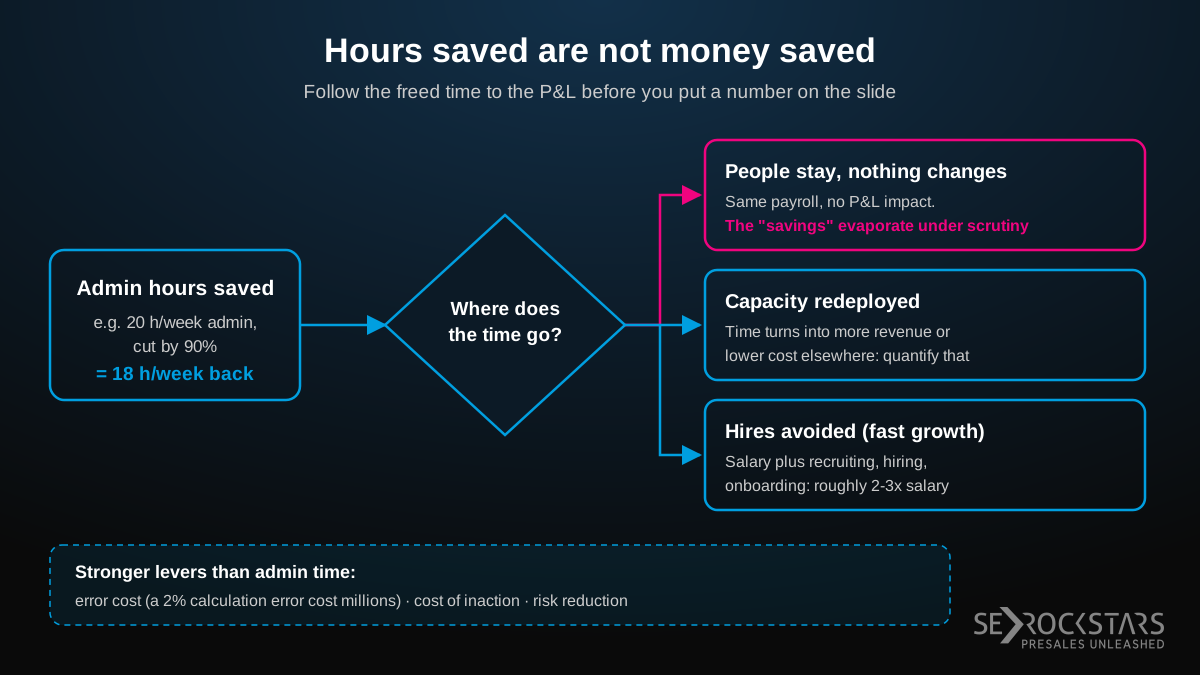 Hours saved only become money when you can say where the time goes. Otherwise the number disappears under scrutiny.
How do you spot a half-truth number before your buyer does?
Ask what the number leaves out. The broadcaster's 15% isn't false. Read on its own, though, it gives a completely wrong picture, and that's the risk with every figure on your business-case slide.
"'My personnel costs are only 15 percent, so I'm totally cost-efficient.' But that's only half the truth. Or a quarter, or however much. We don't know." — Jan-Erik Jank
Before a number goes in front of a customer, put it through four questions:
- Which line in the P&L moves? If you can't name the budget line that shrinks or the revenue line that grows, it isn't a saving.
- What happens to the people? Kept, redeployed, not hired? Each answer means a different calculation. "Saved" is not one of them.
- Would your champion defend it in front of finance? Your champion has to repeat this number in a room you're not in. Give them one that survives the first follow-up question.
- Does it stand without the footnote? If the figure only makes sense with an asterisk explaining what's excluded, lead with the context, not the headline.
A smaller, honest number beats a big one that falls apart.
Does the same logic apply to your own team's time?
It does. We run into it every week at SE Rockstars, a four-person company where Tim handles marketing largely on his own.
Our website used to run on Webflow. A few months ago we threw that out and rebuilt it on Vercel, GitHub and Node.js. Now Tim can trigger a site change with a single command from Claude Code, and it's live about three minutes later. He then connected Semrush's MCP server to the same setup, which meant the SEO audit and the tool that edits the website could talk to each other. He asked for the lowest-hanging fruit on visibility and indexing and shipped a batch of fixes within a few hours. Webinar landing pages that took weeks of preparation back in his SE days now take about half an hour. Zapier's MCP handles a similar job for our data flows and automation.
That's freed capacity. And it raises the same question you should be asking your customer: what do the hours turn into?
For us, it shows up as build versus buy. We run our learning community on Disco, a platform that combines learning content, community and live events. Members bring good ideas that we can't build without clumsy workarounds. Building our own software looks more realistic every month. We've gone from "probably not" a year ago to "when, not if."
Our discipline for that decision is worth copying. Start with the outcome: give yourself an hour or two to think about what you'd build with no limits at all. Then do the hard business check. Whoever builds this leaves something else undone, so the only question that matters is: is this our biggest bottleneck right now? If yes, go. If not, the freed time belongs somewhere else.
That's the test your customer's CFO will apply to your 18 hours. Apply it to your own business first and you'll write better business cases.
Frequently asked questions
How do you calculate ROI for software that reduces admin work? Don't stop at hours saved × hourly rate. Work out what the freed capacity turns into: revenue the team can now generate, costs it can cut elsewhere, errors it avoids, or hires it no longer needs. Only count personnel cost savings if headcount actually goes down or planned hires are cancelled.
Why do CFOs reject time-savings business cases? Because the people are still on the payroll after go-live, so the company's costs don't change. A CFO will spot that a "process cost saving" made up almost entirely of retained personnel never shows up in the P&L. From then on, they'll discount every other number you show them.
When is a headcount saving a legitimate argument in B2B sales? When the customer is growing fast enough that the current process would force them to keep hiring. Avoided hires are real savings, and their true cost is well above salary once recruiting, onboarding and training are included. A rule of thumb is two to three times the annual salary.
What is the cost of inaction in a software business case? It's what the customer pays if they keep working the way they do today: extra hires next quarter, recurring calculation errors, growing risk. Framing the status quo as a cost makes the case for change without inventing savings that won't survive scrutiny.
Want your SEs to build business cases that survive the CFO? Quantifying pain and cost of inaction is core to the Trusted Advisor Academy. Book a discovery call and we'll show you how it works, or join the conversation in our PreSales Leader Community.
Tim Brömme & Jan-Erik Jank are the co-founders of SE Rockstars, 30+ years of enterprise PreSales, 350+ SEs coached.
Listen to the full episode
The unscripted conversation that sparked this piece, in German: