
You've got an RFP in your inbox, a deadline that doesn't leave room for a proper discovery cycle, and an AE asking for a technical response by Friday. Half the requirements say things like "strong reporting" with no test attached. The other half look copied from a competitor's data sheet.
Don't start drafting answers. Start by turning every line into a proof plan. If you can't name how a requirement will be scored, what evidence proves it, and how it'll be tested after award, you don't have a requirement yet. You've got a risk to your technical win.
Start With a Requirement Matrix You Can Score
Copy this structure before you write a single answer. It's a hypothetical RFP requirements example for a B2B SaaS platform, and it works the same way whether you're issuing the RFP or responding to one.
The matrix you can copy
| ID | Requirement | Status | Evidence requested | Scoring | Buyer owner |
|---|---|---|---|---|---|
| SEC-01 | Support SSO using SAML 2.0 | Mandatory | Metadata file and recorded test login | Pass or fail | Security lead |
| DAT-02 | Store and process EU customer data in the EU | Mandatory | Data-flow diagram and hosting region list | Pass or fail per data type | Privacy lead |
| INT-03 | Sync account records with the buyer's CRM | Weighted, 20 points | Sandbox demo and API documentation | 20 for two-way sync, 10 for one-way, 0 for file export only | Solutions architect |
| SUP-04 | Median first response under 4 business hours | Weighted, 10 points | Twelve months of SLA reports | 10 under 2 hours, 5 under 4 hours, 0 above 4 hours | Customer success lead |
| AI-05 | Customer data must not train vendor AI models | Mandatory | Contract clause and subprocessor model terms | Pass or fail | Legal lead |
SEC-01 is pass/fail for a reason. If your platform can't do SAML 2.0 today, there's no partial credit that fixes the buyer's identity policy. A roadmap promise doesn't pass a recorded test login. The buyer removes you early, and that saves both sides weeks of work.
INT-03 is weighted because depth separates vendors who already cleared the gates. Two shortlisted platforms can both "integrate with CRM" and still be far apart. A two-way sandbox sync with documented error handling earns more than a nightly CSV export, and the scoring rule says so before anyone demos.
Use the same rows as your proof plan
For the buyer, each row is a scoring instruction. For you as the Solution Engineer (SE), each row is an assignment: product artifact, document, or named reference. SEC-01 maps to a metadata file. SUP-04 maps to dated SLA reports, not a support philosophy paragraph. AI-05 maps to contract language your legal team has already approved.
Practical rule: If a row has no evidence you can name today, mark it red now, not the night before submission.
That discipline also helps you judge how much effort a row deserves. A 20-point integration demo deserves your solutions architect. A factual question with no points attached deserves two accurate sentences and the right attachment.
If you're on the government side of this work, the BidFunnels guide to government proposals is a useful companion for how formal solicitations expect proposals to mirror the buyer's structure.
Copy the six columns into your RFP template or response tracker. Then go row by row and write the exact evidence you'd submit. Every blank is either a clarification question, a build task with an owner, or a reason to walk away.
Write Requirements You Can Test After Award
Here's how you rewrite a vague line into a requirement an evaluator can score and a delivery team can test.
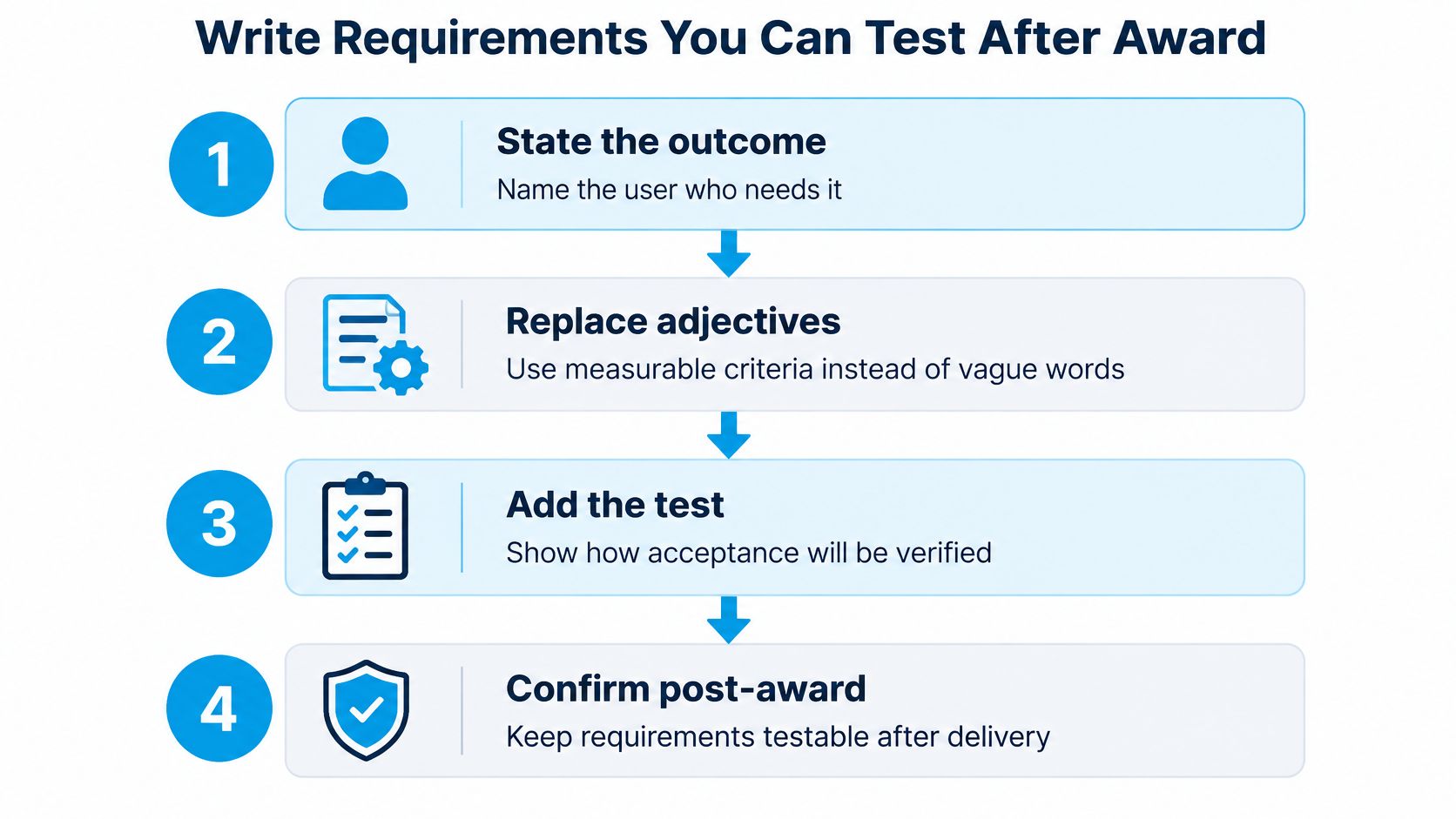
Six steps from adjective to acceptance test
- State the outcome and name the user. "Support admins must onboard new agents without IT help" gives evaluators a person and a job. "User-friendly admin" gives them an opinion to argue about.
- Replace adjectives with an observable measure. Use a protocol, a time limit, a percentage, or a dated document. Virginia's IT procurement guidance recommends defining evaluation criteria before drafting the RFP and expressing objectives as observable, measurable criteria, with technical capability, management capability, experience, personnel, resources, and project-control plans assessed as distinct areas.
- Name the evidence and what a pass looks like. A metadata file plus a recorded login is checkable. A statement that you support SSO is not.
- Pick the scale or mark it pass/fail. Don't let evaluators invent the scale during scoring. If partial credit exists, say what earns it.
- Write the acceptance test. It should run in a sandbox, a scripted demo, or the first delivery milestone. The common slip is a test that depends on data or access nobody can provide in the vendor's environment. A clear POC test plan template helps you keep that test tied to entry and exit conditions instead of open-ended exploration.
- Assign a buyer owner. Someone collects the measure after award and reviews it on a stated schedule. Without an owner, even a good metric dies at signature.
Adding more requirements doesn't fix weak ones. A line that can't be verified or mapped to a score creates writing volume for vendors and reading volume for evaluators, without improving the decision.
Vague lines and testable rewrites
| Vague requirement | Testable rewrite | Why it scores |
|---|---|---|
| Good authentication | Support SSO using SAML 2.0 with metadata exchange | Vendors answer with proof, not adjectives |
| Fast support | Median first response under 4 business hours, reported monthly | Two vendors can be compared on one number |
| Strong security | SOC 2 Type II report dated within the last 12 months | Evaluators can check the date and scope |
| Easy to use | New admin creates a role and assigns permissions in under 5 minutes in a scripted test | The test runs during the demo, not after award |
Run the self-check on every line before you publish or respond: name the document or demo that would prove it. If you can't, the requirement isn't ready. Rewrite it, clarify it, or cut it.
Structure the Four Parts Every RFP Needs
A usable RFP requirements example separates four things vendors often find mixed together in one long questionnaire.
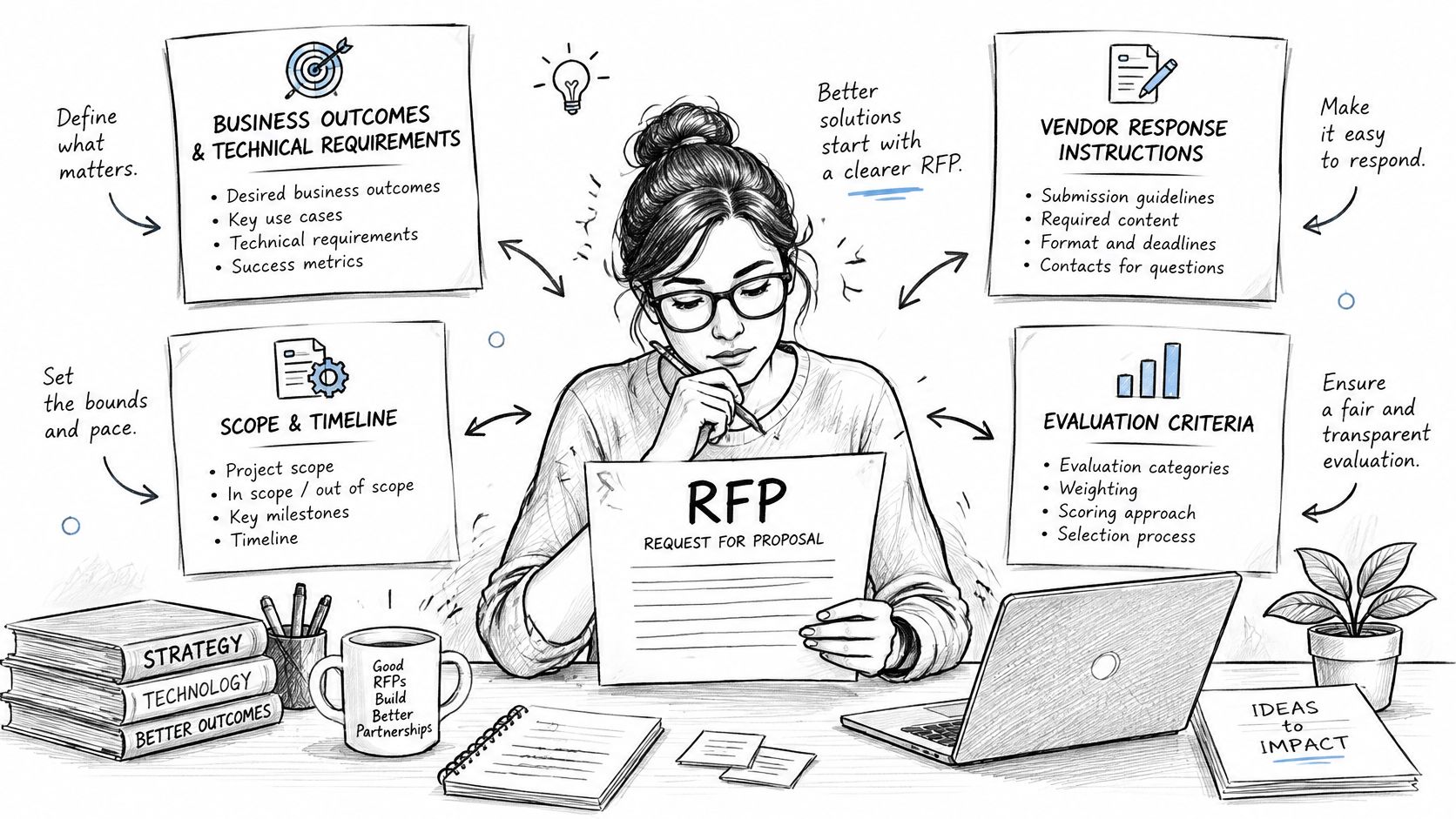
The four parts in SaaS terms
The Federal Acquisition Regulation subpart on solicitation content identifies four minimum elements for a competitive RFP: the buyer's requirement, anticipated contract terms and conditions, required proposal information, and evaluation factors with their relative importance.
Translate that into sections a SaaS buyer recognizes:
- Business outcomes and technical requirements: The problem, required functions, users, volumes, and implementation scope.
- Contract terms: DPA, security and privacy duties, liability caps, termination rights, and assumptions on term and volume.
- Response template: Numbered sections, page limits, evidence per requirement, and file format. Vendors shouldn't guess where an architecture diagram belongs.
- Scoring model: Points or weights per factor, what's pass/fail, and how pricing is scored.
If you're deciding what to cut from an overloaded template, Procright's view on what modern RFPs can skip is worth comparing against your own section list before you add another page of questions.
Take a hypothetical customer-support platform. The outcomes section says first-contact resolution must improve from the buyer's stated baseline. The terms section requires EU hosting. The template asks for an architecture diagram under INT-03, not buried in an appendix. The scoring model gives technical approach 40 points, so you know where to spend SE time.
The video below walks through RFP structure from the buyer's side, which is useful when you're deciding what to challenge and what to answer as written.
Your job is mapping. Every paragraph you write should trace to a stated requirement, a submission instruction, or an evaluation factor. When a requirement has no acceptance criteria, flag it as a clarification question before you commit solution effort. Don't fill the gap with a long narrative and hope an evaluator rewards it.
Set Data Residency and Subprocessor Terms
"GDPR compliant" and "SOC 2 available" don't answer the questions that decide a multinational deal. Where does processing happen, feature by feature? Who touches the data on the way?
Ask operational questions, not compliance labels
Canadian government procurement security guidance recommends asking where sensitive data is stored, how it's transmitted, how it's categorized, what access controls apply, how long it's retained, and which subcontractors participate in storage, transmission, categorization, or retention.
Turn those questions into artifacts you can score:
- Data-flow diagram: Systems, regions, and subprocessors for each data type, including support access.
- Geographic-processing matrix: Each product feature listed against the region where it runs. Core platform in one region and an AI feature in another must show up as separate rows.
- Fourth-party disclosure: The subprocessors behind your subprocessors, with notice periods for changes.
- Retention and deletion terms: Retention period per data type, deletion method, and a deletion certificate at exit.
- Breach-notification timeline: Stated in hours, with the named contact route.
- AI data-use clause: Customer data, prompts, and outputs must not train vendor or third-party generative AI models, with prompt retention stated explicitly.
A compliance badge tells you a control framework exists. A processing matrix tells you whether a specific feature breaks the buyer's residency rule.
The hypothetical that exposes the gap
Say a support platform hosts tickets in the EU, but its AI ticket-summary feature sends ticket text to a US inference region and retains prompts for quality review. "GDPR compliant" leaves that open. The matrix closes it: the buyer sees the US row, scores it as a mandatory failure or a weighted risk, and you learn that before you've built a full demo around the AI feature.
Send these clarifications before the deadline:
- Which features process data outside the contracted region? This changes mandatory scoring.
- Are prompts and outputs retained, by whom, and for how long? This changes legal review.
- Can the AI feature be disabled per tenant with no data leaving the region? This can turn a fail into a workable scope limit.
- What notice do you give before adding a subprocessor? This tests whether the contract terms match the proposal answer.
Qualify the RFP Before You Invest Time
Bid/no-bid is a scored decision, not a gut call you make after solution design has already started. Score eight factors in one pass, each as strong, partial, or weak: strategic fit, mandatory compliance, technical feasibility, incumbent or relationship position, competitive differentiation, delivery capacity, deadline realism, and expected commercial value.
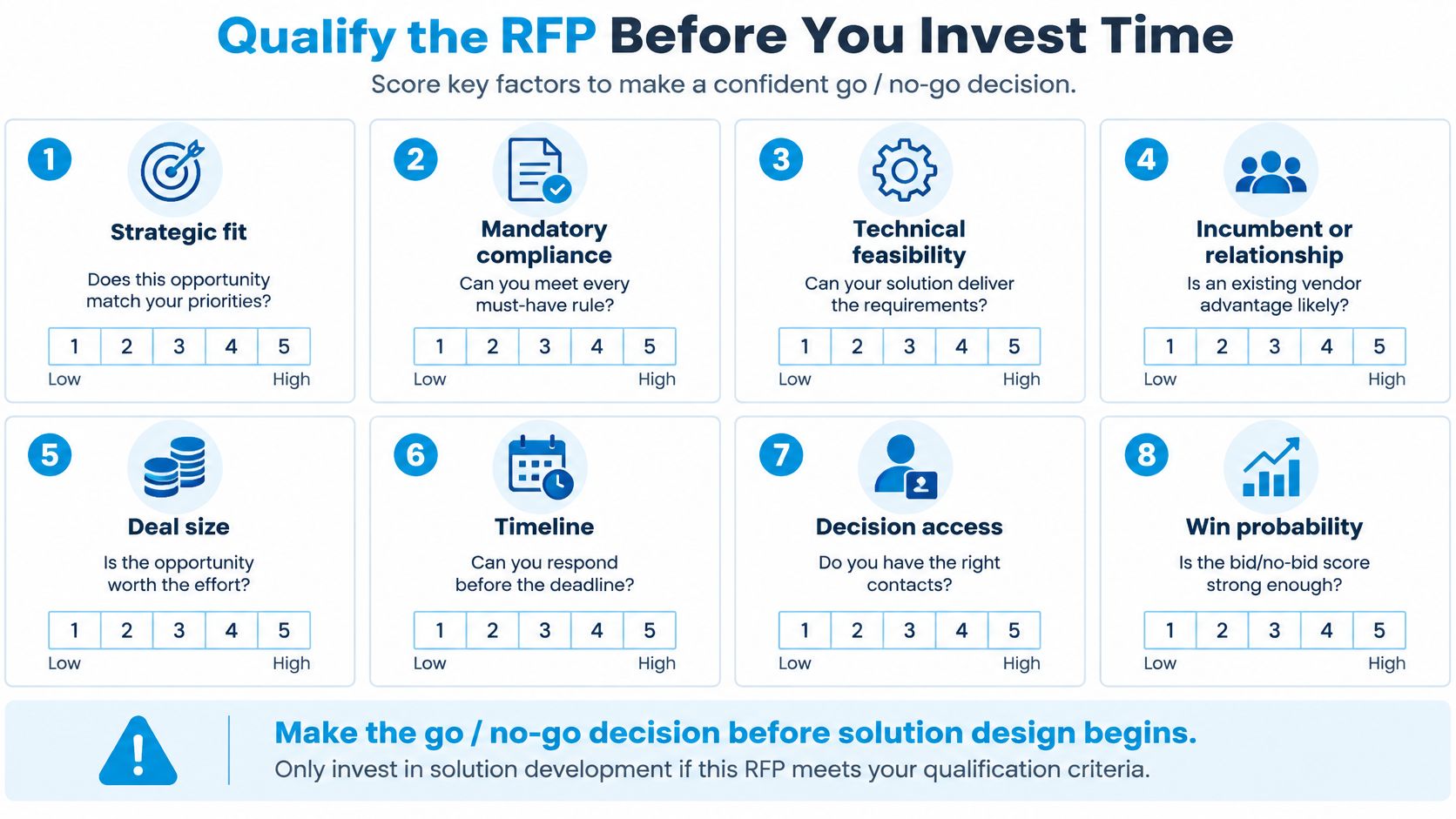
Selectivity protects scarce SE time. In benchmark data summarized by QorusDocs' proposal management study, organizations respond to only 65% of received RFPs on average, while the average win rate across submitted responses is about 47%. Treat those as survey benchmarks, not your forecast. Your baseline is your own win and loss history, segmented by market, deal type, and incumbent status.
Clear the gates first
| Gate | Question to answer before design | Walk away when |
|---|---|---|
| Mandatory compliance | Can we meet every pass/fail requirement? | A non-negotiable fails and cannot be resolved in writing |
| Data residency | Can we prove where data is stored and processed? | The buyer requires a region we cannot serve |
| Delivery capacity | Can named specialists cover the demo, POC and response? | Two or more required specialists are unavailable |
| Deadline realism | Does the window allow a compliance review and a red-team review? | Time for both reviews does not fit before submission |
| Incumbent position | Is there evidence the buyer has informally chosen a vendor? | Requirements read as written around another vendor |
| Commercial value | Does expected deal value justify the response effort? | Value falls below the effort threshold you set |
Gates run before solution work because a failed gate makes a polished demo irrelevant. This is the same discipline behind the RFP trap discussed in this SE Rockstars podcast episode on turning RFP conversations into discovery.
Once you decide to bid, assign one accountable owner, build the requirement matrix, allocate specialists by section, and run a compliance review before a red-team review. Track response time, specialist review time, content reuse, and clarification count.
Two execution risks sink otherwise winnable responses: outdated content and specialist scheduling. Fix them with an answer library that carries expiry dates, a named backup for every specialist, and a final page-by-page check against the buyer's instructions.
Read the Evaluation Tracks Before You Respond
Most RFPs run three evaluation tracks at once, and they punish different mistakes. New York State's procurement guide describes administrative review as pass/fail documentation checking, technical review as scored evaluation, and financial review as scored evaluation using a predefined formula.
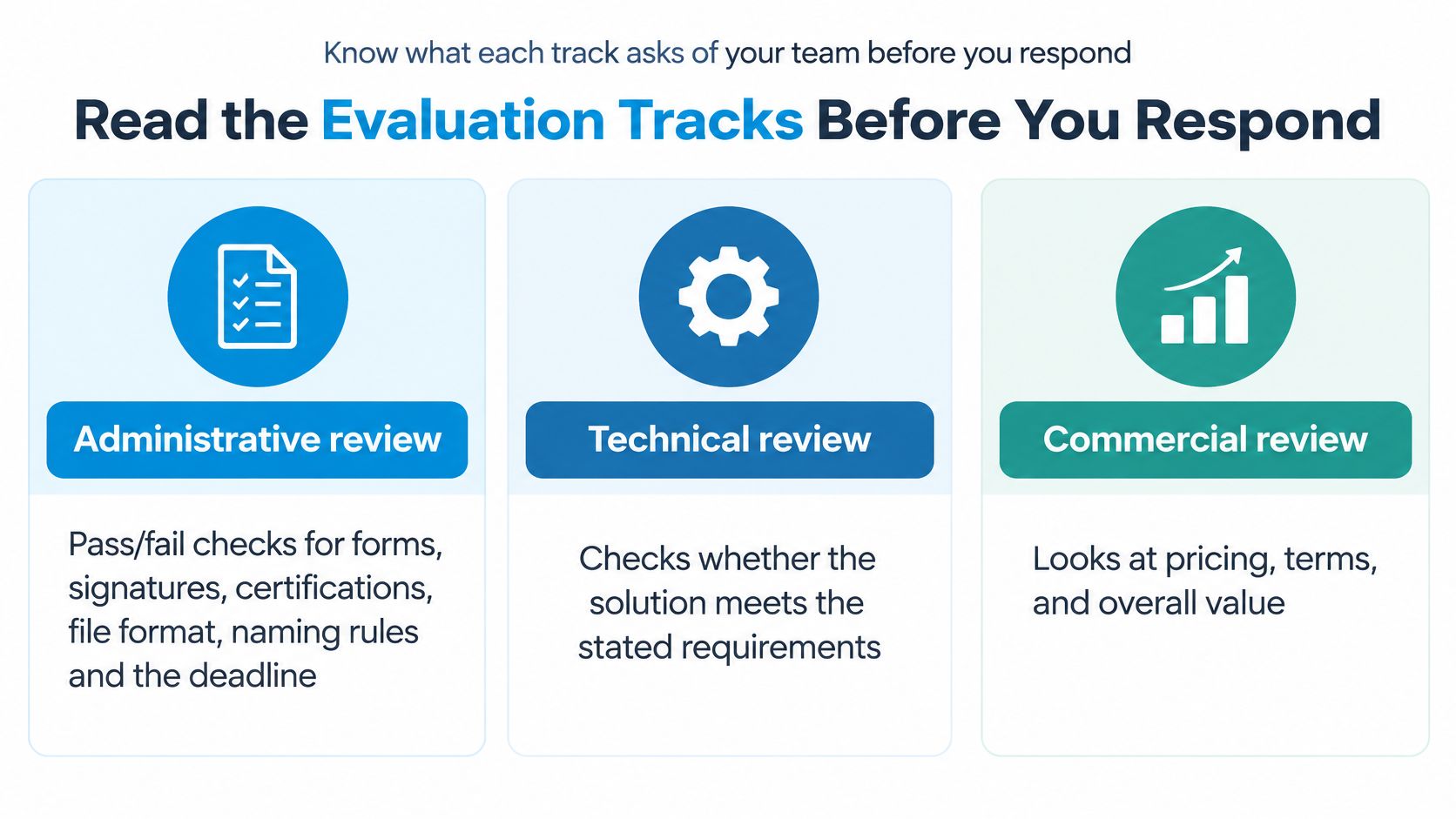
What each track eliminates
| Track | What it checks | How it is scored | What eliminates a proposal |
|---|---|---|---|
| Administrative | Forms, signatures, certifications, file format, naming, delivery deadline | Pass or fail | Any missing mandatory item or a late delivery |
| Technical | Evidence against each weighted criterion | Weighted points per criterion | Not eliminated; low scores lose ranking |
| Financial | Pricing against the stated formula | Predefined formula, scored separately from technical merit | Eliminated only if the RFP marks pricing pass/fail; otherwise scored |
In a hypothetical case, a technically strong proposal gets eliminated because the security certificate was attached in the wrong format. Nobody scored the demo. That's why the response requirements for RFPs versus RFQs from FederalPipeline are worth checking when a buyer mixes proposal scoring with quote-style compliance rules.
Run two reviews in order:
- Compliance review first. The proposal lead checks every form, signature, format, naming rule, and deadline item against a checklist.
- Technical evidence review second. The technical lead checks proof for the highest-weighted criteria. Low-weight questions get short, factual answers, not equal effort.
Don't spend your best SE hours polishing a two-point answer while a 20-point criterion has no artifact attached.
If the buyer introduces a new factor late, such as a live POC or extra data-residency evidence, ask for a formal clarification with its scoring impact. Don't absorb a new decision criterion into your response and hope competitors do the same.
Decide Bid or No-Bid Before You Draft
You have three honest options. Bid when every mandatory gate passes, the deadline allows both reviews, and evidence for each weighted criterion exists or can be built in time. Clarify when a weighted criterion or scoring method is undefined, or a late requirement changes scoring. Decline when a mandatory gate fails and can't be resolved in writing, or required specialists aren't available.
Use clear entry and exit criteria to make that call explicit instead of relitigating it in every deal review. The Academy teaches strategic qualification techniques that help SEs disqualify 4 out of 10 deals early, which protects capacity for deals you can win.
A clarification email you can adapt: name the criterion, quote the ambiguous line, propose the scoring rule you'd apply, and ask the buyer to confirm or correct it by a set date. That gives the buyer an easy yes and creates a written record for every vendor.
Then do the discovery work. No discovery, no demo. Discovery quality decides which requirements are real, so talk with the buyer's evaluators before you commit solution effort, using the discovery call guide as your checklist. Members apply frameworks to their current deals and receive feedback on their own discovery calls, demos, and POCs, and in the free discovery call, the team pressure-tests the assumptions in the ROI calculation against the customer's actual funnel. Start with the Trusted Advisor Academy if you want that feedback loop on live deals.
If RFPs keep pulling your team into late, unqualified work, PreSales Unleashed GmbH can help you build a qualification and proof-plan habit that protects SE capacity and raises your technical win rate on the deals worth pursuing. The Trusted Advisor Academy gives you live practice and feedback on discovery, demos, and POCs tied to your current opportunities. Visit PreSales Unleashed GmbH to see how the program fits your team.