
Most POC advice tells you to prove as many features as possible. I would do the opposite. Cut the POC to the smallest set of tests that can change a buying decision, then fix the verdict rules before day one.
A demo can look good and still leave you with no decision. A good POC test plan template does a different job. It records the decision, the baseline, the target, the owner and the evidence, so the sponsor can say proceed, revise and retest, or stop without another round of opinion.
That discipline matters because late defects get expensive. The NIST economic impact summary estimated inadequate software testing infrastructure cost the U.S. economy $59.5 billion annually, and found more than half of defects were discovered downstream. Test the risky assumptions early, while they're still cheap to confront.
The POC Test Plan Template, Field by Field
Start with the decision, not the feature list. If the sponsor can't state what decision the POC supports, and when that decision happens, you don't have an evaluation yet. You have an open-ended trial that will consume SE time and end in a vague readout.
Build the plan in one shared document or spreadsheet, with one tab per section. That lets you filter the test list, sort defects and link evidence without hunting through chat threads. Use the same structure for every POC. Sponsors learn to read it, AEs know where the verdict sits, and you stop rebuilding the format under deadline pressure.
POC test plan template, section by section (examples are hypothetical)
| Section | What to record | Owner | Example entry (hypothetical) |
|---|---|---|---|
| Decision | The decision the POC must support and the date it is made | Sponsor | Proceed to a contract for the reporting module, or stop |
| Business objectives | Two to four outcomes tied to a number the buyer already tracks | Buyer business owner | Cut monthly report build time from three days to under four hours |
| Scope and exclusions | Use cases in scope and use cases explicitly out | SE with buyer lead | In: EU invoice export. Out: multi-currency reconciliation |
| Success criteria | Requirement, baseline, target, minimum threshold and class | SE and buyer technical lead | API sync latency under 2 seconds at p95, mandatory |
| Test cases | ID, requirement link, steps, test data, expected result, observed result | SE | TC-07: SSO login with an expired token returns a re-authentication prompt |
| Environment | Tenant, data volume, integrations, versions and access accounts | SE and buyer IT | Sandbox tenant, anonymized EU invoice set, named test accounts for each role |
| Roles | Who executes, who validates and who approves each part | Plan owner | SE executes, buyer technical lead validates, sponsor approves |
| Timeline | Phases, dates, checkpoints and the evidence deadline | SE and AE | Days 1 to 2 scope, days 6 to 10 testing, evidence freeze day 13 |
| Risks and assumptions | Each assumption, the test that proves it and the impact if it fails | SE | Identity provider test tenant is ready. If not, SSO tests can't run |
| Evidence log | Screenshots, logs, metric exports and links, each with a date | Executor | Shared folder with dated, named files |
| Exit rules and verdict | Conditions for proceed, revise and retest, or stop | Sponsor | No open critical defects and all mandatory tests passed |
Why the order matters
The order forces traceability. Decision first, then objectives, scope, criteria and test cases. Environment, roles and timeline come next because they're pointless until you know what you're testing. Risks, evidence and exit rules close the loop.
Every test row should trace back to an objective. If it doesn't, cut it or mark it informational. A template that starts with features fails this test, because it invites the buyer to add roadmap items that have no link to the decision.
Practical rule: If a test can't change the verdict, it doesn't belong in the mandatory set.
The three fields teams skip
- Baseline: The buyer's current number, captured before configuration starts. Without it, a target is just a vendor claim.
- Class: Mandatory, weighted or informational. Mandatory criteria can stop the deal. Weighted criteria shape the score. Informational criteria inform the sponsor without deciding anything.
- Exit rules: The conditions for each verdict, agreed in advance. Without them, you'll argue about the meaning of the results at the readout.
Keep the template tight. Eleven sections is enough. More fields won't save a POC with no baseline, no owner and no exit rule.
How to Set Objectives, Owners and Success Criteria
Fix the decision, the owner and the fail line before day one. An objective that cannot force proceed, revise or stop is a feature note. Take every objective from what the buyer said in discovery, tied to a number they already track. Thin discovery means you do not have objectives yet. Use the discovery call guide to close that gap before you promise a POC.
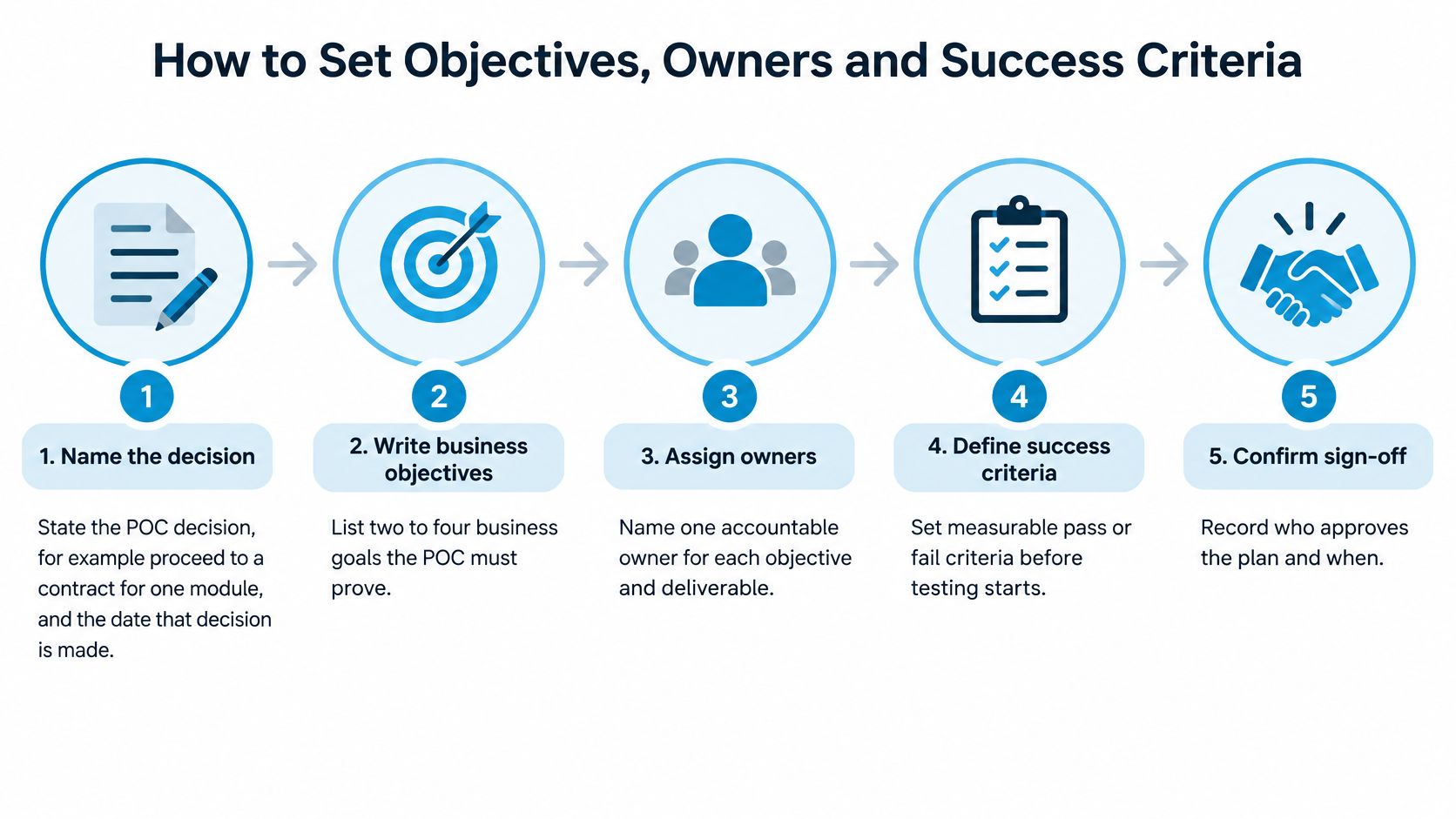
Treat the POC as a controlled investment. The sponsor should know, before configuration, which result buys a contract, which result sends you back to retest, and which result kills the deal. A pass that only holds in a lab tenant is not a production-ready result. Name the identity provider, data volume and operator the buyer will use, and write those into the criterion.
The setup sequence
- Name the decision. Example: proceed to a contract for one module, on a named date, with a named sponsor who signs the verdict.
- Write two to four business objectives. Each one maps to a number the buyer already reports, not a slide from your roadmap.
- Capture baselines before configuration. Pull them from the current process. Record the source system, the owner and the date.
- Set a target and a minimum threshold. The target is what good looks like. The threshold is the lowest result that can still pass.
- Classify each criterion. Use mandatory, weighted or informational, and record who approved the class.
- Name one owner per measurement. Not a team. One person produces the number and defends it at the readout.
Keep a traceability chain on every row. The NIST acceptance testing guidance supports a chain from business objective to measurable requirement to acceptance criterion to test case to execution evidence to go/no-go decision, and defines coverage as the number of requirements tested divided by the total number of requirements. Each row needs a requirement ID, owner, priority, test status, defect severity, evidence link and exception approval.
For a ready structure for those fields, use a POC success criteria template rather than a free-form doc. When the business case has to reach the economic buyer, map the metrics through the MEDDPICC for Solution Engineers guide. Proof of value stays on the buyer's outcome, not the vendor's feature list, including when teams evaluate technology bets with Rite NRG.
Make wording testable
"Supports SSO" is not a criterion. Name the identity provider, the protocol, the user lifecycle events and the failure handling. Provisioning, deprovisioning and an expired token each need an expected result, a measurement method and the person who will pull the log.
A buyer who asks for a "fast" integration will argue for weeks if nobody writes the number down. Write the target as under 2 seconds at p95, name the load, and assign one owner before the first configuration change.
Example criteria with baseline, target and class (hypothetical values)
| Criterion | Baseline | Target | Class |
|---|---|---|---|
| Monthly report build time | Three working days in the buyer's current process | Under four hours | Mandatory |
| API sync latency at p95 | Not applicable, new integration | Under 2 seconds | Mandatory |
| SSO login success rate | Identity provider success rate from the last 30 days, pulled by buyer IT | Match or beat baseline, with no failed mandatory flows | Mandatory |
| New user setup time | Half a day of admin time per user (hypothetical onboarding log) | Under 30 minutes | Weighted |
| Dashboard accuracy against finance totals | Month-end finance totals on the agreed sample | Zero variance on the agreed sample | Weighted |
| End-user satisfaction after pilot | Not measured | Average of 4 out of 5 from the pilot group | Informational |
Read the class column before you run anything. I would block a proceed verdict on a missed mandatory until it is fixed, waived in writing by the sponsor, or recorded as the stop reason. A weighted miss lowers the score. An informational miss gets discussed. It does not get traded away at the readout.
How to Build Test Cases, Combinations and Test Data
Every test row carries the same fields. Use requirement ID, scenario, actor, test data, steps, expected result, observed result, evidence location and status. If a row is missing the expected result or the evidence location, it isn't ready to run.
Don't test variables only in isolation. NIST research published in 2010 found that between 70% and 95% of software failures were triggered by interactions between only two variables, while practically 100% of failures were triggered by no more than six variables. That argues for a small, deliberate matrix, not exhaustive coverage.
A short procedure you can finish
- Write three cases per mandatory criterion. At least one positive, one negative and one boundary case.
- Pick the risky pairs. User role plus data type, API version plus authentication mode, workload size plus latency target, or regional configuration plus compliance setting.
- Define each pair fully. Data, environment, measurement method and pass threshold go in the row before execution.
- Use realistic, anonymized data. Log exactly what was loaded, including volume and source date.
- Add failure-recovery cases. An expired token, a dropped integration and a re-run after a timeout expose more than another happy-path run.
- Freeze the list before day one. Route every later change through a change log with an owner and reason.
For context on how disciplined test matrices work in a regulated setting, this healthcare software testing case study is a useful reference. For more deal-shaped examples, these POC examples show how narrow a test set can be and still support a decision.
Record observable evidence: response time, accuracy, throughput, error rate or successful integration runs. Never record that the demo "worked". For binary tests, report pass rate as successful runs divided by total runs, and repeat unstable tests enough times to see the pattern. For detection tests, report precision and recall.
Cut any case that doesn't change the decision. A longer list that you can't finish inside the window is worse than a short list you complete.
Members apply frameworks to their current deals, and receive feedback on their own discovery calls, demos and POCs. That review loop is useful here, because test lists tend to grow unless someone challenges each row.
Security, Operational Readiness and Adoption Tests
Feasibility isn't deployability. A product can pass the functional tests and still fail on identity, data governance, support ownership or total cost under realistic load. Put readiness checks in the plan as their own workstream, with their own owner and approver.
What to test before the readout
- Identity and access: SSO, role provisioning and deprovisioning, tested with the buyer's actual identity provider where possible.
- Data controls: Tenant isolation, audit-log export, data handling, retention and data region.
- Operations: Monitoring and alert hooks, deployment dependencies, rollback and who owns support after go-live.
- Cost and onboarding: Total cost at realistic load, plus timed new-user setup by a buyer admin.
For monitoring, agree what "available" means and who gets alerted. This uptime guidance for DevOps teams is a practical reference for that conversation. For each check, write the test method, evidence type and one owner. Name the security controls under test and the approver before the first login.
The NIST Secure Software Development Framework requires organizations to define criteria for software security checks and track those criteria throughout the software development life cycle. Apply the same logic here. Late security reviews reopen finished evaluations, and regulated or public-sector buyers often treat security as a pass/fail gate.
Use four status words only
Test statuses and who signs them off
| Status | What it means | Who signs | Next action |
|---|---|---|---|
| Passed | Observed result met the threshold, with evidence attached | Technical owner | Carry the result into the verdict |
| Failed | Observed result missed the threshold | Technical owner and sponsor | Log a defect, then retest or treat as a stop factor |
| Not tested | The test did not run, and the reason is recorded | Plan owner | Decide before the readout whether the gap blocks the verdict |
| Accepted with risk | The gap is known and the buyer accepted it in writing | Business sponsor and security lead | Add to the risk register with a named owner and date |
Never use "mostly passed". It hides whether the result met the threshold, and it gives procurement nothing to sign.
Finish with adoption. Include at least one test where a real end user completes the core workflow without help from you. If the user needs the SE standing next to them, the workflow hasn't passed, whatever the latency number says.
Timelines, Responsibilities and Evidence Collection
Write the scope, goals and success criteria before deployment or configuration starts. Microsoft's enterprise Azure DevTest Labs guidance lists defining goals and success criteria as a scoping task. A useful plan also names participating users, prerequisites, the evaluation window, customer and vendor responsibilities, the evidence deadline and the final decision meeting.
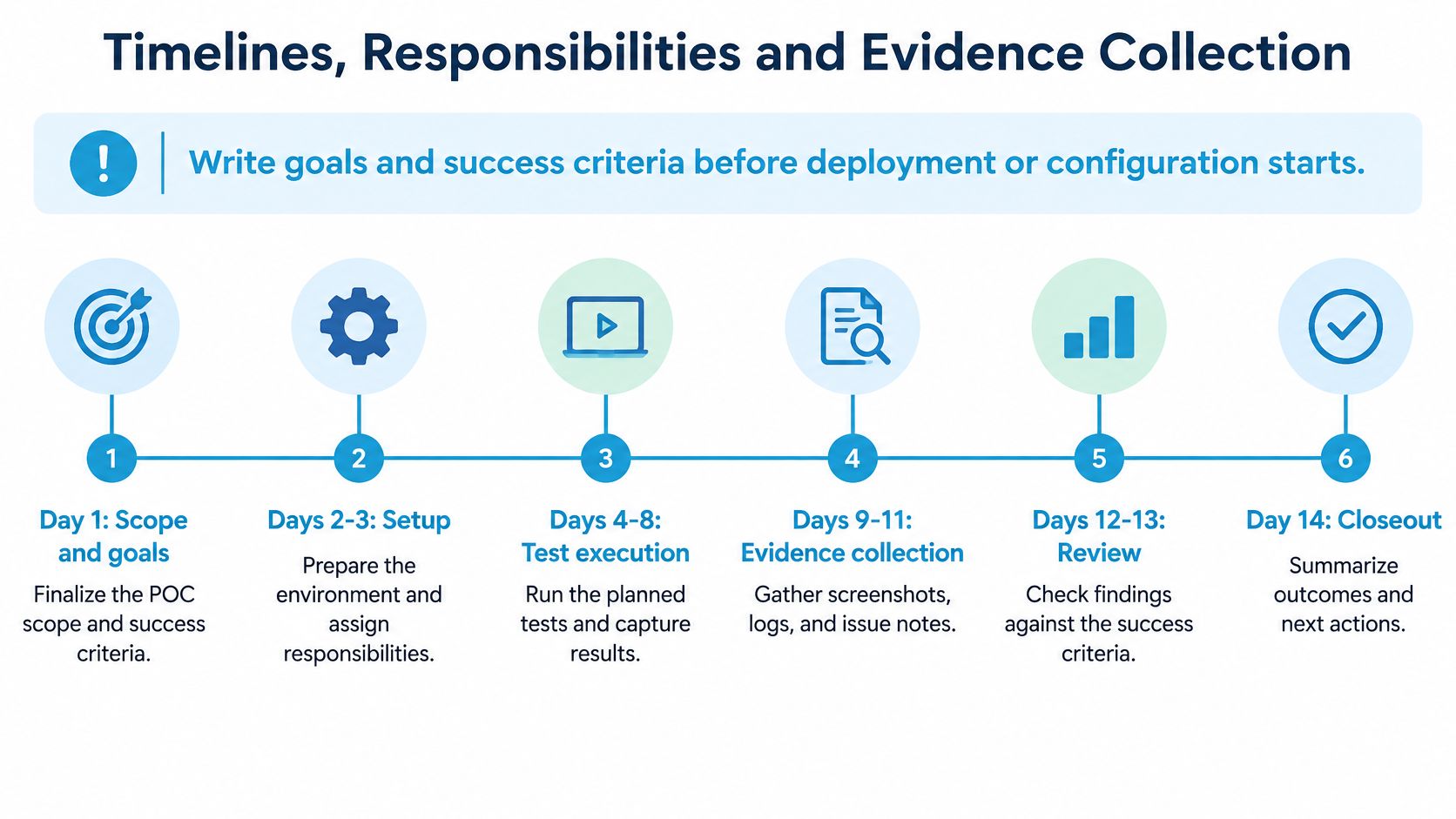
A 14-day structure that protects SE time
Hypothetical 14-day POC schedule
| Phase | Working days | Owner | Exit output |
|---|---|---|---|
| Scope freeze and access | Days 1-2 | SE and buyer IT | Signed scope, user accounts and sandbox access |
| Environment and integrations | Days 3-5 | SE and buyer engineer | Connected test environment and smoke-test log |
| Test execution | Days 6-10 | SE and buyer technical lead | Test results with evidence for every row |
| Defect triage | Day 11 | SE and vendor product contact | Defect list with severity and disposition |
| Evidence pack and readout | Days 12-14 | SE, AE and sponsor | Verdict memo and signed go/no-go record |
Setup eating half the window is the usual failure mode. If the environment and integrations aren't working by day five, raise it with the sponsor that day. Don't compress testing and then present thin evidence as if the plan had run.
Who owns what
- Solution Engineer (SE): Runs execution, owns the test list and the evidence log.
- Buyer technical lead: Validates results and confirms the environment matches the agreed setup.
- AE: Owns the commercial calendar, the readout meeting and the next commercial step.
- Vendor product contact: Owns defect response by severity, with dates, not general assurances.
- Sponsor: Signs the verdict and owns accepted risks.
Fix the evaluation window at signing, and name the extension rule in advance. An extension should require a named gap, a named owner and a new evidence deadline. Without that rule, the POC drifts into an open-ended implementation and your technical win gets decided by whoever has the most patience.
Freeze the evidence
Set an evidence freeze 24 hours before the readout. By then, every screenshot, log and metric export is filed, dated and linked from its test row. No new runs after the freeze unless the sponsor agrees to move the readout.
If the evidence isn't filed, the test didn't happen. Memory isn't evidence, and neither is a screenshot in someone's chat history.
Name files so a sponsor can find them cold. Test ID, date and result in the filename beats a folder full of final versions. Keep the evidence deadline in the scope document at signing, not in a side conversation with the buyer lead.
Make the Go/No-Go Call and Record It
Give the decision rules first. A proceed verdict requires all mandatory tests passed, no open critical defects, and a documented disposition for every failed or untested criterion. That's the same discipline behind clean entry and exit criteria, applied at the end of the POC.
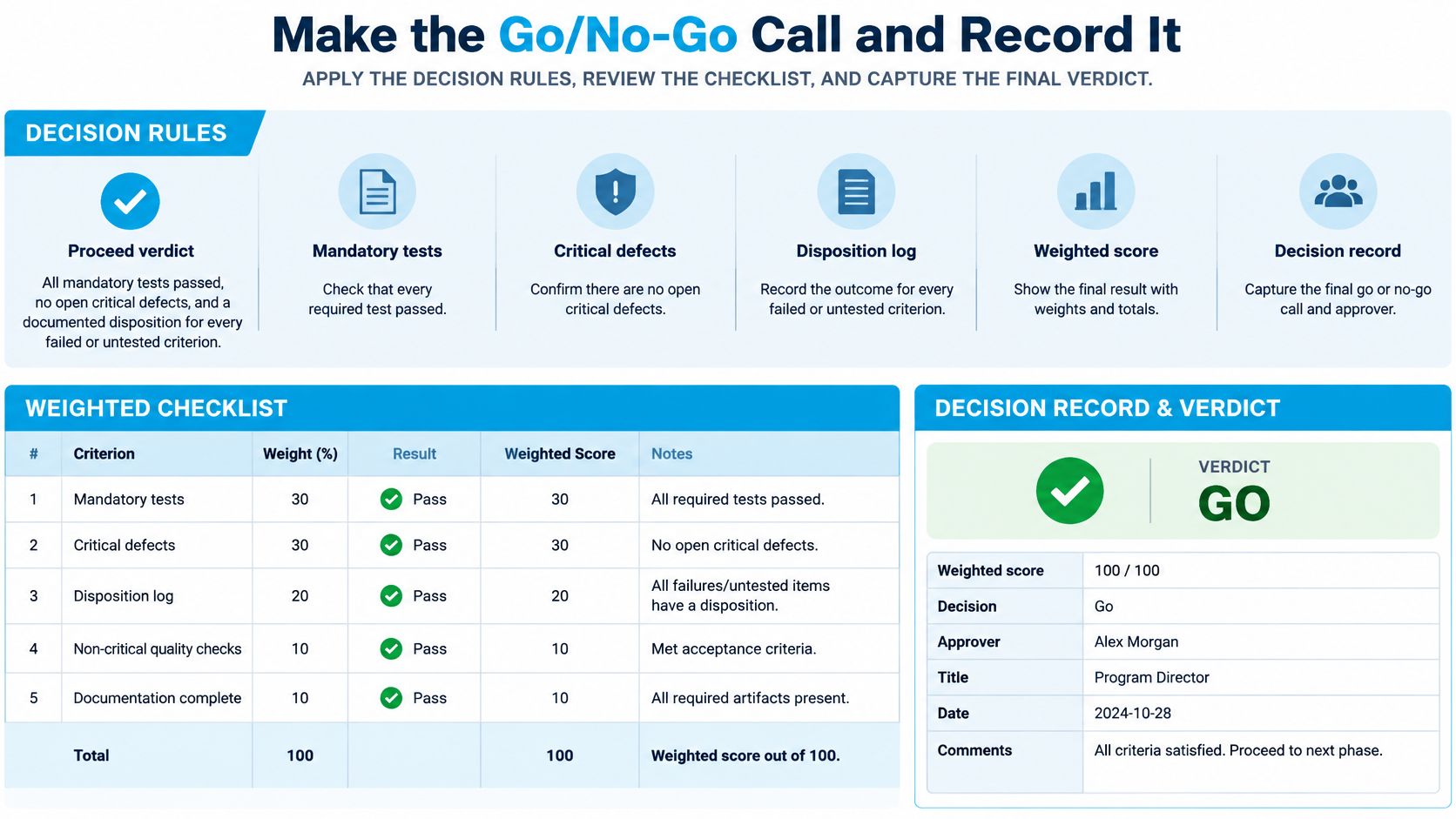
Show the weighted score next to mandatory failures, never instead of them. The NIST work on evaluating bug finders supports recording observed value, target, variance and repetitions rather than a bare pass or fail. A single average can hide a disqualifying security, compliance or integration defect.
POC verdicts and the next step for each
| Verdict | When it applies | Required next step |
|---|---|---|
| Proceed | All mandatory tests passed, no open critical defects, and the weighted score meets target | Start contract and implementation planning with named owners |
| Revise and retest | A mandatory gap has a clear fix and a retest date inside the agreed window | Record the fix owner and date, then retest only the affected criteria |
| Stop | A mandatory criterion fails with no credible fix, or the sponsor withdraws the business case | Close the POC, write the reason down, and release SE capacity |
Work through the verdict in order
- Calculate mandatory coverage. Executed mandatory tests divided by total mandatory tests.
- List failures by class and severity. Separate mandatory failures from weighted misses.
- Match the results to one verdict. Use the table, not the mood in the room.
- Write a one-page memo. Decision, evidence links and a named owner for every open item.
- Get the sponsor's sign-off in the record. A verbal yes in the readout isn't a decision record.
Add the governance before testing begins. Name who owns each baseline, who validates results and who breaks a tie when technical and business evidence conflict. When only some targets are met, the sponsor chooses between revise and retest or stop, and the memo records the reason. That stops teams moving the goalposts after the results appear.
Consider a hypothetical stop scenario. The POC fails a mandatory SSO requirement on day nine, the buyer confirms there's no fix window, and the team stops the evaluation. That releases two weeks of SE capacity for other deals and gives the buyer a clear reason, not a slow fade.
The Trusted Advisor Academy teaches structuring POCs so SEs can pull the plug after 2 weeks if a POC is not working. If you're choosing how to build that skill across a team, the PreSales training selection guide sets out what to look for. You can also book a discovery call to pressure-test your own POC plan before you commit SE time to it.
If your POCs keep ending without a signed decision, the fix is better discovery, tighter criteria and exit rules agreed before day one. PreSales Unleashed GmbH helps Solution Engineers and PreSales leaders build those habits through the Trusted Advisor Academy, with structured content, live practice and feedback on active deals. Visit the site, pick the POC currently on your desk, and rewrite its decision, baselines and exit rules before the next test session.