
You're three weeks into a customer POC, the demo looked sharp, the SE work is solid, and everyone keeps saying it's “going well.” Then the AE asks the question that matters, and nobody can answer it cleanly: did this thing pass?
That's the trap. A poc success criteria template is supposed to stop that moment from turning into a month of drift, free work, and awkward extensions. Without written exit criteria, a POC turns into a polished pilot with no decision owner, no finish line, and no defensible way to say go, revise, or stop.
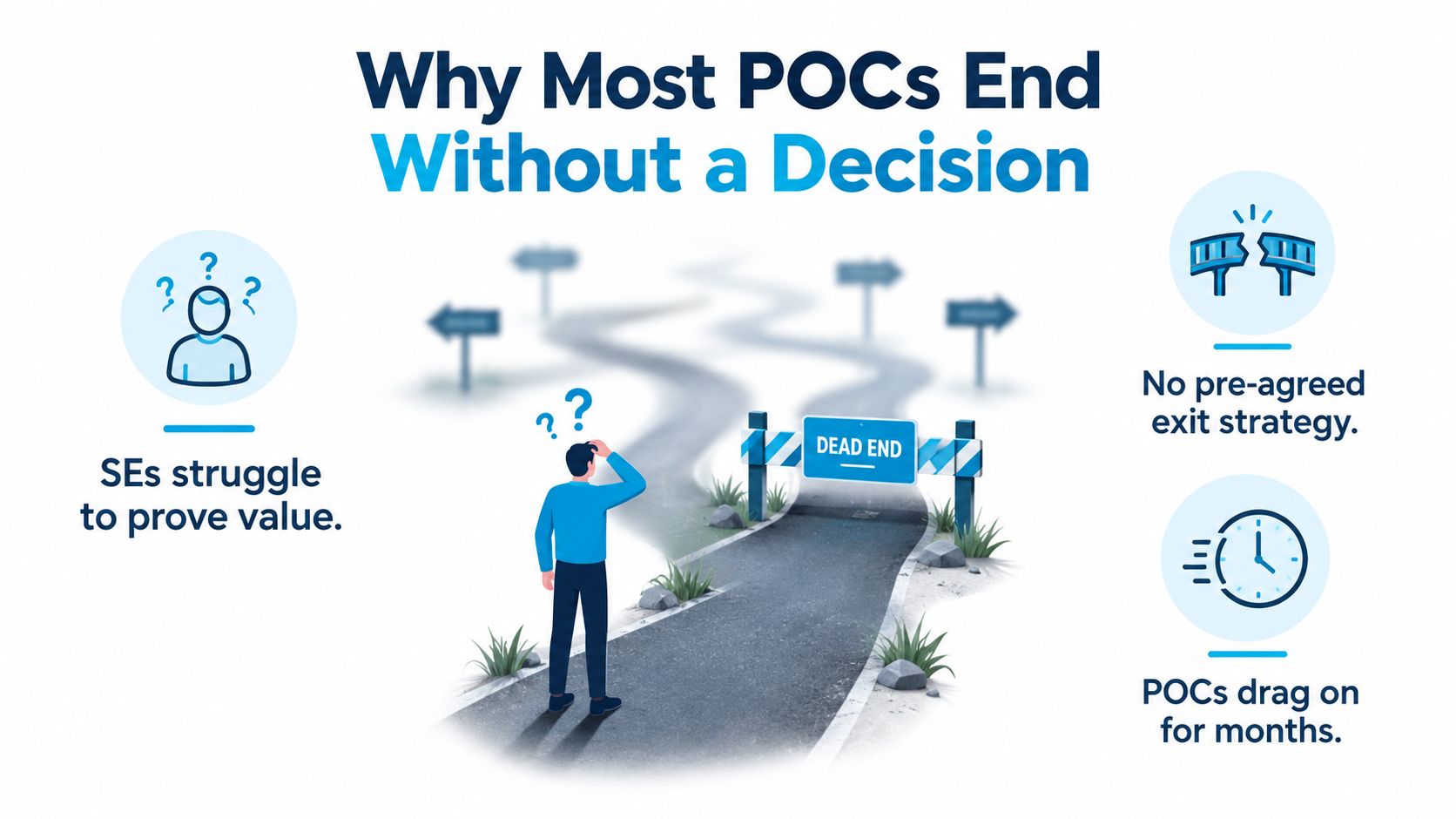
A lot of teams treat the POC like a test drive and then act surprised when the buyer wants a buying decision from what was never defined as a decision instrument. That's backwards. The discipline is in discovery, because no discovery, no demo, and no serious POC should start until the problem, the proof, and the stop point are clear. If you want a practical comparison of decision tools, the compare SWOT and OODA methods article is a useful companion, because it shows how different frameworks shape different kinds of decisions. For a broader view of how PreSales teams handle active deals, the case studies page gives you more context.
| POC failure mode | What actually happened | Missing template field |
|---|---|---|
| Endless “one more week” | The team kept testing new requests after the original scope was met | Decision deadline |
| Friendly demo, no outcome | The product looked good, but no one wrote down what pass meant | Pass or fail rule |
| Technical success, business silence | The workflow worked in isolation, but the buyer couldn't defend the spend | Business value criterion |
| Security stall | Security questions appeared after the test began | Prerequisites and security inputs |
| Open-ended pilot | The evaluation continued because nobody owned the stop decision | Named decision owner |
The pattern repeats because builders often focus on activity rather than closure. They document features, then wonder why the buyer still can't make a call. A better template forces the conversation earlier, while the customer still cares about the original problem and before the deal gets buried under tasks. If you want a simple way to frame that conversation on a live deal, the right Discovery Call Guide is usually where the work starts.
Why Most POCs End Without a Decision
The meeting starts with optimism. The SE has the environment running, the customer has access, and the AE is already talking about next steps. Then the customer says the dreaded phrase, “We need a little more time,” and the deal slips into a zombie POC.
That happens when the team mistook activity for evidence. A POC can be technically alive, meaning logins work, screens load, and integrations behave, while still being commercially dead because nobody agreed on what success looked like before the test began. The proof of concept distinction matters here, because a POC is a limited realization meant to demonstrate feasibility, not a promise that every production requirement has been satisfied.
The real reason the deal stalls
In PreSales, the technical win doesn't come from a polished walkthrough alone. It comes from discovery quality, because discovery tells you whether a POC is even worth running, what uncertainty it needs to remove, and who will use the result to make a decision. If that work is weak, the POC becomes a proxy for missing qualification.
Practical rule: if the customer can't say what a pass looks like before the test starts, you're not running a POC. You're funding ambiguity.
The cost isn't abstract. You lose SE capacity, the AE loses momentum, and the customer loses trust because the evaluation keeps expanding without closure. That's why a written template matters more than extra effort. It gives everyone a shared reference when the buyer asks for a free extension or tries to move the goalposts.
| POC failure mode versus its template-level cause | ||
|---|---|---|
| Failure mode | What actually happened | Missing template field |
| Scope creep | New requests entered after kickoff | Excluded work and change rule |
| Decision drift | The customer liked the demo but couldn't decide | Explicit go, revise, stop rule |
| Confused stakeholders | The champion was happy, the approver wasn't | Decision owner |
| Security surprise | Security got involved too late | Prerequisites checklist |
If you're used to evaluating deals with a loose sense of progress, tighten the frame. A useful POC isn't a bigger demo, it's a decision path. For a deeper look at how those decisions can be structured, the PoC development for enterprises resource is worth reading because it reinforces the value of scoping before execution.
The Five Building Blocks of a Defensible Template
A defensible template starts with one job, help the customer make a decision you can stand behind later. That means every field should trace back to a hypothesis, not to a wish list of product behavior. The Agile software POC checklist reference to problem definition, inputs, and output criteria reflects the same logic, a POC needs a clear reason to exist before anyone starts configuring anything.
1. Write one falsifiable hypothesis
Keep it narrow. “This platform will improve the team's workflow” is too soft to test. “This system can sync order data between the CRM and the billing tool without breaking the current approval flow” gives you something you can prove or disprove.
That single sentence is the anchor for the rest of the template. It keeps the SE from stacking on extra asks, and it gives the buyer a clean frame for the evaluation.
2. Define the baseline and the test population
You need to know what the current process looks like, who is being tested, and what data they're using. Without that, the POC can accidentally measure a controlled setup rather than the actual workflow.
Include fields for the current method, representative sample, edge cases, exclusions, and constraints. A controlled lab run might show the product at its best, but production transfer requires a realistic test population.
3. Convert the hypothesis into thresholds
That is where vague language dies. “Fast,” “scalable,” and “reliable” need pass or fail rules. The Saber POC guidance points to examples such as bidirectional sync, completion within a target window, low error rates, and uptime targets. Use that style, but only for the deal in front of you.
4. Name the owners
Every metric needs a person attached to it. One owner collects the evidence, another validates the result, and a third confirms what the result means for the deal. Without that, the customer will assume someone else is handling it.
5. Pre-authorize the decision rule
Write the rule before testing starts. If the POC meets the thresholds, the decision is go. If some criteria are met and others need adjustment, the decision is revise. If the key risks are not cleared, the decision is stop.
The cleanest POCs don't end with a debate. They end with a record.
A quick field check helps. Your template should answer these questions: what are we testing, what does success mean, how will we measure it, who owns each metric, and what happens when the deadline arrives? If any of those are missing, the template is incomplete.
For teams who want a more structured alignment on the commercial side, the What Does a Sales Engineer Do guide helps frame where the SE owns the technical proof and where the AE owns the broader deal motion.
What Goes In and What Stays Out of the POC
A good template is picky. It doesn't try to measure everything, it measures what the buyer needs to decide. That means you separate must-pass from nice-to-have, and you keep anything open-ended out of the POC window.
| Category | Must-pass | Nice-to-have |
|---|---|---|
| Technical | SSO works, core integration completes, error handling behaves | Minor UI polish, optional dashboard variant |
| Business | The buyer can defend the workflow change | Broader expansion ideas |
| Operational | Security prerequisites are met, support path is clear | Future-state admin preferences |
| Adoption | Named users complete the core workflow | Broader team rollout ideas |
The mistake is to let every stakeholder add their favorite ask. That's how a narrow POC becomes a hidden implementation project. The cleaner move is to mark anything outside the current decision as excluded work and push it to a later pilot or production phase.
Technical thresholds should be concrete enough to test, not vague enough to admire. Published examples in POC success criteria guidance include throughput, response time, and uptime-style thresholds, which are useful because they turn “fast” into an actual pass or fail rule. Use the same principle for the buyer's environment, but don't borrow thresholds blindly from another deal.
Business thresholds need the same discipline. If the customer says the POC must prove value, tie that to a specific workflow outcome, not to a broad aspiration. For a buyer who wants proof of operational fit, the right evidence is usually in the process friction, handoffs, and user behavior, not in a feature checklist.
For a practical view of how SEs frame these conversations in the field, the Discovery Call Guide is the right place to sharpen the front end of the evaluation.
Measuring Evidence Quality, Not Just Feature Performance
A feature can work and still not be credible enough to support a buying decision. That gap is why a stronger template separates technical feasibility, user adoption, operational impact, and financial value. Each one needs its own field, measurement method, and confidence label.
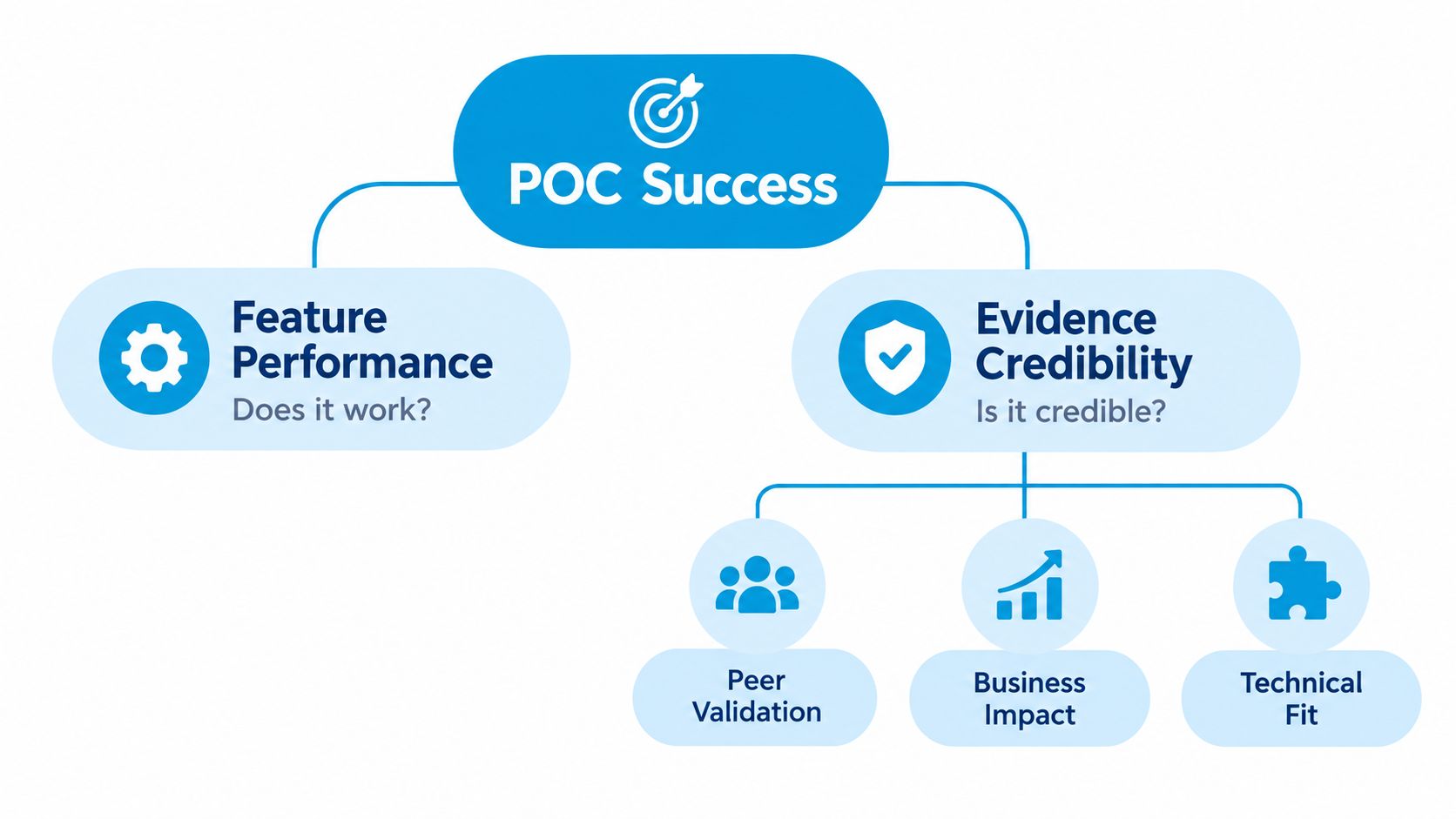
How to label what the POC actually proved
Use three labels: validated, directional, and inconclusive. Validated means the result holds under the test conditions you agreed on. Directional means the result points the right way, but the evidence is thin. Inconclusive means you don't have enough to call it either way.
That matters because a smooth demo in a controlled environment can still fail to prove repeatability, generalizability, or economic value. The Australian Treasury's pilot guidance frames pilots as collecting “evidence of promise,” not proving full-scale effectiveness, which is the right mental model for many POCs. The same caution appears in modern automation and AI guidance, where you need real data and progressively larger tests before claiming production readiness.
Map each evidence type to a field
| Evidence type | Template field | Measurement method | Confidence label |
|---|---|---|---|
| Technical feasibility | Integration result, response behavior, control status | Logs, test cases, security findings | Validated or inconclusive |
| User adoption | Named user completion, stakeholder feedback | Observation, feedback notes, task completion | Directional or validated |
| Operational impact | Cycle friction, process fit, support burden | Baseline comparison, workflow review | Directional |
| Financial value | Cost avoided, time saved, revenue influence | Customer calculation, assumptions review | Directional unless proven in production |
The important part is not the label itself. It's the fact that the template forces the buyer and the SE to say what the evidence can and cannot support. That stops people from treating a positive outcome as if it were proof of rollout value.
Practical rule: if you can't point to the baseline, the sample, and the comparison point, don't call the result a win.
For teams who want to separate confidence from vanity metrics in their own reporting, the SE qualitative metrics piece is a strong companion. And if you're comparing frameworks for measuring website or content performance, the LLMrefs guide to SEO analytics shows the same discipline of separating signal from noise.
Aligning the Template With the AE, the Buyer, and Procurement
A good template fails fast if the wrong people are missing. The SE owns the technical thresholds. The buyer's economic owner owns the business outcome and the go or no-go call. The evaluation team owns user-adoption evidence. Procurement or security owns the prerequisites that can stop the POC before it starts.
The kickoff should make those lines explicit. Attach the security questionnaire, data-protection rules, environment access details, integration owners, and the test timeline to the template before anyone begins. If those artifacts arrive late, the POC starts on shaky ground and the customer will blame the evaluation when the core issue is missing alignment.
Who signs what
- SE sign-off, confirms the test is technically fair and the metrics are measurable.
- AE sign-off, confirms the POC supports the commercial path and doesn't drift from qualification.
- Buyer sign-off, confirms the business outcome and the decision owner.
- Security or procurement sign-off, confirms the prerequisites are acceptable.
That structure also fits cleanly with MEDDPICC-style qualification, because the metrics behind the deal don't disappear once the POC starts. They just become more visible. If the POC can't be tied back to the reason the opportunity existed, you're probably solving the wrong problem.
The simplest way to run the kickoff is to walk line by line through the template and ask who owns each field. If a field has no owner, it isn't ready. If a field has an owner but no deadline, it will slide.
For teams that want a reference point on qualification discipline, the MEDDPICC for Solution Engineers guide fits naturally with this step. It helps keep the POC tied to the buying logic instead of turning it into a detached technical exercise.
The Kill Condition That Protects Both Sides
The most useful field in the template is the one usually avoided in drafting. It's the kill condition. That's the pre-agreed point where the POC stops, even if people still have energy for it.
A good kill condition protects both sides. It keeps the buyer from drifting into an endless evaluation and it keeps your team from burning capacity on a test that no longer has decision value. A recent governance framework recommends recording a baseline, minimum threshold, fixed duration, and automatic stop rule. That's not harsh, it's respectful.
Write stop rules as conditions, not emotions
Use objective triggers. If the POC exceeds the time window, if key stakeholders disappear, if the technical blocker remains unresolved, or if the business case falls apart, stop. The point is to define failure boundaries before enthusiasm takes over.
Also separate not achieved from not tested. Those are different outcomes. If data access never happened, that is not the same as product failure. If a control wasn't in scope, that isn't a red flag, it's an exclusion.
Stop decisions get easier when the template names them before the kickoff.
Many SEs get stuck in negotiation. The buyer asks for one more week, and the team says yes because nobody wants to sound difficult. A better move is to treat the kill condition as maturity. It shows that both sides understand the cost of prolonged evaluation and the difference between evidence and hope.
If you want a practical way to anchor that conversation in the customer's language, the Trusted Advisor Academy can be one place to build the skill set around structured PreSales motions.
Putting the Template to Work on Monday Morning
Pick one active deal and open the template before the next customer call. Fill in the hypothesis, baseline, thresholds, owners, and decision rule before anything else gets added. If any block is vague, that's your signal to slow the POC down, not speed it up.
That's the operating rhythm that holds up in PreSales. Discovery decides whether a POC should run. The template decides whether the POC can produce a defensible outcome. The post-POC decision decides whether the technical win turns into a real buying decision.
Use this short checklist:
- Hypothesis: one testable statement, no fluff.
- Baseline: current process, sample, exclusions, and constraints.
- Thresholds: measurable pass or fail rules.
- Owners: one name per metric and one decision owner.
- Kill condition: clear stop rule with a deadline.
If you already run demos and POCs, the gap probably isn't effort. It's structure. A tighter template gives you a cleaner technical win, fewer zombie evaluations, and a better shot at a decision that holds up after the call.
PreSales Unleashed GmbH helps Solution Engineers and SE leaders build the habits behind that structure, from discovery quality to POC discipline and technical win execution. If you want practical training, templates, and live deal support around PreSales Unleashed GmbH, start there and bring one active POC to the next review.