
The popular advice to keep a POC small and show value quickly misses the harder question: are you running the right test for the deal? A short evaluation can still waste everyone's time if the buyer needs migration evidence and you deliver a polished feature demo.
Not all POCs are built the same. An identity integration test, a workflow pilot, and an AI accuracy evaluation answer different questions. They need different evaluators, pass criteria, and artifacts. Treating them as interchangeable trials leaves the buyer's actual risk unresolved.
No discovery, no demo. Apply that same discipline before provisioning a POC environment. As a Solution Engineer (SE), you need to know what the buyer can't yet approve, who can approve it, and what evidence would change their decision.
A useful POC ends with a decision the buyer couldn't make before the test.
The POC examples below separate technical feasibility from workflow value, operational readiness, and commercial approval. Some are bounded technical experiments; others extend into customer pilots. Keep that distinction explicit so nobody mistakes a successful evaluation for permission to deploy.
Your objective is an early technical win, supported by evidence the buying committee can use, not an environment that stays open until somebody stops logging in.
1. Identity and SSO Integration POC
An SSO button working in your demo tenant proves very little about the customer's identity environment. This POC tests authentication through Okta, Microsoft Entra ID, or Ping, using the buyer's actual group structure, role mappings, and provisioning rules.
Keep the scope to a dedicated tenant, a small pilot group, and agreed roles. The customer's identity owner and security reviewer should define acceptance, including what must happen when access is denied or revoked.
The boundary between identity and application authorization matters. Successful authentication doesn't prove that users receive the correct permissions or lose access when their employment status changes.
Test the Entire Access Path
- Authentication: Validate the intended sign-in flow and the customer's MFA policy.
- Authorization: Confirm that group claims produce the expected application roles.
- Provisioning: Test account creation, changes, and deactivation through the agreed method.
- Evidence: Save configuration details, relevant logs, and observed results in an implementation runbook.
Hypothetical example: An HR platform tests Entra ID integration with a pilot group and discovers that nested group claims need a custom mapping. The teams document the fix before legal review, rather than leaving implementation to discover it after signature.
Run technical stakeholder discovery with the IT lead before setup. Directory structure, provisioning method, and access policy should determine whether this evaluation is necessary.
For adjacent network-access requirements, distinguish application SSO from what's needed to set up Okta for enterprise WiFi. Don't let a successful application login imply that every identity-dependent integration is proven.
The access boundary should remain visible throughout the test.

2. Data Connector POC Against a Real Source System
Hypothetical example: An analytics vendor connects to an anonymized extract from a manufacturer's ERP. Date fields use inconsistent formats across modules, so records that imported cleanly from the vendor's sample dataset now fail transformation.
That's exactly why you run this POC. You're testing whether the connector can handle the buyer's source system, not whether your product can ingest data you prepared yourself.
Agree on data handling terms before requesting access. Then have the customer's data owner select a representative sample that includes nulls, oversized fields, time zone differences, changed records, and awkward relationships.
Prove Repeatability, Not Just Connectivity
A successful initial import is only the start. Run incremental updates, interrupt a sync, restore it, and inspect duplicate handling and reconciliation. Measure against the buyer's required sync frequency rather than whatever interval makes the demonstration look good.
The artifact is a connector validation pack: schema mappings, transformation rules, sync results, rejected-record examples, and recovery instructions. The data owner should approve data completeness; the integration owner should approve ongoing behavior.
NIST's assessment planning guidance calls for explicit scope, responsibilities, limitations, resources, timelines, and deliverables. Apply that discipline before granting a connector broad access.
Name the access-granting stakeholder in your MEDDPICC qualification notes. That person may control the evaluation without owning the purchase.
The trade-off is representativeness versus exposure. Use the smallest approved dataset that still contains the failure modes you need to test.

3. Scale and Performance Load Test POC
A fast demo isn't a capacity assessment. This POC tests the workloads the buyer expects to run, including peak demand, realistic data volume, and competing activity.
Agree on concurrency, transaction rate, query latency, ingestion delay, and acceptable error behavior before execution. Ask for peak-period workload patterns rather than averages. Averages can conceal the conditions the architecture team needs to approve.
Microsoft's Azure Data Explorer POC playbook identifies performance, cost, and security as evaluation areas and explicitly distinguishes a POC from production use. Keep that boundary in your report: measured results apply to the configuration and conditions you tested.
Make the Test Reproducible
- Workload: Use the buyer's relevant transactions and reporting patterns.
- Environment: Record compute configuration, dataset characteristics, caching, and dependencies.
- Instrumentation: Capture latency distributions, errors, resource consumption, and bottlenecks.
- Ownership: Have the customer's architect approve thresholds and your technical lead approve test safety.
Hypothetical example: A logistics vendor tests the buyer's peak order workload alongside reporting activity. A reporting query creates contention, so the vendor proposes an optimization and reruns the affected workload before claiming acceptance.
Your deliverable is a performance report with an operating envelope, not a screenshot of a favorable result. Include the test script, configuration, constraints, unresolved risks, and any required architecture changes.
Don't tune away a failure without documenting what changed. The buyer needs to know what it takes to reproduce the passing result.
A larger test environment may produce better results while weakening the deployment economics. Have the architecture owner validate both capacity and the resources required to achieve it.
4. Single-Team Workflow Pilot With Time-to-Value Metric
Choose this pilot when the buyer's uncertainty is behavioral: will a real team complete its work faster or better? Authentication and integration may already be settled, but operational value remains unproven.
Start with the manager who owns the workflow metric. Then select a team with an active problem, representative work, and enough management support to change its routine.
A practical enterprise AI pilot framework recommends measuring improvement against a pre-pilot baseline and requiring security review, an accountable business owner, and confirmed budget at the decision gate. The same structure works for a non-AI workflow pilot.
Separate Product Value From Pilot Support
Hypothetical example: A field service vendor pilots scheduling with a regional dispatch team. The manager tracks time to assign a technician, reassignment errors, and exceptions requiring manual intervention, then presents the results to the operations sponsor.
Record how much assistance the vendor provides. A workflow that works only because your SE manually fixes every exception hasn't demonstrated repeatable value.
- Baseline: Measure the existing workflow before changing it.
- Adoption: Track completed work, abandoned tasks, and workarounds.
- Decision: Agree on entry and exit criteria, including what happens if improvement is inconclusive.
- Artifact: Produce a baseline-to-pilot scorecard with the manager's interpretation and rollout recommendation.
Don't use a delighted power user as a substitute for representative participation. The manager owns operational acceptance; end users supply evidence about whether the process is usable without constant coaching.
Make the workflow and its handoffs visible to the pilot team.

5. Mutual Success Plan Pilot With Written Exit Criteria
Sometimes the unresolved risk isn't technical. The buyer hasn't agreed internally on what would justify a decision.
A mutual success plan makes that uncertainty explicit. It names the hypotheses, evaluation activities, evidence owners, acceptance criteria, dependencies, decision date, and next steps if the criteria are met or missed.
The enterprise pilot framework from Humbleteam distinguishes the champion's goals, end users' task outcomes, the economic buyer's value assessment, and IT/security's operating concerns. Don't compress those different approvals into a single technical score.
Write the Decision Before Running the Test
Keep the plan short enough that the buying committee will review it. Use a POC success criteria template to record a hypothesis, baseline, measurable threshold, accountable owner, and stop condition for each material risk.
Hypothetical example: A SaaS vendor sends a mutual success plan after discovery. Procurement adds another approval meeting, revealing that the budget decision won't align with the technical evaluation's proposed end date.
That discovery is useful before environment setup. You can negotiate a bounded technical evaluation instead of funding an extended trial.
Commercial boundary: The SE owns evidence for the technical win. The economic buyer still owns whether that evidence supports an investment.
Have the economic buyer approve business acceptance, not just acknowledge the document. Ask the champion to confirm who resolves disagreements and who owns the deployment handoff.
The resulting artifact is a signed-off evaluation plan and final decision memo. A plan without a no-go condition is incomplete: it tells you how to begin but gives you no defensible way to stop.
6. Compliance and Data Residency Validation POC
Start with the control requirement, not a tour of the security settings. This POC tests whether the buyer can obtain the evidence needed for a specific security, privacy, or data handling decision.
Requirements might involve regional data processing, encryption key management, audit exports, access restrictions, or controls associated with SOC 2, ISO 27001, GDPR, or HIPAA. Those aren't interchangeable labels, and a feature test doesn't establish blanket compliance.
NIST SP 800-84 says test scope should reflect current system or security requirements and potential compliance or regulatory requirements. Have the buyer's security or privacy owner translate those requirements into observable checks.
Produce Evidence a Reviewer Can Accept
- Requirement: Identify the exact control or contractual concern.
- Method: Specify the configuration inspection, export, access test, or supporting document needed.
- Expected result: Define what the reviewer will accept before execution.
- Artifact: Preserve results, configuration evidence, limitations, and reviewer disposition.
Hypothetical example: A healthcare workflow vendor tests audit logging for a hospital network. The privacy office requests an export containing specific event details, and the team discovers that the available format needs modification before approval.
Don't label that a passing POC because the events appeared on screen. The required artifact was the export, and it wasn't acceptable.
For residency, examine backups, support access, telemetry, and subprocessors as well as the primary hosting location. Involve security and legal partners early, and distinguish observed behavior from contractual assurances.
The technical win is a documented acceptance of the tested requirements, with remaining conditions named. It isn't a general declaration that the customer can deploy without further review.
7. Coexistence Migration POC With an Incumbent System
The buyer may prefer your product and still reject the transition. A coexistence POC addresses that concern by testing how the business moves, not merely how the destination works.
Pick a bounded workflow that exercises real migration risk. Define which system owns each record, where updates originate, how conflicts are resolved, and what happens if synchronization stops.
Hypothetical example: A project management vendor runs alongside a legacy PPM tool on selected active programs. Custom fields don't map cleanly, so the teams add a mapping layer and identify which historical values must remain read-only.
Make Rollback Part of Acceptance
- Reconciliation: Compare record counts, field values, permissions, and workflow state.
- Coexistence: Test edits in the permitted source system and inspect downstream behavior.
- Recovery: Interrupt synchronization and verify restart behavior without silent duplication.
- Handoff: Assign ownership for cutover, rollback, and post-migration support.
The customer's application owner should approve continuity; the migration or implementation lead should approve execution feasibility. Bring professional services into the evaluation before presenting an implementation commitment.
For service-management replacements, buyers may compare Freshservice pricing options, but your business case must also account for the transition work and the period of parallel operation. Validate those inputs with the buyer instead of assuming immediate retirement of the incumbent.
Your artifact is a migration rehearsal report with cutover and rollback runbooks. Include prerequisites, reconciliation results, unresolved mappings, and the conditions under which migration must stop.
Be willing to conclude that coexistence is impractical under the proposed architecture. A technically attractive replacement isn't a technical win if the buyer can't transition safely.
8. AI Feature Accuracy Evaluation POC on Customer Data
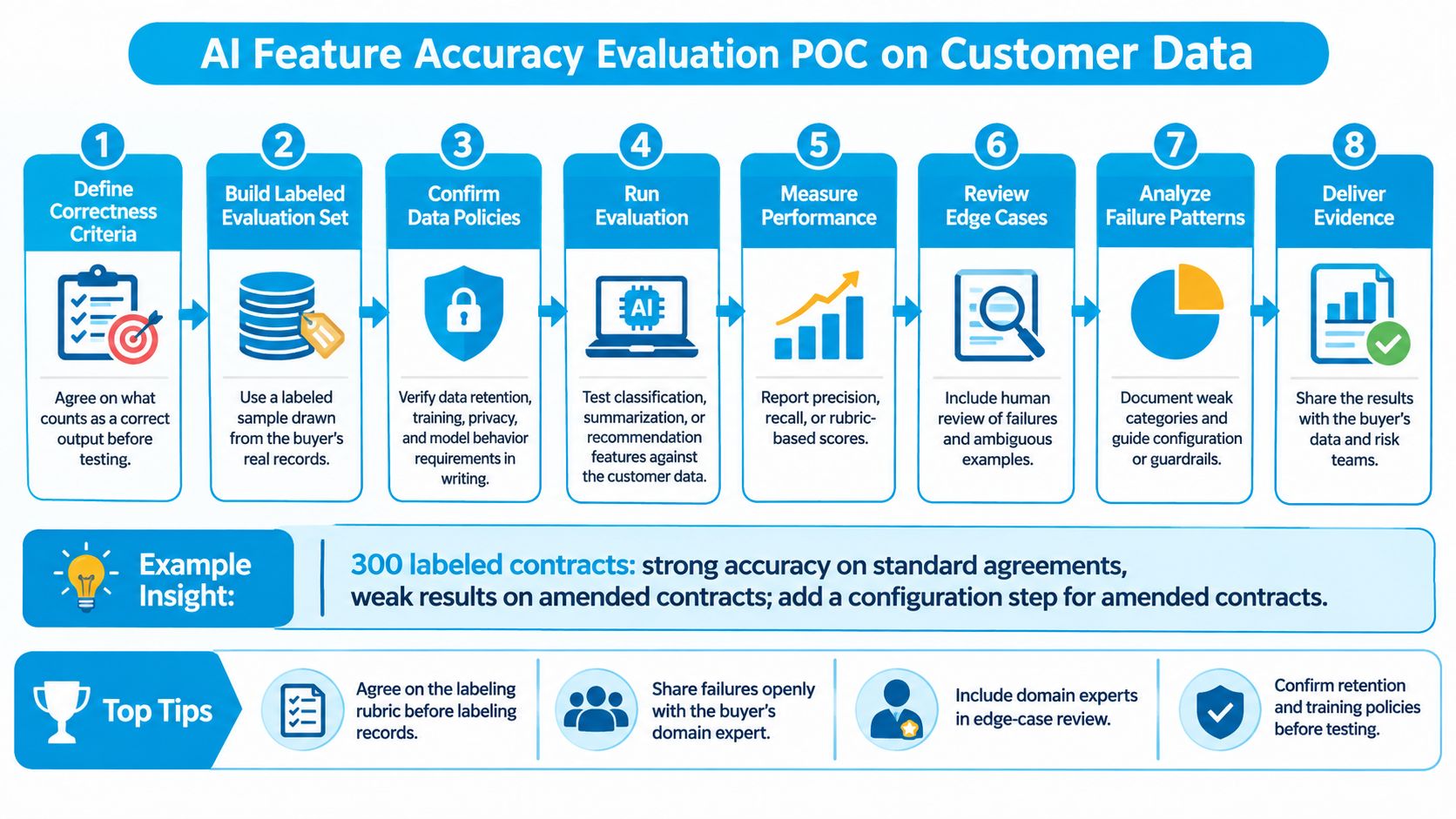
Define correct before you measure accuracy. For classification, summarization, extraction, or recommendations, the buyer needs evidence from representative customer records, not your curated examples.
Have the domain expert approve the labeling rubric and adjudicate ambiguous cases. Keep a held-out evaluation set separate from records used to adjust prompts, configuration, or model behavior.
Use this process flow to keep evaluation design visible.
Report Failure Categories, Not Just a Headline Score
Hypothetical example: A document classification vendor evaluates contracts labeled by the prospect's legal team. Standard agreements perform well, but amended contracts produce unacceptable errors, so the team tests category-specific handling against untouched examples.
Report precision and recall where classification requires them. For generated text, use a rubric covering factual support, completeness, prohibited content, and the consequences of an incorrect answer.
- Governance: Confirm retention, training use, access, and deletion arrangements before transferring records.
- Operations: Measure latency, human review requirements, and override behavior.
- Artifact: Deliver an evaluation report with category-level results, representative failures, and deployment conditions.
Deloitte's enterprise AI survey found that only 25% of surveyed organizations had moved at least 40% of their AI pilots into production. Don't treat a passing quality score as deployment approval.
Apply the same context discipline when evaluating LLM-generated demo advice: fluent output isn't evidence that the answer fits the task.
Use the accompanying video as a discussion prompt, not an acceptance artifact.
8 POC Types at a Glance
A POC earns an early technical win when it proves one specific thing. Choose the test around the buyer's unresolved risk, then agree on the evidence it should produce. The table distinguishes what each type establishes, who needs to assess it, and the artifact that supports a decision.
| POC Type | What It Proves | Primary Stakeholder | Typical Duration | Key Artifact |
|---|---|---|---|---|
| Identity and SSO Integration POC | Authentication, role mapping, and provisioning work with the customer's identity provider | Security and IT teams | Short, focused pilot | Configuration runbook and audit log evidence |
| Data Connector POC Against a Real Source System | The product can reliably connect to and sync representative customer data | Data engineering team | Depends on data access and integration complexity | Data quality report |
| Scale and Performance Load Test POC | The product meets agreed performance targets at production-scale volumes | Engineering and architecture teams | Several weeks, set by the load profile and test window | Performance results and infrastructure sizing |
| Single-Team Workflow Pilot With Time-to-Value Metric | A real team achieves a measurable business outcome using a defined workflow | Team manager and business sponsor | Defined pilot period | Before-and-after outcome comparison |
| Mutual Success Plan Pilot With Written Exit Criteria | Both parties agree on goals, owners, milestones, and a decision process | Economic buyer, account executive, and solution engineer | Two to four weeks, agreed in the success plan | Signed mutual success plan |
| Compliance and Data Residency Validation POC | The product meets specified regulatory, security, and data residency requirements | Security and compliance teams | Several weeks to months, driven by evidence collection and reviewer sign-off | Compliance evidence package |
| Coexistence Migration POC With an Incumbent System | The new product can run alongside the incumbent and support a controlled transition | IT and implementation teams | Often extended due to migration complexity | Migration, cutover, and rollback plan |
| AI Feature Accuracy Evaluation POC on Customer Data | AI outputs meet agreed accuracy criteria on representative customer data | Data, risk, and domain experts | Depends on data approval, labeling, and review | Accuracy report with failure analysis |
The artifact should make the result usable beyond the test itself: a runbook for configuration, a report for measured outcomes, or a plan that records owners and decision points. Match the evidence to the claim. A connector test needs representative data and a quality report; a load test needs results tied to its test conditions; a workflow pilot needs a before-and-after comparison.
Duration depends on access, review, and implementation work, so set a realistic window when defining scope. For a mutual success plan, agree on the period and written exit criteria together. That keeps the POC focused and gives both sides a clear basis for deciding what the evidence proves.
Pick the Right Test, Then Run It With Discipline
Discovery quality decides whether the POC is worth running. Written exit criteria decide when it ends. The artifact you leave behind determines how the buyer remembers the technical win.
Don't begin with a generic trial plan and add activities until every stakeholder feels included. Identify the unresolved buying risk, select the narrowest test that can resolve it, and agree on the evidence before provisioning anything.
An identity runbook won't answer a migration concern. A workflow scorecard won't establish data residency. An AI evaluation report won't resolve an economic buyer's objection unless someone connects the measured result to an operating model and a business case.
Close With a Decision, Not Another Demo
At the final readout, separate what passed from what remains unproven. State the environment, test conditions, exceptions, deployment work, accountable owner, and recommendation.
- Proceed: The agreed criteria passed, and the buyer has accepted the next-stage responsibilities.
- Revise: A bounded unresolved question justifies a specific retest with an owner and deadline.
- Stop: A required capability failed, the business case doesn't hold, or the customer can't support the evaluation.
A technically successful POC can still be commercially unsuccessful. Users might save time without producing enough value to justify adoption, or a workable architecture might require controls the buyer can't approve.
That's why teams seeking to validate AI modernization before scaling should work backward from deployment constraints. Don't declare success while ownership, integration, operating requirements, or acceptance remain unresolved.
Practice on the Evaluation You're Running
The Trusted Advisor Academy includes personalized learning paths for discovery, demos, and POC management. It teaches you to structure evaluations so you can pull the plug after two weeks if they aren't working, rather than letting uncertainty turn into unpaid implementation.
In live sessions, members apply frameworks to active deals and receive direct feedback on their own POCs. That makes the work concrete: a tighter hypothesis, clearer acceptance criteria, or a decision memo the champion can take to the buying committee.
Bring your next evaluation to a deal sparring session. Bring the buyer's unresolved risk, your proposed test, and the decision you need, then leave with a plan you can use the same week.
PreSales Unleashed GmbH offers structured PreSales training and live practice tied to active opportunities, including POC planning, success criteria, and stakeholder alignment. Visit PreSales Unleashed GmbH to explore the Trusted Advisor Academy and turn your next evaluation into a bounded test with a clear technical-win decision.