
Notes from a PreSales leadership evening and a day at DEMOFEST London, written for people who run SE teams.
TL;DR
- Map your SEs on skill and will, then map them again six months later. The grid is helpful. The change over time and the peer review round are what make it work.
- Usage-based pricing pulls SEs into the commercial conversation. You don't write the quote. But you're the one who knows whether a use case fires once a week or every two seconds.
- Making AI use visible changes behavior. A camera alone doesn't. Filming surgeons changed nothing. A public leaderboard did. Just don't reward people for burning tokens.
- "Can't we just build this ourselves?" is back. AI has made it a real objection again, and most SE teams don't have an answer ready.
- Presales can improve pipeline quality before an SE joins a single call. One way is to give SDRs a discovery demo that qualifies buyers early.
A camera in the scrub room changed nothing. About one in ten surgeons still skipped washing their hands before an operation, whether anyone was filming or not. What changed it was a leaderboard. Once the hand-washing data was shown publicly, so everyone could see who was near the top and who was slipping toward the cut-off, hand-washing went up substantially.
Alex, who runs Snowflake's European Solution Engineering organization, told that story to close to 40 SE leaders on the third floor of London's Royal Exchange. Zscaler had lent us its office there for our PreSales Leadership evening. We spent the next day at Consensus' DEMOFEST London, where we gave a mainstage talk. We wore Lederhosen. More on that later.
Over those two days, five ideas stood out. They're worth taking back to your own team on Monday. Below is each one, plus what we'd do with it.
How do you develop SEs when their skill and will don't match?
You place each person on two axes and coach them according to where they land. One axis is skill: technical and soft skills. The other is will: how engaged they are and how much they want to grow and contribute. David Mount leads Zscaler's UK&I solution consulting team, and he uses this Skill-versus-Will framework with his first-line managers.
The four-box grid isn't new. Two things David adds to it made it the takeaway people mentioned most at dinner. Several leaders told us they plan to try it with their teams.
The first is repetition. David's team redoes the mapping every six months. A single snapshot tells you where someone is today. A series of them tells you whether your coaching works. If someone is still in the same box after a year of development plans, that tells you something about the plan as well as the person.
The second is calibration. Each manager places their own people, then has to defend those placements to fellow managers. The other managers can push back and ask whether that person really belongs in that box. Most teams skip this step. It's also the step that stops a manager's favorites from quietly ending up in the top-right corner.
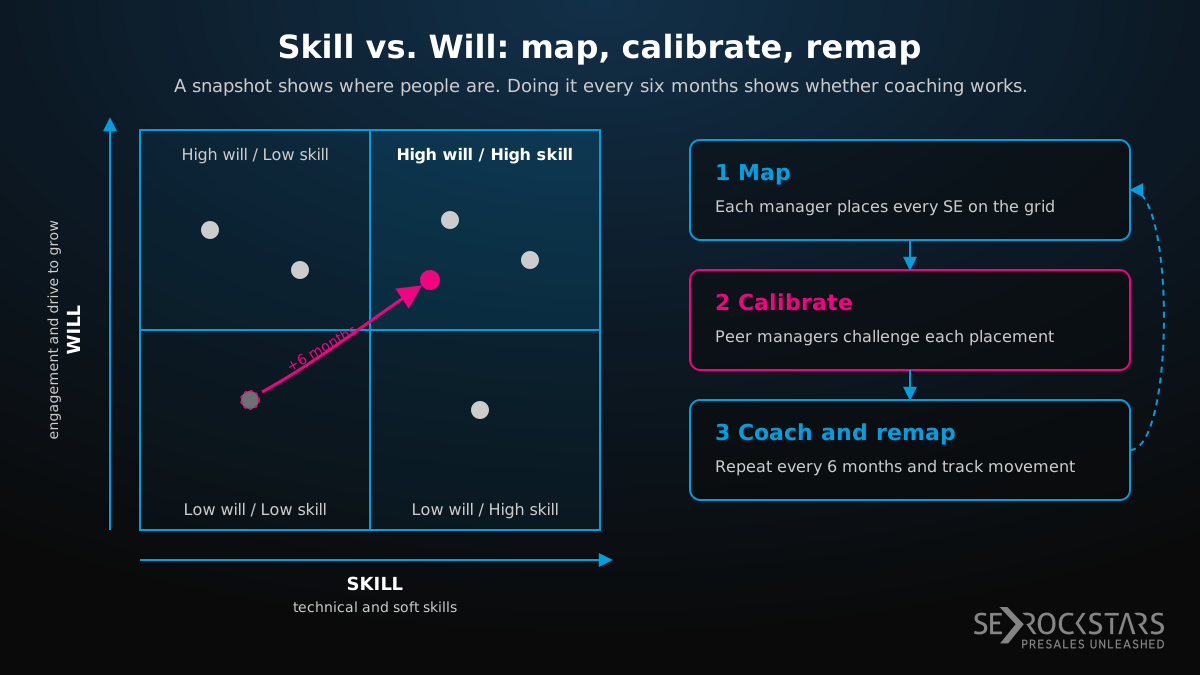 The grid shows where people stand. Remapping every six months and calibrating with peers show whether your coaching is moving them.
Who owns the pricing discussion when pricing goes usage-based?
The SE doesn't own it alone, but the SE can't opt out of it either. That was the argument from Dola, who leads HubSpot's European presales team, in a talk titled "Who Owns the Pricing Discussion?"
Her reasoning is simple. Seat-based pricing made the commercial maths a sales problem: count the users and multiply. Consumption-based and credit-based models change that. The person who identifies the use cases is now the only person who can estimate how much the customer will use. A use case that triggers once a week uses credits very differently from one that triggers every two seconds. That difference ends up on the invoice at the end of every month, quarter and fiscal year.
So SEs aren't responsible for pricing strategy or for writing proposals. They are responsible for understanding how a solution should be sized and what that sizing will cost the customer. Dola's view was that SEs can't hand that responsibility off to someone else, and we agree.
This matters more each quarter. We see more and more B2B software vendors moving to hybrid models, with a seat or platform fee plus a consumption component. In practice, add usage questions to discovery: how often each workflow fires, at what volumes, and what triggers it. An estimate the customer helped build during discovery is far less likely to end in a surprise invoice and an angry renewal call.
How do you drive AI adoption across hundreds of SEs?
Make AI use visible, and measure what it produces rather than how much of it there is. In an organization the size of Alex's, with several hundred SEs, adoption is very uneven. Some people run up something like $7,000 a month in token usage. Others hold back because of worries that stop them using the tools well. In a team of eight, you can sort that out over coffee. With several hundred people, you need a system.
The surgeon study explains why a system beats monitoring. Watching people didn't change behavior. Comparing them in public did. Most SE leaders already have usage data. What they usually don't do is share it.
Alex also gave the counterweight, and we're glad he did. You can overdo this. If the leaderboard counts tokens, you'll get tokens: people firing odd prompts at a model to move up the ranking without producing anything useful. Nobody gains from that. Many organizations are still searching for the middle ground. Our suggestion is to rank people on outcomes they can show, not on raw consumption.
How should SEs answer "can't we just build this ourselves?"
Take the question seriously, because these days it often makes sense to ask it. Gong's global Solutions Engineering leader spoke at DEMOFEST about how the SE role is changing in an AI-first world, including which skills matter less and which matter more. One part of the talk covered build versus buy. More and more customers are raising it as an objection: why buy this when we could build it ourselves?
We heard the same thing in hallway conversations. When we raised it with our Leader Academy group the day after, everyone nodded. For roughly a decade nobody asked this. Now you no longer need a deep programming background to build software that's good enough for production. We know this first-hand, because we've started building our own software at SE Rockstars.
That means waving the objection away won't work anymore. Our current view is to treat "we'll build it" the way you'd treat any other competitor in the deal. In discovery, ask who will maintain the tool, who owns it when the person who built it leaves, and what that team isn't doing while it builds. We're turning this into dedicated material for our academies, because we expect SEs to hear this objection much more often.
Can presales improve pipeline quality before the first call?
Yes, and one of the strongest DEMOFEST sessions showed how. Sabrina's presales team at Planview, which is a Consensus customer, uses discovery demos as a deliberate tool for pipeline quality. A lot of SEs dislike the idea of a "disco demo". Planview found a way to make it useful.
The starting point was a sharp diagnosis: they didn't need more leads. They needed more out of the contacts they already had. So presales worked out what good early discovery looks like. Then, using Consensus, they built an interactive flow that SDRs and BDRs send to prospects very early in the process. The prospect's answers show, in detail, where an opportunity is worth pursuing and where it isn't yet. That lets the whole team put its energy into the strongest contacts.
What we liked most was the attitude behind it. Presales could have said that SDRs are someone else's problem. Instead, they treated the funnel as one system. The line between presales and post-sales is fading anyway. As co-founders, we get approached by sellers every week, and most of the outreach is truly bad. Plenty of companies could learn from a team that designs the buyer's first step with this much care.
What should SE leaders prioritize when everything changes at once?
Pick a few things and go all in on them, without guilt about the rest. All three talks at our evening were really about change. Customers are buying differently, pricing models are moving, AI tools are arriving, and every coaching conversation is about someone changing their own behavior. These shifts also feed each other. Did AI drive the new pricing models, or the other way round? Either way, you can't settle on a five-year operating model anymore. Within a year, a lot of it will look different.
But you can only keep so many balls in the air. When we were SE managers, the end of Q4 always beat a new trend. So decide what is critical for your organization right now, focus on that, and don't worry about missing out on the rest. If everything is important at once, then nothing is.
The profession itself looks healthy. DEMOFEST London had 1,011 registrations and 601 attendees, a 59% show rate for a free, in-person event. Registrations passed both the target of 800 and the stretch goal of 1,000. Attendance was up 20% on the previous year. People also want clearer career paths. One SE asked us how to grow into a leadership role, and there are very few resources for aspiring leaders. A forward-deployed engineer in his mid-twenties, with a 5% variable component in his pay, asked us whether account executives really earn a million dollars a year. Some do, in an exceptional year. It isn't normal.
Frequently asked questions
What is the Skill vs. Will framework for SE teams? It's a two-by-two grid that places each SE according to their skill (technical and soft skills) and their will (how engaged they are and how much they want to grow). You coach differently depending on the quadrant. To get the most from it, redo the mapping every six months so you can see whether coaching moves people, and have managers calibrate their placements with each other to keep them objective.
Should solution engineers be involved in pricing discussions? With consumption-based or credit-based pricing, yes. SEs usually don't set pricing strategy or write proposals. But they identify the use cases, and those use cases decide how much the customer will use and what they'll pay. Estimating usage during discovery protects the deal and the renewal.
How do you increase AI adoption in a sales engineering team? Make usage visible instead of just monitoring it, for example with shared leaderboards. Measure outcomes rather than raw consumption, because ranking people by token volume encourages people to game it. Give extra support to hesitant team members whose concerns are holding them back.
What is a discovery demo? A discovery demo is a short, often interactive demo used early in the sales process to qualify interest and gather discovery information before a full meeting. Planview's presales team built one that SDRs and BDRs send to prospects early, which helps the team see which opportunities are worth pursuing.
How do you handle the build vs. buy objection in B2B SaaS? Take it seriously. With AI, building internal tools has become realistic. Handle it like a competitor: in discovery, ask about maintenance, who owns the tool once its builder leaves, and the opportunity cost of the team's time, so the comparison covers more than the licence price.
Leading an SE team through new pricing models, AI adoption and calibration rounds? That's what our Trusted Leader Academy is built for. Book a discovery call to see if it fits, or join the PreSales Leader Community to get invited to our next leadership evening.
Tim Brömme & Jan-Erik Jank are the co-founders of SE Rockstars. They have 30+ years of enterprise PreSales experience between them and have coached 350+ SEs.
Listen to the full episode
The full London recap is on the podcast (in German): PreSales Unleashed: Demofest Recap (282)