
A good sales story is a customer situation told with enough cause and effect that the buyer can repeat it and act on it.
The usual advice, start with a hero, add conflict, finish with a happy ending, doesn't give a Solution Engineer (SE) enough to work with. You can follow that formula and still leave a buying group unable to explain why it should change anything.
What's a good story in PreSales? One that helps your champion carry a defensible decision into a meeting you won't attend. Entertainment is optional. A clear connection between the customer's problem, the evidence, and the requested action isn't.
What Makes a Story Good in a Sales Setting
A good sales story is a customer situation told with enough cause and effect that the buyer can repeat it and act on it.
A customer logo doesn't make an anecdote a story. Neither does adding a customer's name to a feature tour. Both can sound credible while leaving out the decision that connected the customer's starting condition to the outcome.
That distinction matters after your meeting. Your champion may need to explain the evaluation to a finance lead, a security reviewer, or an executive who hasn't watched the demo. The explanation must work without your narration.
A 2024 study in the Quarterly Journal of Economics found that, after one day, the average effect of statistics on participants' beliefs had faded by 73%, while the effect of a story had faded by 32%. That's a finding about belief persistence, not a forecast of your close rate. Its practical implication is useful: give evidence a situation and a causal sequence people can remember.
Carry the Proof Inside the Situation
Consider this hypothetical contrast:
- Claim with a customer attached: A dispatch lead at a regional distributor says automation reduced errors.
- Retellable story: A dispatch lead describes the Friday exception queue, explains how repeated order entry created mistakes, and identifies the shared queue that removed the duplicate step. The ending states the observed result and the conditions under which it held.
The second version gives a champion something to explain. The first leaves them defending a conclusion without the reasoning.
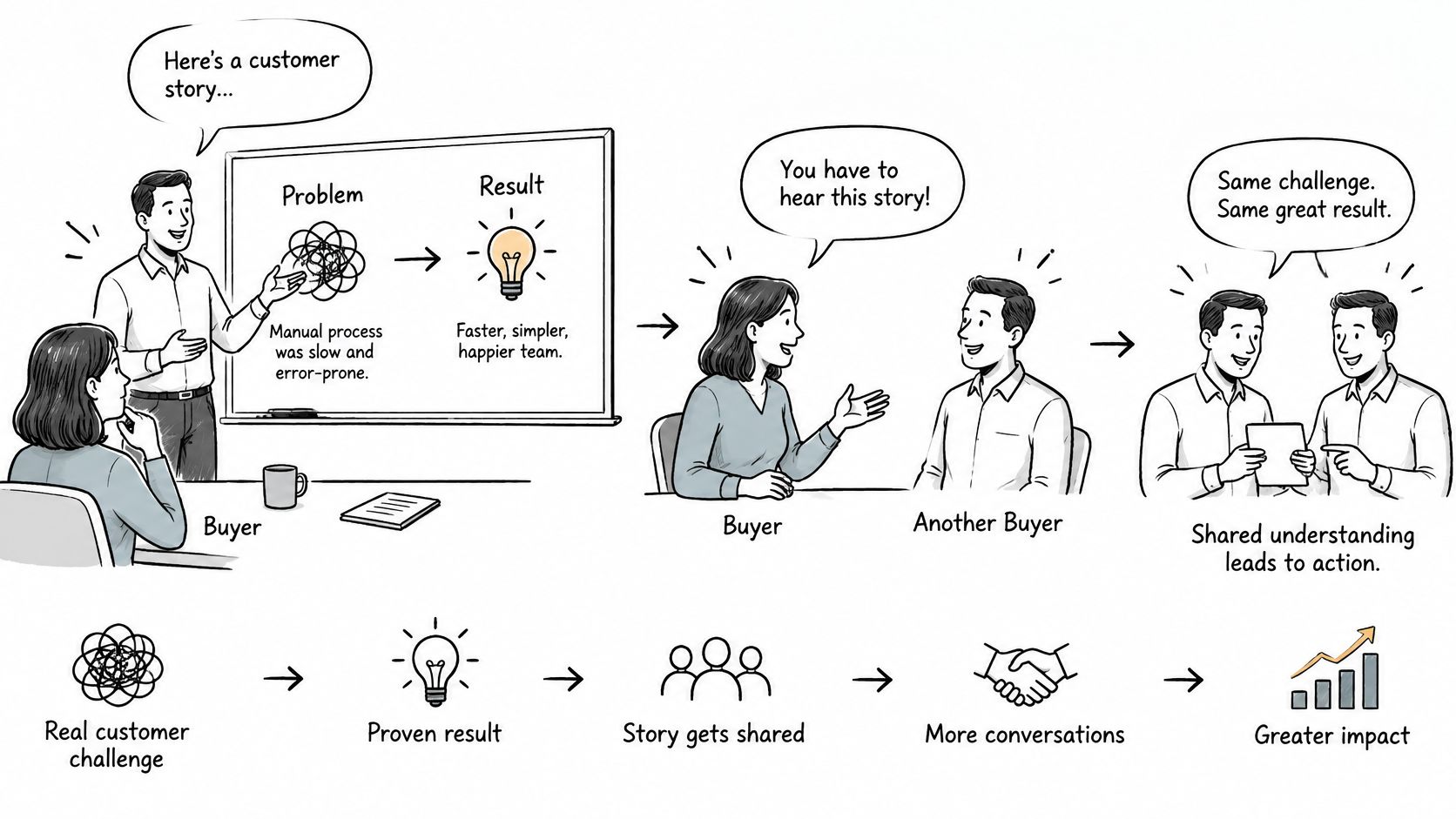
A story carries the numbers; it doesn't replace them. Keep the measurement, baseline, and limitations attached to the customer situation. Don't turn an observed improvement into a promise that every buyer will get the same result.
For longer spoken formats, Podmuse's guide to podcast storytelling for business audiences is a useful companion when adapting a customer account for listeners who can't inspect your slides.
Judge the result by what the buyer can do: restate the problem, explain why it matters now, and name a next step. Those are more useful acceptance criteria than whether the room enjoyed your delivery.
The Five Markers That Turn a Claim Into a Story
Use five markers as an editorial scoring rule: clear all of them before calling an example a complete business story.
Market Logic's business storytelling analysis identifies a time or place, causal sequence, people, an unexpected development, and a business point. Treat these as observable checks, not a license to invent missing details.
Five markers of a business story, weak versus strong
| Marker | Question to Ask | Weak Version | Strong Version (Hypothetical) |
|---|---|---|---|
| Time or place | When and where did it happen? | A company improved efficiency with automation | In one regional warehouse, during the first quarter on the new scheduler |
| Causal sequence | What caused the next event? | Adoption rose, then errors fell | Errors fell after dispatch moved from spreadsheets to one shared queue, and staff stopped re-keying orders |
| People | Who was affected and who decided? | The business approved it | Two dispatch leads and a finance controller who signed off on the pilot scope |
| Unexpected development | What changed the plan? | Implementation went smoothly | A carrier API changed mid-pilot, and the team rebuilt one integration before go-live |
| Business point | What decision or result follows? | Better visibility | Exceptions were reviewed the same day, so the team extended the approved pilot to a second site |
Repair the Weakest Marker First
Don't rewrite the whole case study because it feels flat. Find the missing element.
If you can't identify who made the decision, return to the account team or customer interview. If the sequence contains only events joined by then, establish what caused the change. If there's no business point, decide whether the example belongs in this evaluation at all.
Unexpected doesn't have to mean dramatic. A data dependency, an approval requirement, or a workaround that failed under load can provide the development that changed the plan. Don't manufacture a crisis because the actual obstacle sounds ordinary.
Keep hypothetical labels in the asset itself. A disclaimer in your speaker notes won't protect a slide that someone forwards as a customer reference. Use customer language only when it's verified and you have permission to use it.
ContentBuck's video scripting guidance for B2B marketers is useful when turning the account into a spoken script. Apply the same discipline to narration: every sentence should establish the situation, explain the change, or support the decision.
Compress Without Losing the Story
Write the example in two sentences as a practical editing exercise. Keep the time or place, people, causal sequence, obstacle, and business consequence intact.
Compression should remove decoration, not the explanation. If the obstacle disappears, you may have written a success claim. If the business point disappears, you've written an incident report.
That short version is the one to put in the champion's follow-up material. Give them language they can use, not a paragraph they must translate.
Complication, Turning Point and Ending
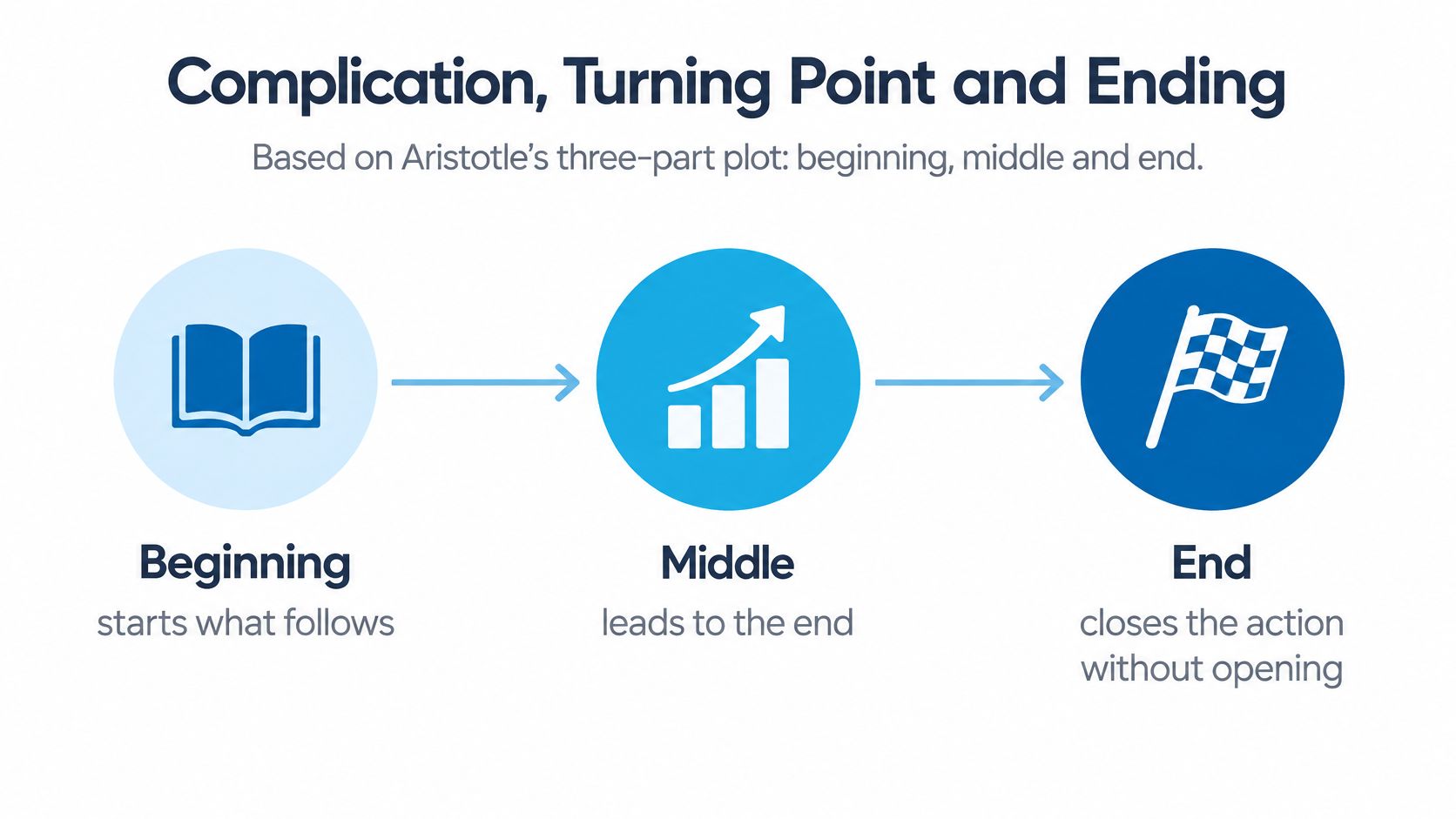
Build the story around causality, not the order of your product navigation. In Aristotle's Poetics, a whole plot has a beginning, middle, and end: the beginning starts what follows, the middle produces the end, and the end follows from the preceding action.
For an SE, that means the buyer should understand why each next step became necessary. Opening with a product menu skips that explanation.
Build the Customer Account Around the Decision
-
Starting condition. What happens today?
Establish the process, the people responsible, and what already works. Don't describe the current state as universally broken if the team can handle routine work well. You need a fair baseline, including the conditions under which the process becomes difficult. -
Complication. Why can't the team keep working this way?
Name the failed workaround, constraint, or new risk. Express the stakes in the buyer's terms: missed reviews, duplicate investigation, uncertain ownership, or exposure that the team can't accept. -
Turning point. What makes a different approach credible?
This isn't the moment you display a feature. It's when the buyer recognizes that an insight, proof point, or agreed criterion creates a plausible path forward. Aristotle's distinction between complication and unraveling provides a useful way to separate the buildup from the response. -
Unraveling and ending. What happens next, under what conditions?
Connect the approach to the defined problem. Close on an observed outcome or an evaluation decision, such as a validated requirement, an agreed pilot hypothesis, or executive approval. Don't append unrelated features after the decision is clear.
A Hypothetical Bank Example
A hypothetical claims operations team at a regional bank has a fraud queue that takes four days to clear. Staff manually copy information between two systems. Routine processing works, but exceptions depend on someone spotting the relevant record.
The complication is that a late flag can reach the customer before the team completes its review. Adding another dashboard won't resolve the timing problem.
The turning point comes when the team sees that its own queue data could trigger the check earlier. The SE demonstrates the trigger against representative records and makes the remaining integration dependency explicit.
The ending is a scoped pilot with a stated review date, an accountable owner, and an agreed criterion for assessing earlier detection. It isn't a claim that fraud has been solved.
Use the same standard when reviewing customer case studies: identify the starting condition, the reason the approach changed, and the evidence supporting the ending.
End where the buyer can make a decision, not where you've exhausted the available screens.
Matching One Story to Every Buyer on the Committee
In this hypothetical example, a regional bank's fraud team can't clear flags in time because its systems lack a shared key, so it evaluates a shared queue that connects the records.
Keep that through-line intact for every stakeholder. Change the entry point and supporting evidence, not the account of what happened or why the team is considering change.
A study of storytelling in B2B advertising published by Springer found that stories can deepen organizational buyers' emotional connection with a selling firm and influence purchase behavior and decision-making. That doesn't excuse weak technical proof. It means human and organizational context belongs alongside it.
Stakeholder map for one customer story
| Role | Desired Outcome | Likely Objection | Proof Needed | Where the Story Hits |
|---|---|---|---|---|
| End user | Less daily rework | The new workflow adds steps | Screen-level walkthrough of their own task | Complication: the rework they describe |
| Economic buyer | Lower cost of delay | Payback is unclear | Cost of the status quo and a time-to-value range | Turning point: the cost of waiting |
| Technical evaluator | Clean integration | Data model may not fit | Architecture diagram and integration path | Unraveling: how the approach connects |
| Security reviewer | Controlled access and data handling | Unknown exposure | Access model and data handling documentation | Unraveling: the conditions for adoption |
| Executive sponsor | Strategic change with bounded risk | Too much disruption | Scoped pilot with a stated success criterion | Ending: the decision requested |
Different Evidence, Same Account
For the end user, walk through the duplicate task and show what disappears. For the technical evaluator, explain record matching, exception handling, and what happens when the integration fails. Neither needs a different protagonist or a different justification for the project.
The economic buyer needs a defensible account of waiting costs. Build any time-to-value range from implementation assumptions you can explain, not a generic benchmark. The security reviewer needs adoption conditions made explicit before anyone promises a rollout.
A separate message for every role creates reconciliation work for your champion. Finance hears cost reduction, security hears a control project, and users hear workflow replacement. They may leave believing they're evaluating different initiatives.
Keep the turning point constant. Let each person's proof requirement sit inside the same proposed change. The practical standard behind demonstrating to win is to make the relevant decision easier to evaluate, rather than give every attendee a private feature tour.
For PreSales, the technical win requires agreement that the proposed approach meets the buyer's evaluation criteria. A moving story can't substitute for that agreement, but a coherent account can make the requirements and remaining objections easier to discuss.
Adapting One Story for Discovery, Demos and Briefings
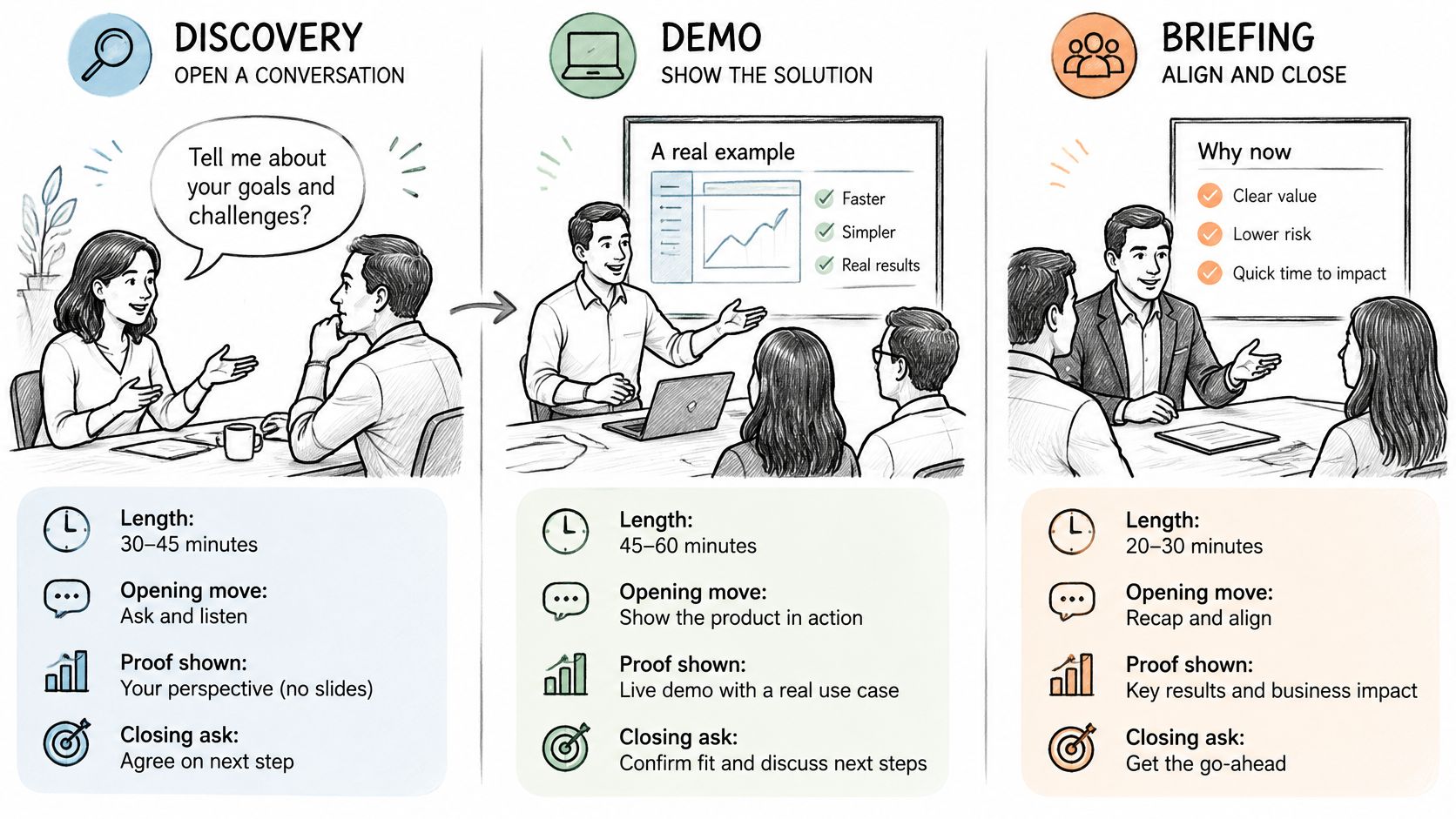
Use the same customer situation across meetings, but change how much you say and what you ask the buyer to do. No discovery, no demo. Discovery quality, not demo polish, decides whether you're demonstrating a relevant path to change.
The durations below are suggested rehearsal budgets, not performance benchmarks. Don't fill the allotted time if the buyer already understands the point.
Story adaptation by meeting type
| Setting | Spoken Length | Open With | Proof to Show | Close With |
|---|---|---|---|---|
| Discovery call | About 2 minutes | The customer's current process, in their words | Nothing beyond their own description | A confirming question on which cost matters most |
| Solution demo | About 5 minutes inside the demo | The workflow the buyer named in discovery | Live screens running the buyer's sample data | The criterion the next step must meet |
| Executive briefing | About 4 minutes | The business consequence of the status quo | One metric with its named source | The decision requested and its scope |
| POC or pilot kickoff | About 3 minutes | The agreed success criteria | Baseline measurements taken before go-live | The owner and date for the first checkpoint |
Follow a Hypothetical Claims Team
A hypothetical claims team at a mid-size insurer has a three-week backlog in a shared intake queue. Reviewers repeatedly reopen incomplete submissions because the queue doesn't distinguish ready-to-review claims from those awaiting documents.
In discovery, summarize that account in about two minutes using the team's terminology. Don't announce that routing automation is the answer. Ask whether waiting time or repeated review creates the greater operational cost, and check whether the queue behavior explains it.
Use sales discovery questions to establish ownership, exceptions, and consequences before writing the demo narrative. If the team corrects your explanation, update it. A polished account of the wrong problem wastes everyone's time.
During the demo, use buyer-approved sample claims to show the relevant workflow. The turning point is that document status can determine which claims reach a reviewer, rather than leaving reviewers to discover missing information after opening each item.
Spend the screen time on that behavior and its exceptions. Show what happens when document status is wrong or unavailable. Close by agreeing on the criterion a pilot must meet, rather than asking whether the audience liked the interface.
Shorten the Explanation as Agreement Grows
In the executive briefing, remove the screen-by-screen narration. Open with the backlog's business consequence, present a metric with its named operational source, and request approval for a bounded pilot. Don't manufacture a financial estimate because the executive expects a business case.
At kickoff, stop selling the change. Confirm the baseline, scope, success criterion, owner, and checkpoint date.
The spoken explanation gets shorter as shared understanding grows, even when the demo itself needs more time for proof. Keep the turning point fixed: route claims using readiness information before assigning review work.
Big Moves Marketing's discussion of three skills shaping B2B marketing offers an adjacent perspective on connecting discovery and storytelling. For an SE, the practical discipline is straightforward: change the delivery format without changing the problem you're asking the buyer to solve.
Where Stories Break and How to Repair Them
A story that ends in a feature list usually lacks a named decision. The SE keeps adding capabilities because nobody has established what the buyer needs to approve, validate, or reject.
Start the repair with cuts. Remove the unsupported result, the extra character, and the capability that doesn't affect the evaluation.
Story failure symptoms, causes and fixes
| Symptom | Likely Cause | Fix |
|---|---|---|
| Story ends in a feature list | No turning point; features replace decisions | Name the decision each feature supports and cut the ones that support none |
| Result sounds too clean | Outcome claimed without constraints | State the trade-offs, the unknowns and the conditions the result depends on |
| Too many characters | No single protagonist | Keep one customer viewpoint and reduce the roles to two named people |
| Statistic floats free | Figure not tied to a situation | Attach it to a marker: who, when, and what changed |
| Logo used as proof | Name stands in for a story | Use only verified facts, and label any hypothetical example |
| Buyer cannot retell it | Sequence too long or unordered | Trim to starting condition, complication, turning point and ending |
Use Real Tension, Not Manufactured Drama
Real tension comes from competing constraints. A buyer may need earlier detection without expanding data access, or faster deployment without replacing a system of record. Explain that conflict plainly.
Manufactured drama adds urgency or certainty you can't defend. Don't call a workaround unsustainable unless you can explain where it fails. Don't describe an implementation as risk-free because the happy ending sounds cleaner.
Kantar Media's media trends analysis emphasizes storytelling as a way to turn complex, diverse data into meaningful insight. For technical communication, that means clarifying the evidence, not decorating it with confidence.
Credibility check: State what the result depends on, what's still unverified, and which condition would change your recommendation.
A credible ending can be a decision to test, defer, or reject an approach. You don't need a conventional happy ending when the evidence supports a narrower conclusion.
For example, if record matching hasn't been validated against production exceptions, say so. Make that validation a pilot condition instead of describing the integration as complete.
After repairing the account, test whether someone else can explain it. If they still can't identify the decision, return to the causal sequence before adding another slide.
Confirm the Story Landed Before You Move On
Don't treat attentive faces as evidence of understanding. Ask the buyer to explain the account in their own words before the call closes.
A narrative-transportation meta-analysis in the Journal of Business Research, covering 64 articles and 138 effect sizes, found stronger transportation for user-generated stories than professionally generated stories and for individual rather than shared reception. That's a reason to work with the listener's situation and language, not a reason to assume that a polished presentation persuaded the committee.
Test Understanding Without Quizzing the Buyer
Frame the request around their next conversation. Ask how they'd explain the proposed evaluation to the person who must approve it, then listen for the problem, consequence, intervention, and measurable outcome or evaluation target.
Don't correct every word. You're checking whether they can carry the reasoning, not reproduce your script.
- Ask for the retell before the call ends. Give the buyer room to explain without prompting each part.
- Check the causal account. Listen for the protagonist's problem, the consequence of leaving it unresolved, the intervention, and the outcome being assessed.
- Repair the missing part. Note the gap and restate only that part in your follow-up email. If the consequence is unclear, clarify it before showing another feature.
- Confirm the next step in writing. Include the criterion it must meet, the owner, and the review point.
This week, choose a customer story from a recent deal and rewrite it in five sentences using the starting condition, complication, turning point, and ending. Test it on a peer before your next discovery call, and use the discovery call guide to gather any missing facts.
If you want to work through the narrative and its evaluation criteria, book a discovery call.
PreSales Unleashed GmbH offers the Trusted Advisor Academy, combining structured PreSales learning with live practice and application to active deals. Members can request a role play or pitch during live calls and receive corresponding feedback, upon prior request. Visit PreSales Unleashed GmbH to explore how to practice a customer story that supports a clear technical decision.