
The most popular advice about demos is to make them more polished. That's the wrong priority. A polished product tour can still waste a buyer's time, consume scarce PreSales capacity, and leave the buying group unable to say what decision the session was meant to change.
Demonstrate to win means using evidence to help a buyer make a decision, not performing the product. That starts before you open the demo environment. If discovery hasn't established a real problem, the right audience, and a next decision, more polish won't rescue the session. No discovery, no demo.
Why More Demos Do Not Create a Technical Win
A packed demo calendar can look like progress. But if the account notes are thin and the room can't name the decision the demo should influence, you're measuring activity, not a technical win. PreSales owns the technical win: evidence that the solution meets the buyer's stated requirements and supports the decision they need to make.
The preparation cost makes weak qualification a capacity problem, not a minor inconvenience. A Salesforce AppExchange document summarizing Gartner research reports that at least three demos are required to close a deal, teams spend about 3.5 hours preparing for each demo, and 30% of demos go to poorly qualified audiences. Three preparations at that rate add up to roughly 10.5 hours before delivery, without counting the sessions themselves. The Salesforce AppExchange document summarizing Gartner's demo research
Set live-demo entry criteria
Before you commit a Solution Engineer (SE) to a live session, get clear answers to five questions:
- What business problem is the buyer trying to solve?
- Who will attend, and what role do they play in the decision?
- Where is the buyer in the evaluation?
- Which capabilities or workflows must the buyer assess?
- What next step will follow if the evidence is convincing?
If the account team can't answer these, the SE shouldn't be asked to improvise a customized session. Route the request to discovery, a recorded walkthrough, or self-serve material until the opportunity is ready. Refusing or rerouting a weak request isn't a service failure. It's capacity management in service of the technical win.
Use a consistent discovery call framework to set the bar for a live session, then connect that bar to technical win rate as a PreSales north star. The point isn't to minimize demos. It's to invest SE preparation where buyer-specific proof can influence a real decision.
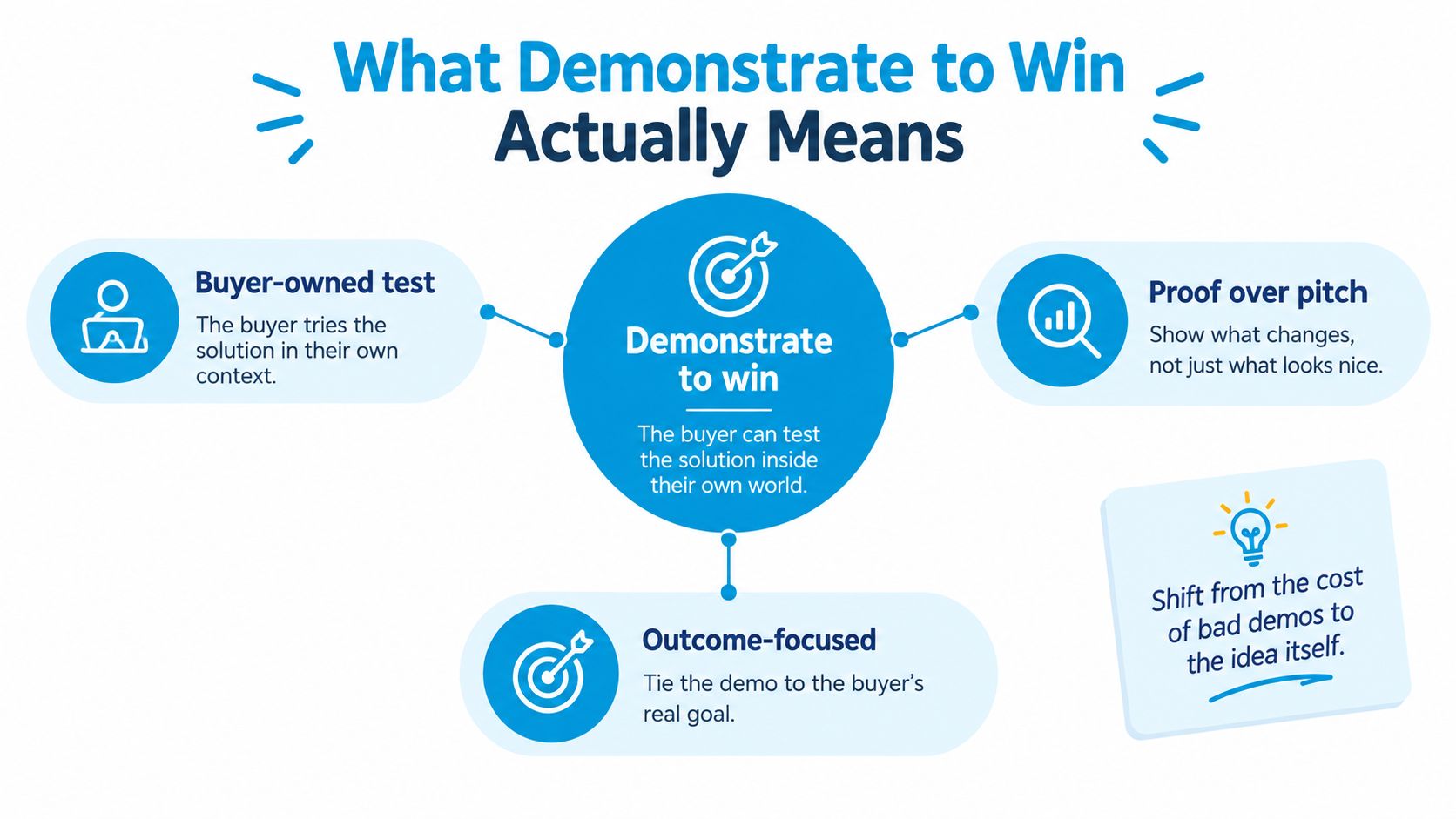
What Demonstrate to Win Actually Means
A buyer should be able to test the solution against their own process and data, then judge whether the evidence addresses their problem. That's different from watching a rep click through modules. The demo has value when it makes the buyer's evaluation more concrete and shows that the seller understands the challenge.
Gartner's guidance, based on a buyer survey in the financial-applications market, identifies demonstrations as the most valuable content type in the purchasing process and describes the response as overwhelming. The guidance also says discovery should happen separately beforehand, and the demonstration should be customized to the prospect's business process and data. It can be delivered by video or web conferencing, so the principle applies to distributed buying groups too. Gartner's guidance on sales demonstration success
Put the demo inside the SE role
The historical shift was from a generic product presentation to buyer-specific proof. The SE isn't there to recite features or create an impressive screen tour. The SE connects the buyer's stated problem to a relevant workflow, exposes the evidence, and helps the buying group decide what to do next.
That work belongs in the broader context of what PreSales is and what a sales engineer does. A demo is one tool in that work, not a standalone performance.
The test: Every capability on screen must connect to a stated business outcome. If it doesn't, cut it from the agenda.
That's the practical meaning of “no discovery, no demo.” Discovery determines which proof matters. The demo makes that proof visible. A buyer who sees a harbor cruise through every module may learn the product's menu, but not whether it fits the business.
Demo Patterns Tied to Buyer Outcomes
Build the session around an evidence path, not a speech outline. Start by restating the buyer's problem. Show only the workflow connected to it, make the relevant technical or operational proof visible, then ask whether that evidence changes the buyer's evaluation.
MEDDPICC helps you keep qualification fields distinct. Metrics define the value the buyer expects. The Economic Buyer holds overall authority. Decision Criteria describe how the options will be judged, while the Decision Process describes how the choice will be made. Paper Process, Identify Pain, Champion, and Competition matter too. The MEDDPICC guide for Solution Engineers helps connect those fields to the work of qualification.
Salesforce reports that 73% of B2B buyers actively avoid sellers who send irrelevant outreach. That figure measures outreach, not demo-specific avoidance. Still, the operating lesson is plain: a generic demo repeats a relevance failure at a more expensive point in the sales process. Salesforce's State of Sales statistics
Match the demo to the gap
| Missing field | Demo may do | Demo must not do |
|---|---|---|
| Pain | Show a workflow that addresses a confirmed problem. | Invent urgency or assume the buyer's problem. |
| Metrics | Make the mechanism behind a target outcome visible. | Claim a quantified result the buyer hasn't validated. |
| Economic Buyer | Provide evidence the champion can share with the authority holder. | Treat attendance as proof of approval. |
| Decision Criteria | Test a specific requirement against a visible scenario. | Substitute a feature list for evaluation criteria. |
| Decision Process | Clarify what evidence supports the next decision. | Pretend a strong session defines the buyer's approval path. |
If a 45-minute tour contains scenarios that don't match known buying conditions, remove them. A short evidence path gives the buyer fewer things to assess and gives the SE a clear way to check whether the session helped. For teams creating concise visual material to support a product story, build a launch teaser with ShipTeaser can be a useful option for presenting a focused message outside the live session.
When to Skip the Live Demo
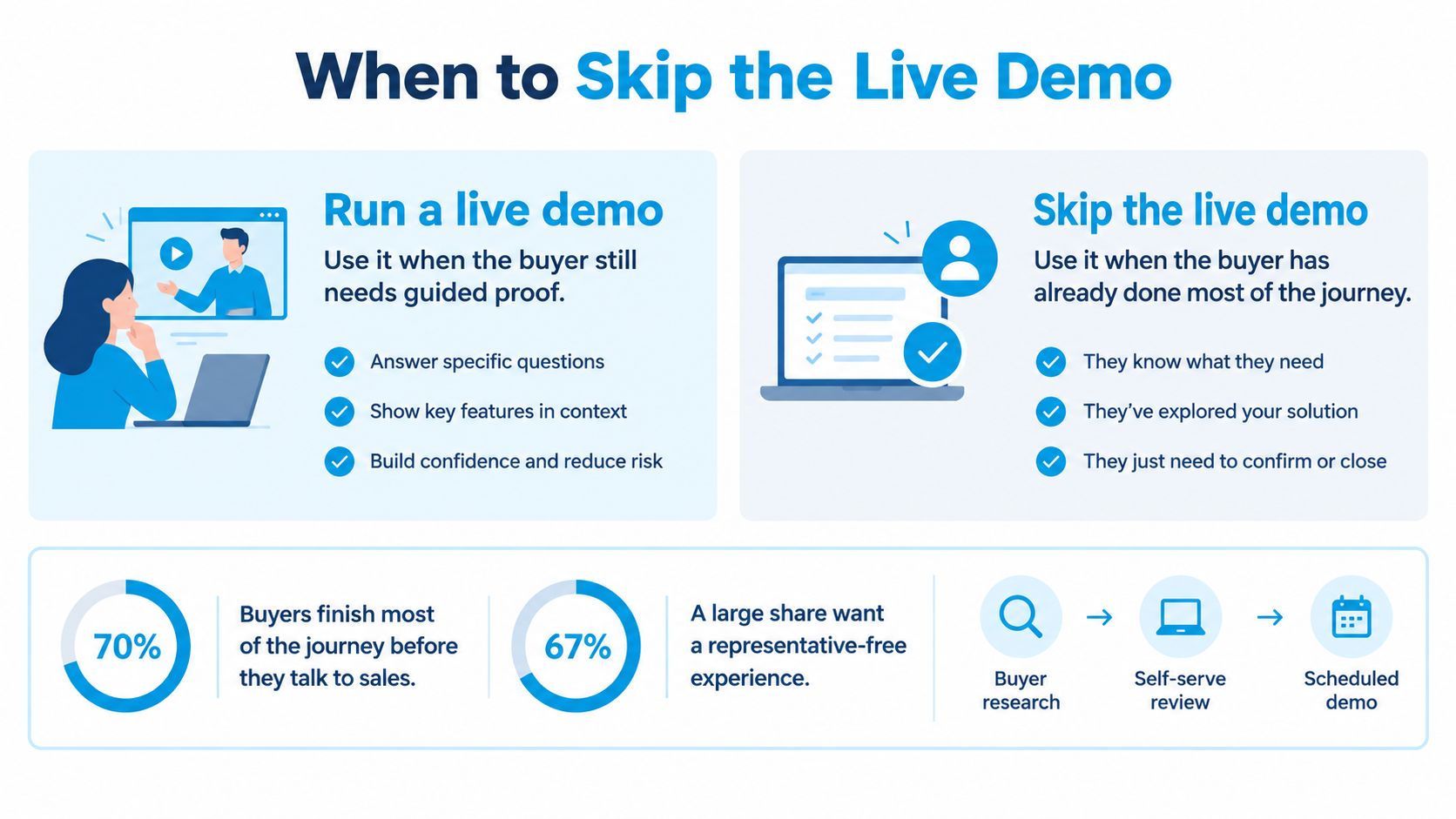
A live demo isn't the default next step for every interested buyer. Gartner-linked reporting indicates that buyers complete more than 70% of their journey before speaking with sales, while 43% prefer a fully representative-free experience. The most common vendor complaint is being forced to attend a demo before evaluation. The buyer-behavior reporting shared by KhalifeAI
Give buyers two clear routes: independent proof when they're still checking relevance, and expert-led proof when a real decision requires guidance.
Route by the buyer's question
| Self-serve proof | Live SE demo |
|---|---|
| Interactive tours and product documentation let buyers inspect the basics independently. | A complex workflow needs an expert to connect requirements to the right configuration. |
| A sandbox helps the buyer test initial relevance on their own terms. | Multiple buying roles need a shared view of the evidence. |
| Clear documentation can state product limits and dependencies. | Security, integration, or operational risk needs a direct technical answer. |
| A recorded walkthrough is a lighter option when qualification is thin. | A decision date requires the group to interpret the evidence together. |
Self-serve must have guardrails. Publish the scenarios buyers can explore, state what the product won't do, and keep documentation clear about dependencies and limits. Before an SE joins, ask for a problem statement. That prevents independent exploration from turning into an uncontrolled feature tour, and it helps the SE arrive with a defined purpose.
Use a simple routing rule: if the buyer can answer their question with available material, don't require a meeting. If the question needs expert judgment, stakeholder alignment, or a shared reading of risk, book a live session. This protects capacity without making buyers sit through a demo just to earn access to basic product information.
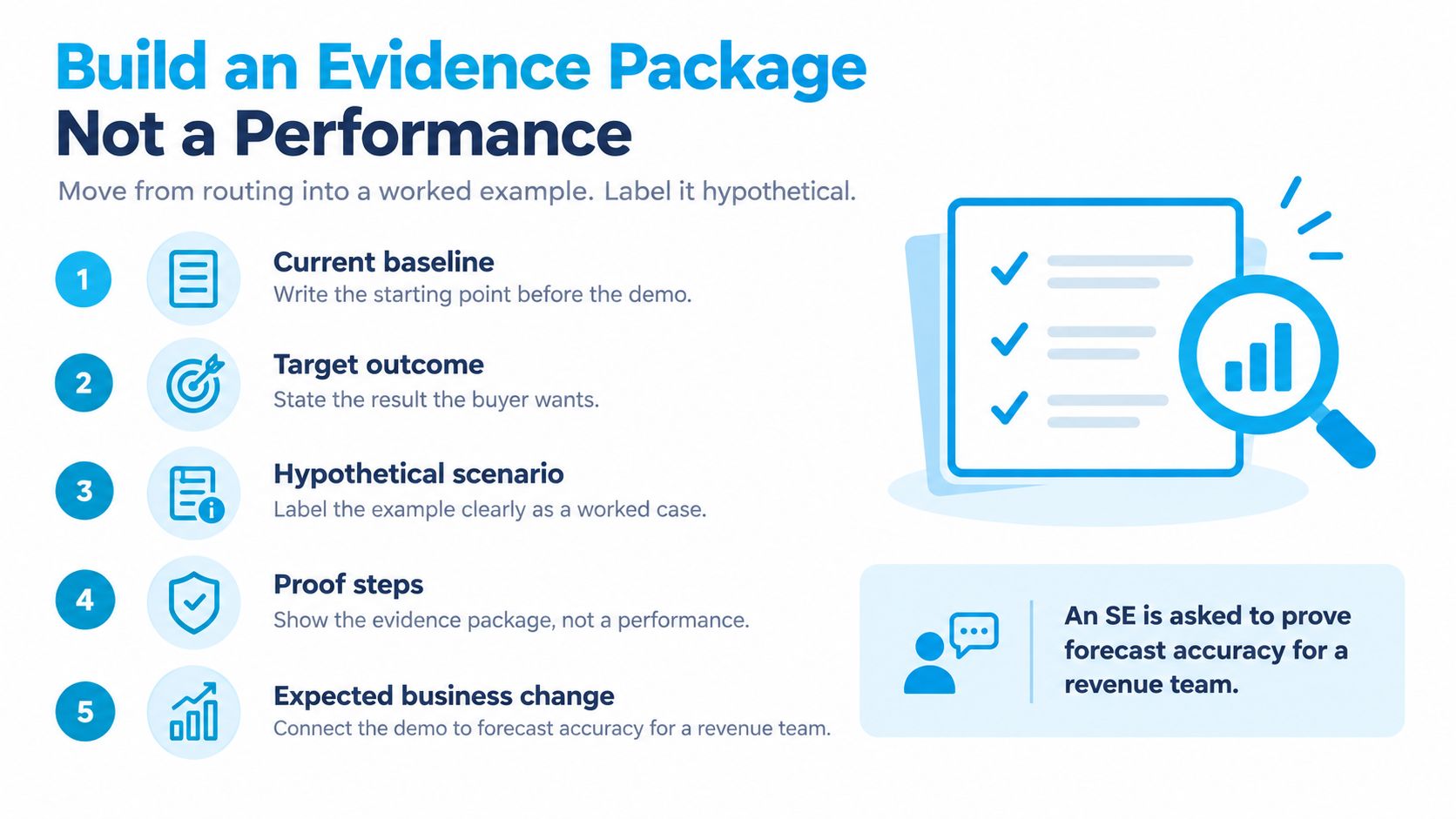
Build an Evidence Package Not a Performance
Hypothetical example: An SE is asked to prove forecast accuracy for a revenue team. Before opening the product, document the current baseline, the target outcome, the data sources, required integrations, test cases, owners, and decision date. The discovery call guide can help frame the questions behind that baseline.
Show only the workflow that connects the available data to the buyer's forecast process. Make dependencies visible. If the workflow relies on a particular integration or data quality condition, state that plainly. Finance, security, operations, and end users need enough detail to judge delivery risk, not just enough polish to enjoy the session.
Know when to use a PoC
A demo is enough when the buyer can assess the relevant workflow and evidence in the session. Move to a proof of concept when the buyer needs validation against a specific scenario before making a technical or security decision.
Microsoft's Azure Architecture Center describes a PoC or pilot as proof that a proposed solution addresses a business problem. It normally covers one to three features or capabilities, targets a specific scenario, and tests what the customer needs to know before a technical or security decision. Scope and decision criteria should be agreed in advance, including whether meeting them leads to purchase or implementation. Microsoft's Azure Architecture Center guidance on PoCs and pilots
For the hypothetical forecast deal, the success plan should name the test cases, owners, evidence to collect, and decision date. It should also say what happens if the criteria are met. A PoC without those boundaries is activity, not deal evidence. A PoC success criteria template can help turn the plan into an artifact the buying group can circulate.
Buyers may also need case studies, product documentation, independent research, benchmarks, and business-case tools to justify a purchase internally. Make the session leave something useful behind: an agreed evaluation matrix, an evidence summary, or a success plan that people who weren't in the room can assess.
Demo KPIs That Show Deal Progress
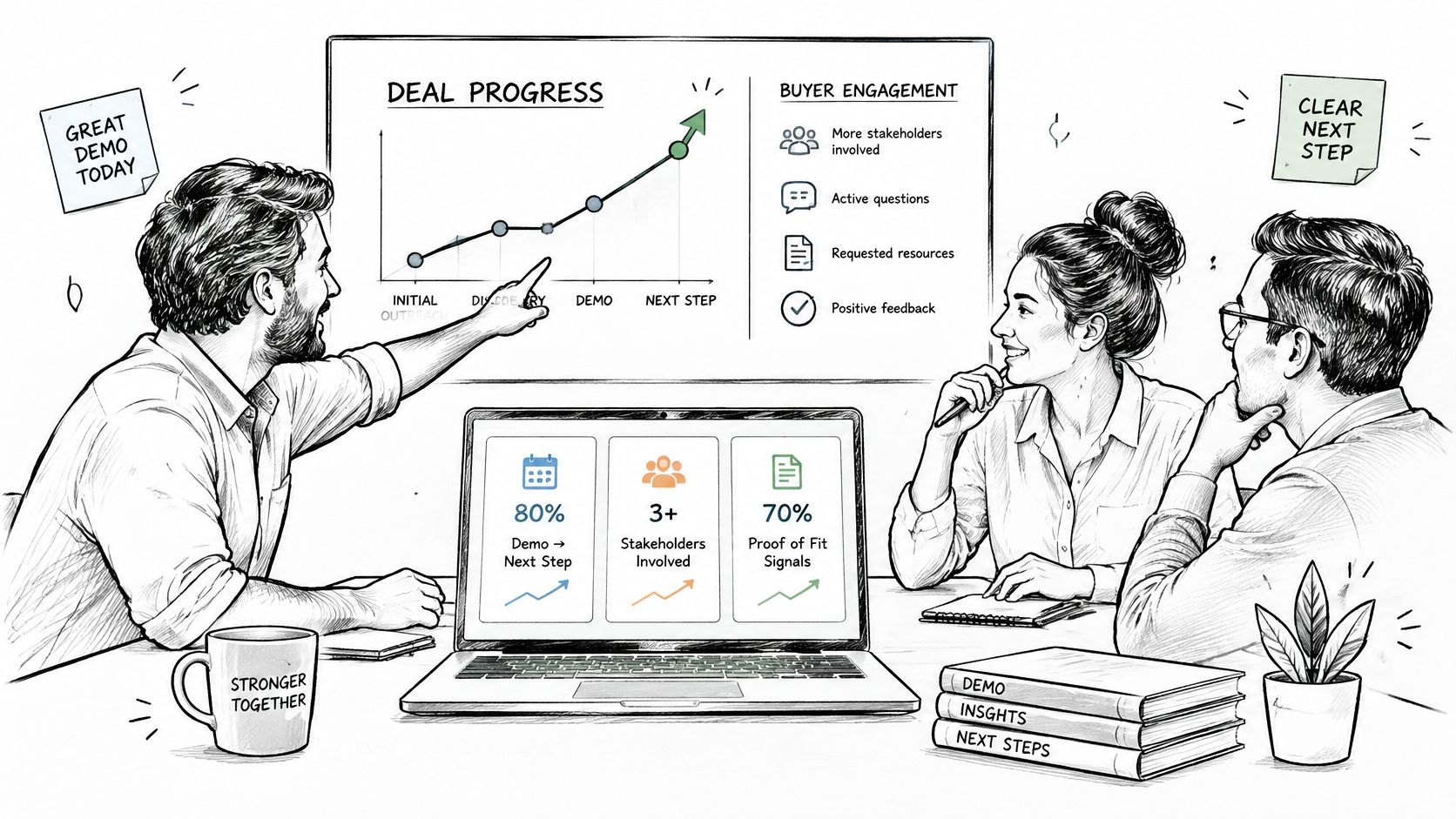
Count activity, but don't mistake it for progress. A session matters when the buyer accepts relevant scenarios as evaluation criteria, completes technical validation, or commits to a next step. Track signals that show whether the evidence changed deal behavior.
Forrester reports that 86% of B2B purchases stall during the buying process and 81% of buyers are dissatisfied with their chosen providers. Those figures are a reminder that a clean demo doesn't finish a purchase. The buying group still needs shared confidence in the solution and the decision. Forrester's reported B2B buying figures
Choose measures that expose deal movement
| Measure | Who records it and where | What a weak result signals |
|---|---|---|
| Discovery-to-demo relevance | The SE records whether the agenda reflects the buyer's stated problem in the opportunity notes. | Discovery didn't produce enough context, or the demo drifted from it. |
| Scenarios accepted as pass criteria | The SE logs which demonstrated scenarios the buyer agrees to evaluate. | The demo may have shown features without clarifying the buyer's standard for success. |
| Time to technical validation | The opportunity owner tracks the time from agreed criteria to technical confirmation. | Dependencies, ownership, or the test plan may be unclear. |
| PoC completion against agreed outcomes | The SE and champion record which pre-agreed outcomes were met. | Scope may be unbounded or the team may not have secured the right access and owners. |
| Next-step conversion | The account team records whether the session led to an owned next action. | The meeting didn't support a decision or a concrete follow-up. |
| Technical win rate | PreSales leaders report wins against the team's defined technical criteria. | The team may be counting activity without consistent evidence of technical success. |
In the hypothetical forecast deal, a before-and-after review should show a concrete change: the buying group has an agreed evaluation matrix, the next step has an owner and a date, and the technical win is recorded only when the stated criteria are met. Don't claim revenue ownership for work the SE doesn't control. Track technical influence accurately, using a consistent sales engineer KPI framework to define what the team records and how leaders review it.
How to Practice Demonstrate to Win on Live Deals
A one-off workshop can introduce a demo framework, but a slide deck won't keep it alive on current opportunities. Ad-hoc shadowing is useful when an SE needs to observe a specific session, yet it often leaves teams without a shared playbook for discovery, demos, and proofs of concept. The stronger operating model is repeated practice on active deals, with feedback tied to the next buyer interaction.
That doesn't mean every team should start with a full training program. A team with no discovery entry criteria should establish those first. Training can help SEs execute a process, but it can't decide which requests deserve a live demo if the team hasn't agreed on that rule.
Pick the practice that matches the gap
The Trusted Advisor Academy, operated by SE Rockstars as part of PreSales Unleashed, is a 12-month membership built around Learn, Train, and Adapt. It includes 37 or more hours of on-demand micro-video, 100 or more ready-to-use assets, and weekly live practice with up to four sessions per week. Activities include deal sparring, roleplay, pitch practice, and office hours, with feedback on discovery calls, demos, and proofs of concept.
The Academy also provides personalized learning paths, certificates and badges, and community access with 100 or more SEs. Its Trusted Leader Academy gives managers a monthly mastermind, quarterly playbooks, and coaching systems. Delivery is bilingual in English and German, with sessions scheduled in CET business hours.
For teams working on product workflow communication, practical app prototyping tips for mobile teams can also help frame how an interactive experience supports buyer evaluation. Keep the same standard: demonstrate the part that answers a real question, not every feature that can fit on screen.
If you're an individual SE, choose one live opportunity and prepare an evidence path before the next meeting. If you lead a team, decide whether the gap is skill, operating rhythm, or both, then compare PreSales training options with ongoing enablement support. For a one-to-one next step, book a discovery call.
PreSales Unleashed GmbH offers the Trusted Advisor Academy, a structured way for Solution Engineers and SE leaders to practice discovery, demos, and proofs of concept on active opportunities. Visit PreSales Unleashed GmbH to review the Academy and decide whether its ongoing practice model fits your team.