
The usual advice on BANT vs MEDDIC is too blunt: use BANT for small deals and MEDDIC for enterprise. That tells you almost nothing about whether a Solution Engineer (SE) should accept tomorrow's demo request. A modest subscription can require difficult integration work, while a larger expansion can follow an established buying path.
The better question is what evidence earns the next investment of SE time? Use BANT to screen for a plausible opportunity. Use MEDDIC to test whether a complex evaluation has a credible path to purchase. Neither acronym should grant unlimited access to your calendar.
Where BANT and MEDDIC Differ at a Glance
BANT and MEDDIC answer different questions. BANT asks whether an opportunity deserves early sales effort. MEDDIC inspects whether the value case, buying authority, evaluation, and internal support line up well enough to pursue a complex deal.
The distinction is operational, not stylistic. Avoma's explanation of MEDDIC separates lightweight qualification from continuous opportunity inspection, including the evidence needed before substantial technical work.
BANT and MEDDIC compared on the criteria that matter to SEs
| Dimension | BANT | MEDDIC |
|---|---|---|
| Core question | Is this opportunity worth early sales effort? | Can we win it, prove the value, and understand how the buyer decides? |
| Structure | Four fields: Budget, Authority, Need, Timeframe | Six fields: Metrics, Economic Buyer, Decision Criteria, Decision Process, Identify Pain, Champion |
| Evidence standard | Can capture stated answers after an initial sales call | Requires buyer-validated evidence for each field |
| Best stage | Top of funnel and lead triage | Active complex opportunities across the cycle |
| Best deal type | High-volume, low-complexity deals | Multi-stakeholder enterprise deals with long cycles |
| Main risk | Qualifies deals with budget and urgency but no value case | Adds overhead and slows deals that don't need it |
| Origin | Widely credited to IBM; Arrows' historical review identifies the earliest located IBM documentation as 2008 | Developed at PTC during the 1990s, according to Spona's MEDDIC history |
Read the table as an allocation decision
The core-question row tells you what decision you're making. The structure and evidence rows tell you how much investigation that decision needs. The stage and deal-type rows describe useful defaults, not hard boundaries based on contract size.
BANT's main risk is premature confidence. Funding and urgency can exist without a defensible reason to choose your solution. MEDDIC's main risk is process weight. Requiring a detailed stakeholder map for an uncomplicated purchase can consume time without changing your next action.
The origin row needs care, too. IBM's operational use of BANT is documented, but the familiar mid-century invention story isn't conclusively established. Historical influence doesn't make either framework the right choice for every opportunity.
Practical rule: Before choosing a framework, decide which SE hours it should protect.
An initial qualification call and a customer-specific proof of concept shouldn't require the same confidence. Treating them alike either blocks useful discovery or admits expensive evaluations too easily.
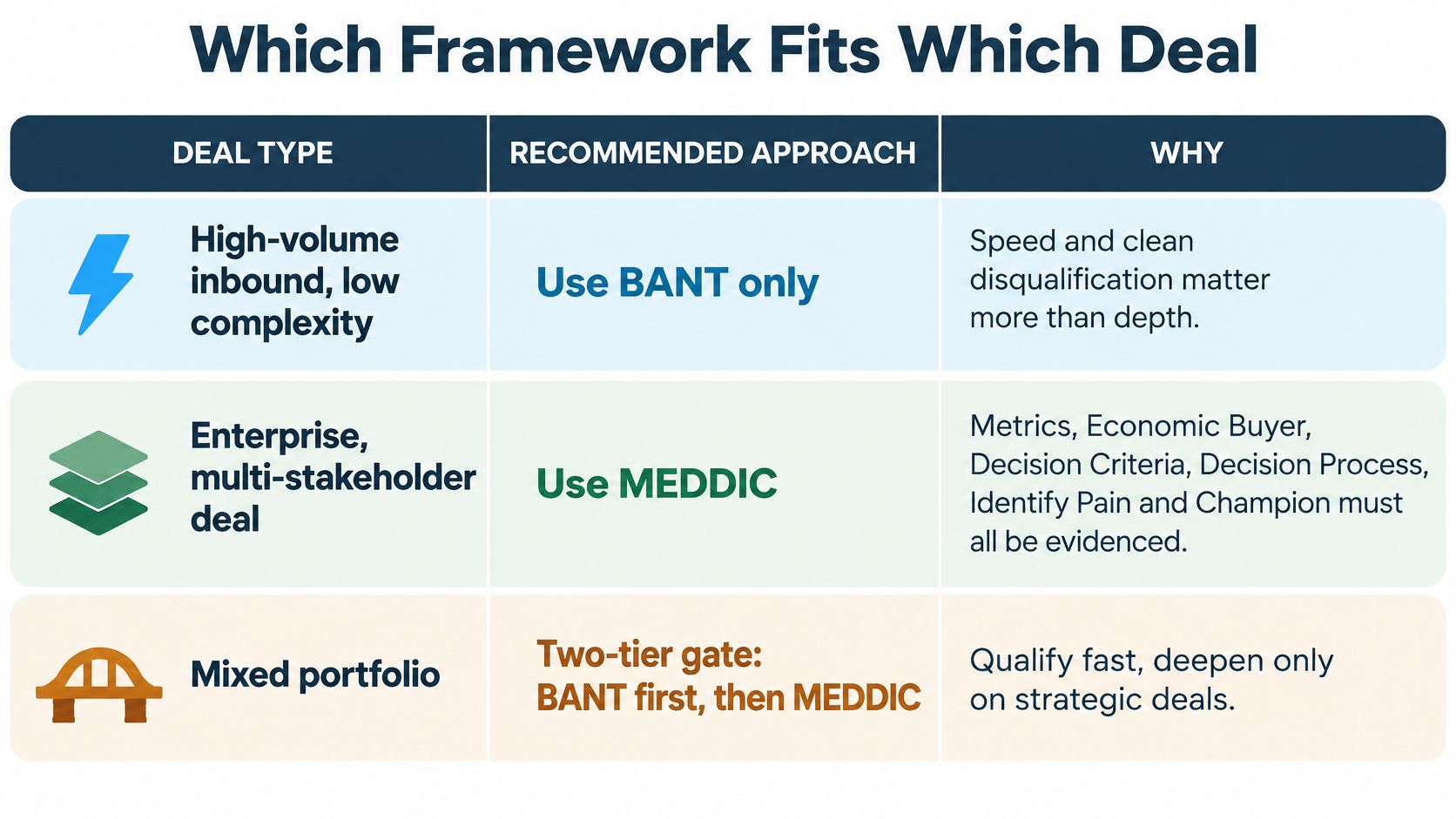
Which Framework Fits Which Deal
Which framework to use by deal situation
| Deal situation | Framework to apply | Why |
|---|---|---|
| High-volume inbound, low deal complexity | BANT only | Speed and clean disqualification matter more than depth |
| Mid-market, one buyer, short cycle | BANT for triage, MEDDIC only when SE effort rises | Keeps documentation light until the deal needs more |
| Multi-stakeholder enterprise, long cycle | MEDDIC on active opportunities | The economic buyer and approval path determine whether the purchase can proceed |
| Enterprise deal with a planned POC or pilot | Two-tier gate: BANT screen, then MEDDIC evidence | Protects scarce SE capacity before tailored work begins |
| Late-stage forecast review | MEDDIC evidence check | Surfaces missing evidence before a deal is committed |
| Stated budget, no named economic buyer | MEDDIC gate, hold SE investment | The budget claim isn't yet verified |
For uncomplicated inbound, disqualify cleanly when the first conversation establishes no plausible fit. Don't promote a lead because the contact accepted a meeting. Captiwate's discussion of why most MQLs never become SQLs provides useful context for defining that handoff rather than treating marketing engagement as sales readiness.
For mid-market opportunities, watch the work requested. A security review, integration investigation, or technical evaluation can justify deeper inspection even when the commercial conversation looks simple.
Let the requested work set the threshold
Enterprise evaluations need an explicit approval path before you commit to customer-specific work. Late-stage reviews need something different: a check that yesterday's evidence still supports today's forecast. A claimed budget without an identifiable owner shouldn't authorize a pilot.
Practicing those transitions is more useful than memorizing definitions. Our Academy includes 100+ ready-to-use assets, including templates, checklists, AI prompts, and phrasing guides. Live practice includes roleplays with expert feedback and pitch practice in a safe environment.
The selection rule stays consistent: choose by buying complexity and SE effort, not deal size alone. A framework earns its place when it changes an allocation decision.
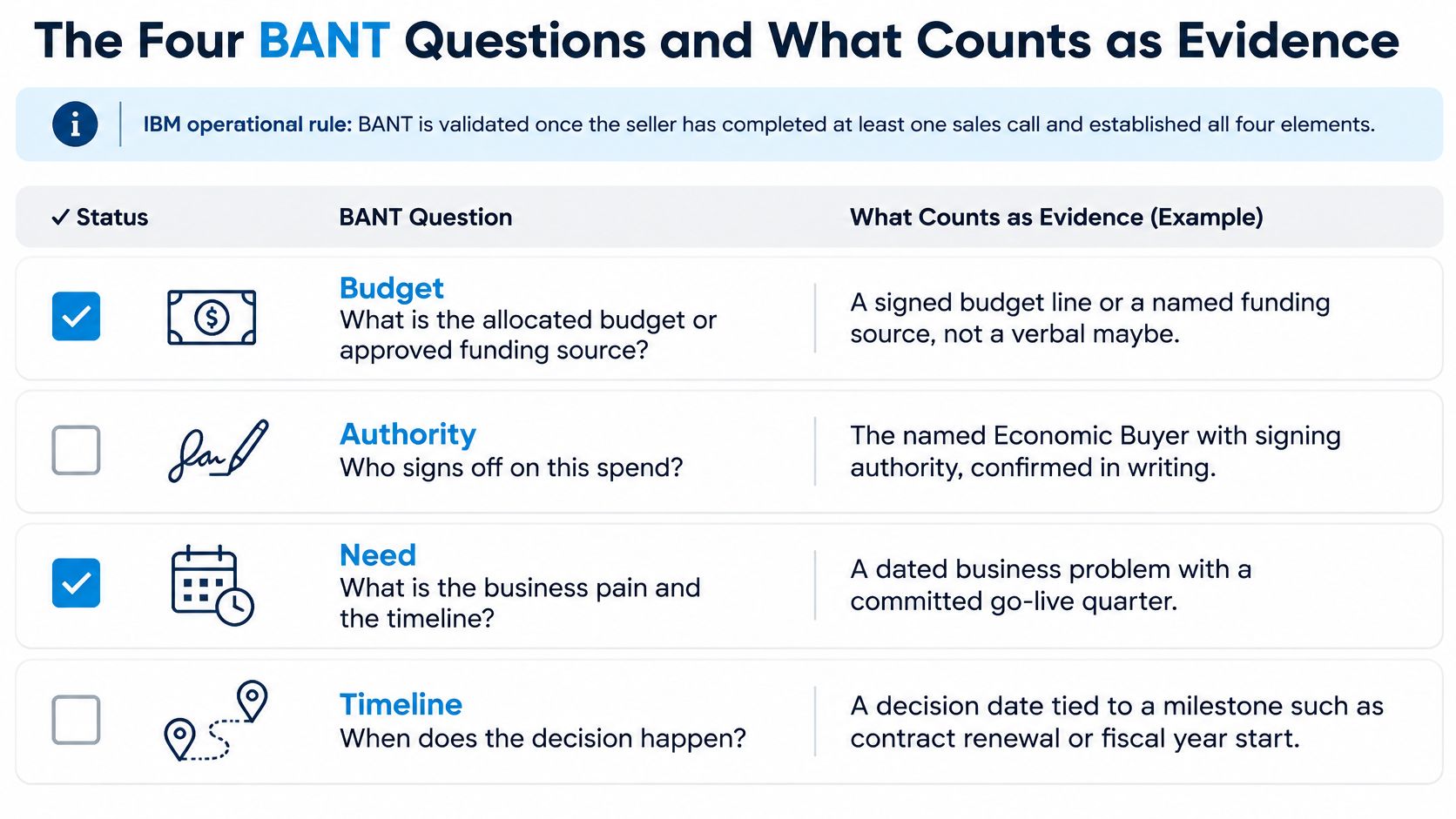
The Four BANT Questions and What Counts as Evidence
IBM's BANT qualification template defines a validated opportunity as one where the seller has completed at least one sales call and established Budget, Authority, Need, and Timeframe. That's an operational threshold for further effort, not a script you must recite in acronym order.
IBM lists Budget first, but doesn't require you to discuss funding before understanding the problem. Ask in the order that makes the buyer's situation understandable.
Make each answer checkable
| Field | Question to resolve | Useful evidence |
|---|---|---|
| Budget | What funding could support this purchase? | A named funding source and its approval status |
| Authority | Who can authorize or sign for the purchase? | A named person and a clear description of their authority |
| Need | What business problem warrants action? | The problem and its consequence in the buyer's words |
| Timeframe | When will the customer act, and why then? | A target date connected to a renewal, launch, or other business event |
A filled field isn't necessarily a validated field. Record whether the contact knows the answer directly, is repeating someone else's answer, or is making an assumption. That distinction matters more than whether the CRM cell contains text.
Hypothetical example: A prospect has a material need and a June deadline tied to a renewal, but no approved budget line. Keep Budget open and investigate the funding path. Don't describe the opportunity as fully BANT-validated, but don't automatically discard it just because funding hasn't yet been allocated.
The discovery call guide helps you structure that conversation around the buyer's problem rather than a checklist. Ask what happens if the renewal arrives without a change, then identify who would sponsor funding to avoid that consequence.
A missing answer is an investigation task. A fabricated answer is a qualification failure.
BANT can establish a reason to continue. It doesn't explicitly map how a committee reaches agreement or identify who will advocate for the change internally. Don't ask its Authority field to carry all of that meaning.
The Six MEDDIC Elements and Their Evidence Standard
MEDDIC focuses a team on complex opportunities rather than merely confirming budget and urgency. Its development is commonly credited to Dick Dunkel and Jack Napoli, working with senior sales leader John McMahon at PTC.
The MEDDIC glossary defines the framework's six elements, including measurable value, buying authority, decision mechanics, pain, and internal advocacy. For an SE, the useful shift is from recording an answer to showing why the team should believe it.
MEDDIC elements, the question each answers, and the evidence to require
| Element | Question it answers | Evidence to require |
|---|---|---|
| Metrics | What measurable value does the buyer expect? | Measures validated by the buyer, not the seller's estimate |
| Economic Buyer | Who can authorize the spend? | A named person with budget control and confirmed access |
| Decision Criteria | How will the buyer compare the options? | Criteria the buyer has written down and confirmed |
| Decision Process | Which steps and approvals lead to a decision? | Mapped people, steps, and dependencies |
| Identify Pain | What problem exists, and what happens if nothing changes? | The business consequence in the buyer's own words |
| Champion | Who sells internally when we're not in the room? | A named advocate who has taken action on our behalf |
Validation requires buyer participation
Read the table in order. Metrics establish what improvement matters; the Economic Buyer establishes who can fund it. Decision Criteria define the comparison, while Decision Process identifies how the customer will reach agreement. Pain explains why action matters, and Champion identifies who will advance it internally.
Hypothetical example: Your team calculates a savings figure and the contact repeats it during a demo. That isn't buyer validation. Ask the buyer to confirm the baseline, assumptions, and expected improvement in their own business-case model.
Apply the same discipline elsewhere. A senior title doesn't prove budget authority. A friendly contact isn't a champion until they act, such as arranging access to a skeptical approver or advancing the business case internally.
Record the evidence source, capture date, and next validation action. If your contact hasn't confirmed the evaluation criteria, the next action isn't to polish the demo. It's to agree on how the customer will judge it.
MEDDPICC adds Paper Process, covering contracting, legal, procurement, security, and administrative steps, and Competition, including rival vendors, internal builds, incumbents, and doing nothing. The MEDDPICC guide for Solution Engineers connects those controls to technical evaluation work.
Technical fit alone doesn't establish a purchase path. You can earn the technical win while the commercial decision remains unresolved.
Where BANT Breaks Down in Complex Deals
Hypothetical example: An opportunity passes BANT, you complete the evaluation, and the purchase stalls. The contact had a need, a deadline, and apparent authority. Nobody had established whether the available funding could pay for the platform.
That's the uncomfortable failure mode: a contact's answer becomes a company-level fact. ParrotNotes' BANT-versus-MEDDIC comparison distinguishes stated qualification from verified deal evidence and highlights the value of confidence levels rather than unchecked assertions.
Test the scope of each claim
Consider these hypothetical situations:
- Budget mismatch: The contact identifies discretionary training funds, but the proposed platform requires a different approval and funding category.
- Authority mismatch: A manager owns the workflow but can't authorize the purchase without finance approval.
- Deadline mismatch: The desired June launch depends on a renewal that procurement hasn't reviewed.
- Champion mismatch: An enthusiastic evaluator attends every meeting but won't introduce the team to other approvers.
None requires the contact to be dishonest. People can accurately describe their own responsibilities while misunderstanding another team's requirements.
The cost to PreSales is tangible. You configure an environment, investigate integration edge cases, and support an evaluation before learning that nobody owns the purchase decision. The technical work may be sound, but the team allocated it against incomplete commercial evidence.
Don't challenge the buyer's credibility. Clarify the boundary of what they can confirm.
Ask who else reviews the proposal, which team approves the funding category, and whether procurement has agreed to the target date. The buyer should understand that you're helping construct a workable plan, not testing whether they deserve your attention.
Look for missing connections
A BANT-only record deserves scrutiny when the contact can't identify other reviewers, the need has no measurable consequence, or nobody has discussed alternatives. Another warning sign is an evaluation checklist the buyer can't explain. Establish who wrote it and why those requirements matter.
BANT remains efficient for triage. Its limit is that an initial qualification result doesn't, by itself, tell you whether the opportunity remains credible as more stakeholders and dependencies appear.
Where MEDDIC Adds Overhead Without Adding Value
More qualification fields don't automatically produce better qualification. They can produce duplicate interviews, conflicting notes, and CRM entries written to satisfy a stage rule rather than inform a decision.
The small-deal versus enterprise split is a false binary. Buying complexity is the useful variable. A small deployment can need security and data-governance approval, while an established customer's expansion may follow an already understood process.
When the process becomes the work
Hypothetical example: You're supporting a 15-seat mid-market purchase with one buyer and a four-week cycle. The buyer has a straightforward requirement and can authorize the spend. Building a separate executive relationship map and elaborate decision-process document may consume effort without changing the buying plan.
The opposite mistake is assuming the deal is simple because the subscription is small. Ask whether technical or administrative dependencies introduce uncertainty before deciding how much qualification to require.
| Symptom | What to change |
|---|---|
| AE and SE repeat the same discovery questions | Share a qualification record and investigate only unresolved points |
| CRM fields contain generic statements | Require a source and a next action, not more text |
| Forecast confidence conflicts with technical notes | Review the disagreement explicitly with the manager |
| Every opportunity requires the same documentation | Set requirements by stage and requested SE investment |
A completed form can conceal unresolved risk. A field reading “efficiency gains” tells you little unless the buyer has explained what improves and why it matters.
Technical complexity needs explicit ownership
Don't bury these signals inside general discovery notes:
- Security review: Identify the reviewer, requested evidence, and approval dependency.
- Integration feasibility: Confirm systems, access requirements, and responsibility for implementation.
- Proof-of-value requirements: Agree on what the evaluation must demonstrate.
- Data-governance approval: Establish who can authorize the proposed use of customer data.
Then assign ownership. Which elements must be established before the next stage? Which belong to the AE, which require SE validation, and which need a manager's decision?
The useful test is uncomfortable: which of your current qualification fields can someone mark complete without any buyer evidence? Fix those before adding another mandatory field.
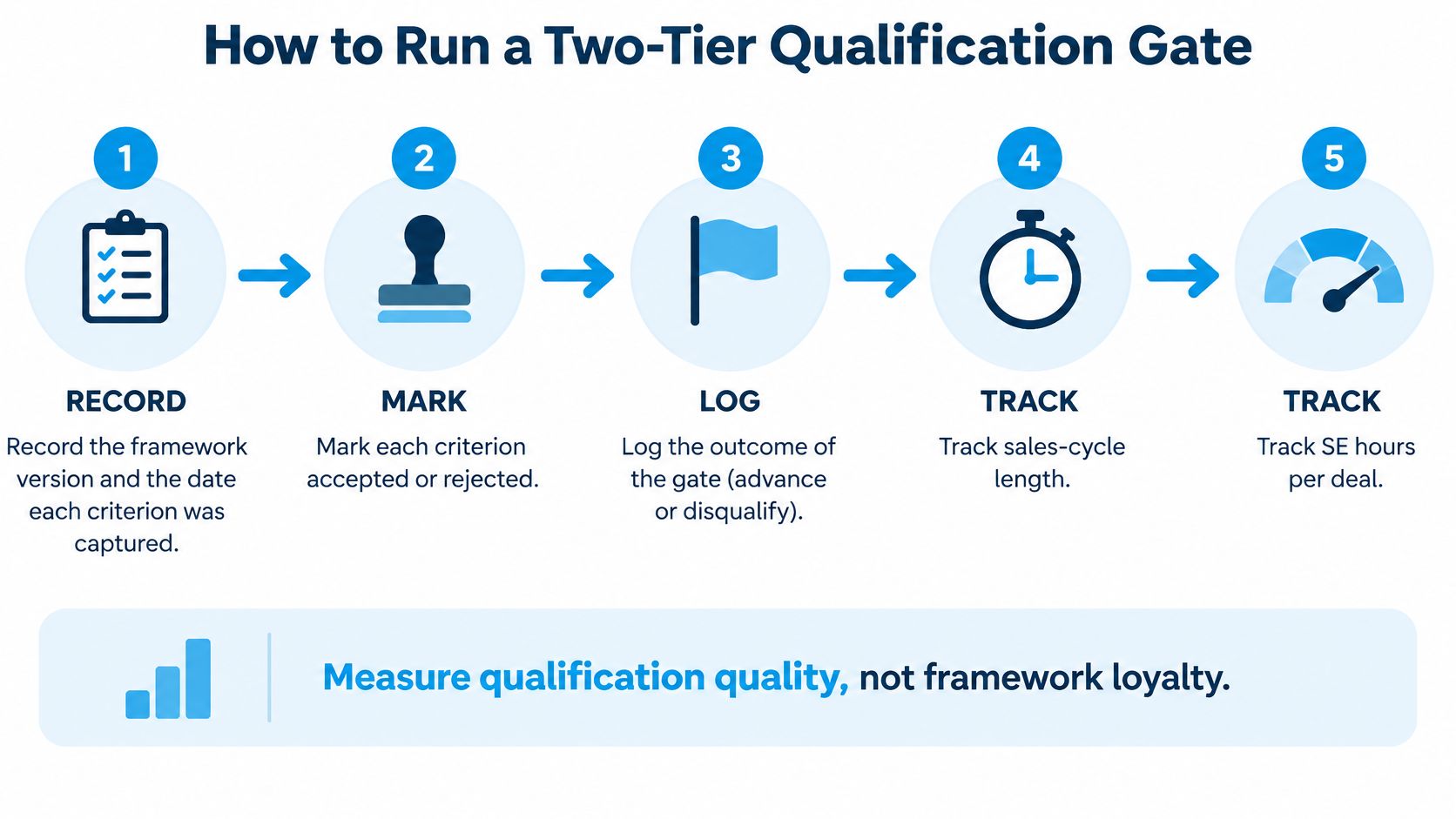
How to Run a Two-Tier Qualification Gate
Measure qualification quality, not framework loyalty. Isoglu's BANT-versus-MEDDIC analysis recommends comparing controlled funnel metrics rather than claiming a universal win-rate lift. Capture framework version, criterion stage and date, accepted and rejected leads, won/lost/no-decision outcomes, sales-cycle duration, SE hours, technical-win rate, and forecast slippage.
Compare cohorts by segment, annual contract value, stakeholder count, and cycle length. Otherwise, a change in deal mix can look like a methodology improvement.
Define confidence before enforcing stages
Use these labels consistently:
| Confidence | Meaning |
|---|---|
| Claimed | A contact or seller states it, but supporting evidence is absent |
| Corroborated | A second source or relevant document supports the claim |
| Documented | The responsible buyer has confirmed the current answer in a retained record |
Documentation doesn't make an answer permanent. Reopen the field when the approver, scope, evaluation, or timing changes.
Apply the operating rules
-
Screen with BANT on the first call. Establish whether there's a plausible problem, commercial path, relevant contact, and timeframe. A lead with no claimed need or timeframe leaves the active funnel for nurture or disqualification. The threshold is a credible reason for continued discovery, not permission for custom work.
-
Tag every field with its confidence level. Preserve the actual answer alongside its source and date so a name in a cell doesn't imply confirmed access. Advance only with visible uncertainty, not blank fields disguised as complete qualification.
-
Require a minimum evidence plan before assigning SE capacity. Metrics, Economic Buyer, Decision Process, and Champion should be at least claimed, each with a named next validation action. This permits bounded technical discovery, not an open-ended evaluation.
-
Release a custom demo, architecture workshop, or POC only when Economic Buyer and Decision Criteria are at least corroborated. For a POC, also agree on success criteria, customer responsibilities, and the decision that follows. No discovery, no demo: discovery quality, not demo polish, decides what you should demonstrate.
-
Escalate persistent uncertainty. If a field remains claimed after two stages, the sales manager reviews whether to narrow the work, secure access, or stop investment. This is a proposed operating policy, not an industry benchmark.
-
Assign owners explicitly. The AE owns Economic Buyer and Paper Process; the SE owns Decision Criteria and technical validation; the manager arbitrates conflicts. Give every other field a named owner, and allow exceptions only when the manager records the reason and bounded investment.
Verify without interrogating. Ask who else reviews the proposal, what the current process costs, and what happened when the customer previously tried to solve the problem.
Connect these rules to your entry and exit criteria. A gate should change what work gets approved, not merely add another dashboard.
Run the Gate Next Week
Don't begin with a CRM redesign. Start by checking whether the evidence behind your current opportunities would justify the work already scheduled.
Use the coming week to make these actions concrete:
-
Audit and configure. Review your last ten closed deals and mark each qualification field as evidenced or assumed. Then create a shared CRM view with one row per field, its confidence level, evidence source, capture date, and owner. Treat the audit size as a practical starting point, not a statistically representative sample.
-
Validate an active gap. On each active deal, choose one missing field that could change your next SE commitment. Obtain buyer confirmation, log the source, and put the resulting customer action into a mutual action plan. Don't turn internal qualification labels into customer homework.
-
Review stalled claims. Bring every opportunity where a field stayed claimed after two stages to your sales manager. Decide whether to continue, reduce scope, seek another stakeholder, or pause the evaluation. Record the decision so the same request doesn't return unchanged.
Practice the next conversation
Trusted Advisor Academy provides ready-made templates and checklists, plus live roleplays with expert feedback for practicing these questions. Use that practice to make your requests sound like joint planning rather than an internal compliance exercise.
Your next step is to choose an upcoming evaluation request and apply the gate before accepting it. If you want to test the discovery questions first, request a discovery-call session and bring the unresolved qualification point you need to validate.
PreSales Unleashed GmbH offers structured PreSales training and enablement through Trusted Advisor Academy, combining learning assets, live practice, and application to active opportunities. Visit PreSales Unleashed GmbH to explore how your team can practice evidence-based qualification, align AE and SE responsibilities, and set clearer boundaries around demos and POCs.