
The popular advice is to start with your target close date and work backward. That's the wrong anchor. Your quarter-end doesn't explain why a buyer should finish a security review, defend a business case, or commit an implementation team.
A mutual action plan template earns its place when it helps the buyer make and execute a decision. For a Solution Engineer (SE), that means connecting the technical win to named approvals, a credible business deadline, and measurable first value. A polished spreadsheet won't create that commitment. Buyer participation will.
Copy-Ready Mutual Action Plan Template Fields
| Field | What to write | Example (hypothetical) |
|---|---|---|
| Milestone | Action as verb plus outcome | Security review completed, with evidence list agreed |
| Buyer owner | Named person with decision authority | Head of IT, confirmed by the champion |
| Seller owner | Named SE or AE accountable for the action | SE owns integration evidence |
| Target date | Date the buyer confirms, marked buyer-controlled or external | March 14, buyer-confirmed and buyer-controlled |
| Dependency | Milestone that must close first | Legal redlines wait for security sign-off |
| Status | Open, at risk, done, or slipped with new date | At risk, date moved and recorded |
| Exit criterion | Objective condition that closes the milestone | Signed order form with kickoff date |
A mutual action plan (MAP) is a shared buyer-seller roadmap from active evaluation through purchase and implementation. Copy these fields into a shared Google Sheet, Excel workbook, or buyer-accessible document. Use a separate milestone row for each decision or approval, rather than packing the evaluation into a single entry.
Write the milestone as an outcome, then identify who can accept it. Replace role placeholders with actual names during the buyer review; an interested contact isn't automatically an authorized approver.
The target date needs buyer confirmation, and the dependency needs to reflect the buyer's actual process. Don't assume legal must wait for security unless the buyer says so.
Practical rule: A meeting is an activity. An accepted deliverable is evidence of progress.
For security, completion means the named approver accepts the agreed evidence checklist, not that everyone attended the call. Keep status separate from completion evidence so a rescheduled meeting doesn't become a completed milestone.
The Revspire MAP benchmark provides observational comparisons, not proof that adding a document causes better outcomes. The operational reason to use the template is simpler: you can inspect owners, dependencies, and unfinished decisions instead of trusting a pipeline stage.
How to Build the Plan Backward From Go-Live
Start with the outcome the buyer needs to achieve. Then identify what must be true before that outcome is possible, including implementation readiness, contracting, approvals, and technical validation. Icaro Iasbeck's mutual action planning guide recommends this backward-planning approach, with verifiable milestones rather than an aspirational close date.
Use the buyer's deadline as the planning anchor, not as a reason to compress work unrealistically.
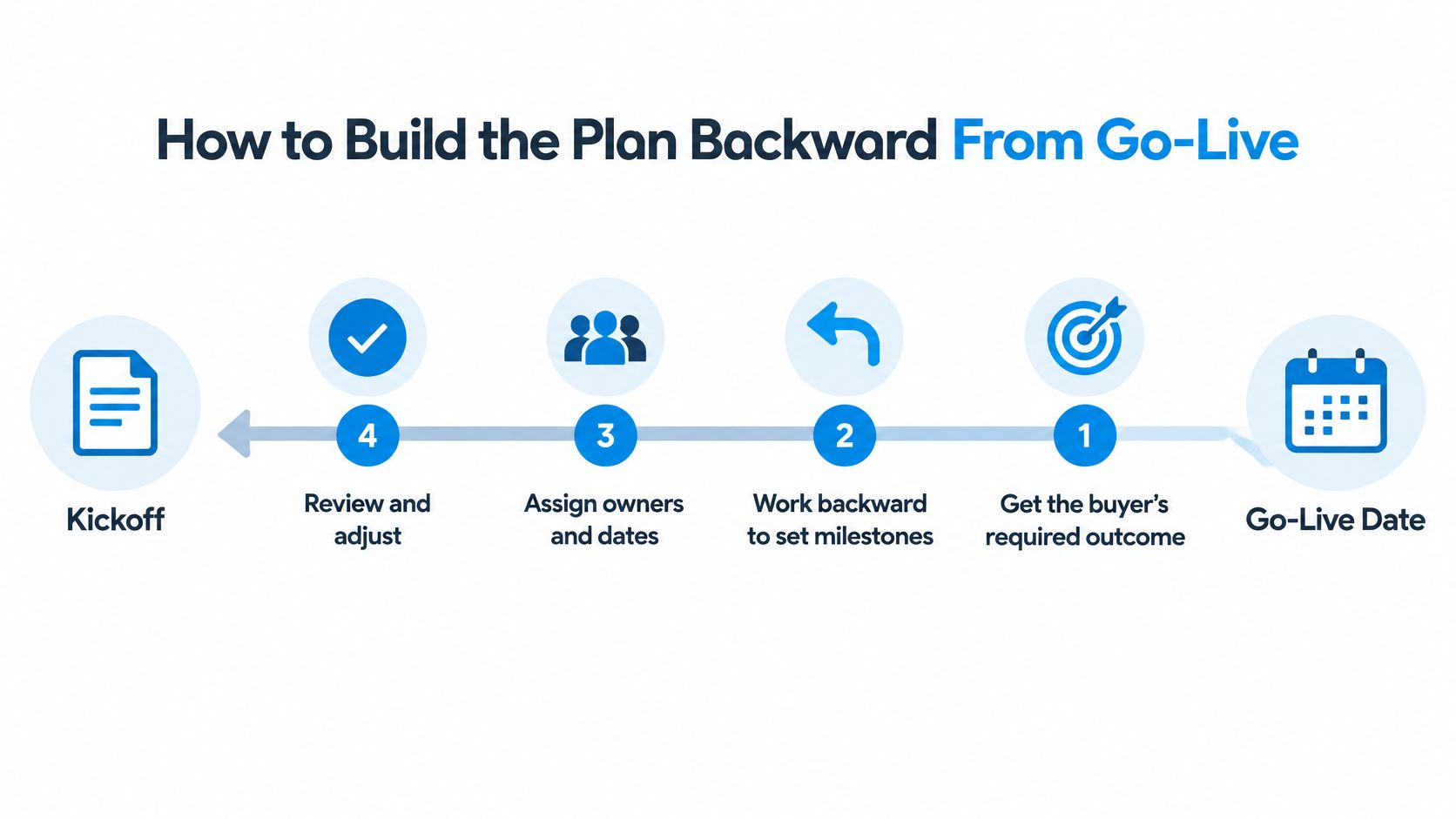
Build the decision path
-
Get the required outcome and date in writing. Ask what needs to be operational and what business event makes that date matter. This protects you from treating a preferred purchase date as a committed deployment deadline.
-
Organize the work into Evaluate, Validate, Decide, Contract, and Launch, following the structure described in Checkpoint GTM's MAP guide, which suggests three to six steps per phase. Keep only milestones that change readiness or decision status, so the buyer can inspect the path without reading a delivery backlog.
-
Attach an owner on each side, a target date, and a status. The seller owner commits to producing an outcome; the buyer owner commits to reviewing, accepting, or routing it. This prevents shared responsibility from becoming nobody's responsibility.
-
Mark dates as buyer-controlled or external. A buyer can negotiate an internal review slot, but a contract expiration may require a different contingency. This distinction protects the deal from a schedule that looks flexible when it isn't.
-
Flag any critical step without a confirmed date, rationale, or owner. Leave the gap visible and agree who will resolve it. Missing information is qualification evidence, not permission to invent a deadline.
Keep technical ownership precise
During Validate, you own the technical outcome, not the buyer's approval. You can provide integration evidence, document limitations, and demonstrate the agreed workflow; the buyer's technical lead must decide whether that evidence meets their requirements.
That boundary matters when an AE asks whether the technical win is complete. An SE's confidence isn't a substitute for buyer acceptance. No discovery, no demo applies here too: discovery quality determines which workflow and acceptance conditions belong in the plan.
Use this video alongside the working document when discussing the planning process.
After the first buyer review, confirmed milestones should have dates and named owners on both sides. Any missing approver should remain visibly unresolved, with someone accountable for finding them. Don't fill the gaps merely to make the document look finished.
Six-Week Milestone Timeline With Exit Criteria
Treat this as an example evaluation-to-signature sequence, not a standard sales cycle. Revspire's MAP examples place goals in week 1, workflow validation in week 2, integration checking in week 3, proposal review in week 4, redline resolution in week 5, and signature plus kickoff scheduling in week 6.
The parallel approval windows below follow Prolifiq's sales close plan example, which places security in weeks 2–3, procurement in weeks 3–4, legal in weeks 4–6, and executive approval in weeks 6–7. These are example windows, not promises about your buyer's process.
| Week | Milestone | Exit criterion |
|---|---|---|
| Week 1 | Goals and success measures agreed | Written goals and measures confirmed by buyer |
| Week 2 | Workflow demo | Stakeholder confirms the workflow fits |
| Weeks 2–3 | Security and IT review | Evidence delivered and approver signs off |
| Week 3 | Integration check | Integration requirements confirmed in writing |
| Weeks 3–4 | Procurement onboarding | Supplier forms accepted by procurement |
| Week 4 | Proposal review | One option selected |
| Weeks 4–6 | Legal and MSA redlines | No open legal points |
| Weeks 6–7 | Executive sign-off | Business case approved |
| Week 6 | Signature and kickoff scheduling | Signed order form with kickoff date |
Don't overlook the scheduling conflict: if executive approval is a prerequisite and finishes after the proposed signature date, signature must move. The table exposes that conflict; it doesn't resolve it. Confirm whether approval can happen earlier before presenting the signature date as credible.
Use the visual as a simplified discussion aid, not as a replacement for dependency checks.
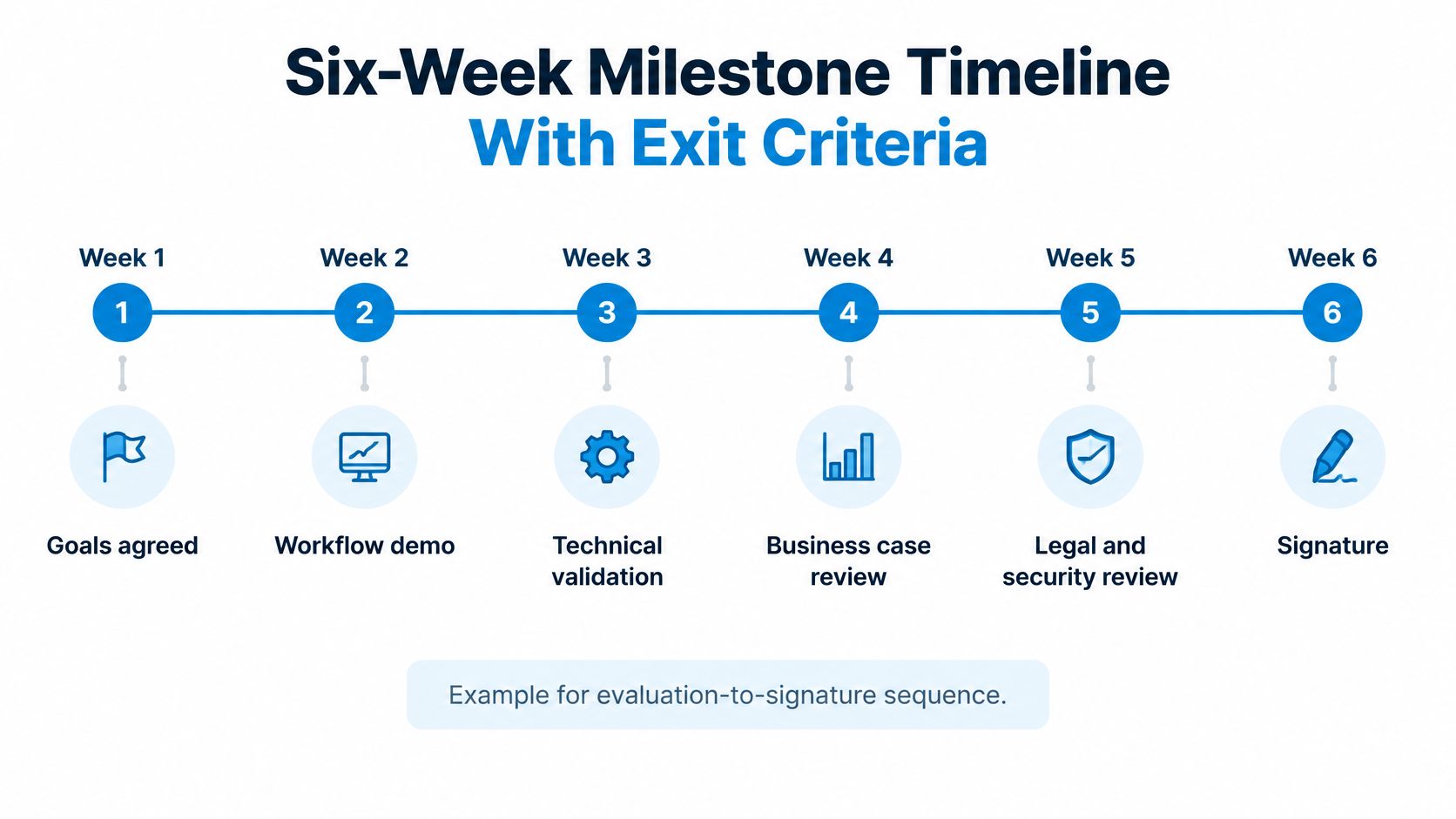
Require acceptance, not attendance
Written goals stop evaluators from changing the test without acknowledging it. Workflow confirmation establishes that the demonstration addressed the buyer's work. Integration requirements expose assumptions about authentication, data movement, permissions, and ownership.
The common failure is marking the demo complete because you delivered it. If the stakeholder hasn't confirmed workflow fit, the activity happened but the milestone remains open.
Don't mark a milestone done because your team has finished talking.
For a pilot, put test execution and evidence in a separate POC project plan, then bring the acceptance decision into the MAP. This keeps detailed testing from overwhelming the buying process.
For the transition after acceptance, Coachful's eight-step coaching onboarding workflow offers an adjacent-service perspective on onboarding structure. Use it as a prompt for examining handoffs, not as a SaaS evaluation benchmark.
Send security materials early enough for review to run alongside commercial work. Before sharing the timeline with the buyer, write an objective exit criterion beside every milestone.
Assign Owners Across the Buying Group
A MAP routed entirely through a champion can fail when that person lacks authority or loses an internal argument. Build for agreement across functions, not just responsiveness from your favorite contact.
The 6sense Buyer Experience Report describes buying groups with conflicting vendor preferences and buyers who may already have ranked their shortlist before engaging sellers. Introduce the plan while requirements and internal alignment are still open.
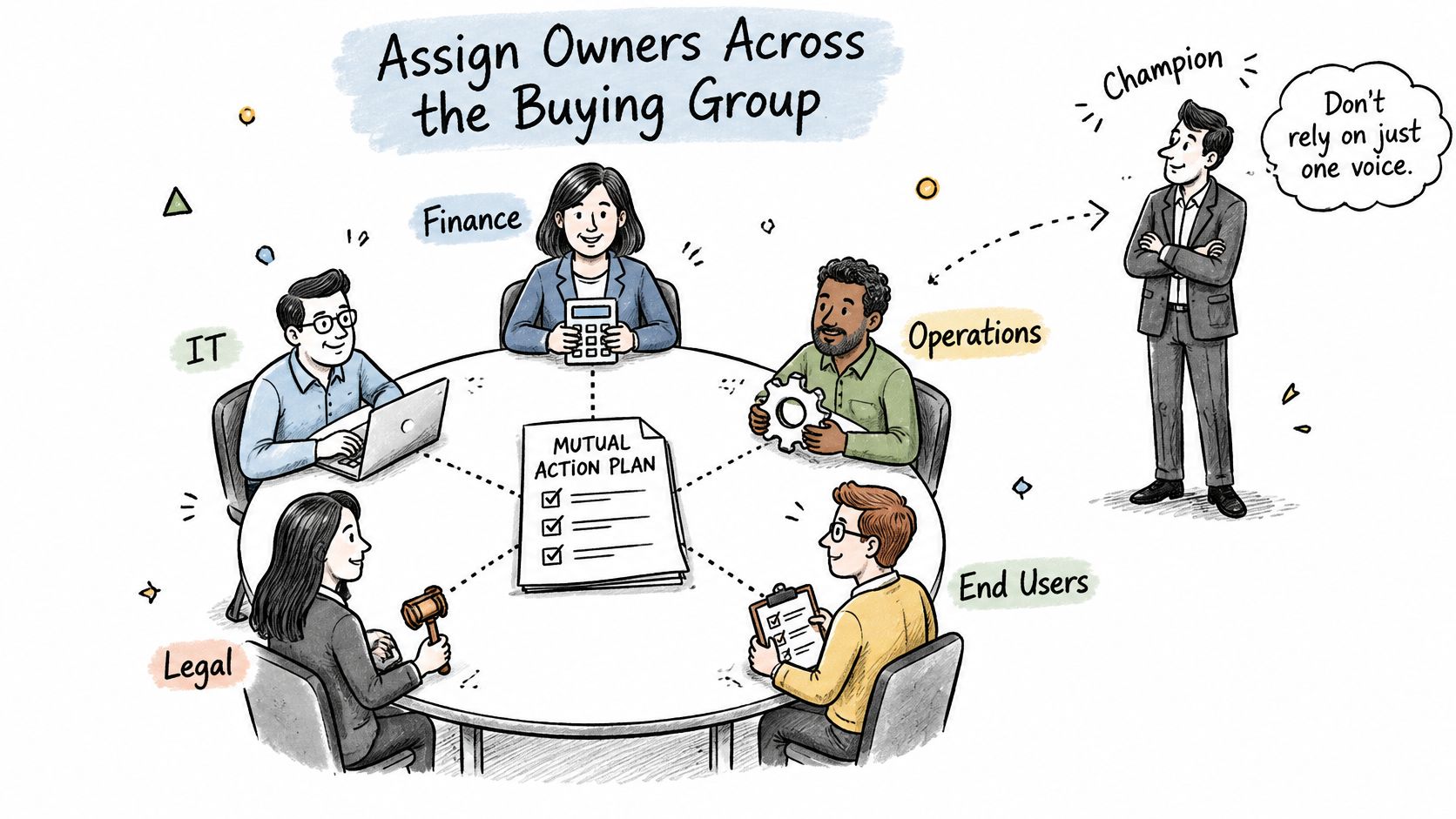
| Role | Typical concern | Proof they need | Decision authority |
|---|---|---|---|
| Economic buyer | Business case and payback | Quantified outcome tied to the buyer's goal | Budget approval |
| Technical evaluator | Fit with existing architecture | Integration evidence and reference architecture | Technical sign-off |
| Security | Data handling and access control | Security documentation and review timeline | Approval or veto on risk |
| Legal | Contract and data processing terms | Master agreement and data processing redlines | Acceptance of terms |
| Procurement | Vendor onboarding and compliance | Supplier forms and process steps | Process gate |
| Operations | Day-to-day workload and adoption | Implementation plan and training scope | Adoption sign-off |
| Executive sponsor | Strategic risk of inaction | One-page outcome summary | Go or no-go |
Confirm authority before commitment
Treat these authorities as starting assumptions to validate. Add each person's name, planned interaction, and confirmation status to the register; your buyer may distribute authority differently.
Before commercial commitment, gather the relevant stakeholders to confirm outcomes, decision criteria, risks, implementation ownership, and the consequences of doing nothing. Use MEDDPICC for Solution Engineers to connect those confirmations to deal qualification.
Hypothetical example: your champion names a legal reviewer but says legal will review later. Keep the row at risk until that contact confirms a review date.
This week, add a missing stakeholder and name the person responsible for bringing them into the plan.
Test Whether the Buyer Owns the Dates
Most templates are seller checklists with buyer names added. Buyers recognize the difference between help making a decision and pressure to advance your sales stage. A document doesn't become mutual because the champion received it.
Aligned's mutual action plan guide highlights the buyer-participation problem. The useful test is whether each milestone helps the buyer resolve uncertainty, coordinate internal work, or reduce purchase risk.
Run this checklist before your next buyer meeting.
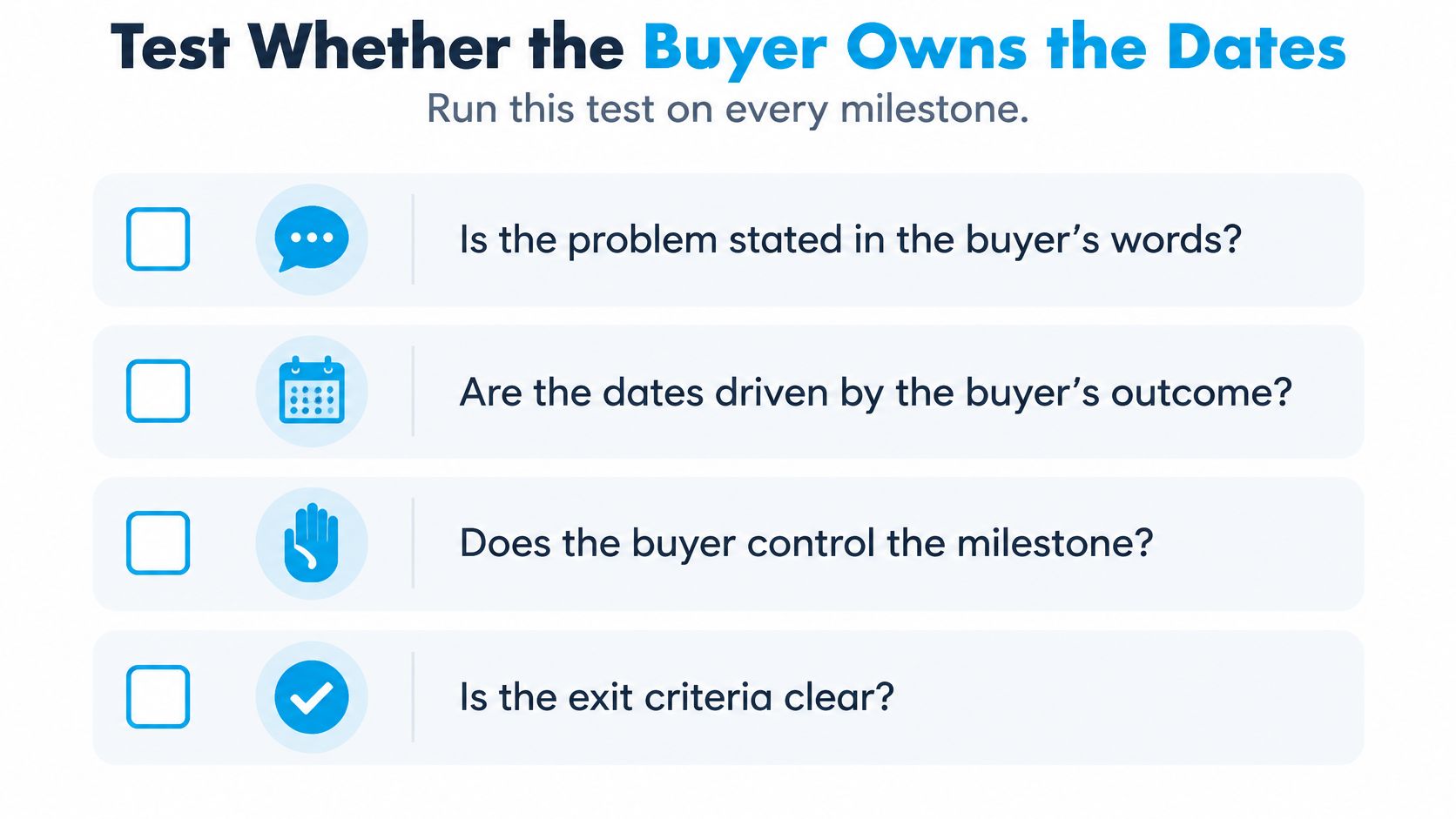
Ask questions that expose borrowed certainty
-
Whose problem are we describing? Ask the buyer to restate the outcome without your product language. Then identify the business event behind the urgency, rather than accepting an unexplained request to move quickly.
-
Who has agreed? Distinguish stakeholders who have confirmed their work from people the champion has merely named. A name in a spreadsheet doesn't establish capacity, consent, or priority.
-
What authority does the champion have? Ask how budget approval and signature routing work, and who can stop either process. Don't confuse someone's enthusiasm for your solution with their ability to commit the organization.
-
Who controls this date? Establish whether the buyer can reschedule it or whether an external event determines it. Ask what happens if the date is missed, including whether the business outcome remains achievable.
-
What does the buyer gain by completing this milestone? If the answer is only that your opportunity advances, rewrite it around a decision or risk the buyer needs to resolve. Proposal delivery, for example, has less buyer value than confirming an option they can take through approval.
Respond differently to different slips
An internal deadline may call for reprioritization, a different reviewer, or a narrower evaluation scope. An external deadline may require a contingency, such as negotiating an extension or changing the launch sequence. Don't respond to either by moving the date cell alone.
For wider process issues, H2's guide to managing a lengthy B2B sales cycle provides context for examining deal progression. Keep that process discussion separate from pressuring an individual buyer to adopt your preferred timetable.
Use explicit entry and exit criteria to distinguish readiness to start a milestone from evidence that it's finished. That makes it easier to challenge an unsupported status without challenging the buyer's intent.
A plan the buyer doesn't recognize as their own gets ignored, even when every date is correct.
Track the Plan Through Go-Live and First Value
Signature doesn't prove the buyer received the outcome that justified the purchase. A technical evaluation can succeed while implementation stalls on data readiness, access permissions, training, or operational ownership.
Salesmotion's mutual action plan template guide recommends extending the plan into kickoff, first value, or a 30-day review. Carry the accepted success criteria into delivery rather than asking the implementation team to reconstruct the business case.
Add post-sale acceptance conditions
-
Implementation owner. Name the customer lead and delivery counterpart who accept responsibility for launch readiness. Record who can approve scope changes.
-
List customer-side dependencies, including data preparation, identity configuration, environment access, and internal communications. Assign each dependency to the person who can complete it, not automatically to the champion.
-
Enablement completion needs evidence. Attendance may establish that training happened; a user completing the target workflow establishes whether they can apply it.
-
Choose an adoption metric tied to the intended behavior. For a hypothetical forecasting deployment, that could mean managers completing the forecast workflow without returning to the previous spreadsheet process.
-
Define first value as an observable business result, not just an activated account. Identify who will confirm that result and what evidence they'll inspect.
-
Add an escalation path for blocked customer work and unresolved seller commitments. Name the people who can change priorities or authorize a workaround.
-
Schedule a value review with the stakeholders who approved the outcome. Compare the result with the original baseline, including any assumptions that changed.
Keep execution tasks in a linked delivery tracker rather than expanding the MAP into an unreadable backlog. The BlokNotes project task list walkthrough is a useful companion for organizing task-level work beneath those decision milestones.
Preserve the baseline when plans change
Keep the original target, current target, change reason, impact, and approving owner. Overwriting the old date removes the evidence you need to diagnose the problem.
Change-control rule: Record what changed and why before accepting the replacement date.
If first value slips while adoption remains on track, investigate delivery constraints and measurement timing. If adoption never starts, inspect readiness, ownership, incentives, and the original business case before blaming implementation alone. These are diagnostic signals, not automatic verdicts.
Update the shared plan at every customer interaction and re-confirm dates after major milestones. The SE doesn't need to become the implementation manager, but the handoff must preserve the buyer's original reason to act.
Confirm Owners and Dates With Your Buyer This Week
Your next meeting should produce buyer decisions, not another seller-authored version. Prepare a draft that reflects discovery, then leave room for the buyer to correct your assumptions.
-
Send the draft before the call. Populate the business outcome, proposed milestones, and acceptance conditions. Leave unconfirmed buyer owner and date fields blank so the buyer supplies commitments rather than inherits yours.
-
Book a 30-minute working review, as a practical meeting format, with the accountable buyer owner, not only the champion. Walk through Evaluate, Validate, Decide, Contract, and Launch in order, concentrating on unresolved decisions.
-
Ask for the business event behind each external date. Confirm the consequence of missing it and whether a contingency exists. Don't accept urgency without an explanation.
-
Ask who else must see the plan and agree who will invite them. Finish with named follow-up owners rather than a general promise to circulate the document.
Support the next live opportunity
If your team needs a starting library, the Trusted Advisor Academy includes 100+ ready-to-use assets, such as templates, checklists, AI prompts, and phrasing guides. For help applying the approach to current opportunities, book a discovery call.
Keep the immediate action small: choose an active evaluation, draft the buyer's decision path, and send the plan before your next call. Don't wait for a perfect template before asking the buyer to participate.
PreSales Unleashed GmbH offers structured PreSales training and live practice tied to active deals, including discovery, sales alignment, and POC management. Visit PreSales Unleashed GmbH to explore support for building buyer-owned evaluation plans, then send your draft MAP before the next buyer call.