
An inconclusive POC can be harder to manage than a failed one. In its project-success research, PMI reported that only 48% of projects were considered successful in 2024, while 40% fell into an ambiguous middle category. Those figures cover projects broadly, not SaaS evaluations, but they expose the problem with treating completion as proof of success.
Your POC project plan template should make ambiguity visible before it consumes more SE capacity. Treat it as a decision instrument: a named customer decision, measurable pass rules, an evidence register owned by the Solution Engineer (SE), and a date to proceed, extend, or stop.
Copy-Ready POC Project Plan Template
This is a hypothetical three-week, SE-led POC for a mid-market SaaS vendor. Maya is the SE lead; Jordan is the Account Executive (AE). Relative dates are example planning choices, not benchmarks. Scope preparation happens before the execution window starts.
POC milestones, key tasks, owners and timing
| Phase | Milestone | Key tasks | Owner | Timing |
|---|---|---|---|---|
| Scope | Decision brief signed | Name the business decision, riskiest assumption and scope exclusions | Maya, SE lead | Preparation days 1–2, before the kickoff invite goes out |
| Kickoff gate | Governance gate passed | Confirm sponsor, decision maker, data access, environments and security approval | Jordan, AE | Week 1, day 1, before build starts |
| Build | Environment live | Connect integrations, load test data, configure SSO | Maya, SE | Week 1, days 1–3 |
| Test execution | Test matrix run | Run priority workflows, edge cases and failure modes on approved customer data | Maya, SE | Week 1 to week 2 |
| Evidence | Evidence register complete | Map each criterion to a result, artifact and status | Maya, SE | End of week 2 |
| Readout | Decision meeting held | Present pass or fail per criterion and recommend proceed, extend or stop | Jordan, AE | Week 3, day 1 |
| Handover | Transition plan agreed | Name customer implementation owner, support path, running cost and next review date | Jordan, AE | Within 5 business days of decision |
Put the decision brief above the milestones
Complete these header fields before anyone starts configuring the environment:
- POC purpose: The uncertainty you need to resolve, expressed in customer language.
- Business decision: What the customer will decide if the evidence meets the agreed conditions.
- Sponsor and evaluator: Named people, their responsibilities, and who has final decision authority.
- Riskiest assumption: The technical or operational dependency most likely to invalidate the proposed solution.
- Scope exclusions: Workflows, features and implementation work you won't evaluate.
- Data and environments: Approved datasets, tenant, integrations, credentials and access dependencies.
- Decision date: The calendar date, time zone and required decision attendees.
For a hypothetical workflow-automation evaluation, the riskiest assumption might be whether the customer's identity rules allow the required cross-system actions. Testing dashboard appearance before that dependency is resolved wastes the evaluation window.
A team owns nothing operationally, so a team name doesn't belong in an accountable-owner cell. You need a person you can chase when a milestone slips, even when several people contribute.
Keep execution ownership separate from approval
Maya can own producing the evidence without owning the customer's acceptance decision. Jordan can own getting the governance gate closed without personally approving security access. Record the approver beside each dependency rather than confusing coordination with authority.
For evaluations with infrastructure dependencies beyond the SaaS tenant, MR2 Solutions' resource on project planning for technology initiatives is useful context for coordinating the broader work. Keep that implementation detail separate from the narrow question the POC must answer.
Paste the table into a shared document, replace the example names and relative timing with actual names and dates, and do it before the kickoff invitation goes out. Treat every blank owner cell as an open risk.
Success Criteria and KPI Tracking Before Testing
Fix the success definition before testing begins. A feature shown during the evaluation isn't a success criterion unless the customer agreed to evaluate it.
NIST's secure software development guidance recommends defining criteria for software-security checks and tracking them throughout the development life cycle. Apply that discipline to the whole evaluation: every criterion needs a definition, evidence source, validator and decision threshold.
The following table is a candidate menu, not a requirement to measure everything. For this hypothetical POC, select three to five decision criteria, while retaining any mandatory security gates.
KPIs for a SaaS POC and how to track them
| KPI | Definition | Evidence source | Threshold | Metric owner |
|---|---|---|---|---|
| Priority workflow completion | Share of agreed workflows finished end to end without a workaround | Scripted test run logs | Agreed at kickoff | Maya, SE |
| Integration success rate | Share of required API or connector calls that succeed in test | Integration logs | Agreed with customer IT at kickoff | Maya, SE |
| Task completion time | Time for a named evaluator to finish a named task | Timed evaluator session | Compared with agreed baseline | Alex, customer evaluator |
| Open high-severity security findings | Count of unresolved high-severity items after security review | Security review record | Agreed with customer security at kickoff | Priya, customer security lead |
| Latency at agreed load | Response time at the specified percentile, concurrency and workload | Load test report | Agreed at kickoff | Maya, SE |
| Evaluator confidence | Named evaluators' score on a hypothetical 1-to-5 readout scale | Post-test survey | Agreed minimum score | Jordan, AE |
Make every measurement reproducible
Workflow completion needs a written finish line. If someone exports a file and repairs it manually, don't count the workflow as completed without a workaround.
For integration success, specify which calls count and how retries are recorded. Otherwise, a successful final response can conceal failed attempts or manual intervention.
Task completion time needs the same task boundary for the baseline and the test. Record whether training, waiting and exception handling are included; comparing different boundaries produces a persuasive-looking but unusable result.
Security severity should use the customer's accepted classification. For latency, write down the workload and percentile rather than reporting an average from an idle environment.
Evaluator confidence supports the decision. It can't carry the decision alone, because a warm room can hide an unresolved integration or security gap.
Use the POC success criteria template to capture those definitions and acceptance rules. Thresholds belong to the joint kickoff agreement, not to a vendor-authored scorecard rewritten after results arrive.
Track exceptions alongside results
Keep one shared sheet in Google Sheets or Excel, with a criterion ID, test reference, artifact location, validator and status. Update it after every test session using passed, failed, partially met or not tested.
Record why any exception exists and what it prevents you from concluding. Missing evidence isn't a pass, and a newly discovered feature request doesn't become a requirement without an approved change.
Test Schedule and Execution Steps
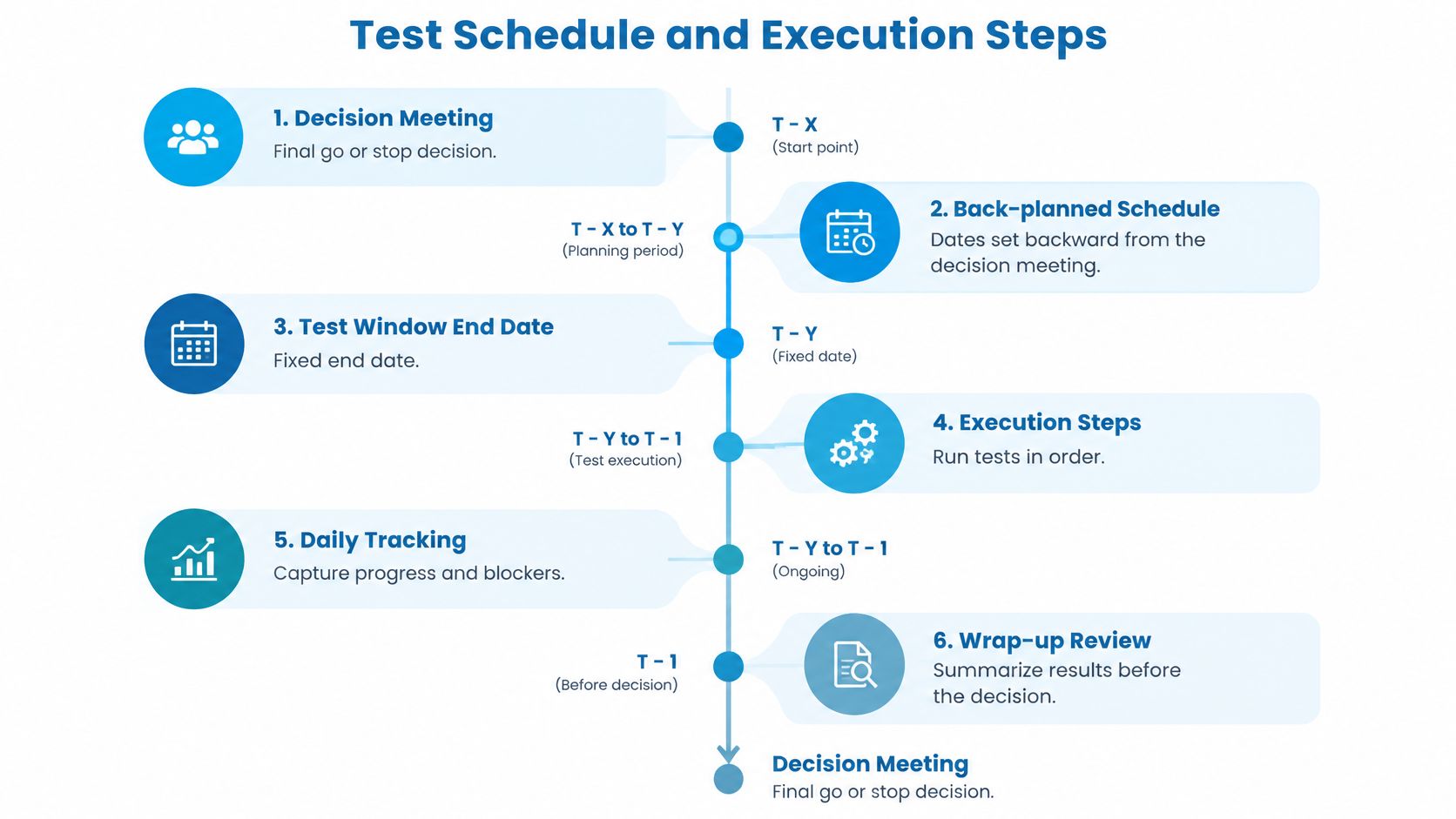
The test window has a fixed end date. Build backward from the decision meeting, reserving time for evidence review rather than filling every available hour with configuration.
For the hypothetical schedule below, preparation precedes kickoff and the execution clock starts on kickoff day. The timing is an operating choice for this example, not a universal POC duration.
-
Freeze criteria and exclusions on day one. Confirm the prepared decision brief in writing before build starts. If the evaluator and sponsor disagree about what passing means, resolve that disagreement before configuration makes everyone reluctant to stop.
-
Confirm environment, data and credential access before each test day. In this example, escalate access gaps within 48 hours rather than moving the schedule. Name the blocked test and its consequence so the sponsor can make a useful intervention.
-
Build the test matrix. List each criterion, workflow, edge case, expected result and evidence artifact. Include prerequisites and reset instructions so another evaluator can repeat a run without relying on the SE's memory.
-
Run priority workflows first, with customer evaluators using their own approved data. Let evaluators operate the workflow themselves rather than watching you manage it. Your prepared demo path isn't evidence that they can complete their work.
-
Log every defect and result the same day. Capture the input, environment version, observed behavior and artifact reference in the evidence register. Separate product defects from configuration errors and missing prerequisites so remediation goes to the right person.
-
Hold the day-seven midpoint checkpoint. Re-score risks, review evidence coverage and reject additions that don't affect the original decision. Accepting another workflow requires an explicit trade-off, not a casual agreement during a working session.
-
Run failure modes and load tests in week two. Test expired credentials, rejected inputs, unavailable dependencies and recovery behavior within the authorized boundaries. A successful happy path doesn't establish how the workflow behaves when a dependency fails.
-
Close the register and distribute the readout pack 48 hours before the decision meeting. Reserve review time for the customer rather than producing results during the meeting. Flag late evidence separately instead of changing the circulated conclusion.
Stop when the answer is already clear
Use relevant POC examples to choose representative workflows, not to expand the test list indiscriminately. Spend the available time on the assumption that could invalidate adoption.
Stop rule: If a core criterion fails at the midpoint and there's no credible fix, call the decision early. An available calendar slot isn't a reason to keep testing.
Risk Mitigation and Security Boundaries
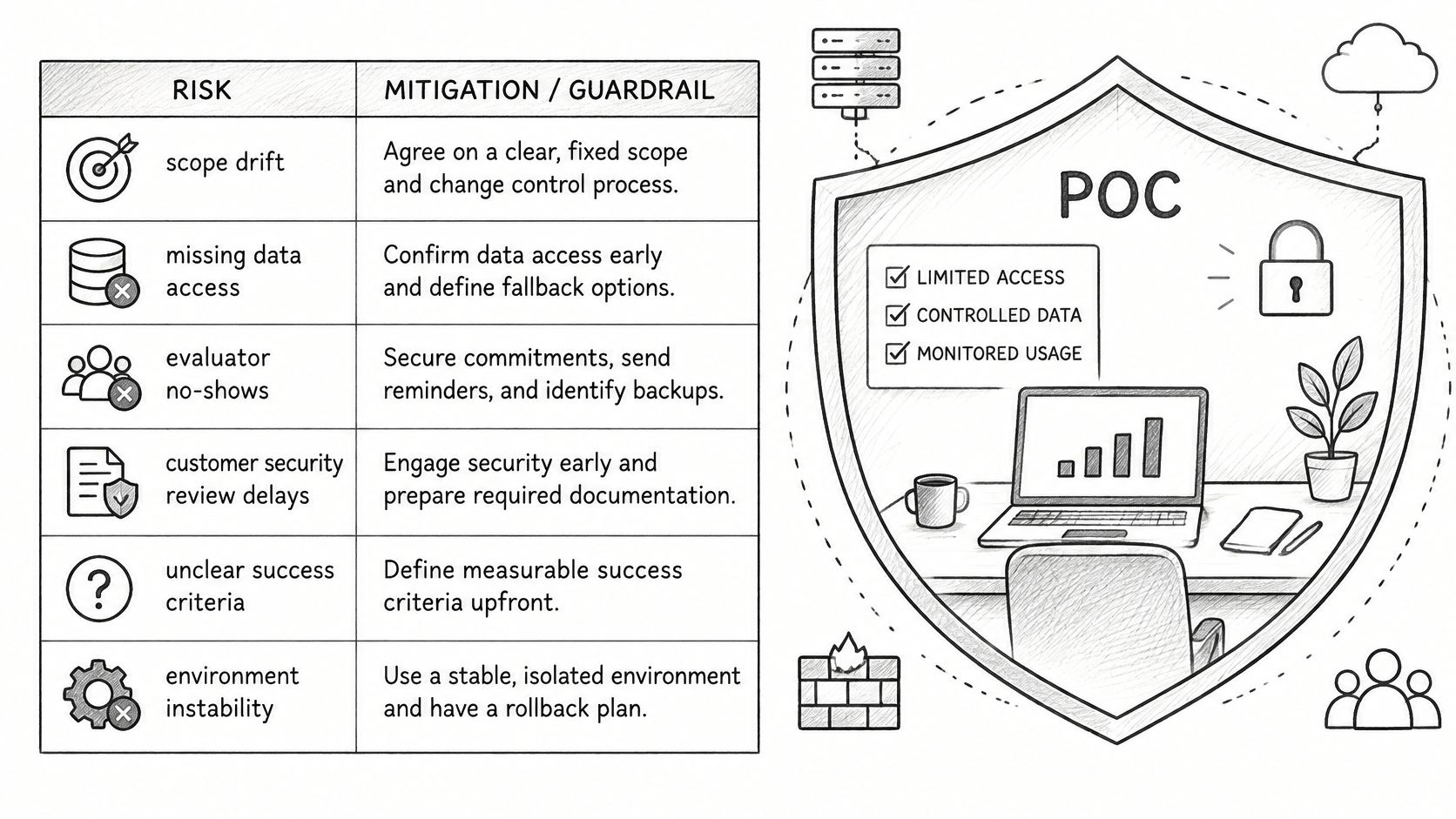
A risk needs an action trigger, not just a mitigation sentence. Record the observable condition that tells the owner to intervene; otherwise, everyone can agree that access is a risk while nobody escalates the missing credentials.
The triggers below belong to the hypothetical schedule.
POC risks, early warning signs and mitigations
| Risk | Early warning sign | Mitigation | Owner |
|---|---|---|---|
| Scope drift | New feature requests during week 1 | Assess impact on time, criteria and owners before accepting | Jordan, AE |
| Missing data access | Test data not loaded by day 3 | Escalate to sponsor, then use a synthetic dataset approved at kickoff | Maya, SE |
| Evaluator no-shows | Named evaluators absent from two sessions | Reschedule with sponsor and reconfirm evaluator list | Jordan, AE |
| Customer IT blocks integrations | Credentials still pending after day 2 | Escalate, then document a workaround or obtain approval to remove the workflow | Maya, SE |
| Security review delays | Questionnaire unanswered by week 1 | Escalate the review; continue only under pre-approved rules | Priya, customer security lead |
| Ambiguous results | A core criterion is partially met | Run one pre-agreed retest, then decide at readout | Maya, SE |
Synthetic data can preserve a test session, but it may not prove behavior on customer data. Likewise, removing a blocked workflow changes the claim you can make. Record those limitations rather than converting a workaround into a pass.
Write the security track before testing
NIST's assessment guidance calls for documented rules of engagement, assessment effort, performed activities and vulnerability evidence. Translate that into explicit evaluation boundaries:
- Permitted assets: Approved environments, datasets and data classifications.
- Authorized tests: Allowed activities, prohibited actions and the approving person.
- Evidence handling: What you may collect, where it's stored and who can access it.
- Incident response: Escalation contacts and conditions requiring an immediate halt.
- Access closure: Who revokes credentials and when evidence is retained or deleted.
Start the security questionnaire at kickoff, not at readout. Have the customer security lead sign the rules for SSO, APIs and customer-managed integrations before those tests begin.
For generative-AI features, add output accuracy and safety testing by named human testers against customer-approved examples. Also require written data-use approval stating whether customer data may leave the tenant or train any model; name the approver for each check and the response to ambiguity.
Keep ambiguity bounded: one pre-agreed retest, then a decision.
Communication Plan and Go, Stop or Extend Readout
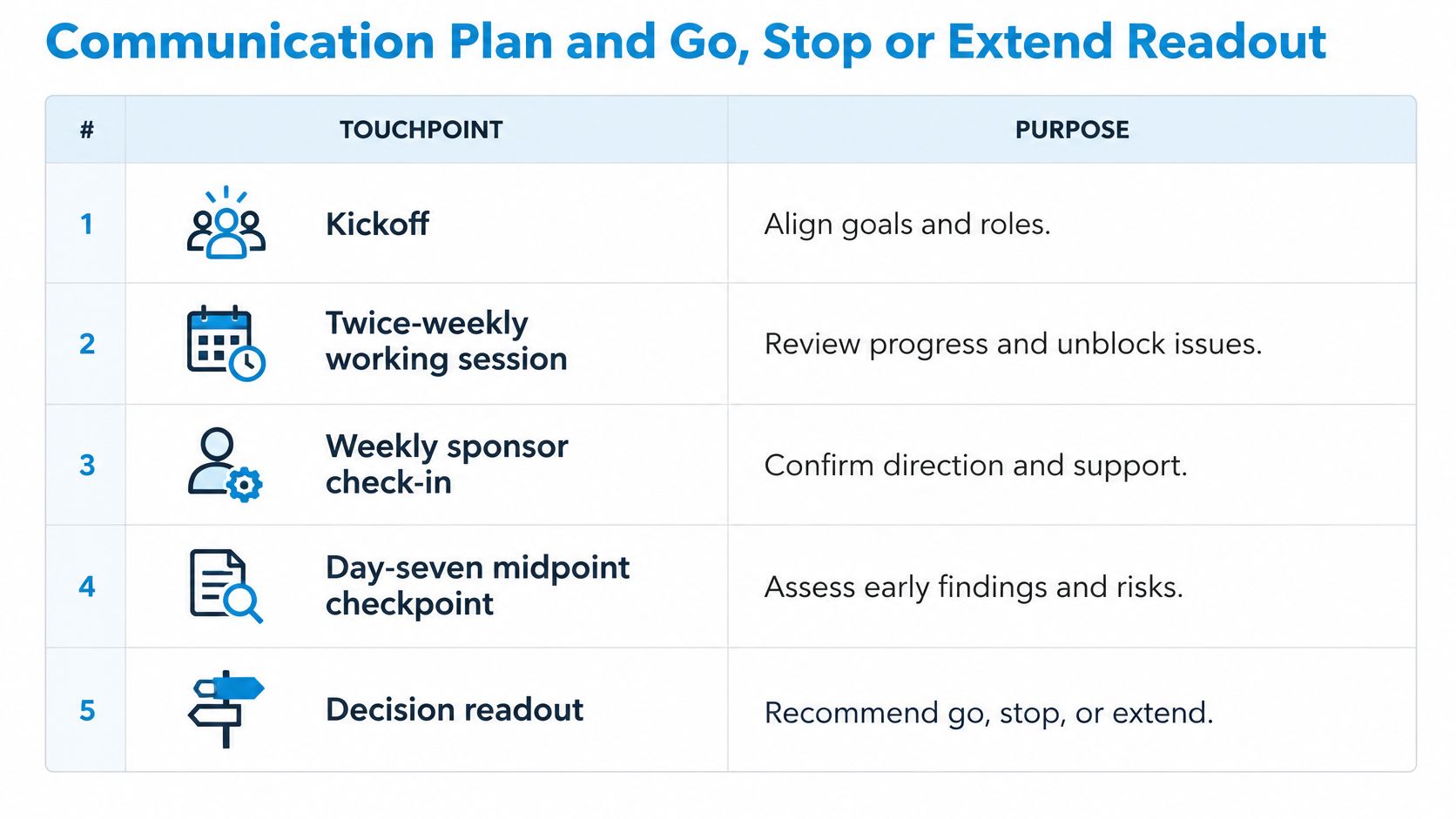
POC communication cadence and outputs
| Touchpoint | Attendees | Cadence | Output |
|---|---|---|---|
| Kickoff | Sponsor, evaluators, SE, AE, security lead | Once, day 1 | Signed criteria, owners and decision date |
| Working session | SE and technical evaluators | Twice weekly | Defect and blocker log |
| Sponsor check-in | Customer sponsor and AE | Weekly, 30 minutes | Risk and escalation update |
| Midpoint checkpoint | Full group | Day 7 | Re-scored risks and scope decision |
| Decision readout | Decision makers, procurement and security | Once, end of window | Proceed, extend or stop, with reasons |
These are suggested cadences for the hypothetical evaluation. Schedule working sessions around the evaluators' time zones, and record artifact locations and decision deadlines in the plan itself.
Evidence first, business decision second
NIST's Common Criteria material describes evaluation against stated criteria and distinguishes assurance levels. The practical lesson is to match the evidence to the claim you're asking stakeholders to accept.
Open the readout with the SE-owned evidence register: criterion, result, artifact, owner and status, followed by explained exceptions. Don't lead with the strongest demo and leave procurement to discover the unresolved gaps.
Then separate the technical win from the commercial decision. Technical acceptance doesn't establish budget approval, implementation capacity or procurement readiness. Use explicit entry and exit criteria to keep those approvals distinct.
Choose an outcome without negotiating the evidence
- Proceed: Every core criterion passed and no high-severity security finding remains open. Confirm the procurement or production next step.
- Extend: Gaps are narrow, named and assigned to a dated remediation owner. Set a fixed second readout before approving further work.
- Stop: A core criterion still fails after the agreed retest, or the business decision the POC supported has changed.
Distribute the pack at the scheduled review deadline so security and procurement can assess it before the meeting. Capture the decision, reasons and approver in the deal record, not just in meeting chat.
Agree the Decision Date Before You Start
The go, extend or stop date belongs in the kickoff invitation. Without it, an evaluation can turn into free consulting: another configuration request, another stakeholder demonstration, another week without a buying decision.
The date isn't a sales-pressure tactic. It protects the customer's evaluators as well as your capacity by defining when both sides will examine what they've learned and decide whether further work is justified.
Make these changes this week
-
Put the decision date and decision maker's name in the first calendar invite. Ask that person to accept the readout invitation before you commit build time. An enthusiastic evaluator isn't a substitute for decision authority.
-
Copy the milestone table and KPI list into the deal record. Replace relative timing with calendar dates and confirm that the customer's owners have accepted their responsibilities. A document shared with someone isn't an agreement from them.
-
Write the pass condition for the riskiest assumption before the next call. If you can't describe the evidence that would disprove your proposed approach, your test is probably too broad.
Use the discovery call guide to confirm the sponsor, operational problem and decision process before building an environment. No discovery, no demo applies here: discovery quality, not demo polish, decides whether you're testing something the customer needs to know.
A useful POC plan lets you recommend stopping with the same confidence that you recommend proceeding.
Build the judgment behind the template
The Trusted Advisor Academy teaches structuring POCs so SEs can pull the plug after two weeks if an evaluation isn't working. Members apply frameworks to current deals and receive feedback on their own discovery calls, demos and POCs; the asset library includes 100+ ready-to-use assets, including templates, checklists, AI prompts and phrasing guides.
Use the template to document commitments, then challenge whether those commitments answer a real customer decision. Before your next kickoff, you should be able to name what could fail, who will validate it and who will act on the result.
PreSales Unleashed GmbH offers PreSales training and enablement through the Trusted Advisor Academy, including POC management frameworks and feedback on active evaluations. Visit PreSales Unleashed GmbH to build the skills behind a decision-ready POC plan and apply them to the deals you're working now.