
The most popular advice about the business term delta is also the one that gets Solution Engineers in trouble: delta just means the difference. That line is fine in a hallway. It is a liability in a buyer meeting.
A CFO, a CTO, and a product owner can all ask "what's the delta?" and mean three different calculations. You answer from the demo notes. Finance writes the number down as a claim you never made. The business case then fails because the figure had no baseline, no time window, and no owner.
Stop using delta as a synonym for change. Treat every delta as a claim. A claim needs a baseline, an endpoint, a time window, a denominator, and a short note on what else moved. Without those fields, a technical win gets dressed up as a revenue story it isn't.
This is PreSales work. You own the technical outcome. You don't own the buyer's P&L. Your job is to translate one into the other before the words drift. No discovery, no demo. If you haven't heard the buyer's own name for the change, you have nothing safe to put on a slide.
Delta and Its Neighbors at a Glance
Buyers use these words as if they were interchangeable. They aren't. Read the row before you quote a number.
| Term | What it measures | Typical use | Common misuse |
|---|---|---|---|
| Delta | Absolute difference between two values | Period-over-period comparison | Read as a percentage |
| Percentage delta | Change relative to a base value | Growth reporting | Compared across different bases |
| Variance | Actual minus plan or budget | Budget reviews | Sign convention never stated |
| KPI | Measure tied to an objective | Scorecards and quarterly reviews | Treated as the change itself |
| Sensitivity | Modeled output response to one input | Financial models | Other inputs assumed fixed |
| Option delta | Option price sensitivity to the underlying asset | Derivatives trading | Imported into business reporting |
The word delta travels. In one sentence it is euros of pipeline. In the next it is a percent. Two minutes later someone imports an options idea and the room is no longer talking about the deal. That slide of meanings is where your credibility goes. Finance notices the wrong word before they check the arithmetic.
Where the swap actually happens
Three swaps cause most of the damage in buyer meetings.
Absolute versus percent. "+€100,000" and "+10%" are different claims. Quoting one when the buyer asked for the other makes a small account look like a company-wide result, or the reverse.
Change versus the measure. A KPI such as technical win rate is the score you track against an objective. The movement in that score is a separate sentence. If you report the KPI as if it were the change, the quarterly review argues about two different objects.
Plan gap versus market move. Variance is actual minus plan or budget. It only means something once you state whether a positive number is favorable. "We're plus 8" with no sign convention is noise.
Option delta belongs on a trading desk, not in a pipeline review. Leave it in the last row until a derivatives conversation begins.
Use the table as the opening move with the buyer's finance contact. Name the row they mean, write that term on the working doc, and refuse to quote a figure until the row is agreed. If two people in the room are on different rows, you don't have a number yet. You have a vocabulary problem, and vocabulary problems become forecast problems by the next QBR.
Why a Delta Needs Four Fields to Mean Anything
A delta describes movement. It does not describe cause. The Fiveable introduction to business treats delta as the absolute change between two values, and separates that change from a KPI. What that definition leaves out is the part you need on a live deal: the comparison only holds when four fields travel with the number. Those fields are baseline, endpoint, time window, and denominator.
Drop any one of them and the same movement tells opposite stories. A €100,000 increase is 10% growth from €1 million and 100% growth from €100,000. The percentage is not a prettier version of the absolute figure. They answer different questions, and neither one proves the business got better.
| Hypothetical scenario | Baseline | Absolute delta | Percentage delta |
|---|---|---|---|
| A: Revenue, prior year to this year | €1,000,000 | +€100,000 | +10% |
| B: Same €100,000 change on a small account base | €100,000 | +€100,000 | +100% |
| C: Pipeline value, plan to actual | €500,000 | +€100,000 | +20% against plan |
Scenarios A and B are the same euros. An executive who hears "+100%" will fund a different decision than one who hears "+10%." Scenario C isn't even the same kind of comparison. It is plan to actual, so the denominator is the plan, not last year's revenue. Mix C into a growth slide and you have invented a trend.
The basis picks the story before the math does
You also have to name the comparison basis, or the four fields still lie. The usual choices are period over period, budget versus actual, target versus actual, forecast versus actual, and scenario versus scenario. Each one changes the story before anyone opens a spreadsheet.
Period over period asks whether this quarter beat last quarter. Budget versus actual asks whether you hit the number finance already booked. Forecast versus actual asks whether the latest call was honest. Scenario versus scenario asks which assumed world you are in. A Solution Engineer (SE) who says "pipeline is up" without naming the basis lets every listener pick a favorite.
Neither reading proves improvement when the rest of the account moves the wrong way. Margins can fall while revenue rises. Retention can slip. Implementation cost can eat the gain. Sales-cycle length can stretch so the euros arrive in a later quarter than the slide implies. Separate the observed change from the factors you think produced it. Price, volume, mix, foreign exchange, and pipeline timing are the usual suspects. A move in technical win rate or proof-of-concept conversion is especially easy to distort when deal mix or the qualification bar changed in the same window.
Working rule: State baseline, endpoint, time window, and denominator in the same sentence as the number, and name the comparison basis before anyone repeats it.
"Pipeline is up 20%" becomes: "Qualified pipeline moved from €500,000 on 1 January to €600,000 on 31 March, a +€100,000 absolute delta and +20% against the Q1 plan, on deals that passed the current qualification bar." That sentence can survive a finance review. The short version cannot.
Mapping Technical Value Into Business Deltas
The technical win is the outcome PreSales owns. Finance will not fund it until you show the business delta that outcome becomes. The mapping is short. Start from the technical change. Name the business process it touches. Pick the delta that process already reports. Then check whether the buyer's own budget line uses that term.
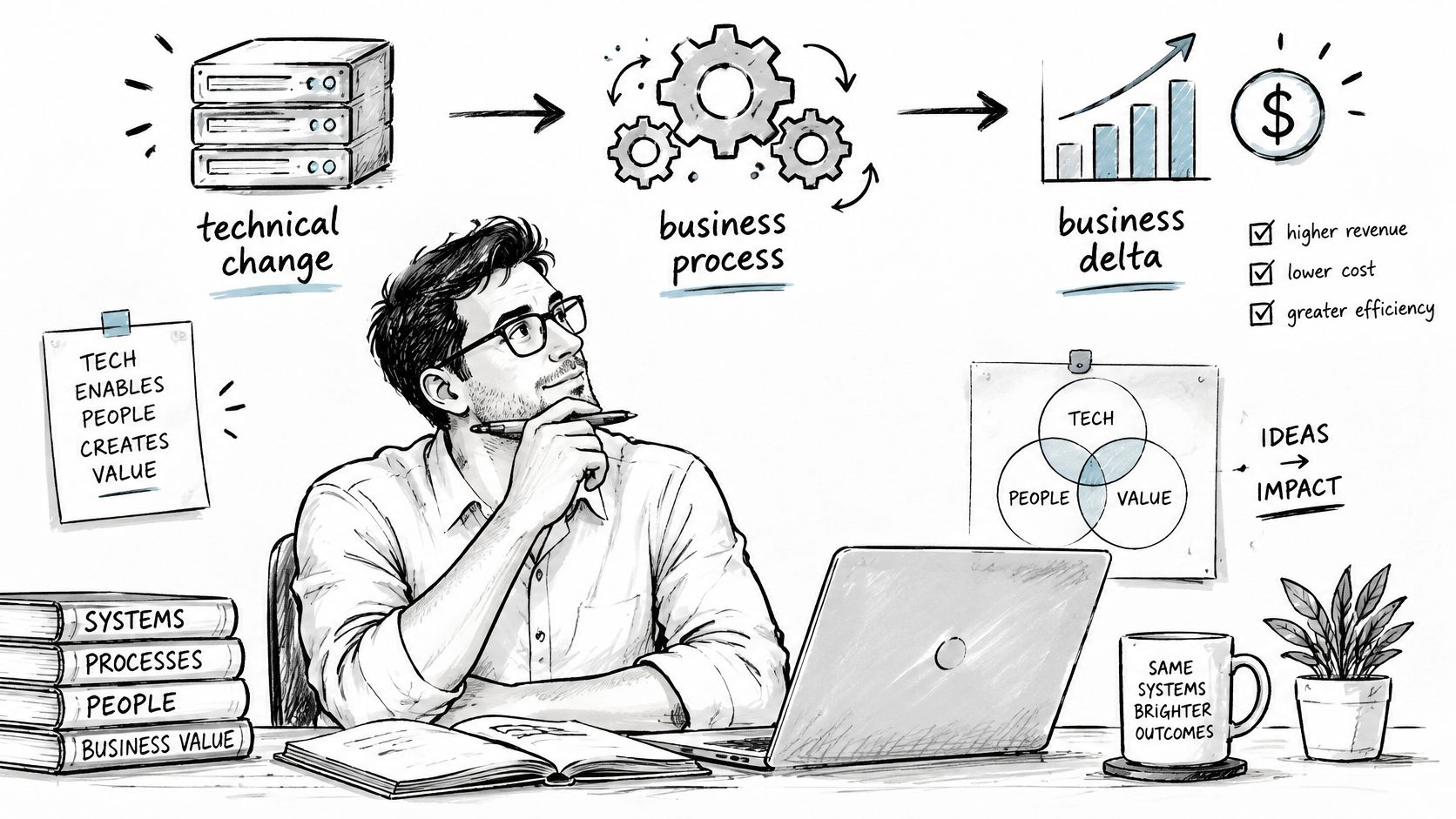
A technical metric with no business owner stays a feature claim. "We cut latency" is a feature claim. "Orders stop waiting on a batch job, so the operations lead can release the afternoon dispatch the same day" is a delta someone can defend. If you can't name that person, don't put the number in the proposal.
| Technical signal | Business delta to report | Question that confirms it |
|---|---|---|
| Integration time cut from six weeks to two (hypothetical) | Days of earlier revenue | Which revenue line waits while integration runs? |
| Uptime improvement on a critical service | Avoided downtime cost per quarter | What does one hour of outage cost the operations team? |
| Fewer manual approval steps | Cycle time per approval, before and after | How many approvals does a typical request pass through? |
| Proof-of-concept scope narrowed to two use cases | Pilot-to-contract conversion | Which of the two use cases sits in the buyer's budget line? |
| Daily reporting moved to real time | Decision lag in days | Which decision waits on the data today? |
Say the translation out loud
Take the first row as a hypothetical. You might say: "Integration now takes two weeks instead of six, so the first month of revenue starts 28 days earlier." That sentence has a before, an after, and a business clock. It still needs the four fields once discovery produces the buyer's dates and the revenue line. Until then, label it as illustrative and keep it out of the executive summary.
The same test applies when the technical change is an AI workflow rather than an integration. Teams that scale high-value AI initiatives still have to land the change on a process someone already measures, or the initiative stays a demo. Real-time reporting is the same trap. "The dashboard is live" is not a delta. "The pricing decision that waited overnight now waits under a day" is, and only if that decision has an owner.
Narrowing a proof of concept to two use cases is a technical win you can measure. Pilot-to-contract conversion only counts if one of those use cases already sits on a budget line. Otherwise you optimized a pilot nobody can buy.
The table is a starting set for the next call, not a library of approved claims. Swap in the buyer's numbers as soon as discovery produces them. Value selling training is useful here only if it forces that swap. A polished value story built on your metrics, not theirs, will not survive procurement.
A short walk-through of how a technical change becomes a number finance will sign is worth watching before you rewrite the business case.
Where Delta Language Misleads Across Teams
The failure mode is rarely bad math. It is two teams hearing one phrase and booking two different claims. Four hypothetical situations cover most of what shows up in a multi-threaded SaaS deal.
The CTO and the CFO. The CTO asks for a 10% faster response time. The CFO hears revenue growth. The speaker meant a latency target on one service. The listener heard a growth rate on the P&L. The delta that removes the ambiguity is cycle time or timeout rate on that service, with the revenue line named only if discovery tied latency to lost orders. Attribution note: no revenue claim until the CFO's team confirms which orders wait on that response time.
Currency dressed up as product. Revenue rose, and the deck calls it product-led growth. The speaker meant bookings in reporting currency. The listener heard that the product caused the rise. Report the constant-currency absolute delta beside the reported-currency figure. Attribution note: foreign exchange, not usage, explains the move. If you can't show constant currency, don't claim product impact.
A higher technical win rate after a tighter bar. Qualification policy changed, small deals dropped out, and the rate went up. The speaker credits SE execution. The listener hears that the same mix of deals now closes technically more often. Split the rate by segment and by the qualification rule in force. Attribution note: deal mix and the new bar, not a sudden change in demo quality. This is the situation where "no discovery, no demo" protects you. A cleaner top of funnel is an AE and SE decision, not proof that the demo got better.
Three pilots and a "trend." Proof-of-concept conversion improved on a base of three pilots. The speaker presents a percentage as a trend. The listener hears a stable rate they can forecast. Report the counts, 1 of 3 then 2 of 3, and refuse the percentage as a run rate. Attribution note: sample too small, and pipeline timing may have pulled one close-ready deal into the window.
A delta without attribution describes movement, not the vendor's effect.
The question that exposes which situation you're in: "Which of these changed besides our work?" Ask it before the readout, not after finance has already screenshotted the slide. If the honest answer is price, volume, mix, currency, or the week the deal was staged, say so in the same sentence as the number.
Reporting calendars make this worse when sales and marketing close on different clocks. Teams that align Salesforce and HubSpot reporting deadlines at least know which "end of day" a figure belongs to. You still have to say whose clock, and whose baseline, the delta uses.
Finance Meanings of Delta You Should Keep Out of Reviews
Option delta does not belong in a pipeline review or a product readout. In derivatives, a delta of 0.5 means the option price would theoretically move $0.50 for a $1.00 move in the underlying, as the NanoGlobals glossary defines it. That is a sensitivity on a contract, not a comment on your quarter. If a buyer says "delta" and they trade around the product, ask which meaning they want before you answer. The first table already holds the full row. Don't restate it in the QBR.
Use the business words for business claims.
- Say variance, not delta, when you mean plan or budget versus actual. State the sign. "Favorable €40,000 versus the Q2 budget" is a variance. "The delta is 40" is a shrug.
- Say KPI for the measure tied to the objective, and put the change in a second clause. The score and the movement are not the same object.
- Say growth rate when you have normalized the change to a base. If the base changed, say that too. A growth rate on a new base is a different claim from last quarter's rate.
- Say sensitivity only after a model was run, with one input shocked and the other assumptions named. "We're sensitive to price" with no model is a mood, not an analysis.
"What's the delta?" speeds a meeting. It also makes finance, sales, product, and technical notes impossible to line up later, because each team stored a different operation under the same word. The finance reader clocks the wrong word before they audit the cell.
Hours saved are the version of this mistake that shows up in SE business cases. Cutting admin time is not cash until finance agrees the hours hit a cost line, which is why hours saved aren't money saved. The same standard applies here. A precise word is not pedantry. It is how you keep a technical result from being booked as profit it hasn't earned. People who turn financial data into business decisions already separate the measure, the variance, and the assumption. Match that habit and your number gets read. Miss it and the number gets relabeled by someone who wasn't on the call.
Run the Translation in Discovery and Confirm the Baseline
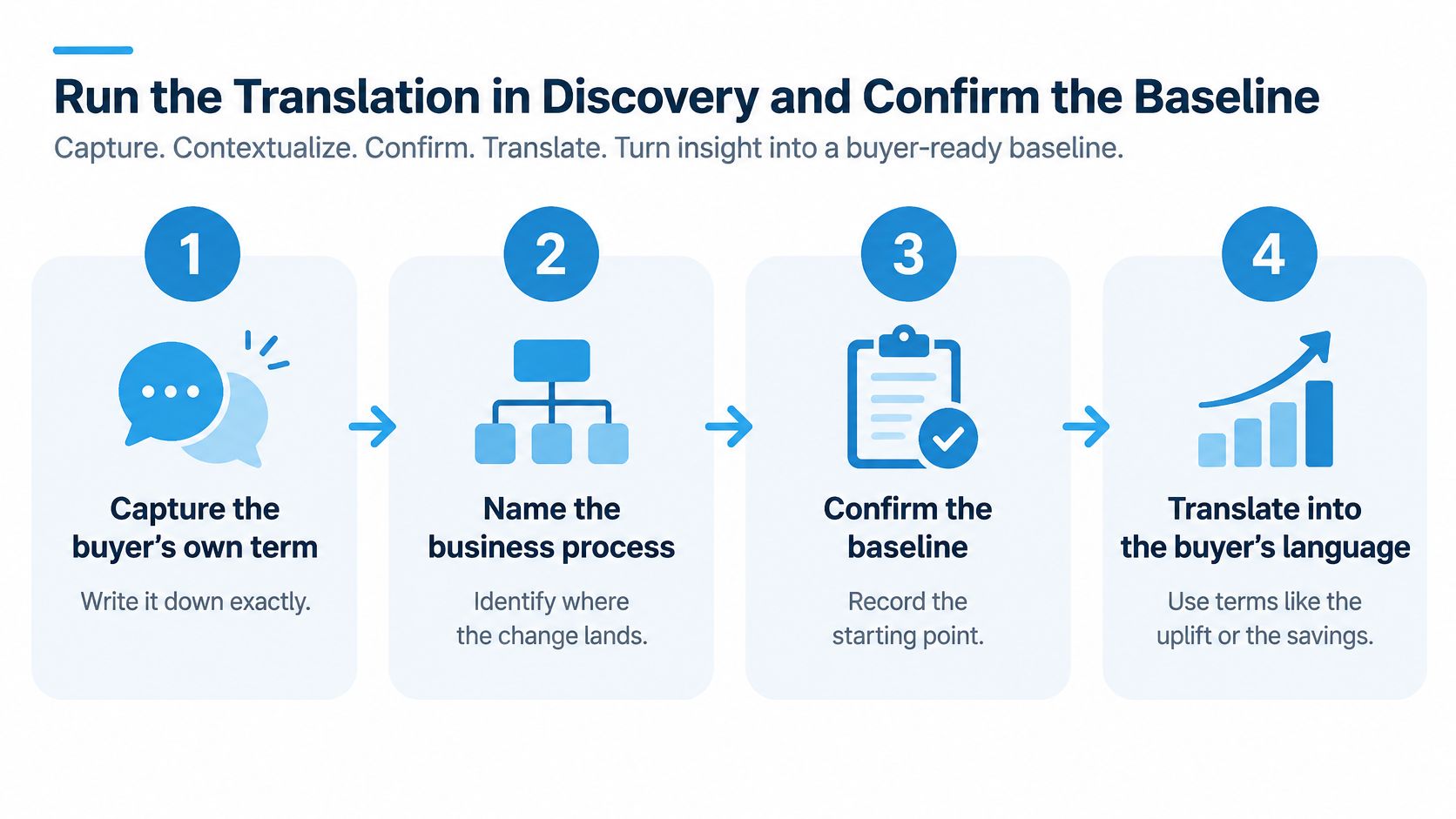
A delta becomes useful in discovery only when the buyer can check how it was calculated. Capture the buyer's wording, then pin down the metric's meaning, source, and reporting window before it enters a demo or business case.
-
Capture the buyer's term. If they say “the uplift” or “the savings,” record that phrase verbatim. Use focused sales discovery questions to clarify what outcome they mean while the buyer is describing the process.
-
Classify the delta. Is it an absolute change, percentage change, variance, or sensitivity? Agree whether the buyer means euros or a rate. If the meaning is unresolved, leave the metric open rather than presenting it as settled.
-
Confirm the baseline owner and source system. Identify who can provide the starting number and where it lives. The buyer's CRM, ERP, or data warehouse may hold the relevant baseline. A vendor dashboard is only a candidate until the buyer confirms it.
-
Set the time window. Use the buyer's reporting cycle. A product release date does not establish when the buyer's finance team will recognize a result.
-
Write the delta in one sentence. Include the baseline, endpoint, time window, and denominator. Read it aloud. If the basis needs a separate explanation, revise the sentence until the comparison is clear.
-
Confirm attribution with finance. Ask the buyer's finance contact to review the calculation and attribution before drafting the business case. Record whether they accepted the basis, not just whether they agreed with the arithmetic.
-
Set the re-measurement point. Compare the same metric using the same source system in the next reporting period. Re-measuring consistent KPIs each quarter prevents a one-time comparison from losing meaning when its basis shifts.
Do this on one deal this week
Choose an active opportunity and write one delta sentence with its baseline, endpoint, time window, and denominator. Send it to the buyer's finance contact before the proposal goes out. If they revise the basis, capture that change before the number enters the business case.
The Trusted Advisor Academy covers discovery, demos, sales alignment, POC management, and value articulation. Those skills help Solution Engineers connect a buyer's stated outcome to a measurable business case. Learn more about the Trusted Advisor Academy.