
The most popular advice about value selling training is incomplete. It treats value as an Account Executive skill, delivers it in a workshop, and assumes the methodology will appear in customer conversations afterward. That assumption fails most often where the deal becomes technical, which is exactly where Solution Engineers carry the most influence.
A polished value statement won't rescue weak discovery, a generic demo, or a proof of concept with vague exit criteria. For an SE, value selling is a practical operating discipline. You use it to identify the business problem, connect technical decisions to measurable outcomes, prove claims with credible evidence, and help the buyer defend the decision internally.
Why Value Selling Belongs on the SE Side
Value selling training is often assigned to AEs because they own the commercial conversation. That division overlooks where many value claims either gain credibility or fall apart. The SE hears how the problem affects workflows, integrations, security, data, and architecture, then tests whether the proposed solution can change the customer's situation.
A weak discovery transcript produces a generic demo. The generic demo produces an unfocused POC. An unfocused POC leaves the AE defending value during procurement, after the buyer has reduced the discussion to features, risk, and price. The SE inherits the consequences of every business question the team failed to ask.
The case for Presales as the missing piece in value selling is made in depth in our analysis of why Presales is the missing piece in value selling. The argument is practical: SEs shape the evidence buyers use to judge whether a technical decision deserves business priority.
The SE hears the unfiltered problem
SEs often join discovery when the customer's issue has operational detail. A buyer may describe the same situation differently in an executive meeting and a technical session. In the technical session, workflow friction, ownership gaps, integration limits, and data risks are more likely to surface.
Your job is not to force every technical detail into an ROI calculation. Identify the details that affect cost, capacity, risk, revenue, speed, or decision confidence. An approval workflow may expose unnecessary manual work. A data-quality question may reveal reporting risk. A deployment-ownership question may show why delay carries a business cost.
Practical rule: If a technical detail cannot connect to a buyer priority, it should not drive the demo.
The SE designs the proof
The demo turns a value hypothesis into something the buyer can inspect. The SE chooses the workflow, sequence, depth, and evidence. A feature tour gives information. A value-led demo helps the buyer judge whether a defined business problem is worth solving with the product.
That requires claim discipline. State the business claim, connect it to the customer pain that gives it relevance, and define the proof that would make it credible. The strongest SEs do not rely on polished benefit language. They show the buyer what must be true, then test it in the workflow.
The SE shapes the POC decision
A POC or pilot can validate a technical solution, or it can become an expensive delay mechanism. If its success criteria are disconnected from discovery, the buyer may complete the evaluation without knowing which business decision the results support.
SE-specific value selling training must therefore include POC design. The sales engineer workflow in B2B SaaS includes qualification, discovery, demo design, and validation through a POC or pilot. Value must remain visible across those activities, reinforced by deal reviews and shared evidence standards rather than left inside the AE's business case.
What Value Selling Training Actually Means for an SE
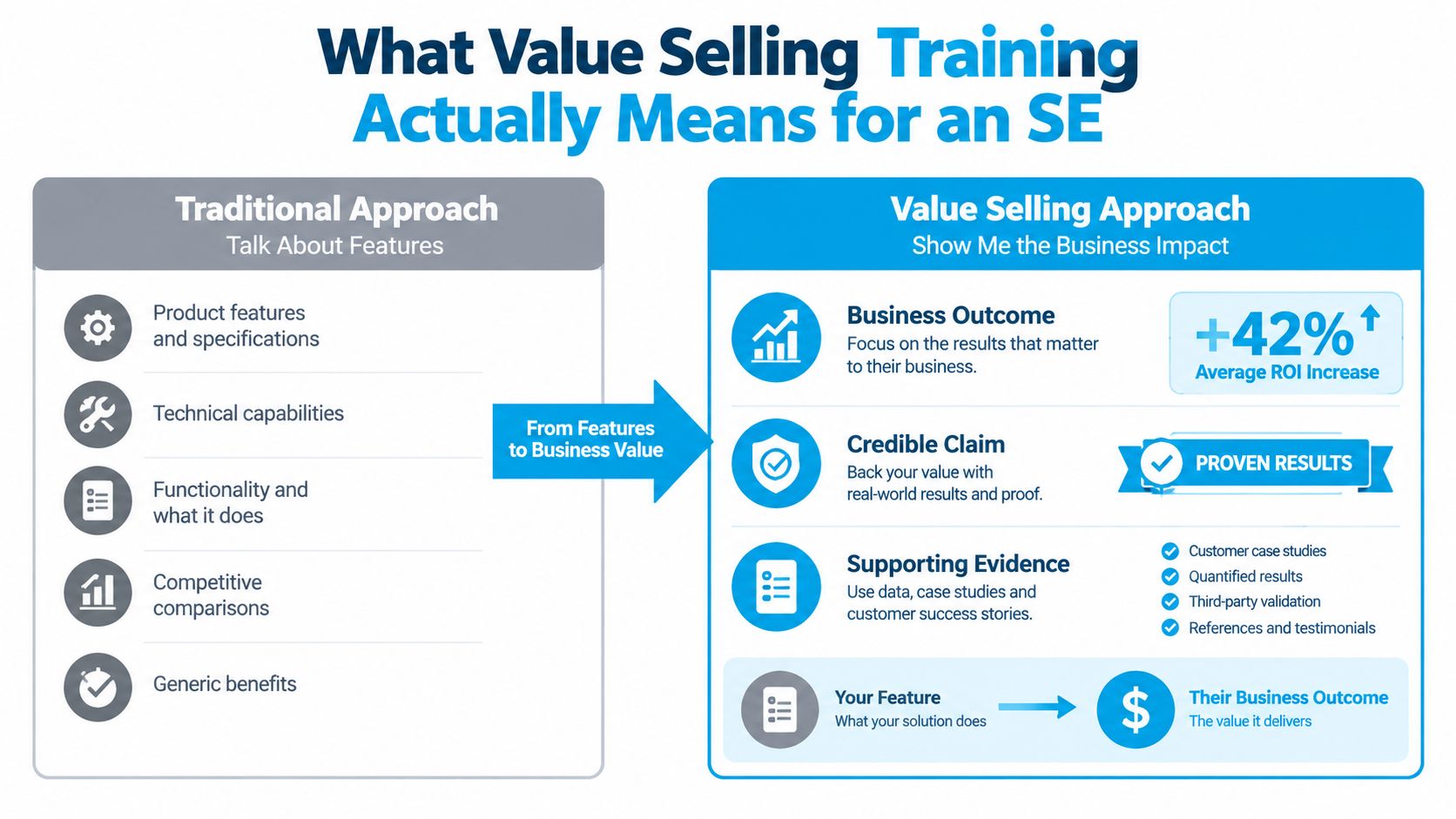
For an SE, value selling means moving through a clear chain:
Customer problem, business outcome, quantified impact, credible claim, supporting evidence, technical validation.
The chain starts with the buyer's situation, not the product menu. A technical capability matters only when it changes an outcome the customer cares about and the buyer can defend.
A feature-led demo might begin with, “Let me show you our workflow builder.” A value-led version starts with a claim such as, “You said approval delays are holding up this process. We'll test whether this workflow can remove the manual handoffs that create that delay.” The first statement tours a screen. The second establishes a proposition that discovery and demonstration can test.
The pre-call pattern
Many SEs prepare by asking what the prospect wants to see, building a sandbox, and collecting the relevant product screens. That preparation is useful, but it starts too late in the reasoning process. The request for a demo often reflects a symptom, a stakeholder's preference, or an internal buying requirement. It doesn't automatically reveal the outcome that justifies change.
A stronger preparation sequence looks like this:
- Form a pain hypothesis. Identify the operational issue that may matter most.
- Ask the question that tests it. Find out how the problem affects work, cost, risk, capacity, or revenue.
- Agree on the outcome. Define what would be different if the problem were solved.
- Select proof. Choose the workflow, data, integration, or POC test that can support the claim.
- Name the assumption. Make clear which customer input still needs validation.
This isn't an instruction to turn discovery into an interrogation. It gives the conversation a reason to exist. The discovery call guide for SEs is useful because it keeps the technical conversation connected to buyer context rather than treating discovery as a checklist.
Quantification isn't the same as an ROI calculator
SE teams often confuse a business outcome with a spreadsheet. A calculator can help, but it doesn't create credibility by itself. The difficult work is building a baseline the customer recognizes, exposing the assumptions behind the impact, and showing which product behavior could influence that baseline.
A credible value conversation contains:
- A named outcome, such as faster processing, lower operational risk, or greater team capacity.
- A customer-owned baseline, captured in the buyer's language and workflow.
- A defensible claim, narrow enough to test.
- Evidence, such as the customer's own process, a documented technical result, an analyst report, a peer benchmark, or a prior POC result.
- A qualification path, which states what must be true before the claim can support a decision.
The evidence half is where technical credibility lives. Without it, “value” becomes vendor assertion with financial vocabulary.
Core Curriculum Components a Real Program Must Cover
A real SE value selling training program needs more than messaging practice. It needs to change the artifacts SEs create, the questions they ask, and the decisions they help buyers make. Six modules cover the operating system.
Six modules for applied SE capability
1. Discovery mechanics. Train pain framing, multi-threading, and questions that surface impact. The SE should know how to move from a technical symptom to a business consequence without pretending to understand the buyer's operation better than the buyer does.
2. Claims-and-evidence demo design. Every meaningful demo section should map to one claim and one piece of proof. This is one of the modules programs skip most often. SEs can explain a product perfectly and still fail to prove why the buyer should change.
3. Business case math. Teach baseline construction, sensitivity ranges, and live defense of assumptions. The point isn't to manufacture precision. It's to make uncertainty visible and show the buyer which assumptions need validation.
4. POC success criteria. Write success criteria before kickoff and secure agreement from both sides. Criteria should state the workflow being tested, the evidence required, the stakeholder who will evaluate it, and the decision the result is meant to support.
5. AE and SE alignment. Define ownership for the discovery record, value hypothesis, demo plan, business case inputs, and POC plan. Deal reviews should expose missing value evidence, not only forecast risk.
6. Stakeholder navigation. Prepare SEs to work with economic buyers, champions, practitioners, security teams, and procurement stakeholders. A champion may understand the technical case and still need help defending the business case under pressure.
A useful way to make these modules part of normal work is to embed OKRs into operating rhythms. The training should appear in deal reviews, onboarding checkpoints, demo preparation, and POC governance, not sit in a separate enablement folder.
| Module | What It Teaches | Covered in Most Programs |
|---|---|---|
| Discovery mechanics | Pain framing, impact questions, and multi-threading | Usually |
| Claims-and-evidence demos | A specific business claim tied to specific proof | Often skipped |
| Business case math | Baselines, assumptions, and sensitivity ranges | Inconsistently |
| POC success criteria | Evaluation tests linked to the buying decision | Often skipped |
| AE and SE alignment | Shared artifacts and value-gap reviews | Usually partial |
| Stakeholder navigation | Economic buyer, champion, and technical stakeholder conversations | Usually partial |
The two omissions matter most. Programs that skip claims-and-evidence design produce demos that sound relevant but remain unproven. Programs that skip POC criteria produce technical activity without a defensible decision path.
Embedding Value Selling in Discovery and Demos
The claims-and-evidence flow starts before anyone opens the demo environment.
Start with a testable pain hypothesis
In discovery, state a hypothesis that invites correction. “It sounds like the manual review step is slowing the team down” is more useful than “What are your pain points?” Follow it with questions that establish the customer's baseline and expose the consequence.
Capture three to five KPI baselines that the customer recognizes and won't argue with. These might relate to processing time, rework, capacity, error exposure, adoption, or another operational measure. Don't fill gaps with assumptions just to make the business case look finished. Mark unknowns and assign a path to validate them.
Also identify the economic buyer or the person who can explain how the organization will judge the investment. A technical champion can guide your evaluation, but a champion isn't automatically the person who approves the business case.
Discovery quality determines the demo structure. The SE discovery and demo training should teach this as one motion, not two unrelated competencies.
Build the demo around claims
Carry the agreed baselines directly into the demo. Every claim should be either a customer mirror, using the customer's number, process, or workflow, or a third-party proof point, such as an analyst report, peer benchmark, or prior POC result. A vendor assertion alone is not evidence.
A simple demo plan might look like this:
- Opening: Restate the business problem and the agreed baseline.
- Claim one: Show the workflow that addresses the primary source of pain.
- Evidence: Use the customer's process or test data to prove what changed.
- Claim two: Connect the technical behavior to a second outcome.
- Close: Confirm what the buyer has learned and what still requires validation.
Before the demo, the plan might say, “We'll show the dashboard, then the automation builder, then integrations.” After discovery, it should say, “We'll test whether the approval workflow can reduce the manual handoff identified in discovery, then confirm whether the reporting output gives the operations leader the control they need.”
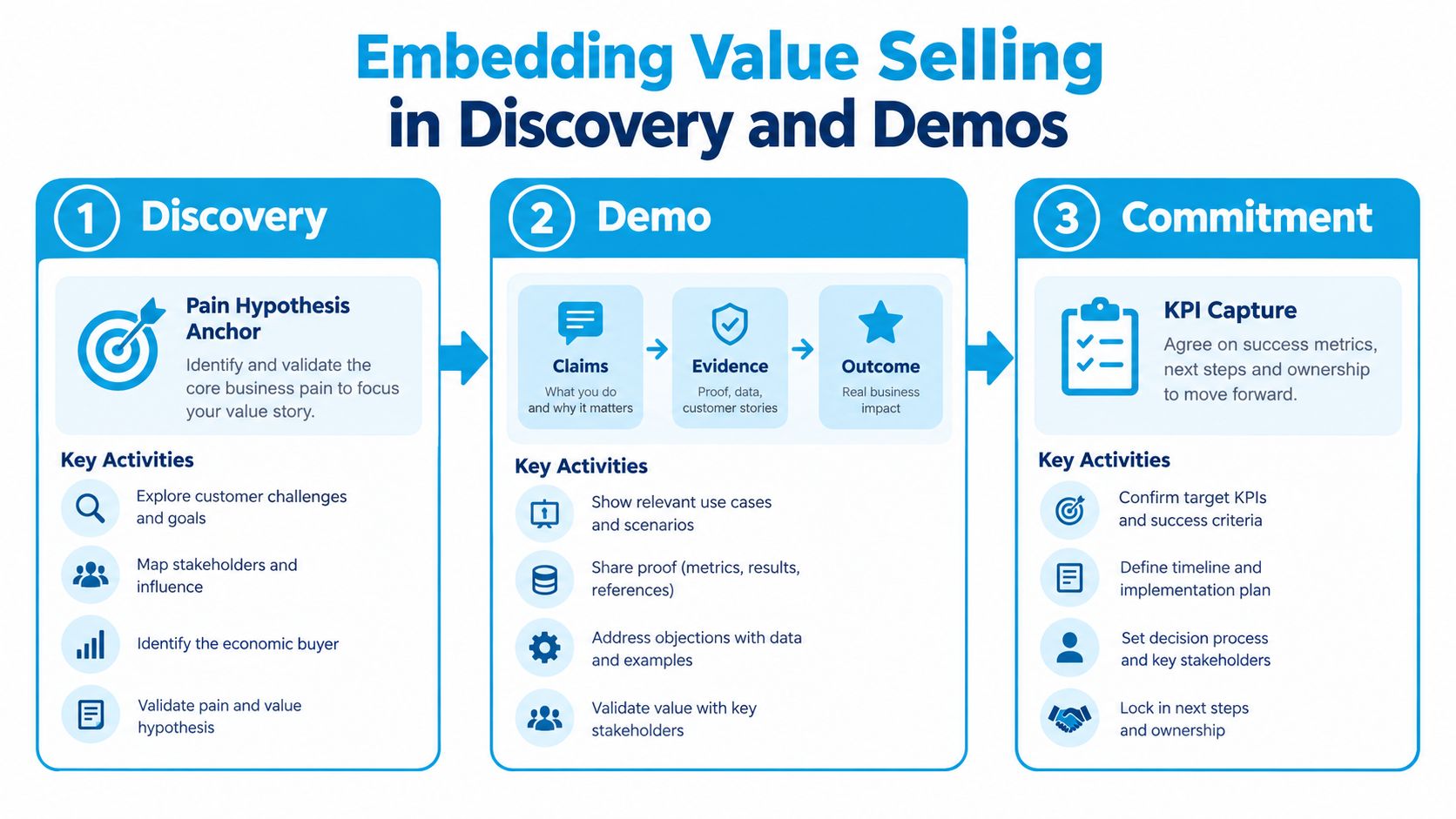
A POC should inherit the same logic. If discovery established a baseline and the demo made a claim, the POC needs an evaluation method that can test both. Teams that want a useful reference on riesgos de la prueba de valor can use it to pressure-test evaluation design before committing resources.
The buyer should know what evidence will count, who will judge it, and what decision follows a successful result. That protects the SE from an open-ended technical exercise and gives the AE a defensible path into the commercial conversation.
Workshop vs Continuous Enablement
A workshop can create shared language quickly. It can also create false confidence. Participants leave able to define value selling, repeat a framework, and complete an exercise. That doesn't prove they can quantify pain while a skeptical buyer is waiting for an answer.
The spacing effect review and sales-training synthesis explains why distributed practice and retrieval-based reinforcement matter. Reconstructing a narrative, objection response, or discovery sequence at increasing intervals strengthens recall more effectively than relying on one concentrated event. For value selling, that means short refreshers, practice prompts, and live-deal application windows.
A separate guide to value-based selling training implementation identifies the post-workshop gap directly. It cites 18% of buyers as feeling salespeople are well prepared for value conversations, and says 84% to 90% of training content is forgotten within 90 days without reinforcement. Those figures point to a practical conclusion: the workshop is the starting event, not the operating model.
| Dimension | Workshop-Only | Continuous Enablement |
|---|---|---|
| Retention at 30, 60, and 90 days | Initial recall fades without retrieval | Practice reintroduces the framework at useful intervals |
| Behavior on live deals | Application depends on individual discipline | Real opportunities supply immediate context |
| Manager coaching load | Heavy intervention after problems appear | Smaller, regular coaching moments expose gaps earlier |
| Cost per SE coached | Efficient for one event | Requires a repeatable system, but spreads coaching across the year |
| Evidence library | Static examples from the training team | SEs add claims and proof after wins and losses |
| POC discipline | Criteria may be written late | Success criteria become part of deal preparation |
A workable cadence includes weekly micro-drills, monthly live-deal sparring, and quarterly deal teardowns. Add recorded demo reviews with peer critique, enablement-lead shadowing in deal rooms, and a shared claims-and-evidence library that SEs update after meaningful outcomes.
Don't measure attendance as adoption. Ask whether the next live discovery call contains a tested value hypothesis, whether the demo plan contains claims, and whether the POC has written success criteria before kickoff.
Measuring Whether the Training Changed Deal Behavior
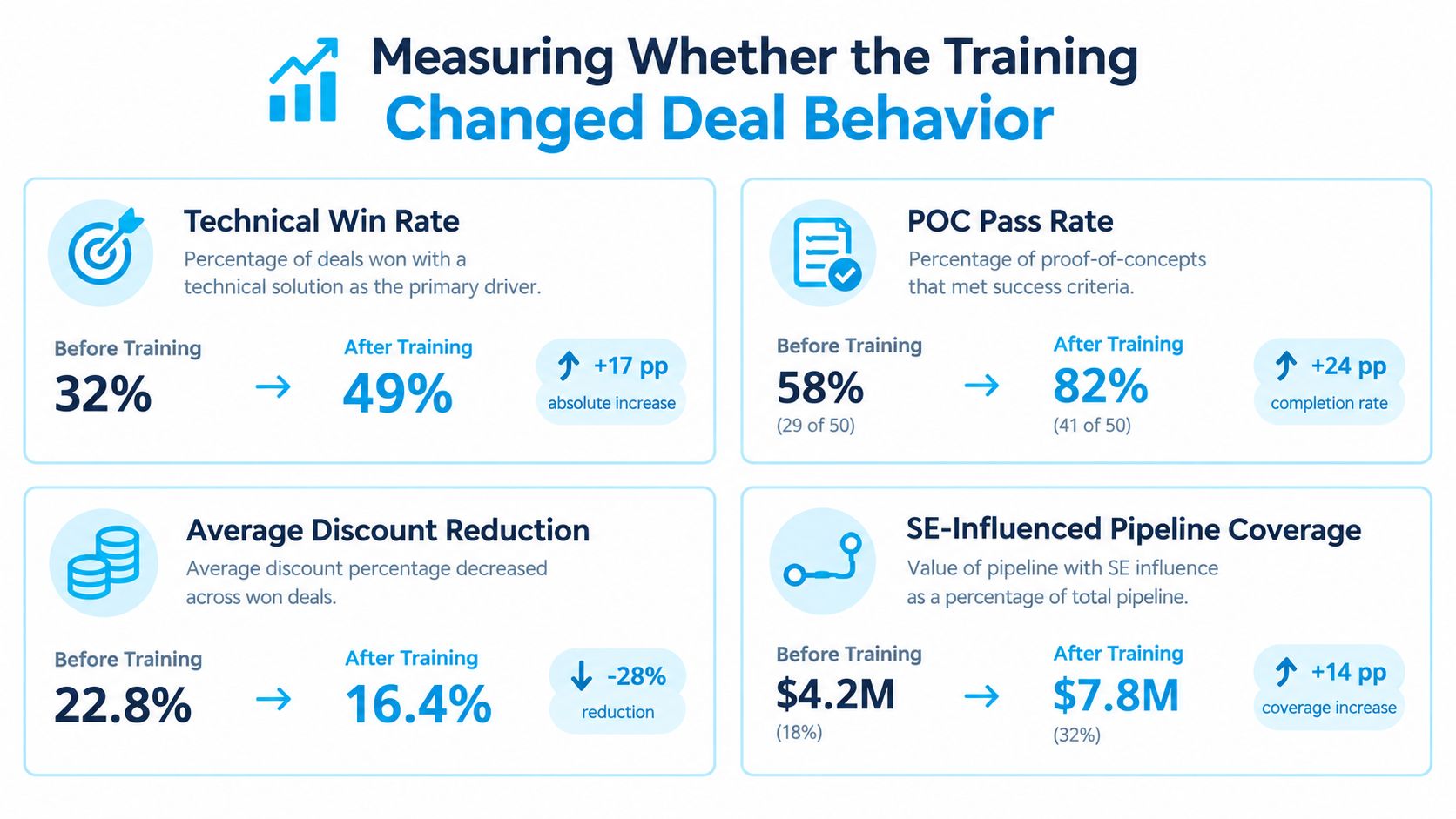
CROs don't sign off on training because the session received positive feedback. They sign off when the operating data shows that SE behavior is affecting deal progression. The outcome PreSales owns is the technical win, so the measurement system should connect learning activity to technical win rate and the evidence that precedes it.
Start with four outcome measures:
- Technical win rate: Compare SE-presented deals with the relevant internal comparison group, using a consistent definition of technical win.
- POC pass rate: Track whether evaluations meet the agreed criteria, not whether the POC reaches its scheduled end.
- Average discount on SE-supported deals: Review whether stronger value evidence reduces the need to trade price for approval.
- SE-influenced pipeline coverage: Show where SE work has shaped qualified opportunities and how much pipeline depends on that contribution.
These measures need context. Product changes, territory shifts, deal mix, and market conditions can affect results, so leaders should compare against a defined baseline and interpret movement with care.
Track the behaviors that lead
Lagging indicators such as training satisfaction and NPS tell you whether people liked an experience. They don't tell you whether an SE changed a discovery call or improved a POC decision.
Leading indicators should include:
- Demo claim density. Count the number of meaningful claims in a demo plan and whether each has supporting evidence.
- Discovery-to-demo handoff completeness. Check for the pain hypothesis, customer baseline, desired outcome, stakeholder context, and unresolved assumptions.
- POC criteria before kickoff. Track whether both sides agreed on evaluation criteria before technical work began.
The sales engineer KPI framework can help leaders define the scorecard without reducing SE work to activity volume. The two metrics teams most often drop are POC pass rate and handoff completeness. Win rate tells you what happened. Those measures help explain why.
Review the scorecard in weekly deal inspection, monthly enablement reviews, and onboarding checkpoints. Managers should sample the underlying artifacts rather than accepting dashboard labels. A recorded demo, discovery summary, or POC plan reveals more than a completed training field.
A 90-Day Rollout for a Small SE Team
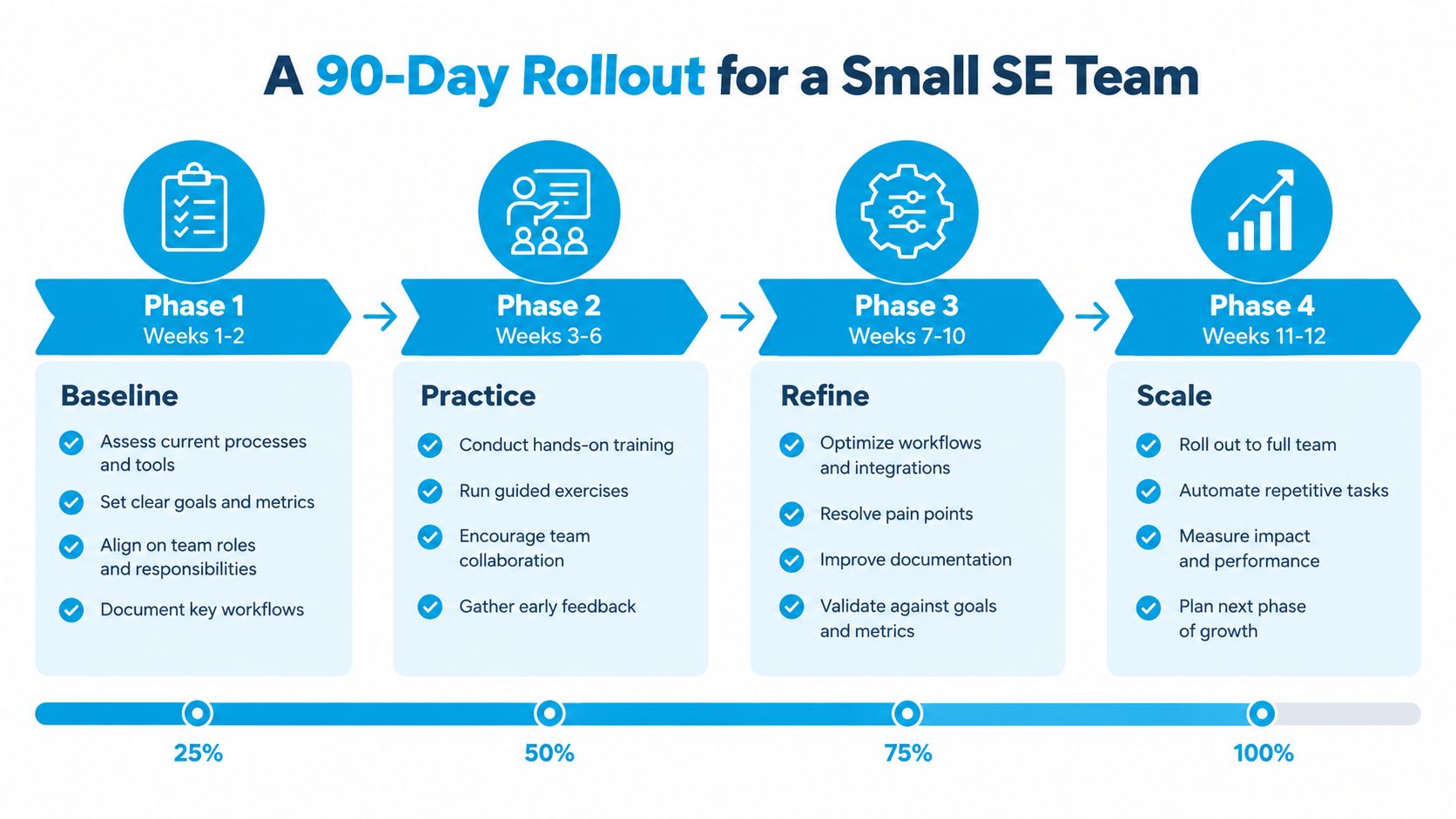
A small team doesn't need a large transformation program. A three-to-six-person SE team can create a useful value selling rhythm by working on active opportunities, standardizing a few artifacts, and reviewing behavior before outcomes arrive.
Weeks 1 to 2 for baseline
Select two live deals with different levels of technical complexity. Review the existing discovery notes, demo plan, and POC material. Mark where a business outcome appears, where the customer baseline is recorded, and where the team relies on a product assertion.
Choose one claims-and-evidence template for the team. Keep it short enough to use before a call. At minimum, it should include the pain hypothesis, desired outcome, baseline, claim, evidence, assumption, stakeholder, and next validation step.
The examples of an effective training plan can provide useful planning context, but the content still needs to reflect how your SEs sell, demo, and validate your product.
Weeks 3 to 5 for practice
Run a discovery-and-demo clinic on two real opportunities. The SE leader should sit in, challenge weak pain framing, and ask the SE to defend every claim.
Use live deal sparring rather than generic roleplay. One person acts as the economic buyer, another as the technical evaluator, and the SE must move from a stated symptom to an outcome without jumping into the product.
Practice the math with ranges and explicit assumptions. If the customer hasn't confirmed a baseline, label it as an open question. A credible estimate with visible uncertainty is stronger than false precision.
Weeks 6 to 9 for inspection
Instrument the deal review cadence. Score technical win rate, POC pass rate, and whether the value hypothesis was tested before the demo rather than after the deal begins to stall.
Review the artifacts, not only the conversation. A manager should be able to answer:
- What business problem is the buyer solving?
- Which KPI or baseline supports that problem?
- What claim will the demo prove?
- What evidence will the POC produce?
- Who decides whether the evidence is sufficient?
Weeks 10 to 12 for executive proof
Run a mock executive business case with a friendly prospect or internal stakeholder. Ask the SE to explain the technical decision in financial and operational terms, then challenge the assumptions.
Audit five closed-won and five closed-lost deals to see whether the discovery-to-demo handoff became value-led. Look for patterns in the claims, evidence, stakeholder coverage, and POC criteria. The purpose isn't to assign blame. It's to identify which behavior the operating rhythm still fails to reinforce.
Don't treat day 90 as the finish line. Keep the template in deal reviews, refresh the claims library after wins and losses, and continue coaching on active opportunities. Value selling training sticks when it becomes part of how the team runs deals, not when the team completes the curriculum.
PreSales Unleashed GmbH offers the Trusted Advisor Academy, a year-round PreSales enablement program with on-demand lessons, live practice, deal sparring, and feedback tied to active discovery calls, demos, and POCs. Visit PreSales Unleashed GmbH to build a reinforcement system that helps Solution Engineers turn value claims into technical wins.