
The most popular advice about need base selling is to ask better questions, listen carefully, and tailor the demo. That advice skips the hardest part: the buyer might be wrong about what needs fixing. If you accept their diagnosis without testing it, you can build a convincing demonstration of a solution they shouldn't buy.
Why More Questions Will Not Save Your Deal
More questions won't rescue a discovery call built around an untested assumption. You can document the current stack, capture every requested feature, and still misunderstand why the customer is considering change. A detailed discovery worksheet isn't evidence that you've diagnosed the right problem.
Corporate Visions' research on discovery effectiveness reports that sellers and buyers align on the core problem after discovery only 45.5% of the time, with alignment falling to 23% in lost deals and rising to 68% in wins. That association doesn't prove alignment causes a win, but it should make you suspicious of discovery scored by question count.
The failure pattern is worth keeping visible.
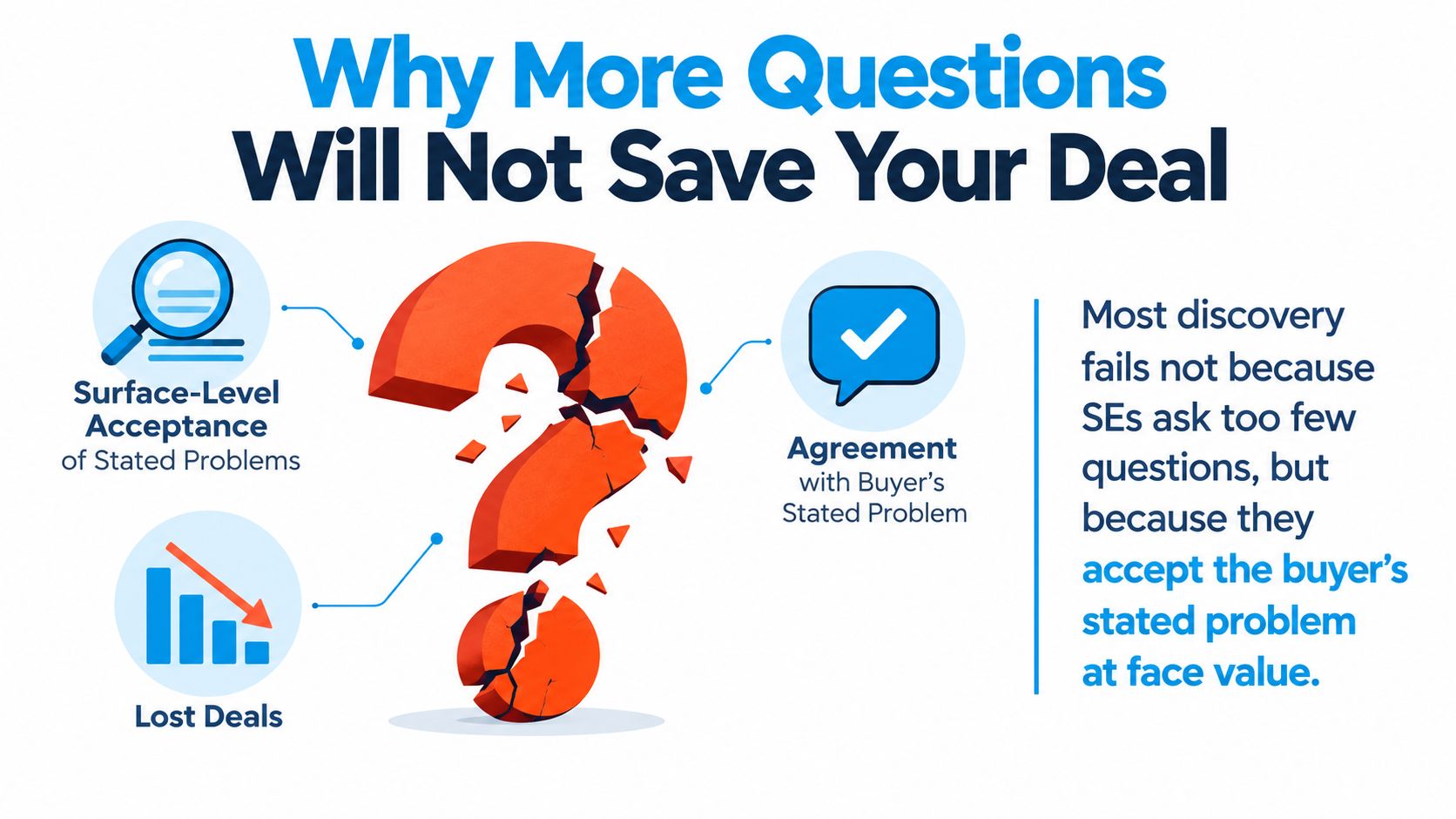
Agreement isn't validation
A buyer asking for better reporting could have a reporting problem. They could also have inconsistent source data, unclear ownership, or a reconciliation process that nobody trusts. Asking which dashboards they want can reinforce the wrong diagnosis.
Need-based selling is a correction discipline. Your responsibility as a Solution Engineer (SE) is to test the explanation before you commit technical effort.
Separate these questions:
- Context: What's happening in the workflow, systems, and organization?
- Clarity: Can the buyer explain where the failure occurs and who experiences it?
- Correctness: Does observable evidence support their explanation, or is another cause plausible?
Challenge the interpretation without challenging the person. Ask, “What would we expect to see if the reporting layer were the cause?” Then request an example that lets you examine that assumption together.
Don't build a demo around a problem you haven't tested.
Good outreach can open this conversation. Flowkon's LinkedIn cold message examples that get replies are a resource for teams working on that opening message, but a reply is permission to investigate, not confirmation of a need.
The technical win starts with a defensible diagnosis, meaningful consequences, and a buyer who can make a decision. A stakeholder map and explicit qualification gates give you something firmer than “the call went well.”
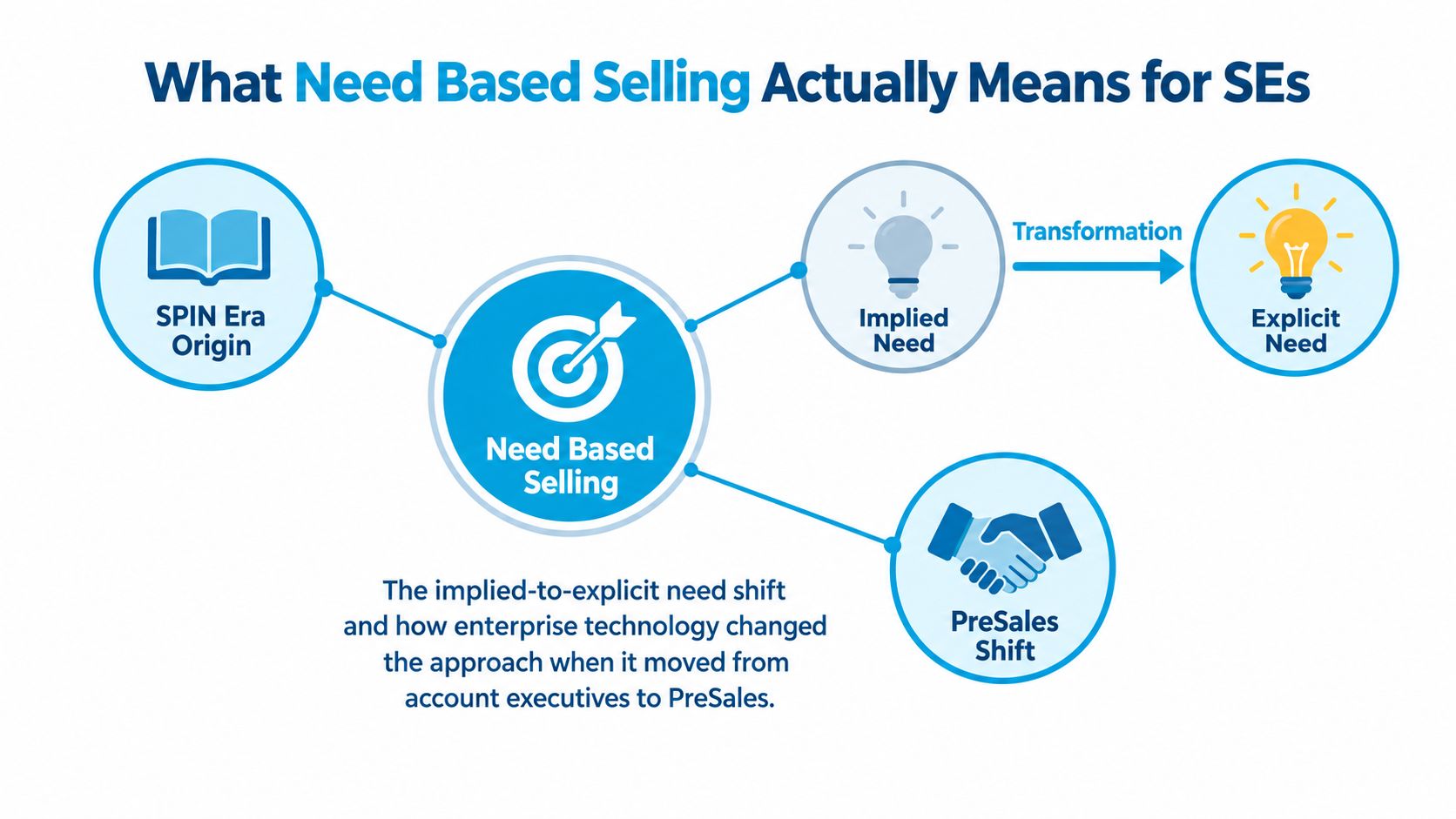
What Need Based Selling Actually Means for SEs
Need-based selling means developing a buyer's dissatisfaction into an explicit, validated requirement before recommending how to solve it. For PreSales, that requirement must connect a business outcome to technical evidence the buying group will accept.
This isn't a new preference for conversational selling. Neil Rackham published SPIN Selling in 1988, drawing on Huthwaite's research into more than 35,000 sales calls, conducted over roughly 10–12 years, across 27 industries and 23 countries, and coded against 116 behavioral variables. The research identified Situation, Problem, Implication, and Need-payoff questions, as described in this account of SPIN's research and framework.
The important shift was from presenting products immediately to developing needs. The buyer's initial dissatisfaction is an implied need. An explicit need emerges when the buyer understands the consequences and can articulate the value of improvement.
That transition is the useful part of the model.
Translate the need into technical proof
For an account executive, explicit need informs the commercial conversation. For you, it must also inform architecture, integration boundaries, governance requirements, and the evaluation plan.
Consider the difference:
| Buyer statement | What you have | What's still missing |
|---|---|---|
| “Our administrators hate the current tool.” | Dissatisfaction | The workflow failure and its consequences |
| “We need a native connector.” | A proposed requirement | Required data behavior and ownership |
| “We need reliable reconciliation before finance approves the new process.” | An outcome to investigate | Acceptance evidence and operating constraints |
Enterprise software and professional services require this translation because features alone don't establish whether the proposed change will work in the customer's environment. Technical fit includes what happens around the product, not merely inside it.
The distinction also separates need-based selling from generic consultative language. Being helpful and curious is useful, but you still need a testable explanation of why this solution fits this problem.
For another perspective on the selling conversation, use the video below alongside your own call reviews.
PreSales owns the technical win, not product coverage. Your deal-review definition should be simple: the customer agrees that the proposed solution meets the validated technical requirements tied to their business need.
No discovery, no demo. A demonstration should prove the need can be met, not compensate for uncertainty about what the need is.
The Discovery Sequence an SE Can Run on the Next Call
Use a sequence, not an interrogation script. Start with observable conditions, test the problem, establish consequences, identify urgency, and ask the buyer to define value.
SuperSummary's account of the SPIN evaluation reports a 30% increase in sales for sellers trained in the method compared with a control group. That's a specific historical result, not a forecast for your team. The practical lesson is to develop the need through connected questions rather than collect unrelated answers.
Keep the progression visible during preparation.
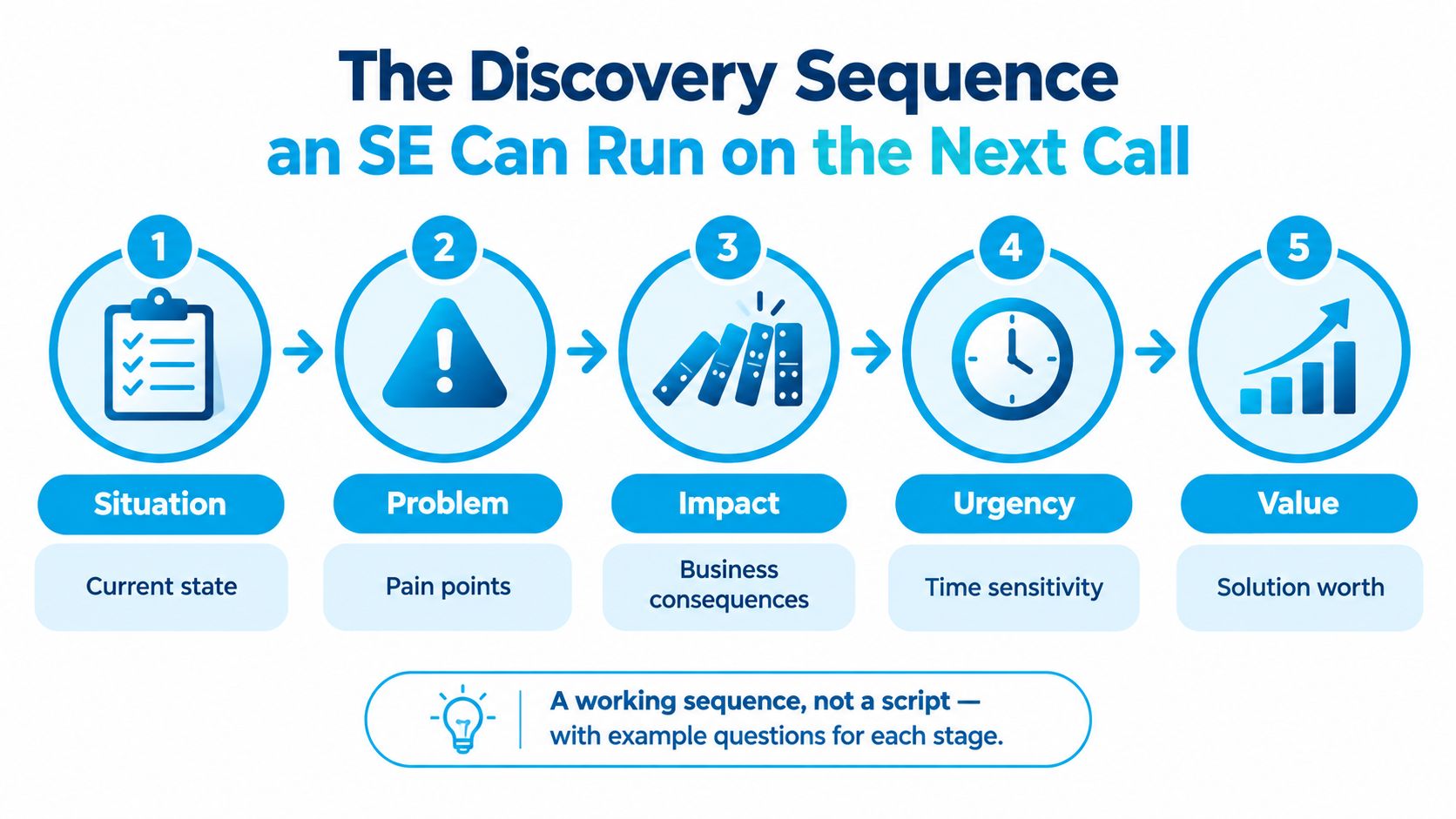
Ask for evidence at each stage
| Stage | Questions you can use verbatim | Evidence to capture |
|---|---|---|
| Situation | “Walk me through how this process works today.” “Which systems and people touch it before it's complete?” | Actual workflow, dependencies, owners |
| Problem | “Where does the process break down?” “What evidence tells you that's the cause rather than a symptom?” | Failure examples and competing explanations |
| Impact | “What does that failure cost in time, money, or missed work?” “Who can validate that estimate?” | Measurable consequences and a credible source |
| Urgency | “What makes this worth changing now?” “What happens if the current process stays in place?” | Business trigger and consequence of delay |
| Value | “What would successful improvement let your team do?” “What result would justify the implementation effort?” | Desired outcome and acceptance threshold |
Don't read the table down the page while the buyer waits. Follow the answer, then return to whatever evidence is missing. If an impact estimate rests on guesswork, record the assumption and who will verify it.
Turn the answers into a value hypothesis
In a hypothetical enterprise integration deal, the situation is a CRM-to-ERP handoff with manual reconciliation. Problem testing reveals that rejected records lack a clear owner, rather than showing that the existing connector is inadequate.
Impact evidence comes from reconciliation logs and finance's record of delayed approvals. Urgency comes from a planned process change that depends on reliable data transfer. Value becomes an agreed ability to identify, route, correct, and reconcile exceptions without unowned work.
Those answers shouldn't produce a connector tour. They should produce a hypothesis about controlled exception handling, with assumptions marked for validation.
Use the PreSales discovery call guide to structure preparation and capture. Your notes should let another SE distinguish what the buyer said, what you verified, and what remains uncertain.
Mapping Every Stakeholder to a Separate Need
An economic buyer can want faster financial reporting while an administrator wants fewer integration failures. Security may reject the proposed access model, even if both agree the business problem matters. Treating the administrator's enthusiasm as organizational agreement leaves you exposed.
Demandbase's State of the B2B Buyer Report states that 72% of B2B purchases involve complex, multi-stakeholder buying groups, 77% of buyers prioritize integration capabilities over standalone features, and only 25% of vendors demonstrate deep understanding of buyer needs. For an SE, the implication is practical: discover the operating environment and the people who can accept or reject the proposed change.
Stakeholder-to-Need Matrix for a PreSales Discovery
Fill this in with names, not just job titles. Mark an answer as unconfirmed until the relevant participant validates it.
| Stakeholder | What 'need' means to them | Evidence an SE must surface | Discovery question to open |
|---|---|---|---|
| Economic buyer | An outcome worth funding | Quantified consequences, outcome ownership, implementation assumptions | “Which business result makes this project worth approving?” |
| Technical evaluator | A design that fits existing systems | Architecture, integration behavior, identity dependencies, failure handling | “Which system boundary is most likely to make this fail?” |
| Security | Acceptable exposure and governance | Access controls, data handling, auditability, compliance evidence | “Which requirement could block approval regardless of business value?” |
| End user | A workflow they can actually complete | Representative tasks, exception paths, adoption constraints | “Where would this proposed workflow create extra work for you?” |
| Procurement | A predictable purchase and implementation | Commercial requirements, responsibilities, contractual dependencies | “What must be resolved before this purchase can proceed?” |
The matrix isn't a contact list. It's a record of separate acceptance conditions.
Resolve conflicts before technical validation
Suppose the economic buyer wants faster processing, but security requires an approval step that adds handling time. Don't promise speed in the executive meeting and leave the administrator to discover the conflict during the POC.
Bring the owners together around the actual workflow. Ask which steps need review, which can run automatically, and which trade-off the sponsor will accept. Document the decision and the evidence each participant needs.
For planning those cross-role conversations, AIDictation's stakeholder alignment techniques offer a communication resource. Use the matrix to keep the discussion tied to unresolved decisions rather than general updates.
Connect this work to MEDDPICC for Solution Engineers, particularly decision criteria and decision process. Knowing who likes your solution is different from knowing who determines whether it passes.
Integration value should be expressed through the work the buyer can stop doing, the failures they can control, and the dependencies they can manage. A connector name is weak evidence. A validated data flow with accepted exception behavior gives the buying group something concrete to judge.
Qualification Gates That Defend Demo and POC Capacity
“Just show them something” isn't an evaluation strategy. It's a request to spend SE capacity before anyone has defined what that effort should accomplish.
Qualification belongs inside discovery. Martal's B2B qualification guidance recommends starting with the buyer's challenge and delaying budget discussion until the need is clear, with five or six fit questions on a first call and roughly a dozen questions across impact, current solution, decision process, and timeline in early discovery. Treat those counts as guidance, not a target.
The headline gates make a useful preparation checklist.
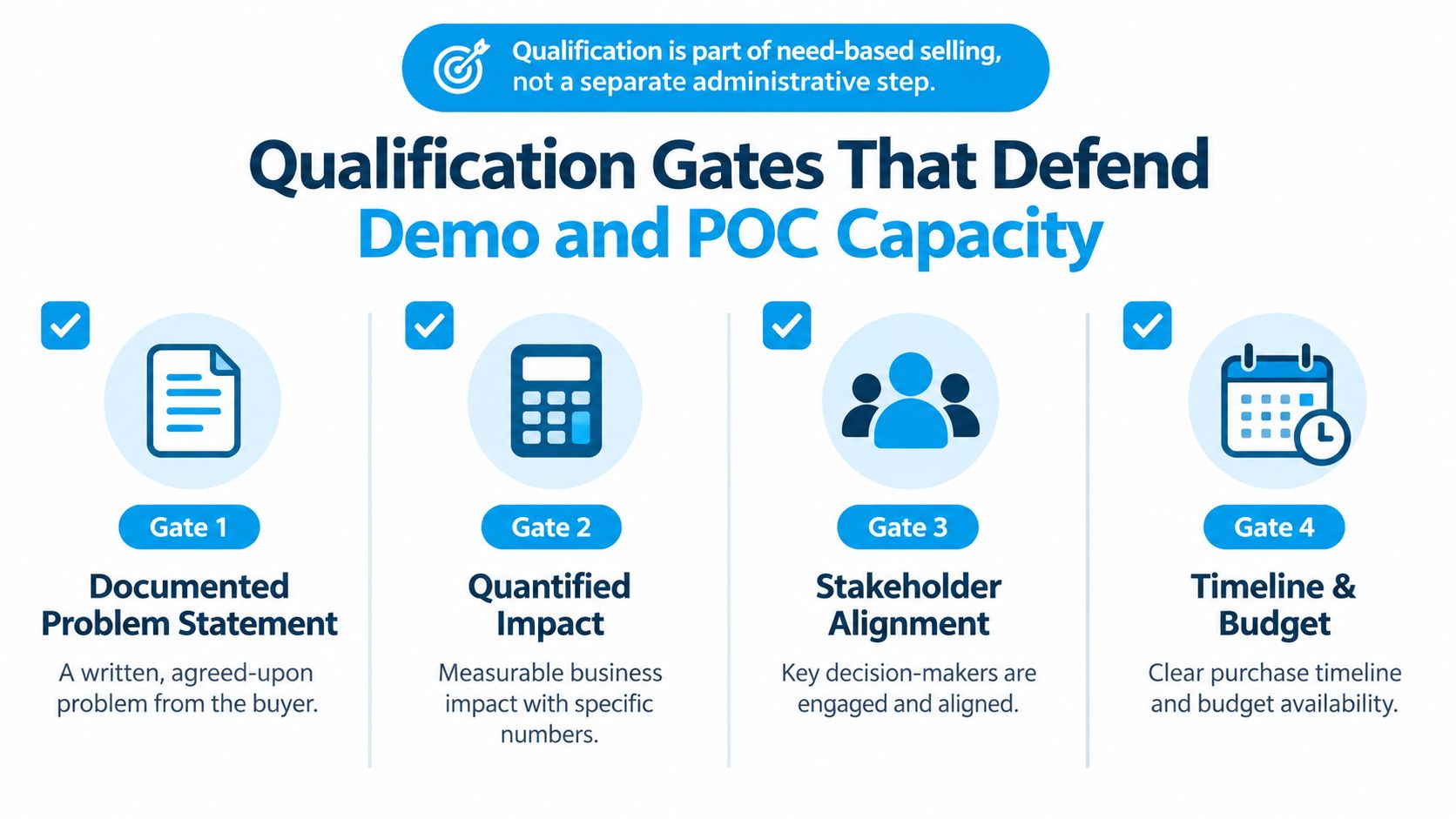
Make the pass condition explicit
For a demo or POC, use gates that distinguish confirmed evidence from optimism.
| Gate | Pass | Hold |
|---|---|---|
| Problem statement | Buyer validates the failure and scope in writing | Feature request without an agreed problem |
| Quantified impact | Consequence has a buyer-owned measure or a credible measurement plan | Unsupported value estimate |
| Evaluation criteria | Buyer agrees observable acceptance conditions | “We'll know when we see it” |
| Decision participants | Technical approvers and decision roles are named | Champion speaks for absent stakeholders |
| Integration ownership | Relevant systems, dependencies, and owners are identified | Access and architecture remain assumed |
| Consequence of inaction | Sponsor explains why leaving the issue unresolved matters | Interest without a reason to act |
Timeline and budget availability matter too, but they don't make an unclear technical evaluation worth running. A scheduled purchase can still be the wrong project.
Give the AE a path forward
Don't say, “PreSales refuses to demo.” Say, “We can schedule a focused demonstration once finance validates the impact and the integration owner agrees the acceptance conditions. Until then, the next step is a requirements session.”
Capacity rule: Every hold should name the missing evidence, its owner, and the action that can resolve it.
Formal qualification can also be buyer-facing. Ever Outbound Inc.’s check your eligibility page is an example of an explicit eligibility checkpoint, though your technical gates must reflect your own evaluation risks.
Document the rules using entry and exit criteria. A standard orientation may help a buyer understand the product category without becoming a custom demo. A POC requires a higher commitment: agreed scope, available participants, acceptance conditions, and a decision tied to the result.
Two Discovery Calls on the Same Hypothetical Deal
A hypothetical enterprise buyer asks for a native CRM-to-ERP connector because finance doesn't trust the current handoff. The AE wants a demonstration of connector setup, field mapping, and monitoring.
The request sounds specific. That doesn't make it correct.
The call that accepts the diagnosis
The SE asks which CRM and ERP the buyer uses, which objects need syncing, and how frequently updates should run. The administrator supplies the details and confirms that a native connector would be preferable.
The SE prepares a polished product tour. It proves configuration is straightforward, but leaves the finance concern unexplained. Nobody has established whether mistrust comes from missing records, conflicting definitions, duplicate transactions, or unowned exceptions.
The call that tests the diagnosis
The SE asks the administrator to walk through a rejected transaction and brings finance into the discussion. In this hypothetical version, the connector delivers records, but nobody owns exceptions after rejection.
Finance wants traceable reconciliation. The administrator wants actionable failure information. Security needs to approve service-account permissions, while the sponsor needs evidence that the new process won't delay approvals.
| Decision point | Accepted-problem call | Tested-problem call |
|---|---|---|
| Working diagnosis | Existing connector is inadequate | Exception ownership and reconciliation are incomplete |
| Evidence collected | Systems and requested features | Rejected transaction, owner gaps, approval dependencies |
| Demo design | Setup, mapping, monitoring | Failure detection, routing, correction, audit trail |
| Gate result | Hold, impact and acceptance conditions missing | Proceed only when remaining evidence is confirmed |
| Possible recommendation | Replace the connector | Validate whether process changes alone can resolve the issue |
The second call doesn't automatically justify buying your product. It may support a smaller project, a process correction, or no POC at all. That's responsible technical advising.
Gartner's B2B buying guidance reports that buyers are 1.8 times more likely to complete a high-quality deal when they use supplier-provided digital tools in partnership with a sales representative rather than independently. The useful application is a shared evaluation worksheet: let the buyer inspect evidence and record decisions with you.
If you can't name the quantified consequence of inaction by the end of discovery, don't build the demo yet.
If the buyer can't quantify it immediately, help them define how to measure it. Don't substitute your estimate for their evidence or build an open-ended POC to avoid the conversation.
Operating This as a Team and Proving It Works
Roll this out as an operating standard, not another presentation about asking thoughtful questions. Your team needs common artifacts, consistent coaching, and metrics that distinguish technical acceptance from commercial outcomes.
Responsive's B2B buyer research finds that 90% of buyers research before contacting a vendor, roughly one in three use AI chatbots to identify vendors, and usage exceeds half in technology. Ask what buyers have already concluded and which assumptions came from external research. Validate those assumptions without dismissing their preparation.
Build the operating loop
- Template the evidence: Standardize the stakeholder matrix, qualification gate, and integration-risk checklist. Keep confirmed facts separate from hypotheses.
- Review discovery behavior: Score call reviews against problem validation, consequence development, and gate completion. Don't reward fluent delivery when the diagnosis remains untested.
- Measure execution and outcomes: Track the percentage of demos with documented needs and acceptance evidence, POC conversion to closed-won, and integration-risk discovery coverage.
Define the technical win rate separately from closed-won conversion. A customer can accept technical fit and still decline commercially, so don't credit or blame discovery for every revenue result.
Adopt it over 30, 60, and 90 days
| Adoption checkpoint | Recommended action |
|---|---|
| 30 days | Pilot the artifacts on active opportunities, establish a baseline, and agree gate language with AEs |
| 60 days | Review calls against the gates and coach how SEs challenge unsupported requirements |
| 90 days | Compare evaluation quality, rework, and capacity allocation; refine the rules before expanding |
These are rollout checkpoints, not performance promises. In the first quarter, look for clearer evidence and more deliberate capacity decisions. Changes in conversion and technical win rate take completed evaluations to assess, and you should account for differences in deal mix.
Use the Trusted Advisor Academy for ongoing practice, or start by discussing your team's evaluation process through the SE Rockstars discovery-call resources. Training should change what your SEs do on active deals.
PreSales Unleashed GmbH offers the Trusted Advisor Academy, combining structured learning, live practice, and application to active discovery calls, demos, and POCs. Visit PreSales Unleashed GmbH to explore support for teaching your team to validate buyer problems and defend technical evaluation capacity before committing to the demo.