
The most repeated advice about running a POC is to write down success criteria and put a timebox on the work. Both are sound. Together they still produce the outcome they were supposed to prevent, which is a deal that ends with "the tech worked, but nothing happened."
The advice fails because it points at the wrong test. Criteria written against a curated path prove the product can be made to work on a curated path. Nobody in the room doubted that. The buyer's real question is whether their organization can run the thing on a Tuesday in March, with their data, their identity provider, and their approvers.
A POC is a mutual qualification. The customer tests operational fit, and you test whether the opportunity deserves the SE hours. Run it as POC project management with a decision at the end, not a demo with extra weeks on the calendar, and the technical win stops being a feeling.
A POC Is a Mutual Decision Not a Longer Demo
A click-through on a happy path is a demo with a longer calendar. It is not a proof of anything except that your environment works.
A POC is not a miniature production system either. Standing one up as though it were is how teams spend six weeks on infrastructure and never get to the decision. What you and the buyer are running is a two-way test on a shared date. They check whether the product survives contact with their data, their identity flow, and their operating model. You check whether the technical win is real or whether you're keeping a dead opportunity warm.
If discovery hasn't named the workflow, the executive sponsor, and the decision date, don't start. That's not gatekeeping for its own sake. The outcome PreSales owns is the technical win, and the role that produces it depends on discovery that happened before any environment was touched.
The only four endings. Every POC closes as scale, revise, pause, or stop. If your plan can't produce one of those by a date, you're not running a POC.
The request you should decline
Hypothetical: a security buyer asks you to "just put it in our tenant for a month" so their team can poke at it. No success test, no named production owner, no end date. It sounds collaborative and it is the exact request this whole approach refuses. A month of tenant access produces opinions, not a decision, and the renewal conversation will inherit every unaddressed objection.
Aim the test at whether the customer can operationalize the product under real constraints. Anyone can make a curated path work. The interesting question is what happens when the data is messy, the approver is on vacation, and legal hasn't seen the agreement.
The machinery that forces the decision is the charter, the scope rule, the owners at each gate, the pass/fail evidence with baselines, the timeline, and the written close. Skip any one of them and you're back to a demo with a date you didn't choose.
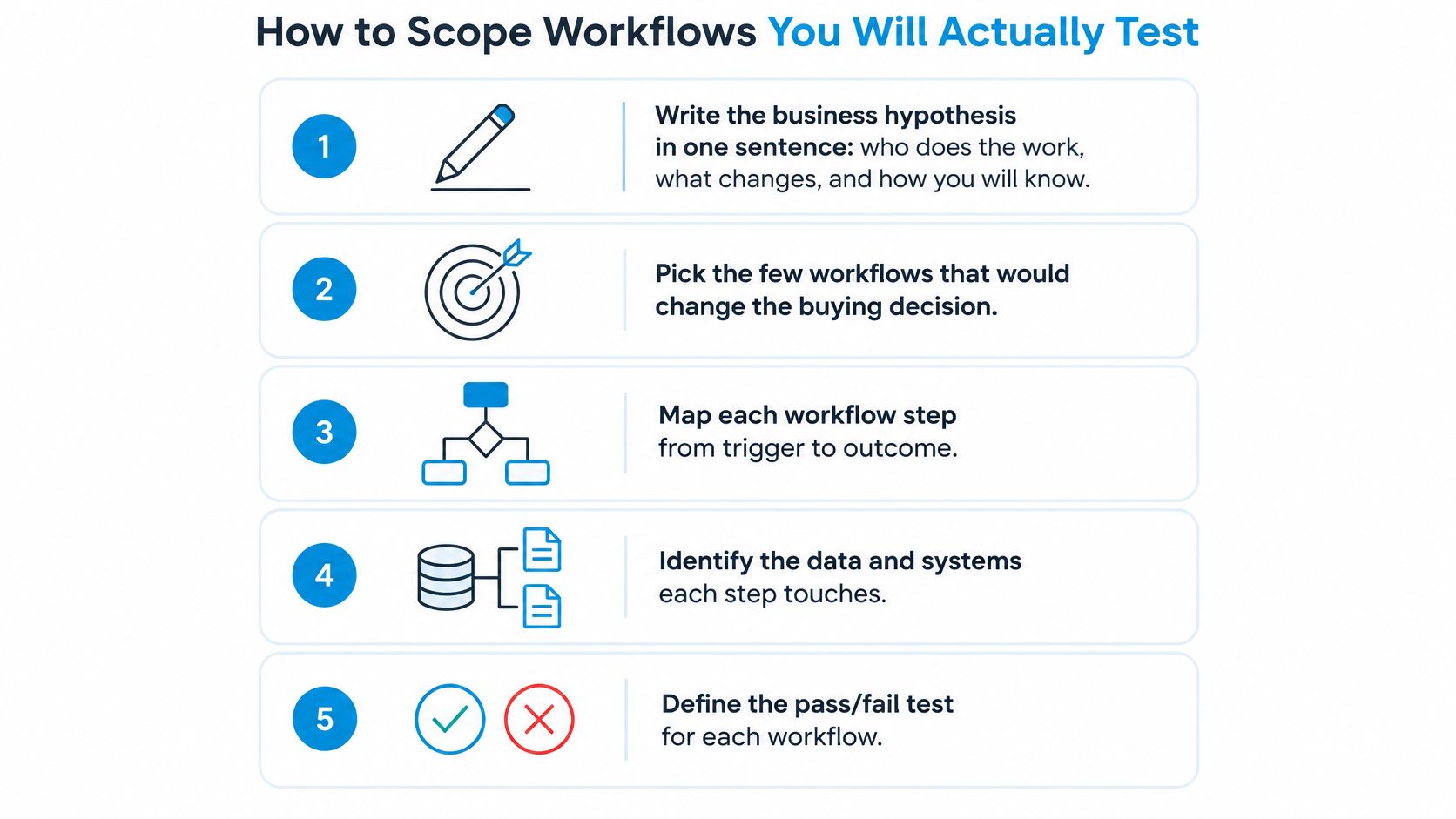
How to Scope Workflows You Will Actually Test
A POC that starts with "let's see whether the product works" has no edge, so it has no end. Scope is what gives it both.
The five scoping moves
- Write the business hypothesis in one sentence. Who does the work today, what changes, and how you'll know it changed. "Adjusters close a first-notice claim in under four minutes without leaving the queue" is a hypothesis. "Evaluate the platform" is a wish.
- Pick the workflows that would change the buying decision. Two or three, chosen from what discovery surfaced. Not the modules you most enjoy showing.
- Tie every test to a decision a named buyer must make. If no one has to decide anything after a test, cut the test. It's costing you a week.
- Check the scope against the systems the workflow touches. The product is only asked to meet the identity provider, the ticketing system, and the warehouse in the actual path. Everything else is a later phase.
- Verify each success test sits inside the scope you wrote. A threshold that depends on data you excluded isn't a threshold, it's a future argument.
Write the exclusion line before anyone asks for it. Four items cover most of the damage: data migration, UI customization, production hardening, and any scenario you won't have time to run.
Western Australia's proof-of-concept guideline for ICT procurement makes the same point in public-sector language. It requires the POC's objectives, scope, resourcing, success criteria, risks, and mitigation strategies to be defined in the procurement strategy, says the scope should prioritize critical areas and stay achievable in the timeframe, and asks teams to confirm the success criteria line up with the scope and with the existing systems the solution must integrate with. A short POC stays short only by leaving lower-value scenarios out on purpose.
Here's the sequence as one checklist you can paste into the evaluation document.
When the workflow is still vague
Go back to discovery instead of widening the build. Vague scope is a discovery gap wearing a project plan. The sales discovery questions that surface trigger, volume, and owner will do more for the POC than another week of configuration, and the discovery call guide covers how to close those gaps in one conversation.
Template, not a customer story. In scope. Two workflows, claim intake and adjustment approval, on 200 records from your test tenant, with SSO through your IdP. Out of scope. Historical migration, custom labels, load testing beyond 20 concurrent users, and any workflow owned by finance.
Copy the shape. Change the workflows. Send it to the sponsor before kickoff and ask for a one-word reply.
Criteria You Agree Before the First Test
Agree the criteria before the first test, not in the review meeting. Criteria negotiated after the evidence exists aren't measurement, they're a negotiation with whoever is loudest.
| Criterion | Evidence that counts | Who scores | How to treat it |
|---|---|---|---|
| Feasibility | The named workflow completes on representative data | SE and business owner | Pass/fail against the hypothesis |
| Performance | Measured result versus a threshold set before the test | Technical owner | A number, not a vibe |
| Integration | Agreed systems only, with effort recorded | Customer IT | In-scope connections only |
| Usability | Frontline users complete the workflow without a guided tour | Frontline owner | An observed task, not a slide |
| Risk | Named risks and whether mitigations held | Sponsor | Open risks block scale |
| Cost-benefit | Production-state effort and expected operational change | Economic buyer and AE | A go or no-go on value, no price list |
| Stakeholder feedback | Notes from the people who must adopt it | Business owner | Input, not a new scope list |
| Business-goal alignment | Result tied to the original hypothesis | Sponsor | Fail if the goal moved mid-test |
| Security | Only the controls named in the charter | Security reviewer | A bounded claim, not a full assessment |
| Legal or compliance | Required review started or cleared for this use | Legal or privacy owner | A gate, not a demo topic |
Turn each row into a threshold with a baseline
Take the baseline before you touch anything: cycle time on the current workflow, a latency ceiling, a defect count from last month's export, or the specific control that either holds or doesn't. Then write the threshold as a number. The Maryland competitive proof-of-concept procurement document.pdf) lists feasibility, performance, integration, usability, risk, cost-benefit, stakeholder feedback, business-goal alignment, security, and legal or compliance as evaluation criteria, and recommends disclosed criteria used consistently with the selection documented. Borrow the discipline, not the paperwork. If your thresholds read as sentences instead of tests, Fluidwave's acceptance criteria examples show how to phrase them so a reviewer can score them without a discussion.
Weight only what could change this deal
Not every row deserves equal weight. Pick the two or three criteria that would flip this deal and say so out loud. The economic buyer's criteria carry the money, which is the same logic you already apply in MEDDPICC for Solution Engineers: identify who decides and what they need to see.
Keep "entered production" and "created measurable value" as separate outcomes. Deployment alone is not a win, and treating it as one is how the review meeting ends without a signature.
Write the security boundary into the charter
NIST's hybrid-cloud cybersecurity practice guide states plainly that its own demonstration work is not a complete test of every security control and is not a red-team exercise, and cannot identify all weaknesses. Your POC has the same limit. Name the claims you will validate, such as identity flow, logging, or one specific control, and list what the exercise will not cover. When compliance evidence, architecture review, or penetration testing is still required, say so in writing before the test starts.
The review meeting stays on this table. New feature wishes go to a later phase, or they kill the decision you came for.
Stage Gates Owners and the Right to Stop
Gates without owners are a calendar with headings. Copy this into the evaluation plan today.
| Gate | What you lock | Evidence owner | Exit |
|---|---|---|---|
| Entry | Business hypothesis, in-scope workflows, exclusions, decision date | SE with an executive sponsor on the buyer side | Written charter, or no kickoff |
| Access and environment | Data set, identity flow, named integrations, what will not be built | Customer IT or data owner plus SE | Access granted on the agreed set, or stop |
| Test window | Pass/fail thresholds only, no new scenarios | Named owner per criterion | Results pack against the original thresholds |
| Decision meeting | Scale, revise, pause, or stop, plus the commercial next step | Sponsor and account executive | Dated decision recorded the same day |
Walk the rows in order. Entry freezes the hypothesis, the workflows, the exclusions, and the decision date. Access freezes the data set, the identity flow, and the named integrations you'll touch, nothing more. The test window scores only the criteria that were already written down, which is where discipline either exists or doesn't. The decision meeting picks one of the four endings and dates the commercial next step.
Assign one job per person. The SE owns test design and the evidence pack. The account executive owns the commercial next step. A buyer-side executive sponsor owns adoption and the go or no-go. Customer IT, security, legal, and the future production owner each hold a gate, not a standing invitation to add scope.
Practical rule: refuse kickoff while any row in that table lacks a named owner. A missing owner today is a missing decision in five weeks.
Write stop rules as conditions, not moods. Missing data access ends or pauses the work. A failed threshold ends it. No sponsor at the decision meeting pauses it. If you need a template for recording those exits, this guide to entry and exit criteria covers the mechanics.
Why one success rate misleads a whole portfolio
In Omdia's 2025 AI Market Maturity Survey, 46% of enterprises moved more than 10% of their AI POCs into production. Within that group, 37% converted 11% to 40% and 10% converted more than 40%. At the other end, 21% converted only 5% to 10%, and nearly one-third converted fewer than 5%. One number called "success rate" is hiding four different outcomes: technical completion, stakeholder acceptance, deployment, and realized value.
The abandonment side tells the same story. S&P Global Market Intelligence's 2025 survey of 1,006 IT and business professionals in North America and Europe found that the share of organizations abandoning most AI initiatives before production rose from 17% in 2024 to 42% in 2025. Read that as tighter selection under real governance, not as a verdict on technology. Stopping after evaluation is the system working when the value, risk, data access, or operating model doesn't justify scale.
An Illustrative POC Timeline You Can Adapt
The dates below are an illustrative timeline set by the charter, not a benchmark. Fix your own total window, put a hard stop date on it, and keep the shape.
| Phase | Illustrative timing | Owner | Exit |
|---|---|---|---|
| Charter and entry | Days 1 to 10 | SE, AE, executive sponsor | Signed charter with hypothesis, thresholds, and decision date |
| Access and setup | Weeks 2 to 3 | Customer IT, data owner, SE | Data and identity live on the agreed set, or stop |
| Test window | Weeks 3 to 5 | SE, named criterion owners | Results scored against baselines and thresholds |
| Decision meeting | Final day | Sponsor, AE | Scale, revise, pause, or stop recorded the same day |
Charter and entry, days 1 to 10. The SE, account executive, and sponsor sign the hypothesis, the thresholds, the exclusions, and the decision date. No signature, no kickoff. This is the cheapest place to kill a bad POC.
Access and setup, weeks 2 to 3. Customer IT and the data owner grant the agreed data, identity flow, and integrations. If access slips past the agreed date, the stop rule applies. Don't move the decision meeting without saying so.
Test window, weeks 3 to 5. The SE and the named criterion owners score only the written thresholds against baselines taken before testing. No new scenarios enter the window, however interesting they look in week four.
Decision meeting, final day. The sponsor and AE choose one ending and record it the same day.
Set a hard stop date that ends the test even if one criterion is still open. A longer window doesn't fix a missing owner, it just delays the discovery that the owner was missing. Run procurement and change work in parallel only when a named owner already exists, otherwise it becomes a second project with no charter. If you want a shared artifact for the parallel work, this mutual action plan template gives both sides dates and names.
When a Working Demo Still Fails Production
A clean technical result that never becomes a purchase usually isn't a technical story at all. It's an organizational one.

The functions most plans forget are the ones that decide whether anything ships: procurement, legal, privacy, security, data owners, IT operations, frontline users, and the team that will own the system after the POC ends. Map them before kickoff and each one gets an exit criterion, not a standing invitation to join week five.
Hypothetical one, the curated file
The demo runs on a three-column export you built with the champion. Production data is still uncleared, and the privacy review hasn't started. The charter line that stops this is a representative data set approved before kickoff, with the data owner named on the access gate. No approved data set, no test.
Hypothetical two, security reads it as an audit
A reviewer treats a single control check as evidence the product is safe overall, then asks why penetration testing wasn't part of the POC. The charter line is a written limit that names the controls you validated and the ones you deliberately left untested.
Hypothetical three, the win nobody owns
The technical win gets declared, and no one owns budget, support, adoption targets, or a rollback path. Six weeks later the deal stalls on a question your POC never touched. The charter line is a named production owner and a handoff document agreed before testing starts.
Omdia's 2025 findings, as reported by The Register, put the main cause of AI POC failure on customers and vendors failing to appreciate deployment complexity, rather than defects in the technology itself. That matches what the stalls look like in practice.
Here's the contrarian reading of "keep the POC short."
A shorter POC reduces waste only when the readiness work starts earlier. Otherwise a fast technical pass with no operating owner just accelerates a predictable no. Separate the technical win, which you can earn on your own, from the production decision, which the customer has to fund with a budget, a team, and a date.
Write the Decision and Move the Deal
Hold the decision meeting on the date in the charter. Read the original hypothesis, the original thresholds, and the evidence pack out loud. Don't add criteria in the room.
Then pick one ending and attach its action.
- Scale. Name the production owner, hand off support, set adoption targets, and put a date on the commercial next step.
- Revise. One changed hypothesis and a new short timebox. Never a quiet expansion of what the POC now covers.
- Pause. Name the missing gate (data access, legal, an unassigned owner), give it an owner, and set the date that reopens it.
- Stop. The test missed the agreed bar, or the customer can't operationalize the product. Release the SE time the same day.
Record the decision in writing the same day, in the customer's words where you can. That's what turns a technical win into something you can point at, which is the whole idea behind measuring your technical win rate rather than your demo count.
The first ending to practice is stop. It's the one that protects capacity and the one most SEs avoid longest. If you want a structured way to build that habit, book a discovery call and bring a live POC to pressure-test, or start with the Trusted Advisor Academy and work through the POC management path with feedback on the deals you're running.
PreSales Unleashed GmbH runs the Trusted Advisor Academy, a year-round program where Solution Engineers build the charter, criteria, and exit discipline described here and apply them to live opportunities in weekly sessions, with feedback on your own discovery calls, demos, and POCs. The Academy teaches structuring POCs so you can pull the plug after two weeks when a test isn't working, which is the habit that protects both your calendar and your credibility. If your evaluations keep drifting past the decision date, start at PreSales Unleashed GmbH.