
Build a bigger content library and sellers will win more. That's the most popular advice on this topic, and it's backwards for PreSales. You don't lose technical evaluations because an SE couldn't find one more PDF. You lose them because nobody ran strong discovery, the demo answered a question the buyer never asked, or the POC had no exit criteria. Build fewer assets, tie each one to a deal stage, and measure the behavior it changes.
What Sales Enablement Content Is and Why It Differs From Collateral
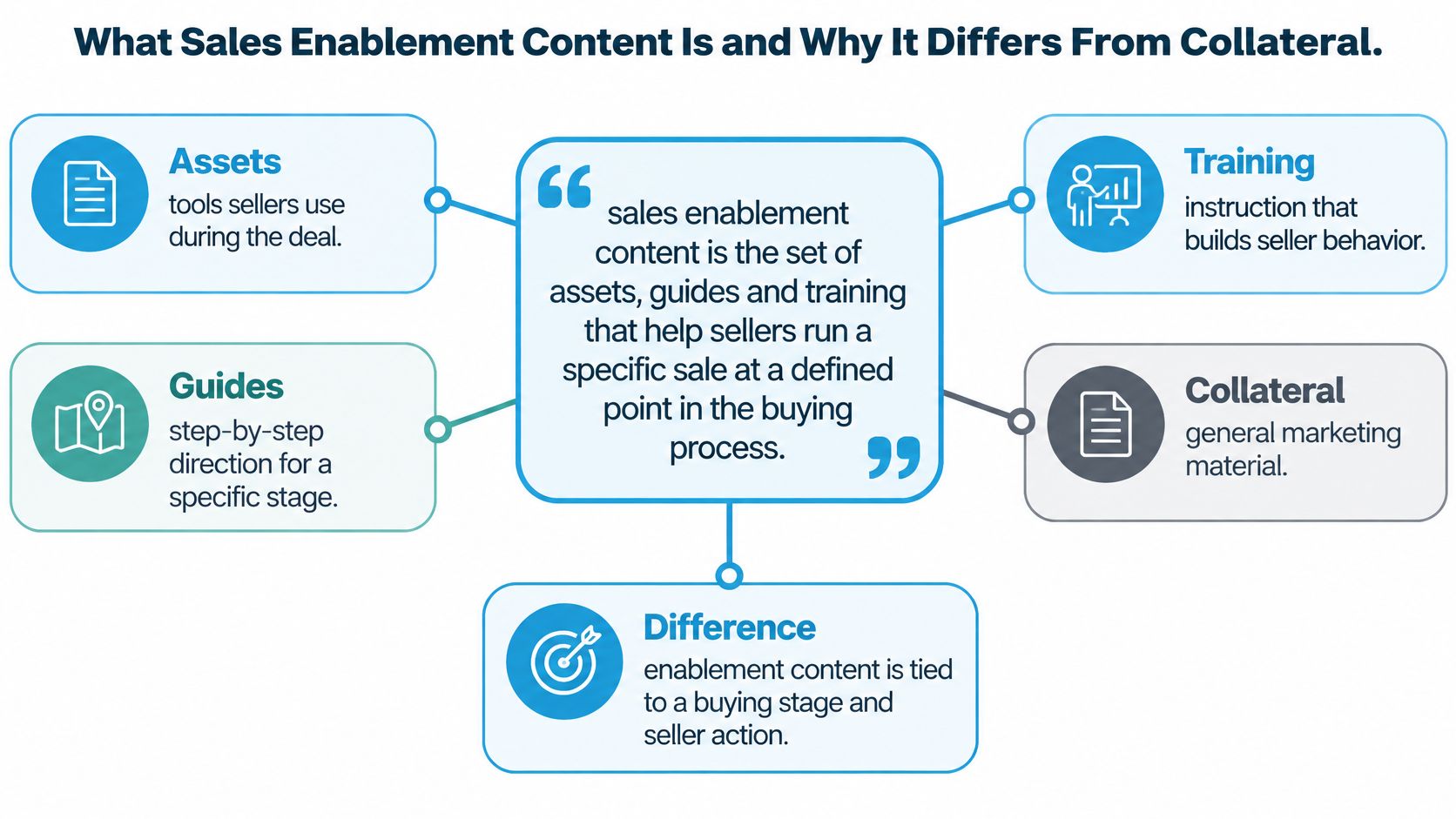
Sales enablement content is the set of assets, guides and training that help sellers run a specific sale at a defined point in the buying process.
That definition rules a lot out. Collateral describes the product. Sales enablement content tells a seller what to do next in a named situation, with a named buyer, at a known stage. If an asset doesn't change a decision, a question, or a next step, it belongs in marketing, not in your core set.
Think of a product brochure as a city map. It shows everything, for everyone, all at once. Enablement content works like turn by turn directions for one trip. It assumes a starting point, a destination, and a driver who needs the next action, not the whole street network.
Who uses it on a PreSales team
- Solution Engineers: You use discovery guides, demo scripts, POC plans, and technical responses to earn the technical win.
- Account Executives: AEs use the same discovery output and value language to frame the business case for stakeholders you may never meet.
- SE managers: You use playbooks, rubrics, and training modules to coach the same behavior across deals, instead of giving different advice on every call review.
Take a hypothetical example. An SE prepares for a security review at a mid-market SaaS account. She needs a current security response, a short architecture brief that states integration boundaries, and a POC plan with success criteria. A marketing one-pager covers none of that. It names features the security lead didn't ask about and leaves the questions that can kill the deal unanswered.
That gap is why library size is the wrong goal. A large library raises search time and version risk. A seller under time pressure grabs the first plausible file, often an old one, and improvises the rest. I'd rather you run ten assets that each have an owner, a stage, and a review date than two hundred files nobody trusts.
Hold this test against every asset you keep. Name the stage, the seller action, and the buyer decision it supports. If you can't name all three, retire it, merge it, or move it out of the core set.
Ten Asset Types and the Deal Stage Each Serves
Start with inventory, not production. The table gives you the ten asset types that cover most technical sales, the job each one does, the usual owner, and the stage where it earns its place.
| Asset | Job it does | Usually owned by | Deal stage |
|---|---|---|---|
| Discovery guide | Frames the questions that decide which demo to build | SE team lead | Before the first demo |
| Battlecard | Positions your product against a named competitor | Product marketing with SE input | Evaluation |
| Playbook | Sets the sequence of plays for a segment or deal type | Enablement | Whole sales cycle |
| Demo script | Structures a short demo around the buyer's stated problem | SE | Demo |
| Training module | Builds a specific skill through practice | Enablement or L&D | Ongoing |
| POC plan | Defines success criteria, timeline and exit steps for a trial | SE | Evaluation |
| Security and technical response | Answers architecture, integration and compliance questions | Security with SE | Evaluation |
| Value calculator | Turns technical benefits into business case figures | SE with finance input | Evaluation and proposal |
| Case study | Shows proof from a comparable customer | Marketing with customer success | Consideration |
| Objection handling guide | Gives tested responses to recurring technical objections | SE team | Any stage |
Read the table as a starting inventory, not a build list. One asset can serve several stages, and ownership splits in practice. Product marketing may draft a battlecard, but SEs have to validate the technical claims. Marketing may own the case study, but you decide whether the customer in it is comparable enough to send.
The stage mix matters because teams overbuild early stage material. Gartner's 2023 buyer journey research found that 36% of sales professionals primarily focus buyer enablement on awareness content, while 28% focus on consideration content. The same research found case studies or customer success stories were the most commonly distributed asset, used by 71% of respondents, followed by product demos at 60% and product one-pagers at 55%.
Don't read that as a shopping list. A demo isn't the automatic answer to every technical question. Buyers need proof, context, and implementation confidence before or alongside a demonstration, and they take in much of that material on their own. Your job is deciding which asset moves this buyer to the next agreed step.
Triage rule: Ask whether a seller would reach for this asset in a live deal this month. If the answer is no, retire it or move it out of the core set.
Your first action is simple. List what your team uses today, match each asset to the table, and mark the stages with nothing at all. That audit comes back at the end, so keep the list open as you read.
Where SEs and AEs Hand Off the Deal
Content fails at the handoff more often than at the writing desk. The SE owns technical discovery and evaluation. The AE owns the business case and commercial timeline. Overlap is fine. Ambiguity isn't. If both of you assume the other captured the buyer's decision criteria, nobody did.
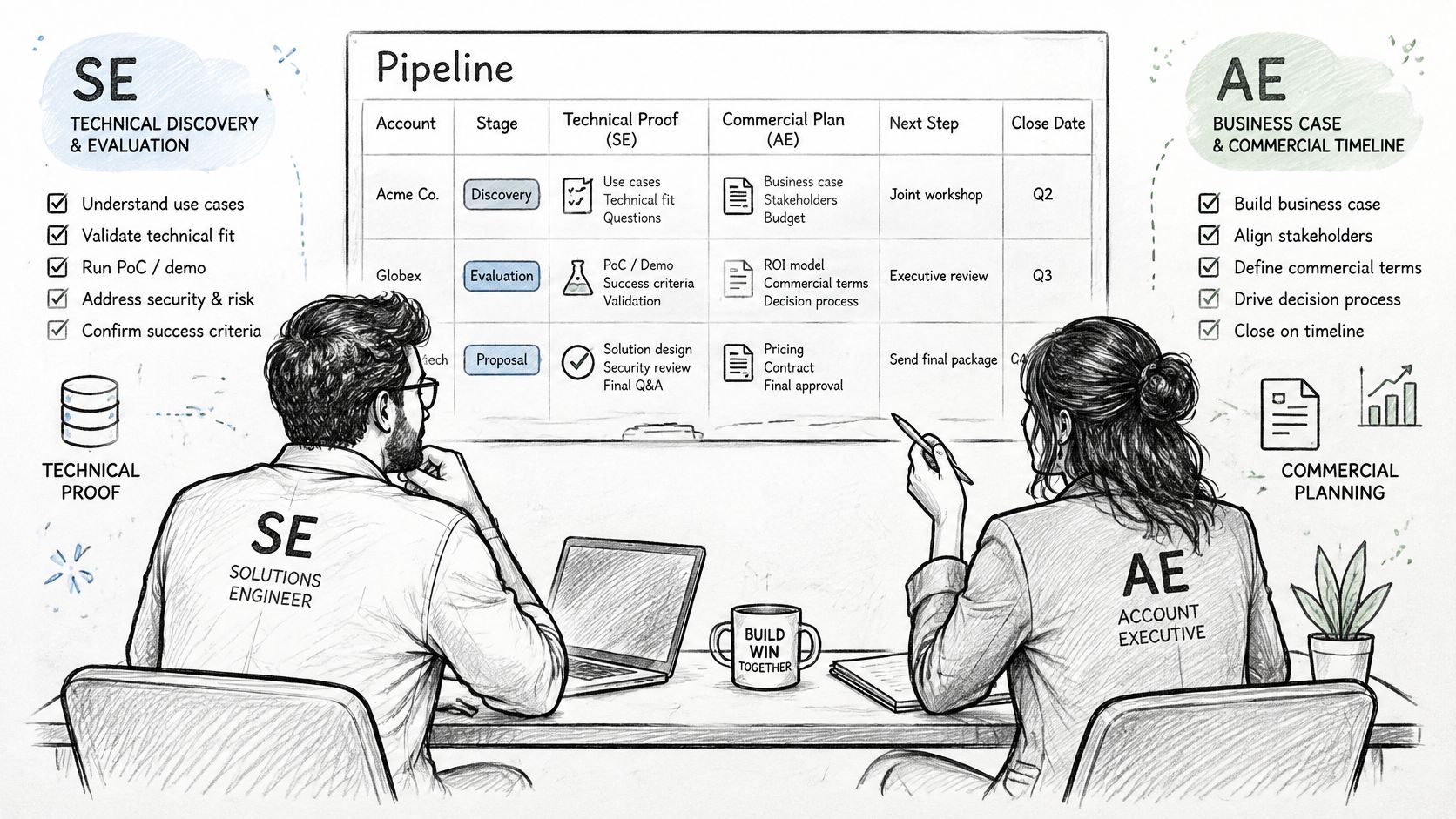
The table sets out who uses what at each stage, and the feedback signal you capture so the next stage starts from facts.
| Deal stage | SE uses | AE uses | Feedback to capture |
|---|---|---|---|
| Discovery | Discovery guide and qualification questions | Deal brief with stakeholder map | Which questions were answered and by whom |
| Demo | Focused 15-minute demo script | Account brief and value summary | Which features the buyer reacted to |
| Evaluation | POC plan and security responses | Success criteria and mutual evaluation plan | Gaps the buyer raised and their owners |
| Proposal and close | Architecture brief and technical sign-off notes | Value calculator and case study | Objections that stalled the deal |
The risk sits between the rows. If your discovery guide lives only with you, the AE writes the proposal without the buyer's stated criteria. If the AE's stakeholder map never reaches you, you demo to an evaluator while the economic buyer judges a different problem.
Use one shared deal brief and update it after every call. Keep it short. State the business problem in the buyer's words, the technical criteria, the stakeholders and their concerns, the agreed next step, and open risks. Name the source and capture date of every figure in it.
Here's a hypothetical example. An AE opens the business case with a value calculator built from figures you captured in discovery. The buyer's finance lead asks where each number came from. If the deal brief records who gave each figure and when, the AE answers in seconds. If it doesn't, the calculator loses credibility and you get pulled into a repair call.
Buyers also research without you. Gartner's sales enablement guidance reports that 75% of B2B buyers prefer a rep-free experience, while 43% of buyers who use self-service digital commerce report higher purchase regret. That combination tells you where to spend SE time. Make core architecture, security, and integration material easy to consume independently. Save your live time for contextual, consequential decisions, such as POC design, security trade-offs, and fit against the buyer's environment.
End every stage with this rule. Every asset used must name the feedback it generates. No feedback field, no way to know whether it worked.
Playbooks, Battlecards and Demo Scripts Done Right
Three assets carry most of the weight in a technical sale, and all three fail the same way. They get written once, in general terms, and never revised against a real deal. Tailoring is what separates them from collateral. A CSO Insights study reported that organizations tailoring sales messages to the customer's path achieved win rates 5.7 percentage points above the study average, while organizations that did not tailor messages performed 7.5 points below average.
The playbook illustration below shows the logic to copy. One segment, one sequence, clear entry and exit points.
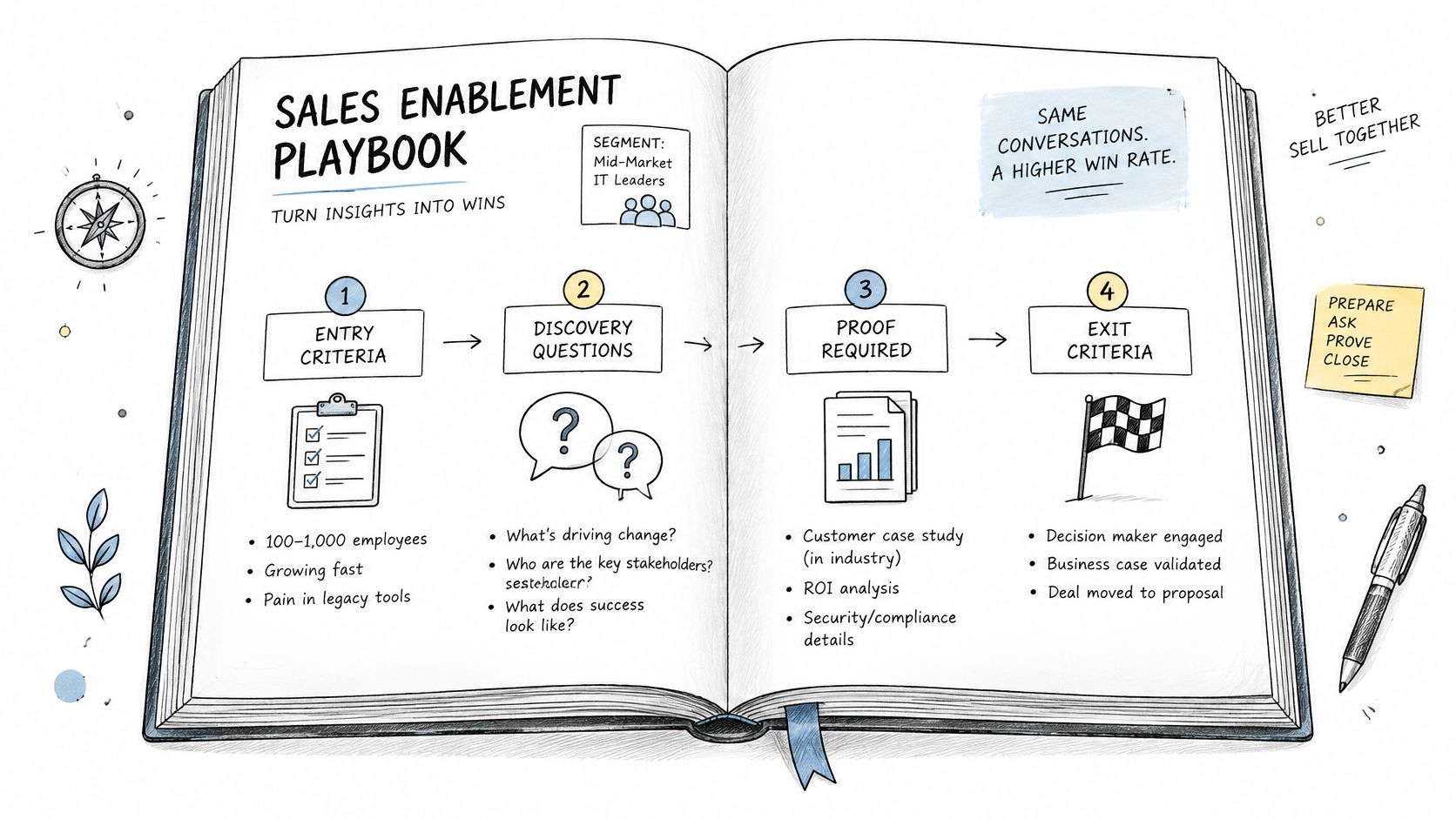
The playbook
Build one playbook per segment or deal type, not one giant playbook for the company. Each play needs four fields:
- Entry criteria: The signals that say this play applies, such as company size, trigger event, or incumbent tool.
- Discovery questions: The questions you must answer before you demo or scope a POC.
- Proof required: The evidence the buyer needs at this step, such as a reference, a security document, or a benchmark the buyer can check.
- Exit criteria: The condition that moves the deal forward, or stops it.
Take a hypothetical data platform deal where the buyer's security team holds veto power. Your playbook should force security discovery before the POC, name the security documents to send, and set an exit rule. No security reviewer identified, no POC start date. That rule protects your scarcest resource, SE evaluation time.
The battlecard
Keep it to one page per named competitor. Cover where you win, where you lose and why, questions that surface gaps through the buyer's own criteria, and proof points a buyer can verify. State your weaknesses clearly. A battlecard that hides them collapses in the first real comparison, and you lose trust you won't get back. Describe the competitor fairly, then let the buyer's criteria do the work.
The demo script
The video below walks through demo structure. Watch it against your own default tour and count how many features you'd cut.
Run a focused 15-minute demo with three features that address the buyer's stated problem, not a 40-minute product tour. Use four parts:
- Confirm the problem in the buyer's words, and check it still holds.
- Show the three features that address that problem, in the buyer's workflow order.
- Quantify the impact the buyer named in discovery, using their figures where you have them.
- Agree the next step, with an owner and a date.
The script must change when discovery changes. If a new stakeholder names a different criterion on Tuesday, Thursday's demo can't run Monday's script. That's why our position stays fixed. No discovery, no demo.
Keep all three assets current with one rule. Review each asset after every lost or stalled deal where it was used. Expect field created versions, too. Sellers adapt material in live deals, so give those adaptations a path back into the owned asset instead of pretending they don't exist.
Training Modules That Stick Past the Workshop
A multi-day workshop feels productive. People take notes, energy runs high, and then the knowledge fades within days because nobody practiced it on a live deal. A video library doesn't fix that. It adds exposure without application, and completion data tells you a file was opened, not that behavior changed.
The Association for Talent Development summary of spaced learning describes spaced learning as exposing learners to content multiple times with intervals between sessions, rather than concentrating instruction in one event. It also distinguishes retrieval practice from passive review. Repeatedly reconstructing information supports long term retention better than rereading it. ATD cites Lehmann-Willenbrock and Kauffeld, "Sales training: effects of spaced practice on training transfer," published in the Journal of European Industrial Training in 2010.
That gives you a mechanic you can copy. Introduce a framework, revisit it after a delay, require the learner to apply it, and give feedback. Build your own cadence from a practical spaced repetition schedule instead of releasing every module at once and hoping.
What one module contains
- Short micro-lesson: One concept, taught once, in plain language.
- Working template: The exact discovery guide, POC plan, or demo script the learner will use in a deal.
- Practice prompt: One scenario the learner must work through, not just read.
- Checkpoint question: One question that forces retrieval of the key idea.
Here's a hypothetical timeline. You release a discovery module in week 1. In week 3, each SE runs the framework in a roleplay against a written case. In week 6, a manager reviews one live call per SE and scores it against the same framework. That sequence creates three retrieval points, and the last one happens where the skill matters.
Score the roleplay with a simple rubric. Did the SE confirm the business problem? Did they identify the decision process? Did they agree a next step with an owner? Three yes or no judgments beat a long scoring sheet nobody completes consistently.
Completion still has a place for records. If you need to document that someone finished a module for compliance or internal tracking, CertSeal's course completion certificate guide explains what a completion record should contain. Treat that record as administration, not evidence of skill.
Ask one question of every module before you build it. What will the learner do differently in a live deal within two weeks of finishing it? If you can't answer, don't build the module yet. Fix the practice design first.
Metrics That Prove Content Changed Behavior
Downloads don't prove anything about selling. You need two metric types, read together. Leading indicators show behavior while you can still coach it. Lagging indicators show outcomes after the deal has moved. Teams that track only lagging numbers learn too late. Teams that track only adoption mistake activity for impact.
| Metric | Indicator type | Data source | Limit to watch |
|---|---|---|---|
| Asset adoption rate | Leading | Content platform or CRM usage logs | Shows exposure, not whether the skill changed |
| Discovery quality review | Leading | Manager scoring of call recordings against a rubric | Needs a consistent rubric across reviewers |
| Demo progression | Leading | CRM stage movement after the demo | Shows momentum, not cause |
| Technical win rate | Lagging | Opportunities marked technically won versus evaluated | Requires one shared definition of technical win |
| Win rate and cycle time | Lagging | CRM deal data | Moves with many factors; needs matched comparisons |
| Time to productivity | Lagging | New-hire ramp tracking | Slow to read; most useful for training modules |
Adoption misleads on its own. A discovery guide can hit high usage because managers told everyone to open it before forecast review. That tells you nothing about whether SEs asked better questions, disqualified weak evaluations earlier, or wrote tighter POC criteria. Pair every adoption number with a behavior check, such as a manager scored call sample.
The measurement gap isn't unique to enablement. The Content Marketing Institute's 2024 benchmark research found that only 46% of B2B marketers agreed that their organization measured content performance effectively, while 36% disagreed and 15% were neutral. Use that as a warning about weak measurement practice, not as evidence about your program.
The attribution problem
A complex B2B deal involves several sellers, channels, and enablement interventions at once. When win rate rises, you can't credit one battlecard. Pricing changed, territories changed, a competitor stumbled, and your best SE worked the biggest deals. Anyone claiming a single asset caused a revenue lift owes you a comparison design.
Run two practical tests instead:
- Before and after on the same team: Keep the same metric definitions, the same rubric, and the same stage rules. Compare discovery quality scores and demo progression for a fixed period before and after you release the new asset.
- Matched cohort: Pair similar deals by segment, deal size, and stage. One group uses the new discovery framework, the other doesn't. Compare POC conversion and technical win outcomes, then read a sample of calls from both groups to check the framework was used.
Neither test gives you laboratory certainty. Both beat pointing at a rising chart.
A metric without a shared definition is an argument waiting to happen.
Technical win rate needs that shared definition before you report it. Decide what counts as evaluated, who can mark a technical win, and what evidence is required. The North Star technical win rate guide sets out a definition and reporting approach you can adopt. Once definitions hold, use consistent KPI reporting examples so managers read the same numbers the same way each quarter.
Report in pairs. Adoption with discovery quality. Demo progression with technical win rate. That pairing keeps you honest about the difference between content people opened and behavior buyers felt.
Building a Continuous Enablement Loop
Sales enablement content decays. Products change, competitors move, and buyers raise objections your assets never anticipated. A publishing calendar won't keep up. You need a feedback loop with owners, cadence, and retirement rules.
The diagram below shows the loop at a glance. The steps after it give you the operating detail.
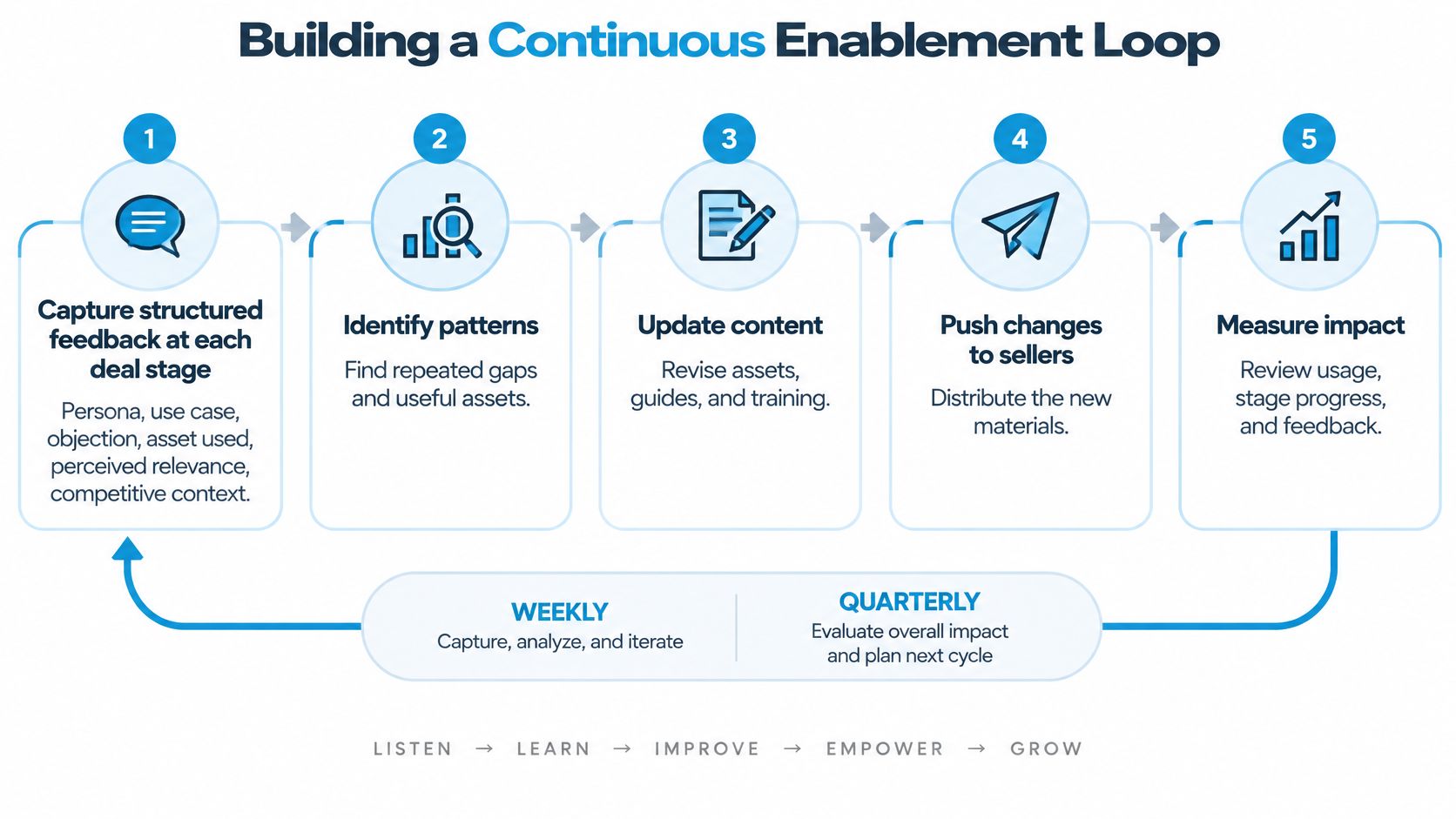
A content effectiveness benchmark report found that teams receiving regular sales feedback experienced 31% higher content usage than teams receiving little or no feedback. It also reported that highly aligned sales and marketing organizations produced content meeting sales needs 81% of the time, versus 35% in low-alignment organizations. Feedback is the mechanism behind both numbers.
Run the loop in five steps
- Capture structured feedback. After each call, the seller records persona, use case, objection, asset used, perceived relevance, competitive context, and next step outcome. Require it within a day, while detail is accurate.
- Triage weekly. Classify every issue as a content gap, an outdated fact, or a training gap. The classification decides who acts, because a wrong fact needs an editor and a weak discovery question needs coaching.
- Revise or retire. Update the asset, give it a version number, and record which version each deal used. Retire assets that no longer earn a stage.
- Release with a change note. State what changed and why, in two or three lines. Sellers ignore silent updates and keep using local copies.
- Check after one quarter. Compare usage and deal outcomes against the problem you set out to fix. If nothing improved, reopen the issue instead of declaring victory.
Give each asset one named owner, a review date, and a retirement rule. Ownership by committee means nobody updates the security response when your architecture changes. Put the owner's name on the asset itself, so a seller in a live deal knows who to challenge.
Your quarterly review needs three lists. Pull assets with no use in the last quarter. Pull assets sellers rewrote on their own. Pull objections that appeared in more than one deal. Each list points at a different fix. Retire, absorb, or build.
Treat a seller's rewrite as a signal to capture, not a failure to police.
That last point matters. When a strong SE rewrites your demo script for a segment, she's telling you the central version doesn't fit her buyers. Take her version, test it against other deals, and promote what works. Teams that punish local adaptation drive it underground, where you can't learn from it.
Keep the loop small enough to run every week. A thirty minute triage with clear classifications beats a quarterly content summit that produces a backlog nobody clears.
Audit Your Discovery Content This Quarter
Make one decision now. Audit the content your team uses before the first demo, and fix that stage first. Discovery quality, not demo polish, decides which deals move forward. A weak discovery guide contaminates every asset downstream, from the demo script to the POC plan to the value calculator.
Run the audit in four steps:
- List every asset in use, including the local versions sellers keep on their own drives.
- Match each asset to a deal stage from the inventory table, and flag any asset with no stage.
- Record the owner and date of last use for each one.
- Flag stages with no asset at all, especially evaluation exit criteria and technical sign-off.
Use a solid discovery call guide as your reference point for what good discovery output looks like. Then set your first two changes. Rewrite the discovery guide around the buyer's stated criteria, not your product areas. Add a feedback field to the demo script that records which features the buyer reacted to and which questions stayed open.
If your team lacks capacity to run this alone, two options fit different needs. The Trusted Advisor Academy covers discovery, demos, sales alignment, POC management and value articulation in a year-round program with live practice on real deals. Enablement-as-a-Service is a continuous subscription program for PreSales and Sales Engineering teams in B2B SaaS that want lasting behavior change and provable impact.
Start with the audit either way. Bring your current asset list, pick the stage with the weakest coverage, and fix one asset before you build anything new. When you're ready to review your assets against this framework, book a discovery call and work through the gaps deal stage by deal stage.
If your audit shows strong demos built on weak discovery, PreSales Unleashed GmbH can help you rebuild that sequence with structured training, ready to use assets, and live practice tied to active deals. The Trusted Advisor Academy develops Solution Engineers and SE leaders across discovery, demos, sales alignment, and POC management over twelve months, so new behavior gets reinforced instead of fading after a workshop. Visit PreSales Unleashed GmbH to see how the program fits your team and choose your next step.