
The most popular advice on a spaced repetition schedule is also the least useful advice for a live PreSales team: memorize a fixed ladder such as 1-3-7-14-28 and trust the calendar. That works for a static deck of flashcards. It breaks when an SE has a discovery call, a security review, a late-stage demo, and an RFP response competing for the same block of time.
Your schedule should follow deal relevance, skill risk, and observable execution. A review matters when it helps an SE handle the next objection, sharpen the next discovery call, or protect the next technical win. Memory is the input. Deal-level behavior is the outcome.
Why the Standard Spaced Repetition Schedule Breaks in Sales Enablement
The 1-3-7-14-28 ladder looks disciplined because the dates are clean. That appearance creates a bad operating assumption: if the reminder fired, learning happened. In a live pipeline, an SE may postpone the review because an executive demo moved forward, a prospect opened a security thread, or an AE needs urgent technical support. The calendar doesn't know which skill matters this week.
A fixed schedule also reviews content whether the SE has used it or not. Repeating a demo framework after a week with no demos produces recognition, not reliable performance. The SE can recognize the slide and still miss the qualification signal in a real call. PreSales owns the technical win, so the review must test whether the SE can apply the skill in the opportunity, not whether the person remembers a definition.
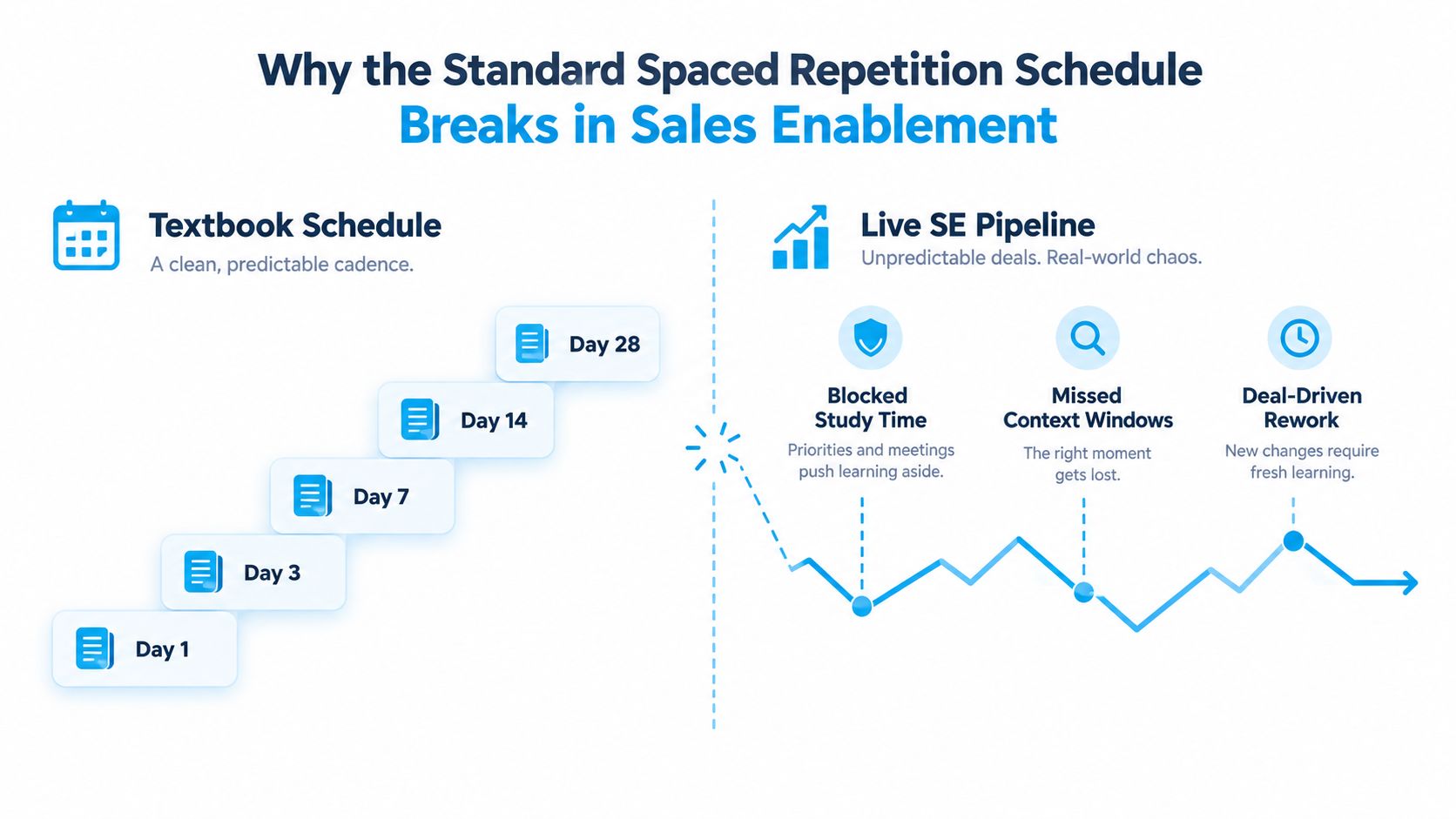
The three failure points
- Protected time disappears: Pipeline volatility pushes passive learning behind customer work.
- Context goes missing: A review fires without reference to the demo, discovery call, or RFP currently in motion.
- Memory becomes the KPI: Leaders report completion instead of measuring discovery quality, demo execution, objection handling, or technical win rate.
Operating rule: A review isn't complete when the SE clicks through content. It's complete when the SE retrieves the idea and uses it against a real deal artifact.
Build the system around active opportunities and coaching loops. For a practical foundation, align the schedule with what PreSales owns, then connect each review to a deal stage and a measurable behavior. That gives you a QBR narrative you can defend: this review addressed a live risk, produced a coaching signal, and changed the next customer interaction.
How Forgetting Curves Actually Apply to PreSales Skill Decay
Hermann Ebbinghaus's 1885 memory experiments established the pattern behind modern review algorithms. Without review, remembered material fell to about 58% after 20 minutes, 44% after 1 hour, roughly 33% after 1 day, about 20% after 1 week, and around 15% after 1 month, as summarized by RTL's explanation of spaced repetition.
That pattern maps cleanly to PreSales. A new objection-handling framework can feel available immediately after bootcamp, then become harder to retrieve during a customer call the next day. A demo flow may still feel familiar after a week while the transitions and diagnostic questions have started to fragment. Discovery questioning can become noticeably less sharp after a month without deliberate use.
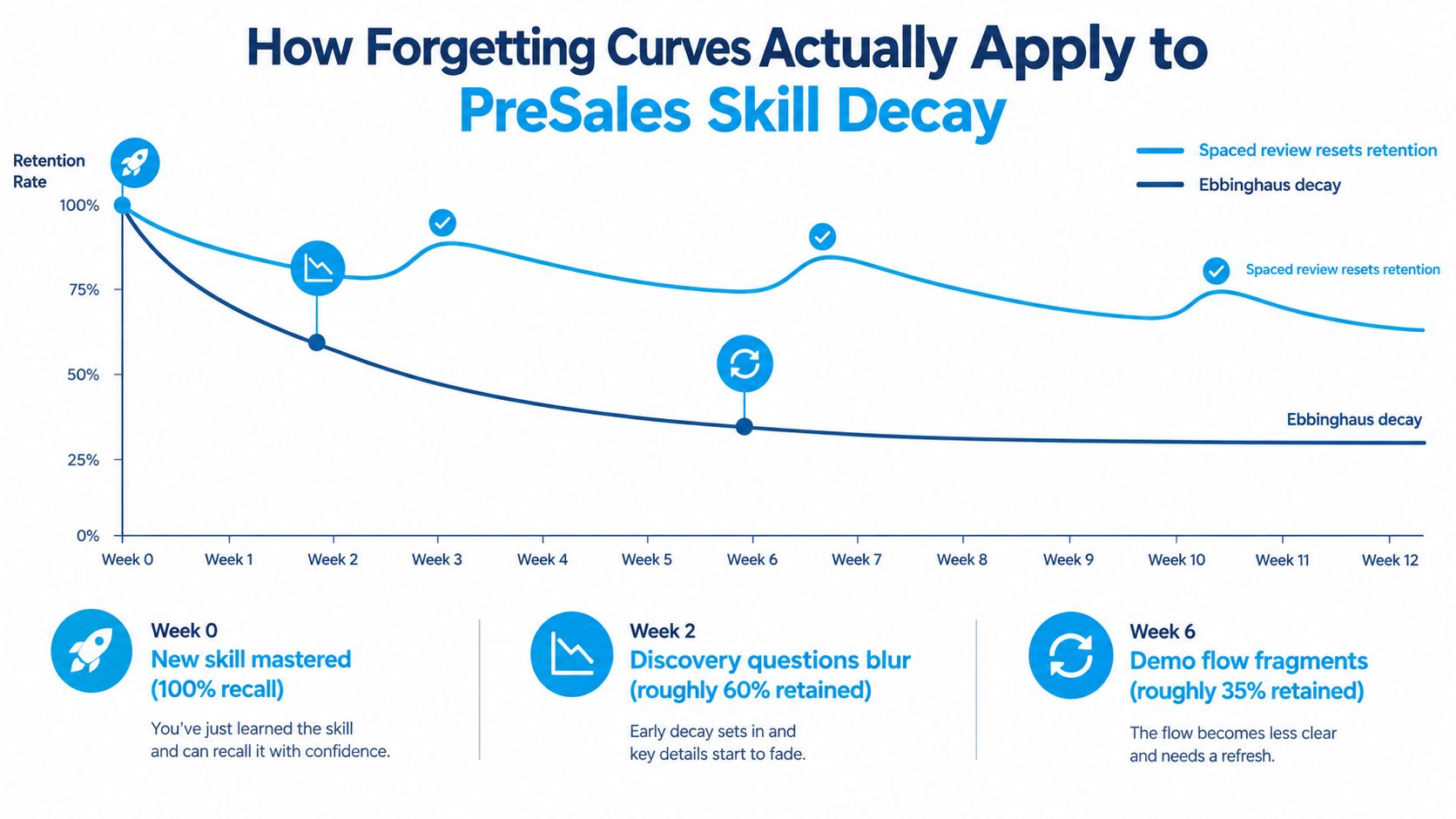
Turn decay windows into SE actions
| Decay window | SE behavior to test | Review material |
|---|---|---|
| Minutes to hours | Explain the new technical win theme without notes | Product narrative and discovery prompts |
| Around one day | Handle an objection from the last enablement session | Call transcript or objection card |
| Around one week | Reconstruct the demo flow under pressure | Demo script and live prospect context |
| Around one month | Run discovery without reverting to feature questions | Discovery notes and qualification framework |
The point isn't to chase a perfect recall percentage. It's to schedule retrieval before the skill becomes unavailable in the situation where the business needs it. The KPU learning guide describes the useful pattern: early reviews sit close together, then intervals lengthen as the learner keeps succeeding.
Passive rereading won't carry the skill into a customer conversation. Ask the SE to recall the discovery sequence aloud, rewrite a technical answer for a specific account, or explain why a reference architecture fits the prospect's constraints. Research summarized in Frontiers in Psychology shows that interval length changes retention outcomes, and that the best interval depends on the final retention delay and the number of reviews.
The implication is direct: intervals matter only when each one includes retrieval practice tied to an upcoming deal context.
Comparing Common Spaced Repetition Schedules Side by Side
Enablement teams usually reach for one of three fixed patterns. Each has a legitimate use. None should become a permanent policy without reference to skill difficulty, deal timing, and the cost of a missed review.
| Schedule | Intervals | Best For | Main Risk |
|---|---|---|---|
| Classic ladder | Day 1, 3, 7, 14 | New-hire bootcamps and certification preparation | Backlog grows when a live deal interrupts the ladder |
| 2357 method | One, two, three, five, and seven days counted back from the exam or target date | Short, deadline-driven preparation | It compresses too much activity around a single outcome |
| Product refresher stretch | Day 1, 3, 7, 14, and 30 | Product launches and quarterly refreshers | The final gap can be too wide for fast-changing product details |
The classic ladder is the right default for a new SE learning a discovery framework or demo structure. The University of Arizona Thrive Center pattern puts the first review on day 1, followed by day 3, day 7, and day 14. That tight sequence forces early retrieval before the skill gets buried under customer work.
The 2357 method is better when you have a defined deadline. Birmingham City University presents it as a reverse-planning pattern that counts back one, two, three, five, and seven days. For PreSales, adapt the target from an exam to a major demo, certification review, or executive technical validation.
Use the wider day-1/3/7/14/30 pattern for evergreen skills that need to survive alongside steady deal flow. It creates enough early pressure to establish recall, then moves the maintenance burden away from the first weeks. Don't use it for a feature that changes every sprint.
Choose one cadence this quarter based on the shortest business deadline and the cost of failure. Tight ladder for new capability, mid-range for a defined launch or certification, wider spacing for stable skills. If the skill sits inside an active deal, replace the calendar date with the next meaningful customer event.
Designing a 12-Week Spaced Repetition Schedule Around Live Deals
A 12-week program should feel like a deal operating rhythm, not a course with reminders. Start with an intensive kickoff, then use weeks 2, 3, 5, 7, 10, and 12 for structured reinforcement. Keep the practice anchored to whatever your SEs are selling that week.
The program needs three modes. Solo prompts build fast retrieval. Peer role-play exposes weak phrasing. Manager coaching connects the behavior to pipeline risk. A Friday block works well because it gives the team a fixed place to inspect what happened in customer conversations and prepare for the next one.
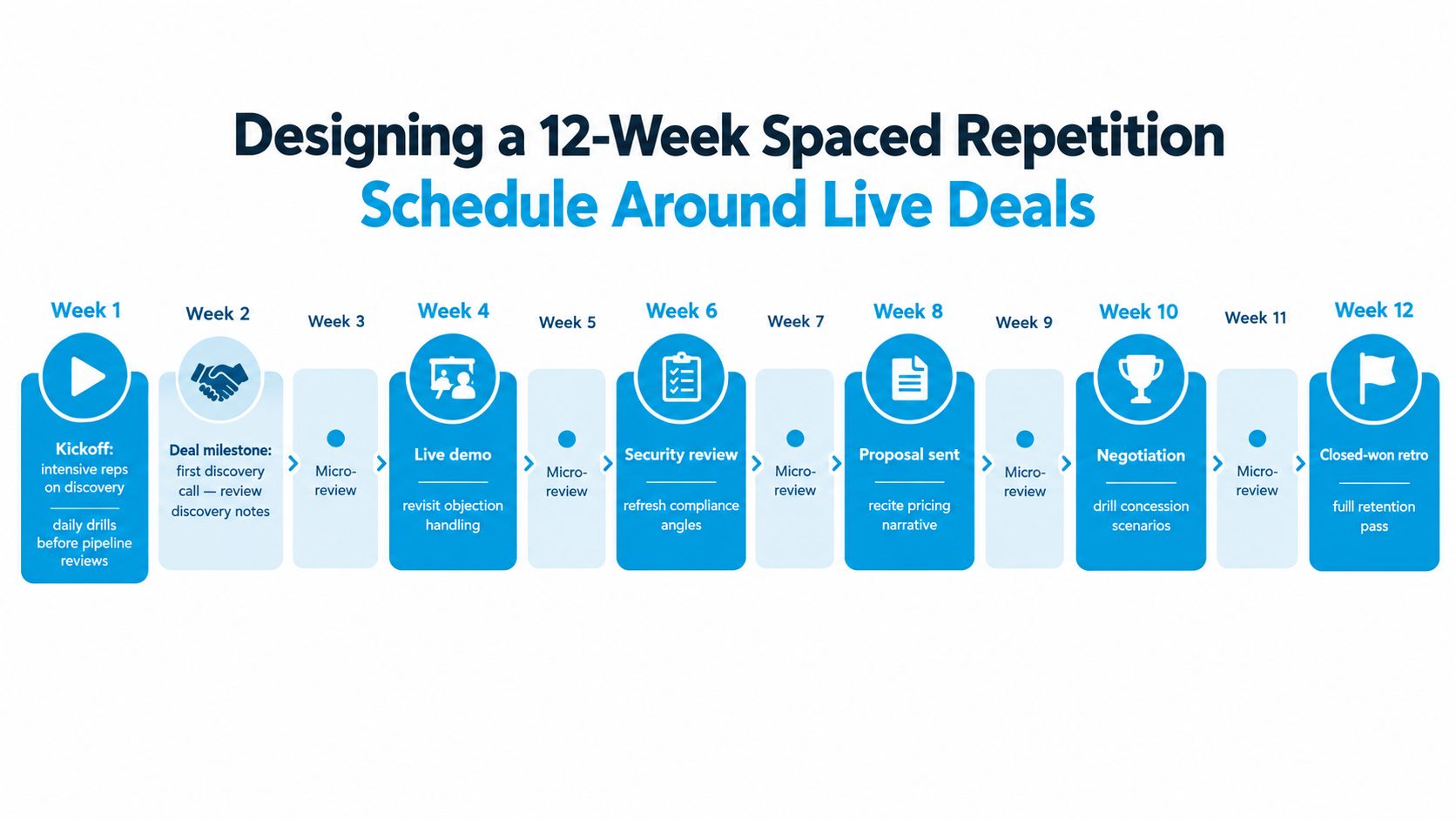
The weekly operating pattern
| Week | Enablement activity | Deal anchor | Review mode |
|---|---|---|---|
| 1 | Intensive reps on discovery, technical win themes, and competitive positioning | Current pipeline review | Daily drills and manager observation |
| 2 | First reinforcement | Discovery notes from an active account | Solo recall, then peer role-play |
| 3 | Retrieval under pressure | Prospect objection from the prior week | Peer role-play with a scorecard |
| 4 | Application check | Upcoming live demo | Manager listens for discovery-to-demo continuity |
| 5 | Targeted refresh | RFP response or architecture question | Solo prompts based on real artifacts |
| 7 | Rebuild weak areas | Security or integration review | Manager coaching and role-play |
| 10 | Advanced application | Negotiation or evaluation plan | Peer challenge using account context |
| 12 | Retention pass and retro | Closed-won or closed-lost opportunity | Full review, lessons, and next-cycle assignment |
Don't make every session a flashcard exercise. A solo prompt might ask, “What are the three technical risks in this account, and which discovery question surfaces each one?” A peer role-play should force the SE to respond to a buyer who introduces a security concern halfway through the conversation. Manager coaching should inspect whether the SE linked the answer to business impact.
Protect the Friday review block before the quarter begins. The sales onboarding program for SEs is a useful reference for combining short drills with repeated practice across topics such as security, integrations, competitive positioning, and qualification. The same principle applies after onboarding: keep the review short, specific, and attached to current opportunities.
When to Move Beyond Fixed Intervals and Personalize the Cadence
A shared cadence works while the team is small and the skill gap is narrow. Once you have more than roughly eight SEs, mixed tenure and different opportunity exposure make one schedule inefficient. This threshold is an operating heuristic, not a research benchmark. Treat it as the point where a common queue deserves a personalization layer.
Tighten the interval when an SE fails a mock demo, loses the thread in a discovery call, or faces a new competitor in active accounts. Widen it when the SE consistently executes the behavior, maintains strong win performance, or holds certification scores above 90 percent. The 2025 medical education study summarized in Frontiers in Medicine supports the broader position that adaptive timing deserves attention, while not establishing one universal schedule for every learner or material.
Use three review levels
| Tier | Who It Fits | Review Interval | Trigger to Move Down | Trigger to Move Up |
|---|---|---|---|---|
| Core | New skill, weak recall, or active deal risk | Weekly or tied to the next deal event | Missed retrieval or weak live application | Successful role-play and customer use |
| Stretch | Reliable execution with a harder scenario ahead | Every two to three weeks | Failed advanced scenario | Strong application across varied accounts |
| Refresh | Stable skill with consistent execution | Monthly or at a relevant pipeline milestone | New product, competitor, or performance slip | Not applicable, return to Core after a miss |
Run the review assignment in 30 minutes per rep per quarter as a planning block, not a software project. For each SE, identify one core skill, one stretch skill, and one refresh skill. Attach a trigger to each, then record the result after the next live application.
Feed the pattern back into the team cadence. If several SEs miss the same security objection, make it a shared review. If only one person struggles with it, keep the intervention personal. Personalization should sharpen the system, not create separate enablement programs nobody can operate.
A Real Scenario Putting the Schedule to Work
Consider a hypothetical SE named Maya. She lost a $400K enterprise deal after missing a technical compliance angle during discovery. The issue wasn't that Maya lacked product knowledge. She didn't retrieve the right compliance question early enough to shape the evaluation.
The enablement lead doesn't assign a generic refresher course. The next morning, Maya completes a 15-minute recall session without notes. She states the discovery sequence aloud, identifies the compliance signal she missed, and rewrites the question for the account profile. The check is verbal recall, not content completion.
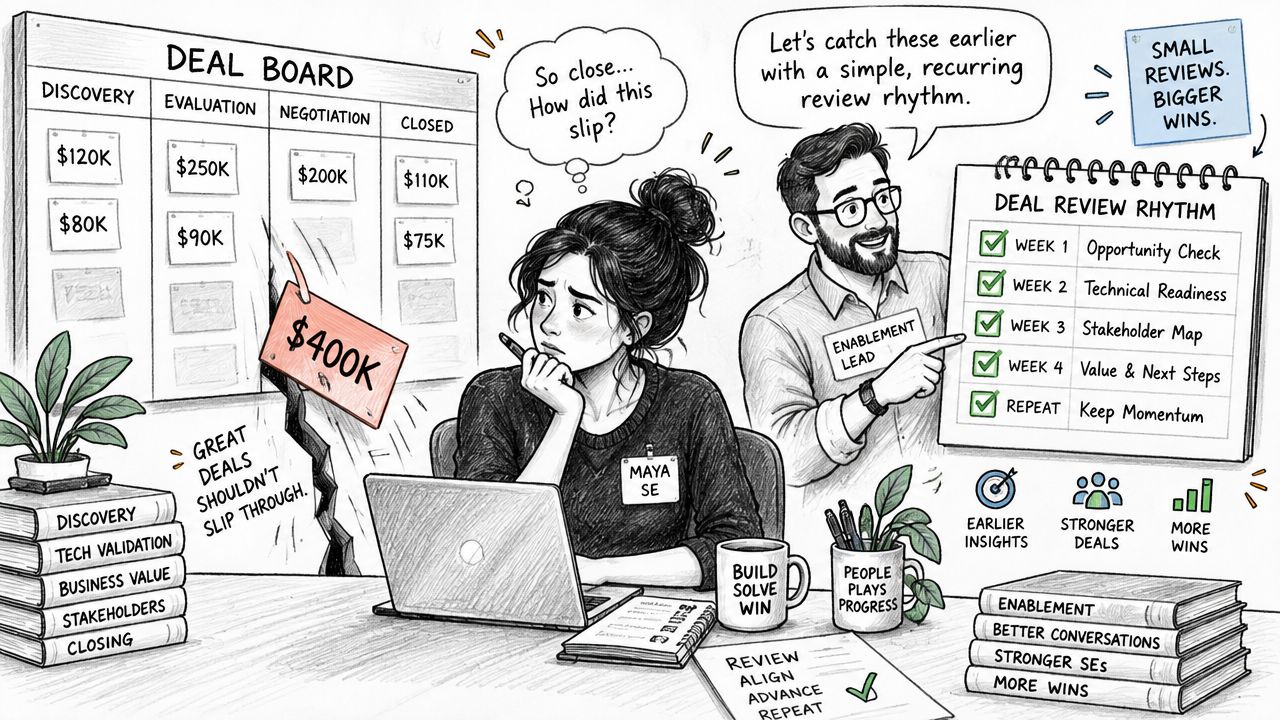
The re-spaced intervention
On day 3, Maya runs a peer role-play. Her partner plays a skeptical security lead who gives partial information and redirects toward product features. The peer scores whether Maya asks a business-impact question, surfaces compliance requirements, and confirms the evaluation consequence.
On day 7, the manager leads a deeper review using the lost-deal notes. Maya compares the question she asked with the question the account needed. She then handles a more difficult version, where the prospect introduces a competitor's compliance claim. The manager doesn't move her forward because she can recite the framework. The manager moves her forward because she can use it under pressure.
On day 14, Maya applies the skill in a live upcoming demo. The review uses the prospect's discovery notes and the technical validation plan. The scorecard combines her verbal recall, mock-call result, and prospect feedback. If she misses the compliance angle again, the next review moves sooner. The system doesn't wait for the original calendar date while the gap compounds.
A demo skills training resource can support the application side of this loop, but the operating decision remains with the enablement leader: every failed retrieval shortens the next interval, and every successful application earns more distance.
In this hypothetical, Maya closes her next enterprise deal after using the question early enough to shape the technical evaluation. The schedule becomes her default preparation ritual because it fits the work. She reviews the skill before the customer moment, tests it with another person, and uses the account as the final assessment.
Measuring Retention and Operating Rhythm That Keeps It Going
A spaced repetition schedule survives when leaders measure behavior, not attendance. Use three retention KPIs:
- Recall accuracy at 30, 60, and 90 days, so you can see whether the skill remains available after the initial training cycle.
- Demo certification pass rate, so managers can inspect whether the team can perform the expected flow.
- Deal-stage win rate tied to refreshed skills, so RevOps can connect enablement activity to technical outcomes without claiming that training alone caused the result.
Assign one owner to each metric. The enablement leader owns recall health, the SE manager owns certification execution, and RevOps owns the deal-stage view. If ownership is shared by everyone, nobody maintains the data.
| KPI | Owner | Cadence | Source |
|---|---|---|---|
| Recall accuracy at 30, 60, and 90 days | Enablement leader | Monthly review | Retrieval checks |
| Demo certification pass rate | SE manager | After each certification cycle | Certification scorecard |
| Deal-stage win rate tied to refreshed skills | RevOps | Monthly or QBR | CRM opportunity data |
| Review completion against live deal context | Enablement operations | Weekly | Learning or enablement system |
Run a Monday review queue and a Friday coaching debrief. Monday answers, “Which skill does each SE need before the next customer event?” Friday answers, “What did the customer interaction reveal, and should the next interval shrink or expand?” A sales engineer KPI framework can help structure the technical performance view.
Keep one dashboard with two views: per-SE recall health and per-content-piece decay. Export both to the CRM so RevOps can compare review activity with deal stage and technical win outcomes. In a retention meeting, review one failed recall, one successful application, and one content item that repeatedly decays. Then assign the next action and owner before closing.
Pick one active deal today. Assign the first recall review for this Friday, then instrument the dashboard by Monday. PreSales Unleashed GmbH offers the Trusted Advisor Academy, a year-round PreSales program built around on-demand lessons, live practice, active-deal application, and leader operating rhythms. Visit PreSales Unleashed GmbH to see how that model can support a spaced repetition schedule that survives the quarter.