
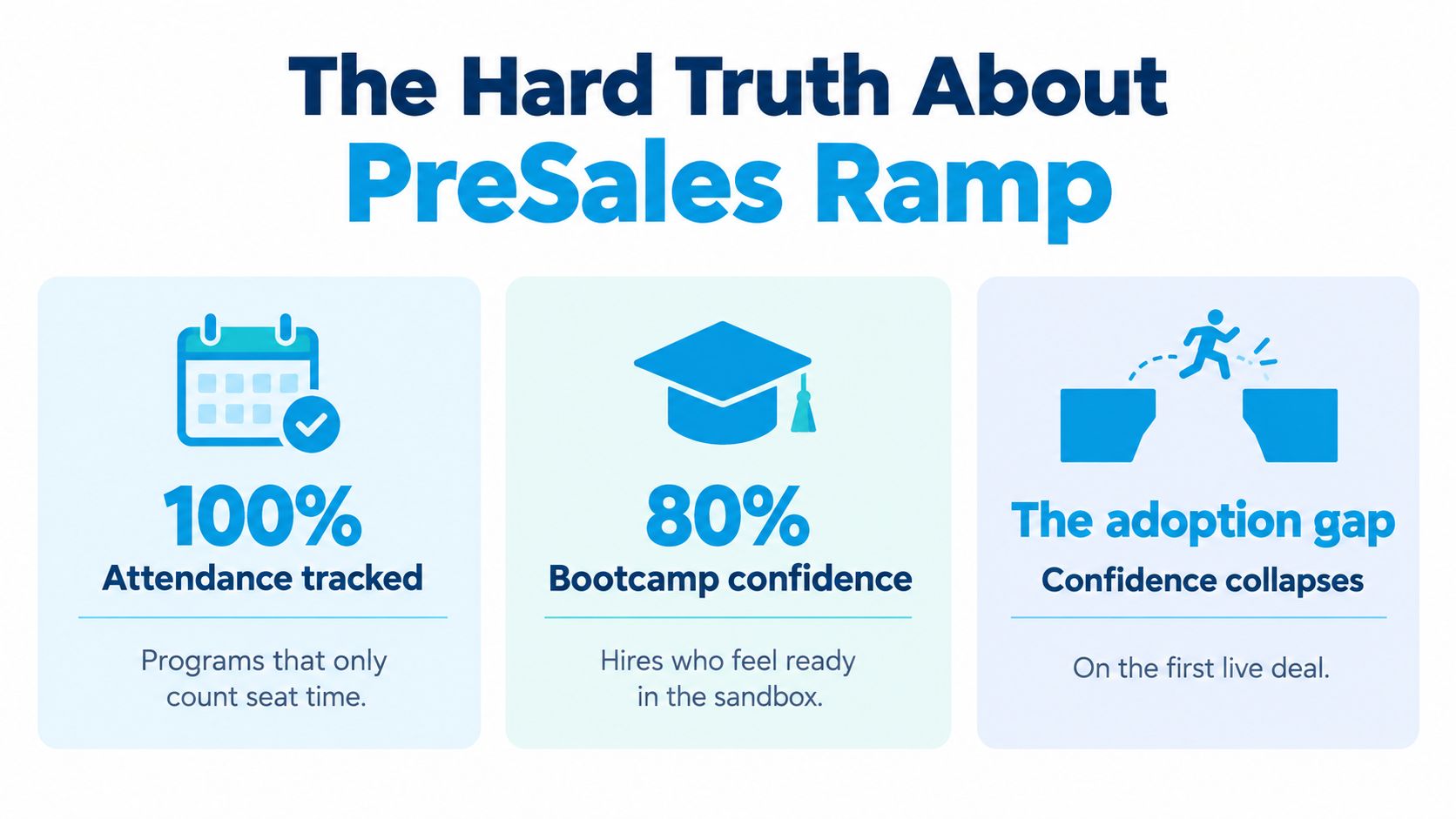
Your new Solution Engineer finishes product training, passes the sandbox certification, and gets a calendar invite for a live discovery call. The AE expects useful technical questions. The buyer raises an integration concern. Suddenly, confidence built during bootcamp has little connection to the work that decides whether the opportunity advances.
That gap is where most sales onboarding programs fail. They measure attendance, course completion, and certification status, then treat field readiness as a matter of time. A stronger approach measures observable behavior, especially how quickly a new SE can contribute to a technical win.
The Hard Truth About PreSales Ramp
A new SE may know the product architecture cold and still fail to run useful discovery. They may deliver a polished demo while missing the buyer's decision criteria, or complete every assigned module and still send basic technical objections to Product or Engineering.
PreSales asks one person to combine product fluency, industry context, discovery judgment, commercial awareness, presentation skill, technical validation, and strong partnership with the AE. Those capabilities develop at different speeds, and a course completion report cannot show whether the SE can apply them under pressure.
A sales onboarding program should measure the move from knowledge to autonomy. The Forrester sales onboarding guidance reports that only 7% of companies put newly hired reps in front of buyers on day one and describes insufficient ramping as a source of lasting performance gaps. Its practical range places ramp time between 3 and 9 months, with 9 months as an average benchmark, 6 months as strong, and 3 months as exceptional. These figures are broad guidance, not a forecast for every SE role. They do show why an enterprise motion with complex validation needs a different ramp design from a short-cycle SMB motion.
Where the field application breaks
Late exposure creates the first predictable gap. A new hire can spend weeks consuming product material, then face a live call without practicing the parts that make deal preparation difficult:
- Incomplete discovery: The buyer describes a vague business problem, and the SE accepts it instead of testing impact, urgency, and success criteria.
- Uncontrolled demos: The SE follows the product menu rather than building a story around the buyer's stated risks.
- Weak technical qualification: The SE confirms whether something can work without defining how the customer will validate it.
- No commercial context: The SE understands the architecture but cannot explain why the proposed approach matters to the buying committee.
- Insufficient reinforcement: The manager tracks completed activities instead of reviewing calls and correcting specific behavior.
Research summarized by Baylor University found that only 38% of firms rate their onboarding as effective. The same source reports that only 29% of firms say new hires are knowledgeable about their industry, and only 15% say they understand the competitive environment. Product training is easier to deliver than market judgment, yet buyers notice the difference during discovery and technical validation.
Practical rule: If a new SE can explain the product but cannot connect it to a buyer's decision, onboarding is incomplete.
Manager capacity determines whether those gaps close. Baylor's research found decentralized onboarding produced 23.5% higher sales than centralized onboarding, rising to 29.6% when managers had lighter spans of control. For a PreSales leader, the operational lesson is clear: coaching time affects outcomes. Assigning a new SE to a manager who cannot review calls creates a predictable adoption problem.
Measure progress through behaviors tied to revenue acceleration: a sharper discovery plan, a buyer-relevant demo, a defined technical validation path, and faster contribution to a technical win. A bootcamp may build initial confidence. Repeated observation, feedback, and field application determine whether that confidence holds in a live deal.
Building Your SE Ramp Roadmap
A new SE can finish every module and still stall in a live deal. Build the roadmap around observable work: preparing discovery, shaping a demo, handling technical objections, and reaching a technical win with the right support. Each stage needs a manager-checkable gate, not just a completion box.
Start by setting up the operating environment. Provide access to the CRM, demo environment, collaboration tools, product documentation, competitive material, qualification method, and current deal examples. Attach a task to each resource. Reading a discovery guide has limited value until the new SE uses it to prepare questions for a mock call and explains why those questions matter.
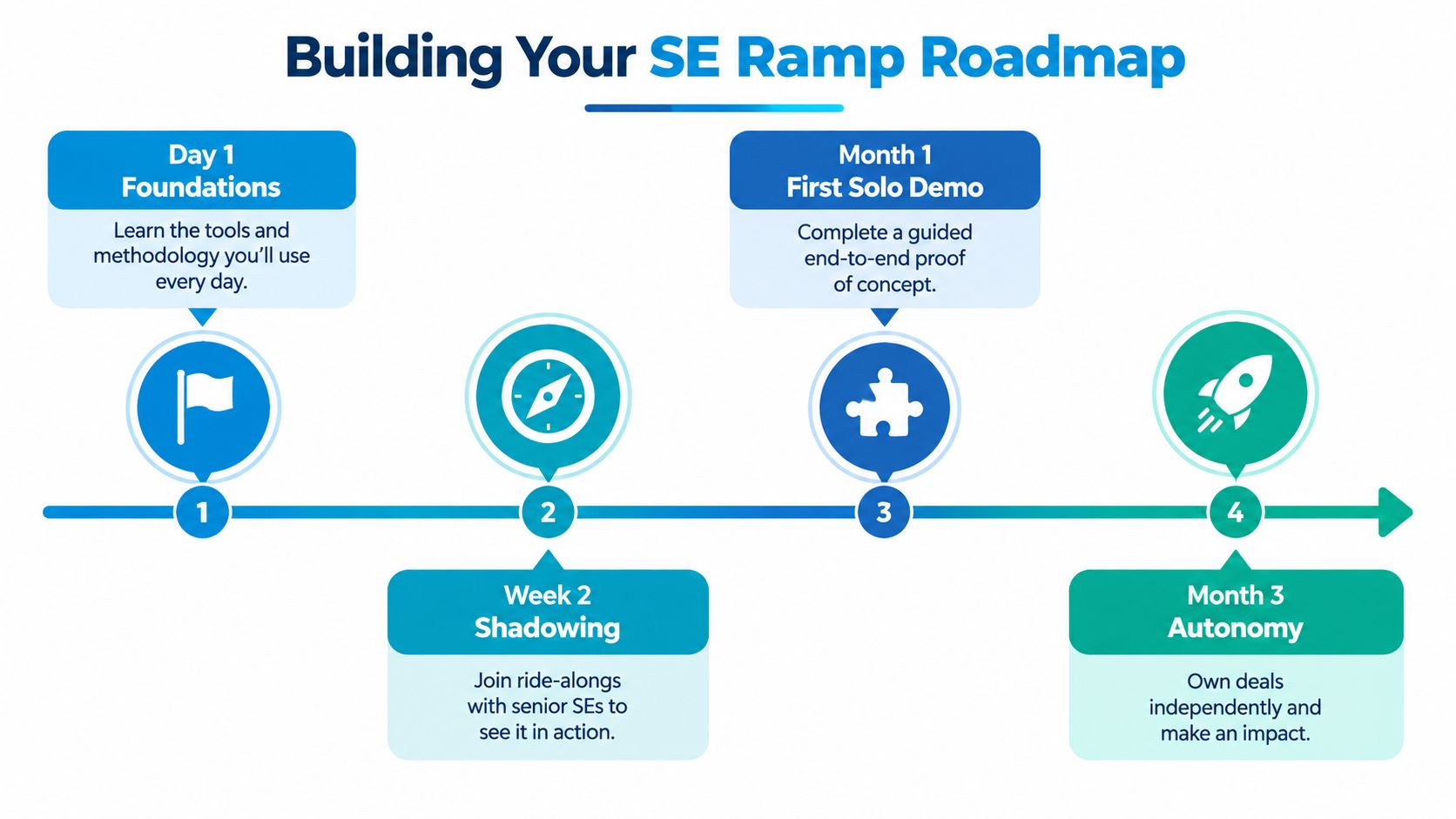
A practical progression by autonomy
| Stage | What the SE should practice | Readiness evidence |
|---|---|---|
| Day 1 foundations | Tools, product position, sales process, security basics, and internal handoffs | Can find information and explain how PreSales contributes to the deal |
| Week 2 shadowing | Discovery calls, demos, technical validation, and post-call debriefs | Can identify buyer goals, risks, stakeholders, and unanswered questions |
| Month 1 assisted execution | Role-plays, a guided demo, and a scoped proof of concept | Can run a defined segment, respond to common objections, and use feedback |
| Month 3 autonomy | Discovery, demo design, technical validation, and deal communication | Can own the technical motion on an opportunity and escalate appropriately |
For Sales Engineers and presales roles, RoverLead's progression model organizes development around increasing autonomy. The SE learns the product, observes discovery and demos, owns smaller demos and scoped proof-of-concepts, then runs discovery with limited support and leads technical validation on active opportunities. The manager should test those behaviors in deal work rather than accept curriculum completion as proof of readiness.
Use 30-60-90 reviews to inspect evidence. At 30 days, test product explanation, discovery preparation, CRM hygiene, and a short demo segment. At 60 days, review a complete discovery-to-demo handoff and a guided validation plan. At 90 days, assess whether the SE can connect buyer requirements to a technical recommendation, communicate risk to the AE, and identify the next action needed to reach a technical win.
Keep the roadmap open beyond the first quarter for roles involving enterprise procurement, security reviews, or complex integrations. Match the schedule to deal-cycle complexity instead of putting every SE on the same calendar. The target is faster, safer contribution to revenue, measured through behavior such as time to a credible technical recommendation, not training attendance alone.
Managers building the curriculum can use a Salesforce training program framework to organize learning objectives, delivery, and evaluation. Pair that structure with a role-specific PreSales training selection guide. Then replace generic completion gates with deal-facing evidence, including call reviews, demo performance, validation plans, and manager-observed technical wins.
Every week should answer one question: What can this SE now do safely with a buyer that they couldn't do before?
Centralized vs Decentralized Onboarding Models
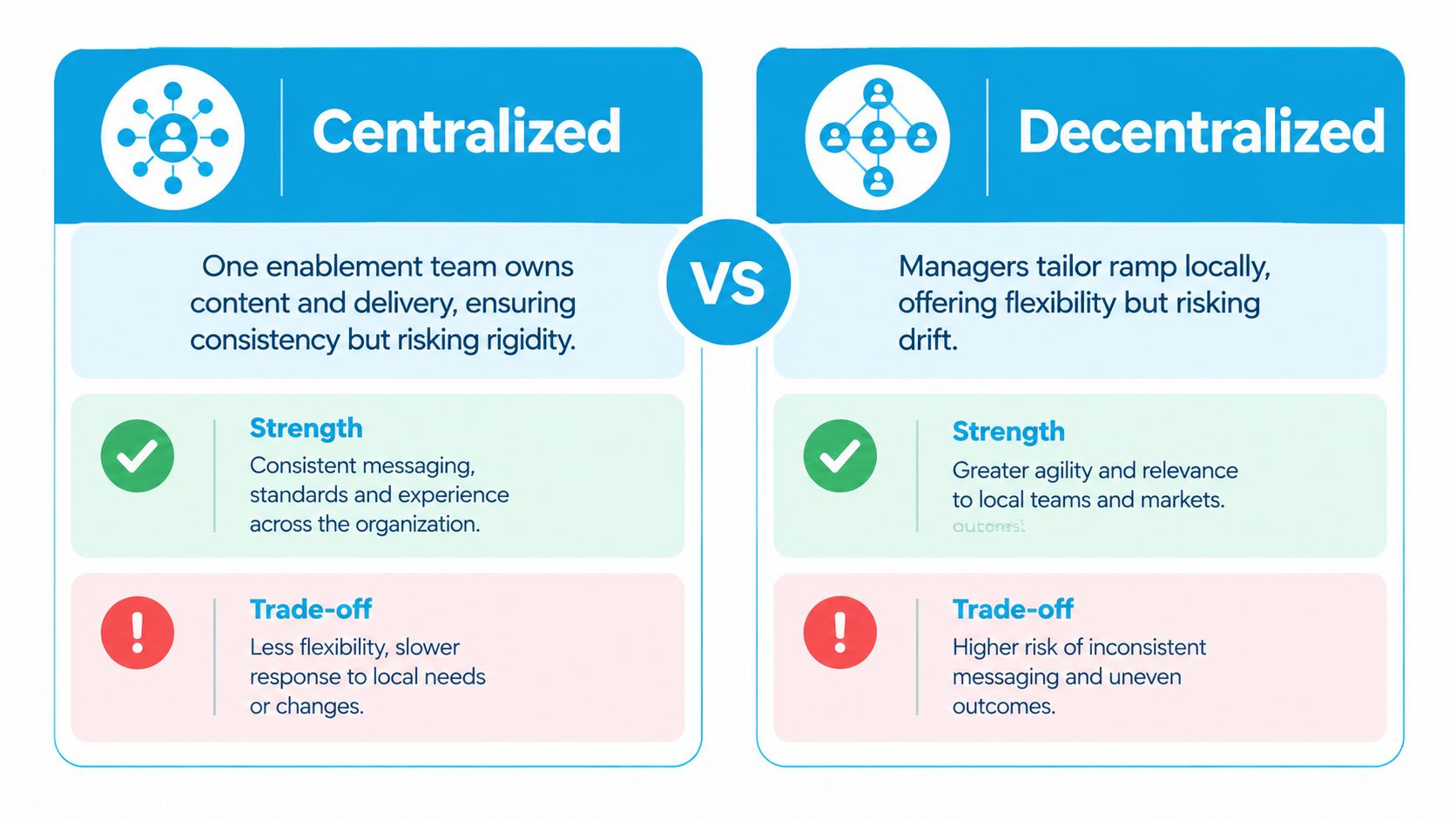
The ownership model determines whether onboarding stays connected to active deals. Central enablement teams are usually better at consistency. Field managers are usually better at relevance. Neither model works well when it owns the entire system alone.
| Model | Where it works | Where it breaks | Control required |
|---|---|---|---|
| Centralized | Product fundamentals, methodology, common tools, certification standards | Content can become detached from current deals, territories, and buyer objections | Strong feedback from field leaders |
| Decentralized | Local deal context, manager coaching, territory-specific practice, live opportunity application | Standards drift, duplicate work, and uneven coaching quality | Shared milestones and reporting |
| Blended | Common foundation with field-owned application | Requires clear ownership and disciplined communication | Central standards plus manager accountability |
A centralized program gives every new SE the same starting point. That matters when teams need consistent language around security, architecture, qualification, demo policy, or escalation. It also reduces the risk that one manager teaches a process that conflicts with Revenue Operations or Product Marketing.
The weakness appears when a central team treats content delivery as the finish line. A module about integrations won't prepare an SE for a buyer asking whether data residency, implementation effort, or legacy system dependencies will delay the business case. The field manager has to connect the general lesson to the specific opportunity.
A decentralized model fixes that relevance problem. The manager can use the current pipeline, local competitors, and real discovery recordings as teaching material. The cost is variation. One team might provide regular coaching while another checks only whether a certification is complete.
The manager capacity test
Baylor's research links decentralized onboarding with stronger sales outcomes and reports a larger result when managers carry lighter spans of control. That finding should change how leaders plan onboarding capacity. If managers can't observe calls, review demo plans, and run deal debriefs, a decentralized model becomes a label rather than an operating practice.
Use a blended model when the team is growing:
- Central enablement owns the baseline: product narrative, methodology, tools, security process, certification criteria, and reusable assets.
- The SE manager owns application: discovery practice, demo coaching, opportunity selection, call review, and technical win assessment.
- The field team supplies feedback: recurring objections, competitor patterns, implementation concerns, and examples of failed or successful validation.
- Leadership reviews outcomes: ramp time, time to first technical win, quota contribution where relevant, and quality of technical handoffs.
The right question isn't whether onboarding is centralized or decentralized. Ask which parts require consistency and which parts require proximity to the buyer. Standardize the first. Localize the second.
Tying Onboarding to the Technical Win
A new SE can finish every course and still lose a deal in discovery. The better test is whether onboarding helps that SE create a technical win, where the buyer has enough confidence in the proposed solution to advance the commercial decision.
The SE does not own the entire revenue outcome. The SE does own the technical conditions that support progression: accurate discovery, a relevant demo narrative, credible validation, and clear handling of technical risk. Those behaviors are visible in live opportunities, unlike a completed assignment.
Completion metrics still have a limited role. They show whether the program delivered its required work. They do not show whether an SE can run a useful discovery call or help a buyer reach a defensible technical conclusion. Managers need opportunity-level evidence for that.
Replace activity metrics with evidence
Use a scorecard that connects observable behavior to the technical win:
- Discovery quality: Does the SE uncover business impact, technical constraints, decision criteria, stakeholders, and the customer's validation process?
- Demo relevance: Does each section answer a stated buyer question, or is the SE walking through available features? A demo skills training resource can help anchor each segment to a specific buyer concern.
- Objection handling: Can the SE distinguish a real blocker from a request for more information and respond without unsupported promises?
- Validation discipline: Does the proof of concept define scope, owners, success criteria, evidence, and a decision date?
- Technical handoff quality: Can the AE explain the customer's technical position after the SE's involvement?
- Time to technical win: How long does it take a new SE to produce a buyer-confirmed technical outcome on an appropriate opportunity?
Time to technical win is the measure many onboarding programs miss. It shifts ramp from an internal training timeline to a revenue acceleration question. A new SE may contribute before a closed-won deal exists. A technical win provides an earlier, role-specific signal that the SE is reducing uncertainty in the buying process.
The MEDDPICC guide for Solution Engineers can support opportunity qualification, but the framework should not become a form-filling exercise. Use it to test whether the SE understands the buyer's decision process and can connect technical evidence to business value.
Discovery quality comes first. The PreSales discovery call guide can help establish a repeatable call standard, while the manager listens for judgment in the actual conversation. No discovery, no relevant demo. A polished presentation cannot repair a weak understanding of the buyer's problem.
Once the technical win becomes the operating target, onboarding content gets more disciplined. Add practice when a field behavior is missing, not another lesson because a topic sounds important. Give new SEs a clear definition of success: reduce buyer uncertainty, give the AE a defensible technical position, and advance the deal through evidence rather than product knowledge alone.
Reinforcement and Continuous Learning
Bootcamp creates a starting point. Reinforcement creates retention.
The Sales Management Association research reports that firms with formal onboarding had 60.7% of reps productive within 6 months, compared with 42.8% in firms without formal onboarding. By 11 months, the figures were 85% versus 67.8%. The same source reports that average onboarding completion takes 58 days, while typical sales ramp takes 4 to 5 months. Completion and productivity are different events, so your operating rhythm must continue after the checklist ends.
The research also found that onboarding is stronger at delivering content knowledge than selling-skill proficiency. Between one-third and one-half of reps remained without proficiency in 12 core selling skills. For SE leaders, that gap points directly to role-play, call review, demo critique, and manager-led practice.
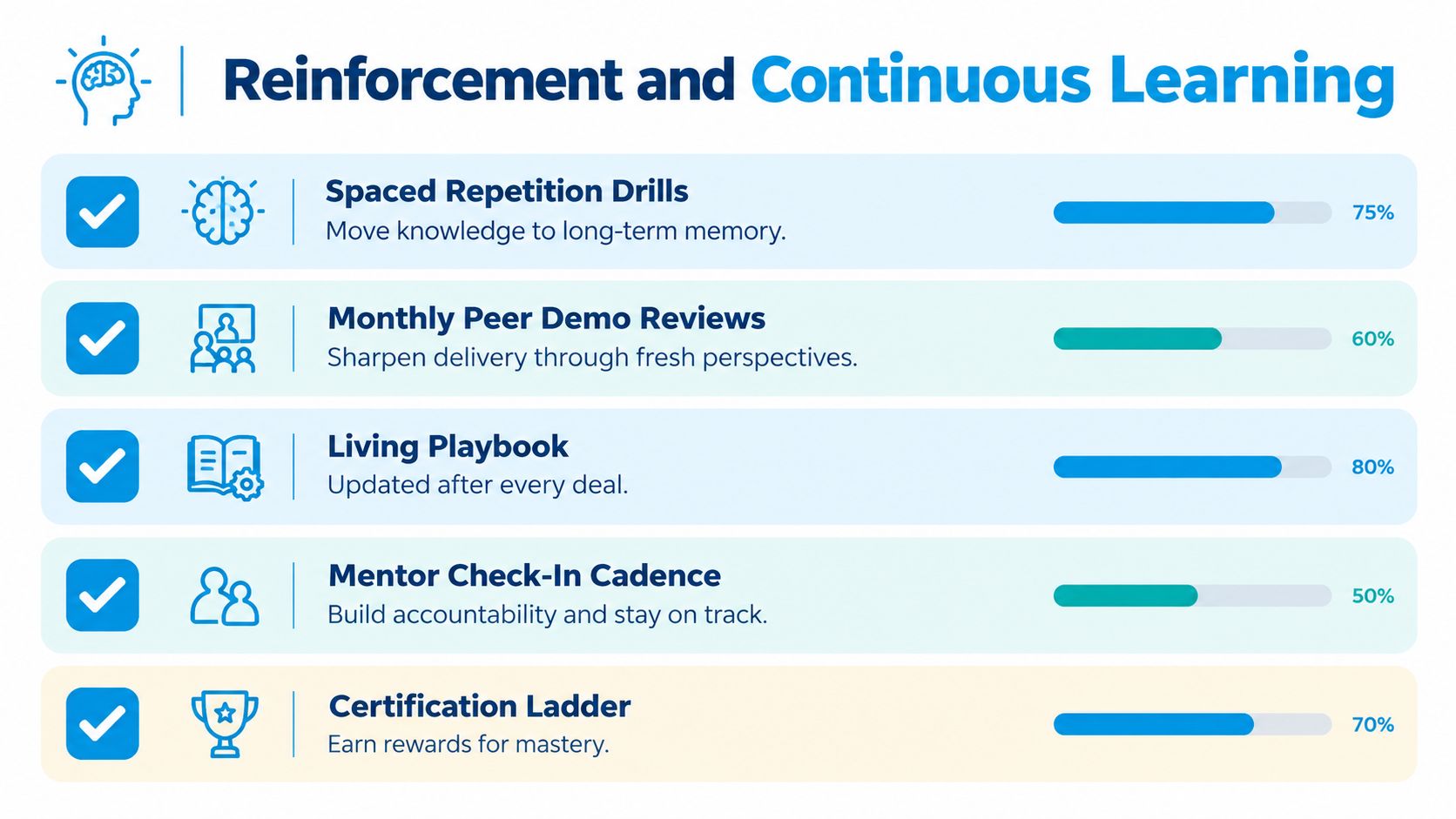
Build the rhythm around real work
A useful reinforcement system includes:
- Weekly deal sparring: Bring one active opportunity and test the problem statement, technical risk, validation plan, and next buyer action.
- Recurring demo critique: Review one recorded or live segment for narrative control, discovery linkage, and objection response.
- Spaced repetition: Revisit security, integrations, competitive positioning, and qualification through short drills rather than another long presentation.
- Living playbook updates: Add what the team learned from recent deals, including objections that exposed gaps in product messaging or process.
- Mentor accountability: Pair the new SE with someone who can discuss preparation, not just answer product questions.
The principle is simple. A short, consistent practice rhythm beats a concentrated event that disappears from the calendar. The research linked from the Sales Management Association reports that highly structured and consistently applied programs reduced average ramp-up from 9.1 to 5.7 months, and that such structure outperformed low-structure programs by 37%.
Don't use reinforcement to repeat the entire onboarding curriculum. Use it to target the behavior that failed in the last deal. If the SE missed a technical champion, practice stakeholder mapping. If the demo became a feature tour, rebuild the narrative from discovery evidence. If the POC expanded without a decision path, rewrite the evaluation plan.
Your Solution Engineer KPI framework should help separate activity from impact. Track completion when you need operational visibility. Track call quality, validation discipline, and time to technical win when you need to know whether the SE is becoming effective.
Practical Tips for Immediate Implementation
Start tomorrow with a one-page ramp sheet. Put the role's essential behaviors in one column and the evidence required in another. Include product explanation, discovery preparation, demo execution, objection handling, technical validation, CRM documentation, and technical win ownership.
Then make five changes:
- Assign a real deal early: Choose an opportunity with a contained technical problem, a responsive AE, and a manager who can observe the work. Avoid the largest, most politically sensitive account for a first solo attempt.
- Require a pre-call brief: The SE should write the buyer's business problem, technical environment, known stakeholders, risks, discovery questions, and desired next step before joining the call.
- Review behavior within a day: A debrief loses value when it becomes a monthly meeting. Ask what the buyer said, what the SE inferred, what evidence is missing, and what the next technical action should be.
- Create a certification ladder: Certify small behaviors first, such as explaining architecture or handling a security question. Later, certify complete discovery, demo, and validation ownership.
- Measure time to technical win: Keep course completion as an administrative signal, but use the first buyer-confirmed technical outcome as the ramp milestone that matters.
Don't overload new SEs with product features while ignoring industry context. The Solution Engineer role guide and the comparison of Solution Engineer, Sales Engineer, and Solutions Consultant roles can help managers define role expectations before they design training.
For the workflow itself, Coachful's guide to design your client onboarding offers a useful way to think about stages, ownership, handoffs, and visible progress. Adapt that logic to technical validation, where every handoff should preserve the buyer's problem and agreed evidence.
PreSales Unleashed GmbH offers the Trusted Advisor Academy, a year-round program with structured content, live practice, deal application, and leader support for Solution Engineers and SE managers. Visit PreSales Unleashed GmbH to connect your sales onboarding program to observable behavior, technical wins, and sustained coaching.