
Most advice about sales training for B2B starts with more content, better slides, or a new platform. That's the wrong starting point for PreSales. A Solution Engineer rarely loses a technical win because a framework was missing from a library. More often, the team knows the framework but doesn't apply it consistently in discovery, demos, or POCs when several stakeholders are pressing for answers.
A workshop can create awareness. It can't, by itself, create reliable deal behavior. The training standard should be simple: can the SE perform the behavior on a live opportunity, and does that behavior improve the quality of the technical win?
Why Most B2B Sales Training Fails to Stick
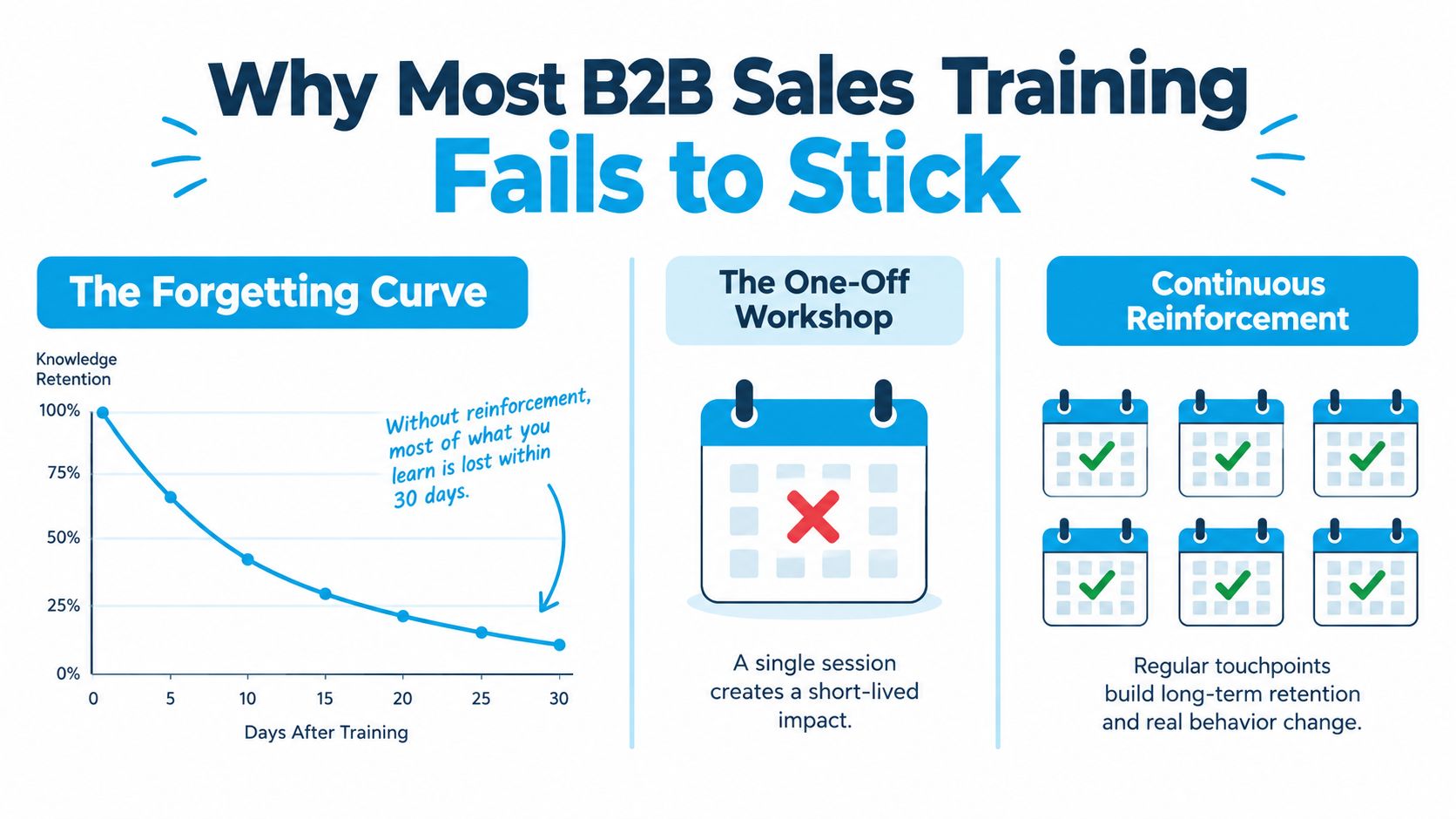
The popular workshop model assumes that exposure creates competence. A team attends a session, completes a quiz, receives a certificate, and returns to active deals. The problem appears later, when an AE asks for a demo before discovery is complete, a prospect introduces a new technical evaluator, or a POC expands without clear success criteria.
One published sales-training summary reports that B2B sales reps forget 70% of what they learn within a week and 87% within a month when training isn't reinforced, as described by ZipDo's B2B sales training summary. That doesn't mean the material was poor. It means memory and execution need repeated retrieval, feedback, and application.
Completion isn't competence
Completion rates are easy to report. They're also weak evidence of field readiness. An SE may finish a discovery module and still ask surface-level questions, accept a vague pain statement, or agree to a demo without understanding the buyer's decision process.
For PreSales, the outcome isn't course completion. It's the technical win, supported by better discovery, sharper technical positioning, controlled evaluation plans, and alignment with the buying group. A useful definition of the technical win is the point at which the buyer accepts that the solution can address the agreed technical and business requirements, while the opportunity remains commercially viable.
That standard changes what managers inspect:
- Discovery behavior: Does the SE uncover business impact, technical requirements, decision criteria, and stakeholder concerns?
- Demo behavior: Does the SE connect the demonstration to confirmed priorities rather than narrate product features?
- POC behavior: Does the SE define success, ownership, evidence, and exit criteria before work begins?
- Deal behavior: Does the SE help the AE build consensus across the buying committee?
Practical rule: If training content can't be translated into an observable action inside a deal, it's probably not ready for the field.
Why continuous enablement wins
A widely cited industry benchmark reports approximately $5.20 in additional revenue for every $1 spent on sales training, according to WorldMetrics' B2B sales training industry summary. That figure is often used to justify ongoing investment in onboarding, coaching, and reinforcement. For a PreSales leader, the strategic point is more useful than the exact return: small improvements in conversion, win rate, or rep productivity can compound across an enterprise pipeline.
Continuous enablement treats training as an operating rhythm. You introduce a skill, require practice, review field use, and adjust the next exercise around actual deal friction. The team stops measuring whether people attended and starts measuring whether behavior survives buyer pressure.
Diagnose Before You Design Needs Analysis That Matters
Don't build a curriculum from a generic competency model. Start with the moments where opportunities slow down, consume unnecessary SE capacity, or lose technical credibility.
A good needs analysis combines deal inspection, observation, manager input, and seller reflection. You're looking for a gap between the behavior your team needs and the behavior it currently performs.
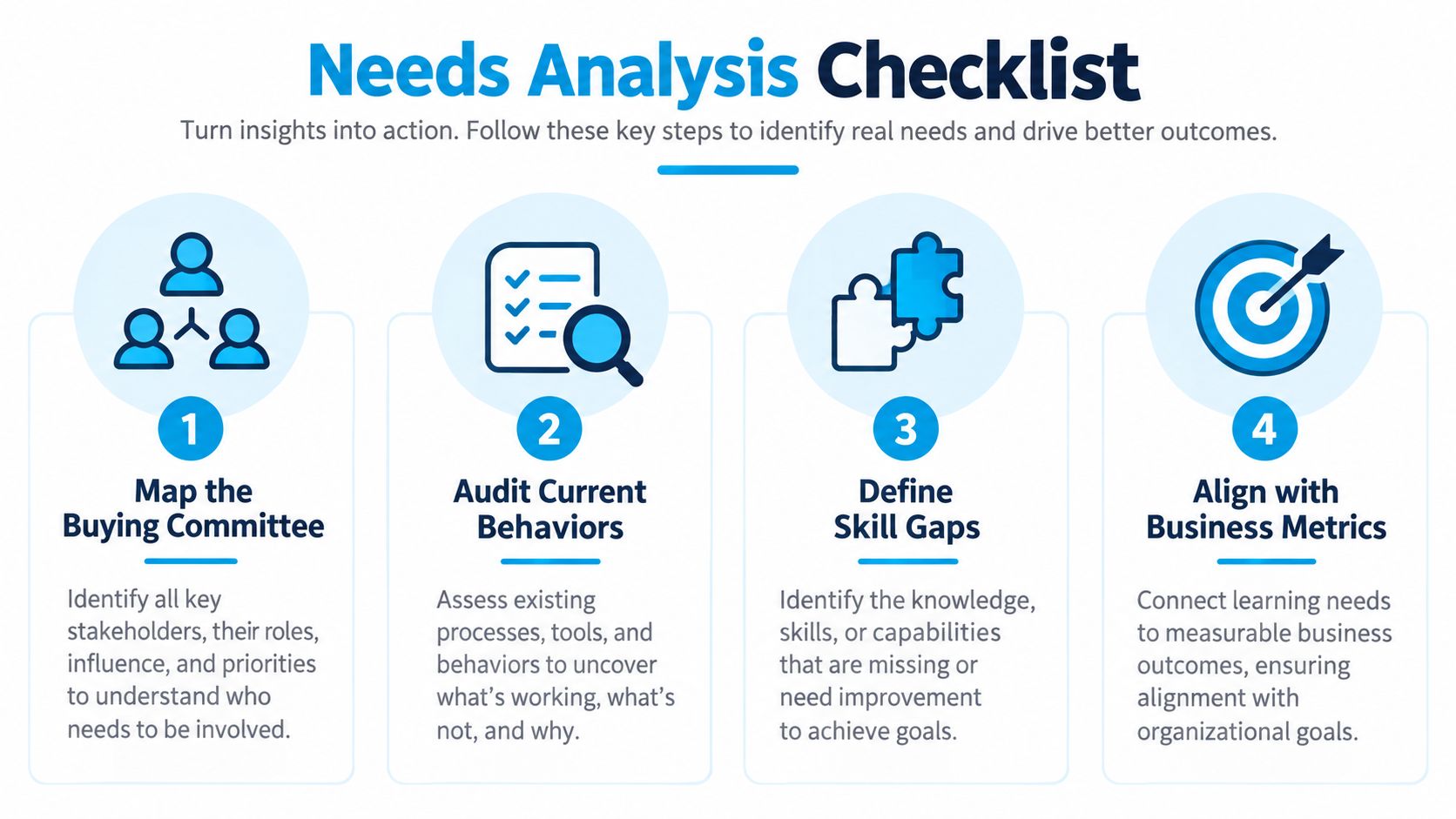
Start with the buying committee
Complex B2B deals often involve more than a seller and a technical evaluator. Current market commentary reports that 60% of B2B sales cycles require 6 to 10 stakeholders, according to Wifitalents' B2B sales training statistics. That changes the training brief. Your SEs need to map influence, identify missing voices, and adapt technical proof for different concerns.
Ask these questions during the audit:
- Who owns the business problem?
- Who defines technical or security requirements?
- Who controls budget or commercial approval?
- Who can block the decision?
- Who will operate the solution after purchase?
- Which stakeholders haven't been engaged yet?
Use the answers to compare the team's stated sales process with the buying process that governs the opportunity. A single-threaded demo may satisfy one evaluator while leaving procurement, security, finance, or operations unconvinced.
Audit behavior, not confidence
Review discovery recordings, demo plans, POC documents, and opportunity notes. Score what happened, not how polished the SE sounded.
Look for evidence such as:
- The SE asked about measurable business impact instead of stopping at a technical symptom.
- The SE confirmed who would evaluate the solution and how the decision would be made.
- The demo agenda reflected buyer priorities discovered earlier in the process.
- The POC included agreed success criteria and a defined decision path.
- The technical recommendation addressed the full buying group, not only the contact in the meeting.
Use the discovery call guide as a reference point, then adapt the audit to your sales motion. The objective isn't to enforce identical wording. It's to create a shared view of what good discovery produces.
Turn findings into a skill backlog
Separate knowledge gaps from execution gaps. If an SE can explain MEDDICC but doesn't identify the Economic Buyer or Decision Process in active opportunities, the problem isn't a missing definition. It's a practice and inspection problem.
Prioritize gaps by field impact:
| Priority | Signal | Training response |
|---|---|---|
| High | Repeatedly causes late SE entry, weak qualification, or uncontrolled POCs | Live practice tied to active opportunities |
| Medium | Creates inconsistent discovery or demo quality | Short drills, templates, and manager review |
| Low | Improves fluency but rarely changes deal progression | Self-directed reference material |
Stop teaching topics that don't connect to a deal decision. Product trivia, broad methodology lectures, and generic presentation advice can consume time without changing technical wins. Keep only the material that helps an SE qualify, diagnose, prove, and guide.
Design a Curriculum That Builds Technical Wins
A lean curriculum follows the sequence of work in a real opportunity. Teach discovery before demo design, qualification before POC commitment, and stakeholder alignment before technical validation expands.
The curriculum should give each module one job. If a module tries to improve discovery, negotiation, presentation, product knowledge, and forecasting at once, managers won't know what to observe and SEs won't know what to practice.
Build around four PreSales pillars
Discovery quality comes first. Train SEs to identify pain, business impact, technical requirements, urgency, and the people involved in the decision. The output should be a usable discovery record, not a completed checklist.
MEDDICC-based qualification gives the team a common deal language. MEDDICC covers Metrics, Economic Buyer, Decision Criteria, Decision Process, Identify Pain, Champion, and Competition. The MEDDPICC guide for Solution Engineers explains how SEs can use those mechanics before investing in demos or POCs.
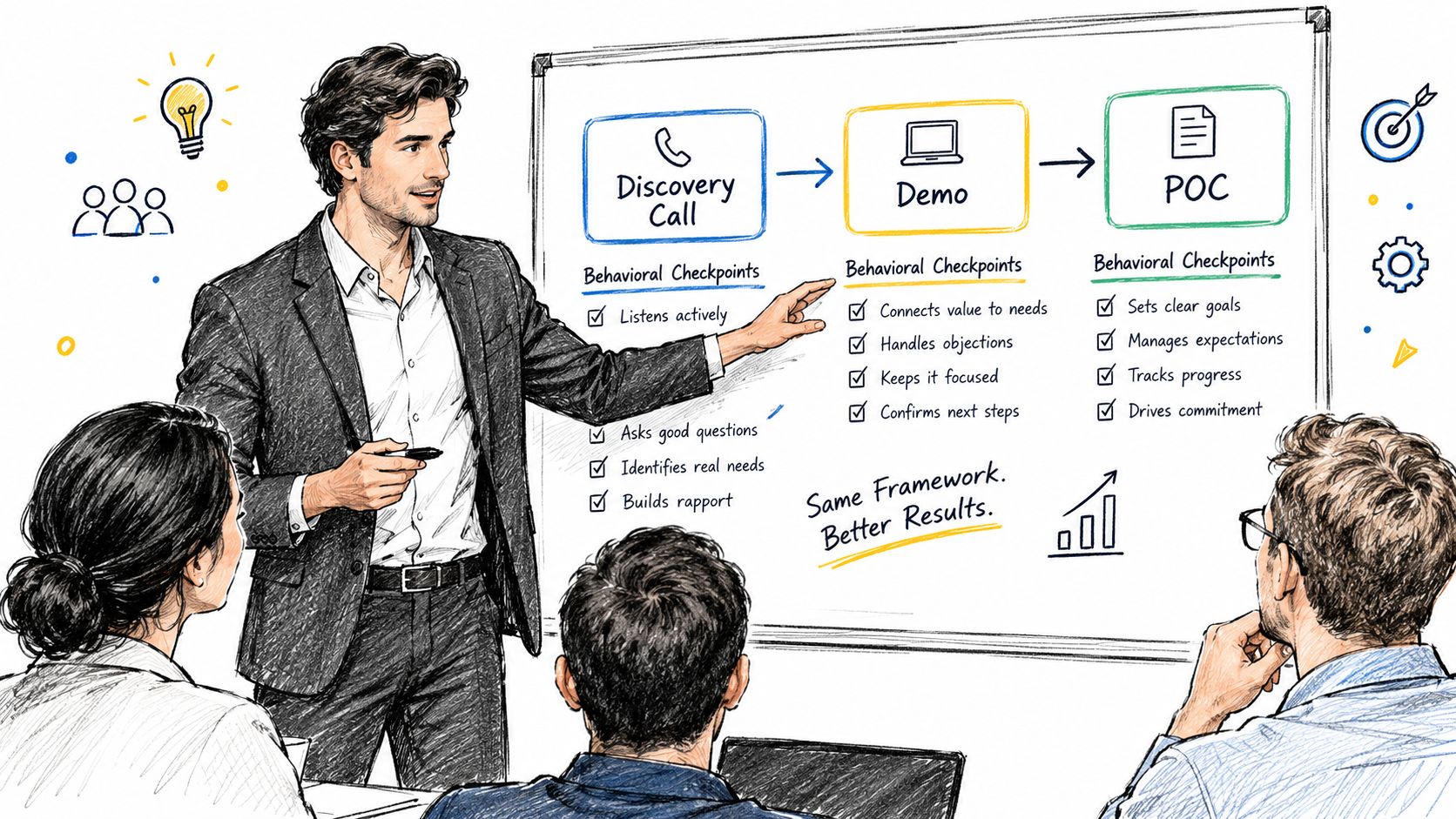
Demo discipline means showing only what supports the buyer's agreed priorities. Train SEs to create a point of view, set an agenda, test assumptions, and ask for reaction throughout the session. A polished feature tour is still a weak demo if it doesn't help the buying group make a decision.
POC control requires explicit success criteria, owners, timelines, evidence, and an agreed path to the next commercial step. Teach SEs to challenge open-ended evaluations respectfully. A POC without a decision structure can turn technical effort into unpaid consulting.
Map each module to a field artifact
| Curriculum Pillar | Observable SE Behavior | Deal Artifact |
|---|---|---|
| Discovery | Connects a technical issue to business impact and buyer priorities | Discovery brief with confirmed pain and stakeholders |
| Qualification | Tests Metrics, Economic Buyer, Decision Criteria, and Decision Process | MEDDICC opportunity review |
| Demo | Demonstrates only capabilities tied to discovered needs | Demo plan with audience, outcomes, and proof points |
| POC management | Defines evidence and exit conditions before technical work begins | POC charter and success plan |
| Consensus building | Equips different stakeholders with relevant proof | Stakeholder map and mutual action plan |
Use microlearning for definitions, examples, and preparation. Use live sessions for role-play, deal sparring, objection handling, and feedback. Templates should reduce cognitive load, not create another administrative layer.
A useful design test is to remove every asset that doesn't support a live conversation or opportunity decision. Your curriculum should feel small enough to use and specific enough to inspect.
Deliver and Reinforce With a Cadence That Sticks
Delivery determines whether a curriculum becomes field behavior. Start reinforcement within 24 to 48 hours, keep each touchpoint short, and continue structured practice for at least 8 weeks, using role-play, coaching, microlearning, and retrieval practice. This pattern is described in sales training reinforcement guidance from Ascent Trainings.
Spacing works because learners revisit an idea after some time has passed, then retrieve and apply it again. A review in PubMed Central on the spacing effect explains how spacing allows learning to consolidate before another repetition. For an SE, that means the discovery framework should return during a deal review, a role-play, and a post-call inspection, not remain inside the original workshop.
Use retrieval, not passive review
Repeated retrieval with longer gaps produced a 200% improvement in long-term retention compared with no spacing between tests in the Karpicke and Bauernschmidt study on spaced retrieval. The practical translation is straightforward. Ask the SE to recall the framework, apply it to a new situation, and explain the choice without looking at the slide.
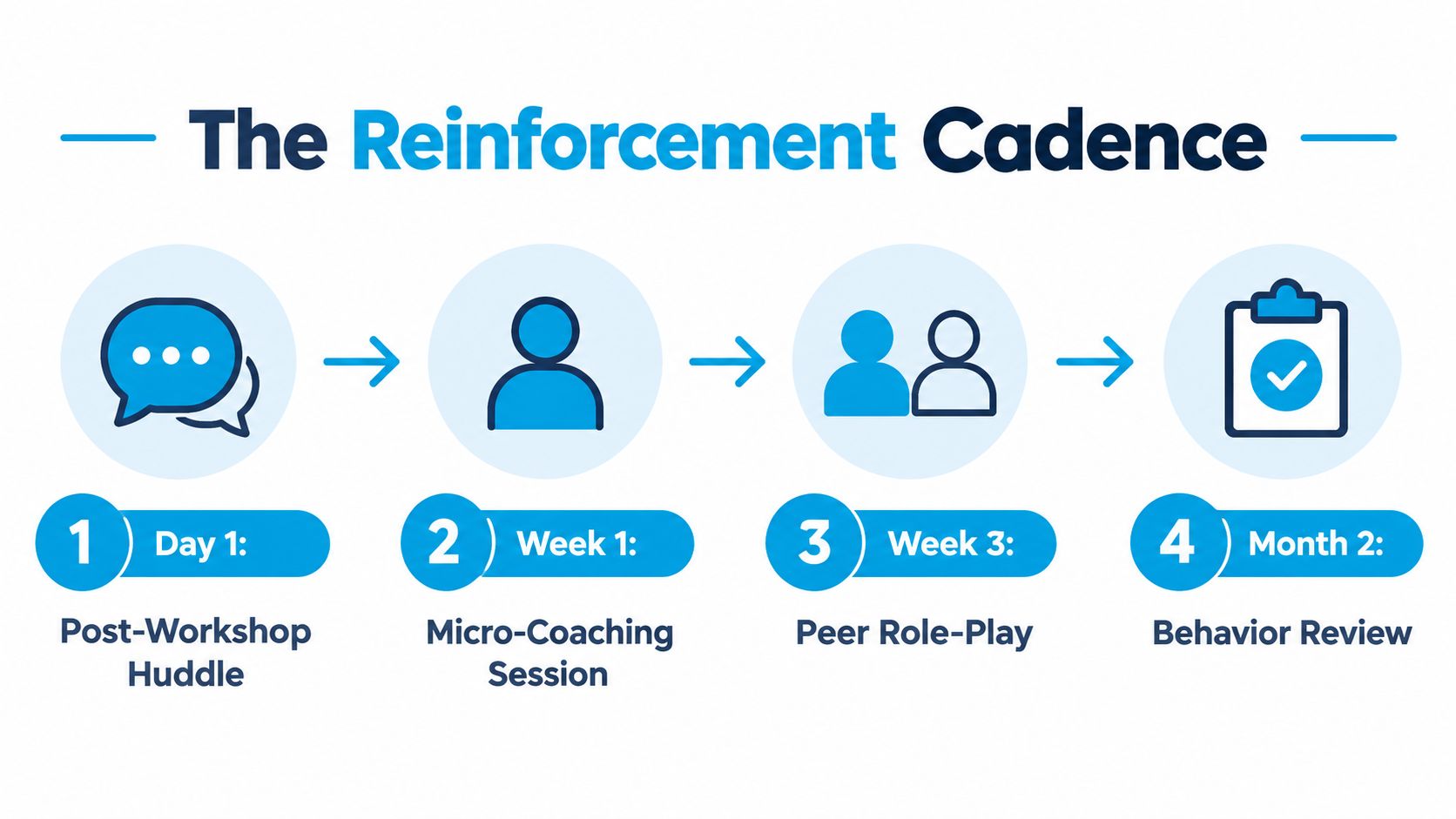
A workable cadence looks like this:
- Day 1: Hold a short huddle after the workshop. Each SE writes one behavior to apply on a current opportunity.
- Week 1: Run micro-coaching on one discovery, demo, or POC artifact.
- Week 3: Use peer role-play with a difficult stakeholder scenario.
- Month 2: Review whether the behavior appeared in live deals and what changed.
Protect field time
Don't schedule long sessions because the calendar has a vacant block. Attach exercises to opportunities already moving through the pipeline. A discovery drill can use a real account, with sensitive details removed where needed. A demo exercise can use the next meeting's stakeholder profile. A POC review can examine whether the evaluation has an agreed exit.
Certificates can record participation, but they shouldn't substitute for field evidence. A practical course completion certificate guide from CertSeal can help teams think through completion records while managers track application separately.
Teams building a continuous rhythm can also review the continuous training discussion for sales organizations. The point is consistency, not training volume.
Coach for Quota Impact and Make It Stick
Manager coaching is where training either enters the deal or disappears. Unstructured coaching sounds like, “Good call, but ask more business questions next time.” Structured coaching identifies the exact behavior, reviews evidence, rehearses an alternative, and checks whether the SE used it afterward.
One benchmark reports that reps receiving excellent coaching are 50% more likely to achieve or exceed quota, while dynamic coaching was associated with a 21.3% improvement in quota attainment and a 19% improvement in win rates, according to Gradient Works' B2B sales performance benchmarks. Treat those figures as a benchmark, not a promise. The operational lesson is to make coaching specific and repeatable.
Compare the two coaching modes
| Unstructured coaching | Structured coaching |
|---|---|
| General feedback after a meeting | One observable behavior selected for review |
| Focuses on confidence or presentation style | Focuses on discovery, demo, or POC execution |
| Uses memory and opinion | Uses call evidence and deal artifacts |
| Ends with encouragement | Ends with rehearsal and a follow-up check |
| Varies by manager | Uses a shared rubric |
Run coaching on real opportunities. Before the next customer interaction, define the behavior to test. Afterward, review the evidence and record whether the behavior happened, what the buyer did, and what the SE will change.
Capture judgment from strong SEs
Top SEs often make fast decisions that newer colleagues can't yet explain. Turn those decisions into teachable prompts:
- What did you hear that made you delay the demo?
- Which stakeholder was missing?
- What evidence would make this POC worth the effort?
- What would cause you to stop investing?
- Which technical concern is a business concern in disguise?
A fortnightly build session can convert those answers into discovery prompts, demo patterns, POC checklists, and role-play scenarios. Resources such as Yalc's guide to engineer ramp up with Yalc can also inform onboarding design, while your own deal reviews keep the material relevant to your motion.
AI can help with call summaries, practice simulations, and feedback prompts. It won't fix a coaching gap by itself. If automation gives managers more time, assign that time to observation and practice rather than adding another tool to the stack. For more manager-focused ideas, see the coaching principles for PreSales professionals.
Measure Sustain and Scale Your B2B Program
A durable program needs a measurement loop, not a final survey. Track whether the team applies the behavior, whether opportunities progress with stronger technical evidence, and whether the technical win improves over time.
Start with a small scorecard:
- Technical win rate: Compare qualified opportunities where the SE followed the agreed discovery, demo, and POC behaviors.
- Opportunity conversion: Review movement between defined technical stages, not activity volume alone.
- POC quality: Inspect whether evaluations have success criteria, owners, evidence, and exit decisions.
- Stakeholder coverage: Record whether the relevant buying voices have been identified and engaged.
- Coaching application: Mark whether the behavior selected in coaching appeared in the next live opportunity.
A benchmark source reports an 8% win-rate improvement associated with structured versus unstructured coaching, as noted in Gradient Works' benchmark analysis. Use this type of external benchmark to support investment discussions, but rely on your own baseline and definitions when judging program performance.
Run the sustainment loop
Every quarter, inspect four things:
- Decay: Which behaviors have weakened in call reviews or opportunity inspections?
- Friction: Which assets, prompts, or workflows are difficult to use during live deals?
- Proof: Which behaviors correlate with stronger technical outcomes in your reporting?
- Scale: Which practices can be adapted across regions, languages, products, and segments?
Spaced repetition supports a 12-month enablement model rather than a bootcamp-only approach. A professional development study found that spaced repetition outperformed no spaced repetition for learning at quarter 6 and knowledge transfer at quarter 10, with double-spaced repetitions outperforming single-spaced repetitions for both outcomes, as reported in this PubMed abstract on spaced repetition. That evidence supports revisiting discovery, demo, and POC skills throughout the year.
Keep the reporting practical. A manager should be able to open one dashboard, inspect a small set of deal artifacts, and identify the next coaching action. If measurement creates paperwork without changing coaching or opportunity decisions, simplify it.
The right sales training for B2B PreSales doesn't produce more content consumers. It produces SEs who qualify earlier, discover more thoroughly, run focused demos, control POCs, and help buying groups reach technical consensus. Build the program around those actions, reinforce them across live deals, and refresh the system whenever the evidence shows decay.
PreSales Unleashed GmbH offers the Trusted Advisor Academy, a 12-month PreSales development program combining on-demand lessons, live practice, deal sparring, coaching, and reusable assets for discovery, demos, sales alignment, and POC management. Visit PreSales Unleashed GmbH to explore a structured way to turn SE knowledge into repeated technical-win behaviors.