
A polished software sales demo can fail before the screen share starts. In a 2026 industry compilation, roughly 5,000 B2B SaaS websites were benchmarked, and 18% included an interactive demo call-to-action, up from 12% in 2024. The same compilation reports that about 40,000 interactive demos were built in the prior year, a 43% year-over-year increase, evidence that demos have become a scalable digital motion rather than an occasional seller-led presentation. The 2026 demo software statistics compilation documents the shift.
The uncomfortable implication for Solution Engineers is that delivery polish isn't the main constraint. Low-probability opportunities, weak discovery, and technical surprises waste more demo capacity than an imperfect talk track. No discovery, no demo. The quality of the conversation before the walkthrough determines whether the meeting can produce a technical win.
What a Software Sales Demo Actually Decides
Discovery quality drives demo outcomes because a software sales demo is not a product tour. It's a focused, evidence-driven conversation in which you prove that the platform can solve the buyer's highest-priority problems within the buyer's actual workflow and technical boundaries.
That distinction changes what you prepare. A product walkthrough asks, “What can the software do?” A deal-focused demo asks, “Can this software resolve the problem this buying group has agreed to solve, and can it fit the way they operate?”
The outcome PreSales owns is the technical win. You earn it when the buyer can connect specific product behavior to agreed business requirements, see how the workflow fits their environment, and understand what still needs validation. A prospect doesn't award a technical win because your navigation was smooth. They award it because your evidence reduced technical uncertainty.
Practical rule: If you can't state the buyer's top pain points, success criteria, and technical constraints before the call, you're not ready to demo.
Relevance beats production value
A beautiful deck can create interest, but it can't compensate for irrelevant content. Long feature tours force buyers to sort through information that may have nothing to do with their decision. That increases cognitive load and gives stakeholders more opportunities to disengage.
The same principle applies to demo videos. A polished recording can support buyer education, but it still needs a clear audience, use case, and next step. Teams that need help producing product demonstration videos can use this Veo3 AI video marketing guide as a production reference, then apply the same discipline to the story and qualification behind the asset.
Your job isn't to prove that the product contains a large number of features. It's to make the buyer confident that the relevant capabilities work for their situation. That requires asking better questions before opening the presentation, choosing the right format, and stopping when the evidence has done its work.
Discovery Before Any Demo Walkthrough
A strong software sales demo begins with a short discovery block before any walkthrough. One practitioner guide recommends reserving 15 to 30 minutes to document the prospect's top 2 to 3 pain points, current workflow, decision criteria, attendees, and technical environment, then sending an agenda 24 hours before the call. Storylane's guide to sales demo best practices provides that preparation pattern.
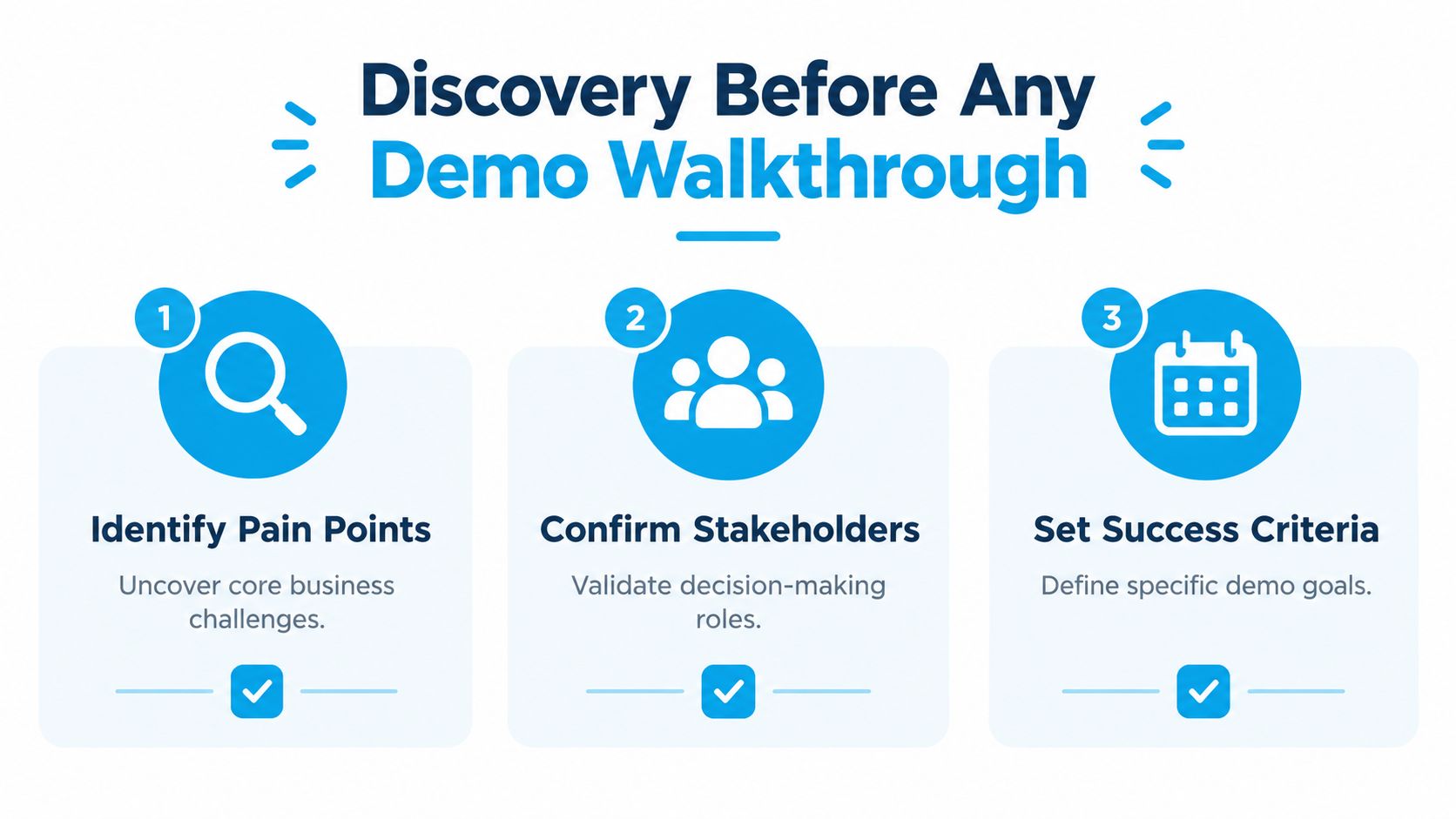
Treat that block as a qualification activity, not administrative preparation. You need enough context to decide whether a live demo is justified and what the buyer should see first.
Capture the decision context
Document the following before you build the flow:
-
Pain points: What business problem triggered the evaluation? Ask what happens if the problem remains unresolved, not only which features the buyer wants.
-
Current workflow: Map the process the prospect uses today. Note handoffs, manual work, systems involved, and where users lose time or control.
-
Decision criteria: Ask how the buying group will judge fit. Separate required capabilities from preferences, and identify which criteria belong to business, technical, security, or procurement stakeholders.
-
Attendees: Record each person's role in the decision. A user, executive sponsor, technical evaluator, security reviewer, and economic buyer may need different evidence.
-
Technical environment: Confirm integrations, data movement, identity requirements, deployment constraints, and security questions early. A demo that ignores the environment creates false confidence.
Use the discovery call guide for Solution Engineers to structure the questions and capture the answers in a format the AE and SE can both use.
Set the meeting contract
Send the agenda at least 24 hours before the call. Name the business problems you'll address, the workflows you'll demonstrate, the people who should attend, and the decision you want to reach by the end.
That agenda gives the buyer a chance to add missing stakeholders or correct your assumptions. It also creates a natural qualification checkpoint. If the prospect can't confirm the problem, participants, or evaluation criteria, a live demo may be premature.
Don't ask buyers to complete a burdensome form before they can see any value. Use the discovery block to create mutual clarity, then offer the smallest credible experience that tests fit. Fast access and disciplined qualification can coexist when you keep the request relevant to the decision.
Demo Patterns That Match Real Deals
Demo format should follow the deal, not the seller's preferred presentation style. A polished walkthrough still wastes time when the opportunity has no clear problem, evaluator, or reason to change.
A seller-led presentation fits a technically complex workflow, a late-stage evaluation, or a buying group that needs one shared narrative. The SE controls the sequence, tests assumptions, and answers questions in context. The trade-off is buyer passivity. If the presenter explains every screen, attendees may agree politely without proving that the product fits.
An interactive demo gives the prospect control over what to examine. It suits early education, asynchronous evaluation, and buying groups that cannot attend one meeting. Buyers can explore at their own pace, but the format rarely resolves detailed architecture, integration, or implementation questions on its own.
A personalized demo maps the product to the prospect's workflow, terminology, roles, or environment. It takes more preparation, so use it after the opportunity has earned that investment. A vague use case does not justify a custom build. A defined problem and active evaluation usually do.
Demo Pattern Decision Matrix
| Deal Context | Buyer Readiness | Best Demo Pattern |
|---|---|---|
| Early exploration with unclear use case | Low or mixed | Interactive demo with a short qualification path |
| Clear pain point and one primary evaluator | Moderate | Personalized demo focused on the stated workflow |
| Technical evaluation with known requirements | High | Seller-led demo with live validation and targeted modules |
| Large buying group with limited shared availability | Mixed | Interactive demo followed by a focused live session |
| Complex integrations or security questions | High | Personalized, seller-led session with technical evidence |
| Repeated education for additional stakeholders | Moderate | Interactive or recorded modules tied to the original use case |
A 2026 analysis of approximately 68,000 B2B SaaS deals reported that personalized demos focused on specific prospect challenges increased conversion rates by up to 40%. It also reported that prospect-controlled interactive demos converted at 38%, compared with a generic screen share. The analysis of demo relevance and conversion noted that about 20% of prospects disengage during lengthy demos.
These figures support a selection rule, not a promise: the clearer the problem, the more precisely you can choose the format. Qualify before personalizing. Use an interactive experience when buyers are still learning. Use a live, seller-led session when the room must validate technical fit. Combine formats when different stakeholders need different levels of detail.
The largest efficiency gain often comes before the demo. A low-probability meeting should not receive a custom narrative, technical preparation, and multiple presenters. Match the format to buyer readiness, and decline or redirect the demo when the deal has not earned one.
Why Discovery-Aligned Demos Convert Better
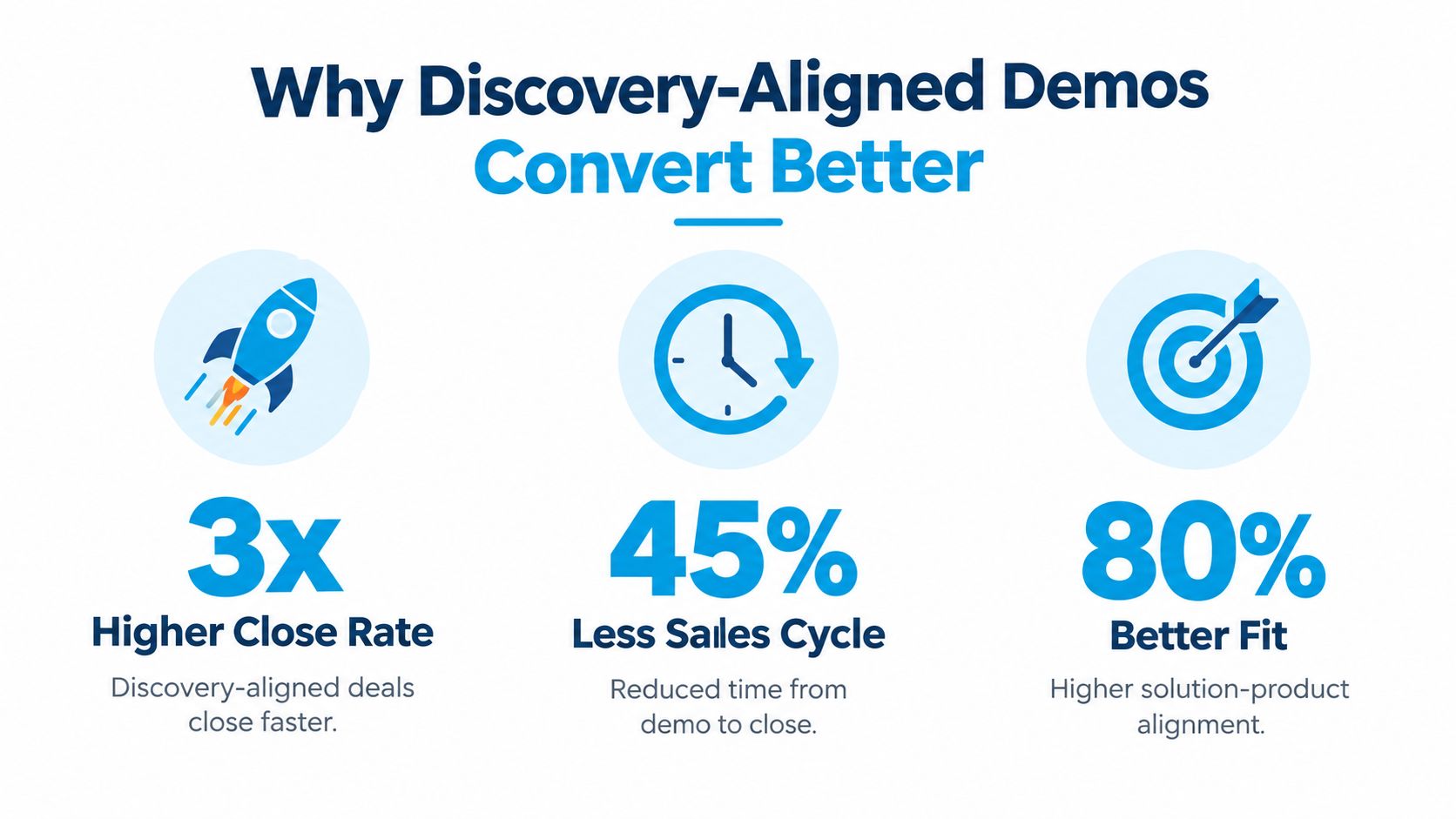
Discovery alignment improves conversion because it changes what the buyer has to evaluate. The prospect is not sorting through a broad product tour to decide which features might matter. They are testing evidence against problems they already described. That focus also explains why qualification matters. A low-probability demo should not receive a custom narrative just because the account requested a meeting. Personalization works best when the opportunity has earned it, a principle reinforced in the value-selling training for Solution Engineers.
Conversion research supports the distinction between relevance and presentation quality. Personalized demos built around specific prospect challenges perform better than generic walkthroughs, while prospect-controlled interactive experiences can give buyers more control over what they examine. Length still creates risk. Buyers disengage when the session asks them to process too much unrelated product detail.
The evidence shows an association, not a guarantee. Personalization cannot fix poor product fit, an absent decision-maker, or a deal without a compelling reason to change. It can make the evaluation easier to follow because each feature has a defined purpose in the conversation. The SE still has to expose gaps, test assumptions, and decide whether the next meeting is justified.
Read the signals in the room
A discovery-aligned demo usually produces observable buyer behavior:
- The buyer corrects details: They refine the workflow or add constraints because the discussion is close to their operating reality.
- Questions become evaluative: Stakeholders ask how the product handles their data, users, approvals, and integrations instead of asking for isolated feature descriptions.
- The next step becomes concrete: The group can name the remaining validation work and identify who needs to participate.
- Stakeholders use the buyer's language: The discussion stays tied to the business problem rather than drifting into vendor terminology.
Misalignment produces different signals. Buyers ask broad feature questions, request unrelated screens, or stay silent while the SE follows the agenda. Those reactions do not always mean the product is wrong. They often indicate a weak discovery hypothesis or the wrong stakeholder in the room.
Gong's analysis of 67,149 sales demos found that winning demos reflected topics raised during discovery. Gong's analysis of sales demos supports a practical rule: mirror the buyer's earlier conversation, remove unrelated explanation, and use the demo to test problems the buying group has already identified.
The Hidden Cost of Unqualified Demos
The most expensive demo failure often happens before the call. A low-probability opportunity consumes SE preparation, meeting time, technical support, and follow-up capacity even when the product was never a realistic fit.
Showmanship gets blamed because the failure is visible. The SE freezes, the environment breaks, or the buyer asks a question the presenter can't answer. Those moments matter, but they often reveal a deeper process problem: nobody checked whether the opportunity had a defined use case, the right attendees, or a workable technical path.

Gate without creating buyer friction
A useful gate doesn't demand exhaustive information. It confirms the minimum conditions for a productive technical conversation:
- A defined problem: The prospect can describe what needs to improve and why it matters now.
- A credible use case: The proposed workflow maps to a real team, process, or technical requirement.
- Relevant participation: At least one person who understands the workflow can evaluate the evidence.
- Technical readiness: Integration, security, data, and deployment questions have an owner or a planned validation path.
- A decision path: The buyer can explain what happens after the demo if the solution fits.
If those conditions aren't present, offer an interactive asset, a short qualification call, or a narrower exploratory conversation. You're reducing effort for both sides, not withholding access.
Before a live session, test the demo environment, data, user permissions, integrations, and fallback path. Prepare screenshots or a recorded segment for any workflow that depends on unstable external systems. A reliable demo environment doesn't replace discovery, but it prevents an avoidable technical issue from obscuring the product's actual fit.
The earlier Gong analysis of 67,149 sales demos found that winning demos reflected the topics raised during discovery. That finding reinforces the operational point: preparation isn't mainly about memorizing a script. It's about confirming that the room is qualified and that the evidence matches the buyer's stated problems.
Building Shorter, Modular Demos
A shorter demo isn't a thinner demo. It's a demo with a tighter burden of proof.
Build reusable modules around buyer problems, not product navigation. One module might explain a workflow, another might validate an integration, and another might address administration or governance. Each module should have a clear entry point, a specific claim, and a reason to continue the evaluation.
Use a modular structure
A practical structure looks like this:
-
Open with the agreed problem. Restate the current workflow and the outcome the buyer wants. Ask for confirmation before showing the product.
-
Prove the primary workflow. Demonstrate the smallest path that resolves the central pain point. Don't detour into adjacent features unless the buyer connects them to the decision.
-
Validate the technical boundary. Show the relevant integration, permissions, data handling, or configuration. If the live environment can't prove it, identify the validation step instead of improvising.
-
Invite targeted questions. Ask which part of the workflow needs more evidence. Let the buyer choose the next module when their involvement adds signal.
-
Name the next step. Tie the next meeting or test to an unresolved requirement, stakeholder, or success criterion.
This structure helps you cut scope without appearing evasive. You aren't saying the product lacks breadth. You're showing judgment about what deserves attention in this meeting.
Make every module earn the next meeting
A module earns continuation when the buyer can state what it proved and what remains uncertain. If nobody can connect the segment to a decision criterion, remove it.
Buyers increasingly expect faster access, buyer control, and content they can revisit between meetings. Interactive demos and recorded modules can handle repeated education, while live SE time should focus on interpretation, technical validation, and decision risk. The right mix depends on the deal, but exhaustive feature coverage is rarely the strongest use of a technical expert's time.
A modular library also improves internal consistency. A sales team can reuse a validated workflow without forcing every SE to recreate it, while still tailoring the opening, examples, and validation questions to the account.
Turning Demos into Technical Wins
A technical win is not the buyer's impression that the product looks good. It's a documented conclusion that the solution fits the agreed technical and workflow requirements well enough to justify the next buying step.
That definition gives you a sharper operating model. Before the demo, qualify the opportunity and capture the decision context. During the meeting, select the pattern that fits buyer readiness and technical complexity. Afterward, record what was proven, what remains open, and who owns each validation task.
Five operating decisions
Start with discovery. Establish the pain points, current process, decision criteria, attendees, and environment before designing the walkthrough. You then decide whether a live demo is warranted.
Choose evidence over breadth. A personalized workflow that answers the buyer's main question has more technical value than a broad tour that leaves the buyer to interpret relevance.
Protect SE capacity. Use qualification gates and asynchronous assets when a live session would add little signal. Fast access should lead to faster clarity, not more unproductive meetings.
Design for recovery. Stable environments, prepared fallback content, and clear technical owners keep one failed integration test from becoming a failed evaluation.
Close the loop. Treat every demo as feedback for the next discovery conversation. If buyers repeatedly ask about the same missing requirement, update the qualification questions, demo modules, or technical proof.
The demo skills training resource reflects this broader view of capability building. Demo quality improves when SEs practice discovery, narrative control, technical validation, and objection handling together, rather than treating presentation polish as a separate skill.
The standard is simple: Can the buyer explain why the solution fits, what still needs proof, and what happens next?
That standard also gives PreSales leaders a better way to review performance. Don't assess only whether the SE covered the agenda or avoided mistakes. Review whether the team qualified the opportunity, connected evidence to stated requirements, included the right stakeholders, and created a clear technical decision.
A software sales demo influences a deal when it reduces uncertainty for the people who must approve the purchase. Discovery makes the evidence relevant. The right format makes it usable. Qualification protects capacity. Modular design keeps the conversation focused. Together, those choices turn a product presentation into a technical win.
PreSales Unleashed GmbH helps Solution Engineers and PreSales leaders build these habits through the Trusted Advisor Academy, live practice, reusable assets, and coaching tied to active opportunities. Visit PreSales Unleashed GmbH to develop a discovery-first demo approach that improves qualification, technical validation, and deal execution.