
Most advice treats solution consultant as a softer label for sales engineer. That's lazy, and it's why teams end up with beautiful demos, weak proof, and deals that drift until the quarter closes badly. In enterprise B2B SaaS, the title matters because it can mean a different operating contract, more advisory work, heavier POC ownership, and direct accountability for the technical win.
If you still treat the role like a demo schedule with better branding, you're underusing it. The best solution consultants don't perform product theater, they frame the business problem, design the proof, and hand the AE a package that can survive procurement, security, and internal politics. That distinction is the difference between a polished presentation and a deal that holds up.
The role is also more established than people assume. U.S. labor data shows it as a defined occupation with identifiable demographics, pay bands, and geography, not an ad hoc support function, which is useful context when companies try to pretend the title is interchangeable with every other pre-sales label. For a broader framing of PreSales, this overview of what PreSales is helps place the role in the revenue team.
What the Solution Consultant Role Actually Is
A solution consultant enters before the demo and stays involved through proof and close. If the AE alone defines the problem, the title is being used for presentation support, not solution consulting. The job is to turn an unclear buying conversation into a business case, then keep that logic intact as stakeholders test the solution.
The core unit of work
The operational definition is specific. A solution consultant owns business problem framing, POC architecture, and the technical win package. The work connects the buyer's measurable outcome to a proof plan, while giving the AE evidence that can withstand procurement, security review, and internal debate.
Practical rule: if the customer cannot explain the decision criteria without your notes, the role has created clarity. If the customer remembers only the demo, the work stopped at presentation.
Enterprise cycles expose the difference between this role and a standard SE assignment. An SE often owns the presentation layer and a repeatable demo motion. A solution consultant spends more time in discovery, shapes the evidence required for a decision, and carries greater responsibility for whether the proof convinces the buying group. The distinction matters most when several teams, use cases, and approval conditions must fit one evaluation.
The U.S. Bureau of Labor Statistics defines sales engineers as professionals who sell business products or services requiring technical expertise. That description provides a useful baseline. In B2B SaaS, solution consulting often extends it through advisory work and POC design, particularly in larger deals. The role remains part of PreSales, as the PreSales definition explains, but its influence reaches beyond the period before a sale. It shapes what the customer tests, how success is judged, and whether the technical win holds.
Three pillars that separate the title from demo work
- Business advisory work, helping the buyer define the problem, its impact, and the internal case for change.
- POC ownership, setting the proof criteria and building a test that answers the buyer's real risks.
- Deal-stage accountability, ensuring the technical win is credible enough for the opportunity to advance.
A solution consultant is paid to reduce decision risk, not to perform the product.
Solution Consultant vs SE vs AE
Most orgs blur these titles until nobody can tell who owns what. That is a mistake. Each role breaks in a different place, and once the lines blur, the technical win turns into a committee project with no real owner. If you want the role to matter, the distinction has to be obvious in the deal room.
The cleanest way to place the solution consultant is beside the other two revenue roles. The AE owns the commercial path. The SE owns the demo motion and technical explanation. The solution consultant owns the proof layer, where the deal either gets grounded in evidence or drifts into opinion.
This comparison of Sales Engineer, Solutions Engineer, and Solutions Consultant is still useful if your team treats the titles as interchangeable.
| Dimension | Solution Consultant | Sales Engineer | Account Executive |
|---|---|---|---|
| Deal ownership | Owns the proof layer and the technical win package | Owns the demo motion and technical explanation | Owns the commercial close and forecast |
| Primary stage of involvement | Discovery, POC, late-stage validation | Demo, technical validation, support throughout the cycle | Full cycle, with strongest pressure near close |
| Technical depth | High, with emphasis on business fit and proof design | High, with emphasis on product knowledge and presentation | Low to moderate, enough to manage the buying process |
| Commercial authority | Influences scope, proof, and feasibility, but doesn't own signature | Advises on fit and feasibility | Owns negotiation, timing, and customer politics |
| What failure looks like | The proof works technically, but the business case never lands | The champion likes the demo, but can't reproduce value internally | The deal slips with no clear commercial path |
A solution consultant should make the reader uncomfortable if the title is being used loosely. If one person runs discovery, another improvises the POC, and the AE translates the outcome into business value at the end, that is not clear role design. It is fragmented accountability.
The AE and SC relationship gets sharper when timing is respected. Late entry into proof usually means someone else already framed the decision criteria. Once that happens, you are no longer shaping the buying process, you are reacting to it.
Core Responsibilities Across the Deal Cycle
The title only works if the work changes the deal at each stage. Otherwise it is just a label. In a strong team, the solution consultant leaves a trail of artifacts that move the buyer toward a decision, and each one has a clear job.
Discovery to demo
Discovery comes first. The solution consultant turns the customer's stated pain into a measurable business outcome and writes it down before anyone books the demo. If the demo starts before that frame is in place, the room drifts into feature talk and the buyer starts judging comfort instead of criteria.
The demo should follow the outcome document, not the default product tour. If the customer cares about workflow friction, reporting gaps, or implementation risk, the storyline has to reflect that. A generic show-and-tell session wastes the only chance to make the product feel tied to the buyer's decision.
The demo is evidence review.
POC to closeout
POC is where weak operating habits show up fast. The solution consultant defines success criteria with the customer, owns the test plan, and ends with a written scorecard, not a vague “it worked.” If the scope keeps expanding without a decision frame, that is drift.
At closeout, the technical win package has to be strong enough for the AE to carry into procurement and security. That package usually includes architecture notes, security answers, references, and ROI logic. If those pieces are missing, the AE ends up improvising credibility in rooms where improvisation gets punished.
Timing matters here too. As noted in the buying signals sales timing guide, proof design works best when it starts early, before the buyer has already locked in their evaluation path. A solution consultant should be in that motion early enough to shape the test, not late enough to validate someone else's story.
What good handoff looks like
- Discovery handoff: a written problem statement, outcome, and success criteria.
- Demo handoff: a narrative that connects product behavior to the buyer's decision.
- POC handoff: a scoped test plan, owner map, and evaluation rubric.
- Closeout handoff: a technical win package the AE can defend without you in the room.
If those artifacts do not exist, the role is not being played. The title is decorative.
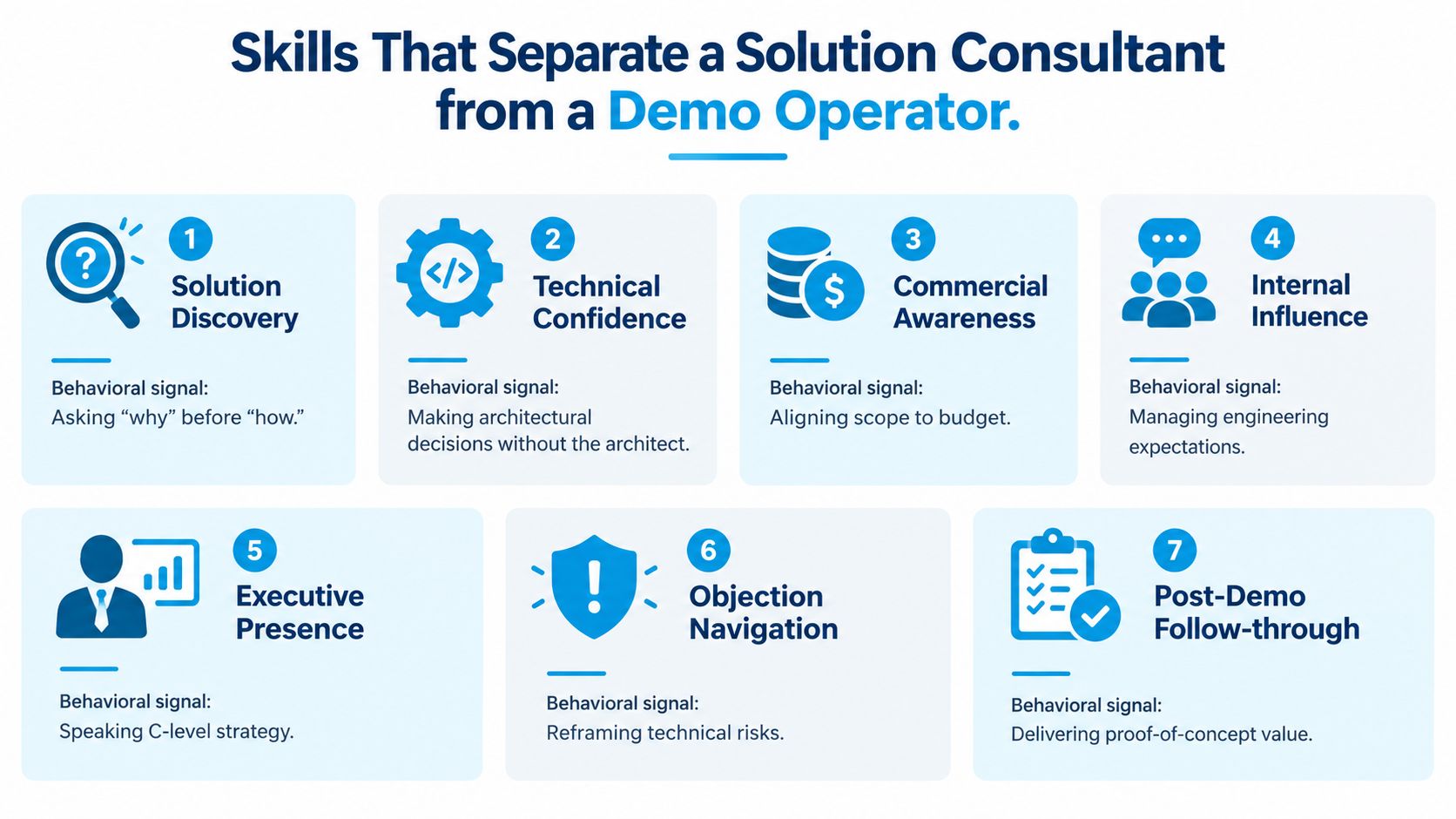
Skills That Separate a Solution Consultant from a Demo Operator
The difference isn't charisma. It's judgment under pressure. A demo operator can run the room, but a real solution consultant can shape the room before it starts.
The signals to audit in yourself
Business diagnosis shows up when you can put a dollar or operational impact on the problem before opening the demo. If you can't, you're still in feature land. The solution consultant who gets this right can explain why the buyer should care in one clean sentence.
Multi-stakeholder navigation means you separate the economic buyer, technical buyer, champion, and blocker instead of treating them like one audience. The signal is simple, you're tailoring the conversation differently for each one. If every stakeholder gets the same deck, the deal usually gets the same response, polite interest and no movement.
Demo architecture is about designing the session around a decision, not a product tour. You know you've got it when you can say, “This demo is meant to answer one buying question,” and everyone in the room understands the point. If the demo becomes a laundry list of modules, you've already lost control.
POC design is the skill many people fake. Real POC work starts with success criteria, scope boundaries, and an exit rule before a single test is run. If the customer says, “Let's just see what happens,” you need to reset that immediately or you'll spend weeks validating nothing.
Commercial judgment is the moment you push back on the AE when deal terms undermine solution integrity. That might mean refusing an unrealistic scope, a compressed timeline, or a promise the product can't support. If you never create tension with sales, you're probably not protecting the customer or the deal.
Internal influence matters when engineering, product, or security starts asking for exceptions. You need to translate field reality without turning into a ticket escalator. The strongest SCs know how to keep the solution honest without making the team defensive.
Executive presence isn't about sounding polished, it's about making a senior buyer feel that you understand the business decision. If you can speak clearly about risk, change, and value without hiding behind jargon, you're operating at the right level.
For a broader read on competency design, elite team building for CHROs is a useful lens on how teams define observable behavior, even if the audience is different. And if you want a practical training option for PreSales teams, PreSales Unleashed GmbH runs a year-round academy built around discovery, demo work, and POC management, which fits this exact skill gap.
How the Role Drives Value in B2B SaaS Deals
A labeled hypothetical deal makes the value clear. A SaaS vendor is selling into Northbridge Logistics, with a buying committee that includes the VP of Operations, the Security lead, the regional IT manager, and a finance sponsor. The AE wants speed, the champion wants a clean demo, and Security already has concerns about data flow and access control.
Discovery week changes the frame
The solution consultant joins early and does one useful thing first. They turn “we need automation” into a business outcome tied to manual handoffs, error reduction, and approval delays. That moves the deal away from a feature contest and into decision criteria, which is where enterprise deals are won or lost.
The demo changes too. A strong SC builds around the operations workflow instead of running the standard product tour, so the buyer starts asking how the product fits their process instead of what else it can do. That shift matters because fit beats novelty once the committee starts comparing options.
Good presentation assets help only if the story is already clear. If your team needs support on that front, best tools for sales presenters is a useful reference, but the tool still comes second to the proof logic.
POC negotiation is where value shows up
The POC can sprawl fast. The SC keeps it tight by defining success criteria with the customer, limiting scope to the key risk points, and writing down what pass or fail looks like before testing begins. That cuts out the endless “just one more test” loop that burns time and weakens momentum.
Practical rule: every POC needs a finish line before it starts. No finish line, no real proof.
At closeout, the SC pulls together the technical win package, architecture, security answers, references, and the business case, so the AE can move the deal through procurement without reopening the whole story. That package pays off because it reduces rework across buying functions and gives the customer a narrative they can repeat internally.
Teams that want a practical way to build those artifacts can look at the Trusted Advisor Academy at PreSales Unleashed GmbH. It focuses on discovery, demo work, sales alignment, and POC management, which maps directly to the pressure points in deals like this.
Career Path and How to Grow Into Senior Roles
The cleanest way to grow is to stop thinking in titles and start thinking in ownership depth. A good SC career usually expands from running individual deals to shaping how the team sells technically across a region. That's the difference between being useful and being scalable.
A practical trajectory
| Stage / Branch | Core Ownership | Skill That Gets You In | Skill That Gets You Promoted |
|---|---|---|---|
| SC I | Discovery and demo delivery | Clear customer problem framing | Reliable execution in live deal rooms |
| SC II | POC design and multi-deal technical strategy | Strong proof design and scoping | Judgement across competing deal priorities |
| Principal SC | Enablement and regional deal review | Repeatable frameworks and clean feedback loops | Coaching others without slowing the team |
| SE leadership | Managing the SC pod | Credibility with reps and technical depth | Building systems, not heroics |
| Product management | Field signal into roadmap | Translating buyer pain into product language | Prioritizing what actually matters in market |
| Revenue architecture | Solutions strategy, RevOps, or chief of staff to CRO | Cross-functional clarity | Designing how the revenue engine runs |
The branching point is more important than the ladder. If you want SE leadership, you need to learn how to coach, inspect deals, and build operating rhythm. If you want product, you need to be the person who can turn field objections into usable roadmap input without sounding like a complaint box.
Where people usually stall
They stay too close to demos. That's fine early, but it becomes a ceiling if you never own proof design, never run tough deal reviews, and never help other people sell better. Senior roles go to the person who can make the team more effective, not just the person who can save their own meetings.
This guide on building a PreSales career when there's no obvious path is a good companion if your org doesn't have a formal ladder. The point isn't to copy someone else's route, it's to choose the skill that creates your next move.
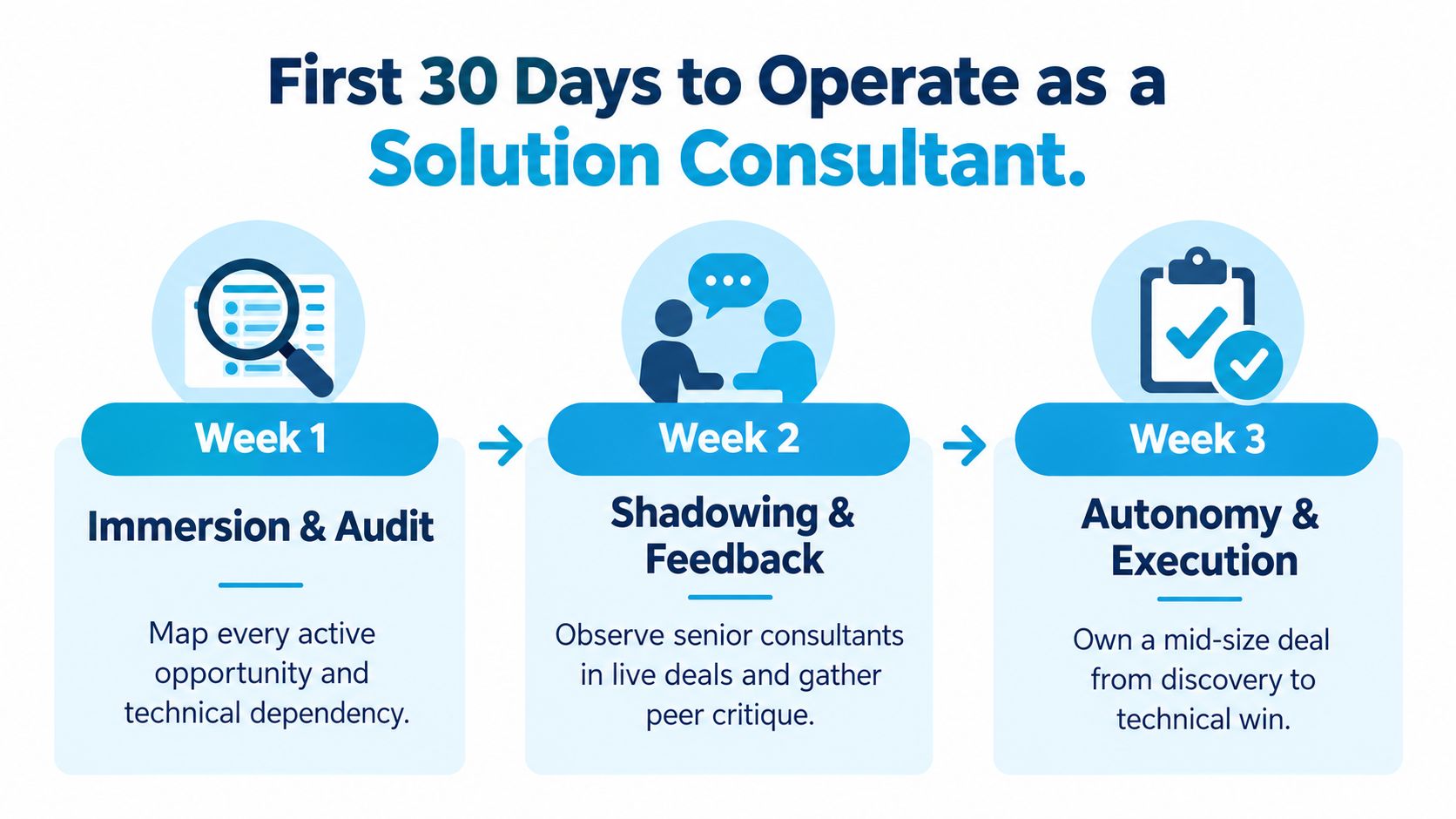
First 30 Days to Operate as a Solution Consultant
Treat the first month like a reset. You're not learning a new title, you're replacing demo operator habits with solution consulting behavior.
Week by week
Week 1, audit the deals. Look at every active opportunity and mark where discovery happened too late, where the POC was scoped by the AE alone, and where technical win criteria were never written down. That audit tells you where the org is confusing activity with proof.
Week 2, build the operating assets. Create a discovery question bank tied to business outcomes, rewrite two demo flows so they start from the customer's problem statement, and draft a POC template that forces mutual evaluation criteria. This is the week that changes how you work.
Week 3, enter live deals mid-cycle. Join three opportunities, pressure-test the new artifacts, and watch whether your framing shortens the path to agreement. If you don't see a difference, the problem is usually the quality of the questions, not the effort.
If you only have one week, do Week 2. Demo and POC rework changes win-rate conversations faster than almost anything else.
The best short-term signal is simple. If you can make a deal easier to evaluate, easier to prove, and easier to close, you're acting like a solution consultant.
PreSales Unleashed GmbH helps Solution Engineers and PreSales leaders build those exact habits through the Trusted Advisor Academy, live practice, and deal-focused enablement. If you want to turn the solution consultant role into real technical win execution, visit PreSales Unleashed GmbH and see how the Academy supports discovery, demo, and POC work inside active deals.