
Most advice tells you to open with a warm line, thank everyone for their time, and hope courtesy carries the deal. That advice is wrong for PreSales. A polite note that doesn't confirm anything, expose a gap, or set a next decision gets filed and forgotten.
Writing Thank you for the great time works after a dinner or a date because it's a social formula, as the Free Dictionary idiom entry for thank you for a great time documents. In a technical sale, the same vague warmth sounds generic and automated. It tells the buyer nothing about what you heard, what remains open, or what happens next.
The good follow-ups below do real work. Each one matches a stage of the deal, gives your champion something to forward, and forces a specific next decision. You'll get the structure, a hypothetical example, and the trade-offs. Send the wrong version at the wrong stage and you'll stall the deal. Send the right one and your email becomes a deal artifact that proves your discovery quality, not your demo polish.
1. The Same-Day Recap Email
Send a short written summary within 24 hours of the meeting. Restate what the customer said in their words, list the open questions you didn't answer, and propose one concrete next step with a date. That's the whole job.

Hypothetical example: after discovery with a logistics operations manager, you restate the three exception-handling problems exactly as she described them. You flag that the warehouse system integration is still unconfirmed. You propose a 30-minute technical session Thursday with the warehouse IT lead to close that one question.
What makes it land
- Use their exact phrases: Paraphrasing pain into sales language weakens trust, so copy their wording for the problems.
- Put the next step first: Place it in the subject line or first two sentences so it survives a skim on a phone.
- Send it same day when you can: You have one business day, but same-day is better when the meeting ended with a clear decision.
Don't write Thank you for the great time and stop there. Replace it with a specific line, like thank you for walking through the exception queue. Your recap is only as good as the discovery behind it, so use a structured discovery call guide before the call, not after. If the recap doesn't trigger a second meeting, fix the next step. The summary is rarely the problem.
2. The Post-Demo Requirements Mapping Follow-Up
Stop sending demo highlights. Send a mapping. Take each capability you showed and link it to a requirement the customer stated earlier, then mark each one met, partially met, or not covered.
Your opening thank-you introduces that candid table. It's not a sales pitch. It turns the demo into a checklist the buyer can challenge, which gets you to a clear technical win or a clear no faster than another polished tour.
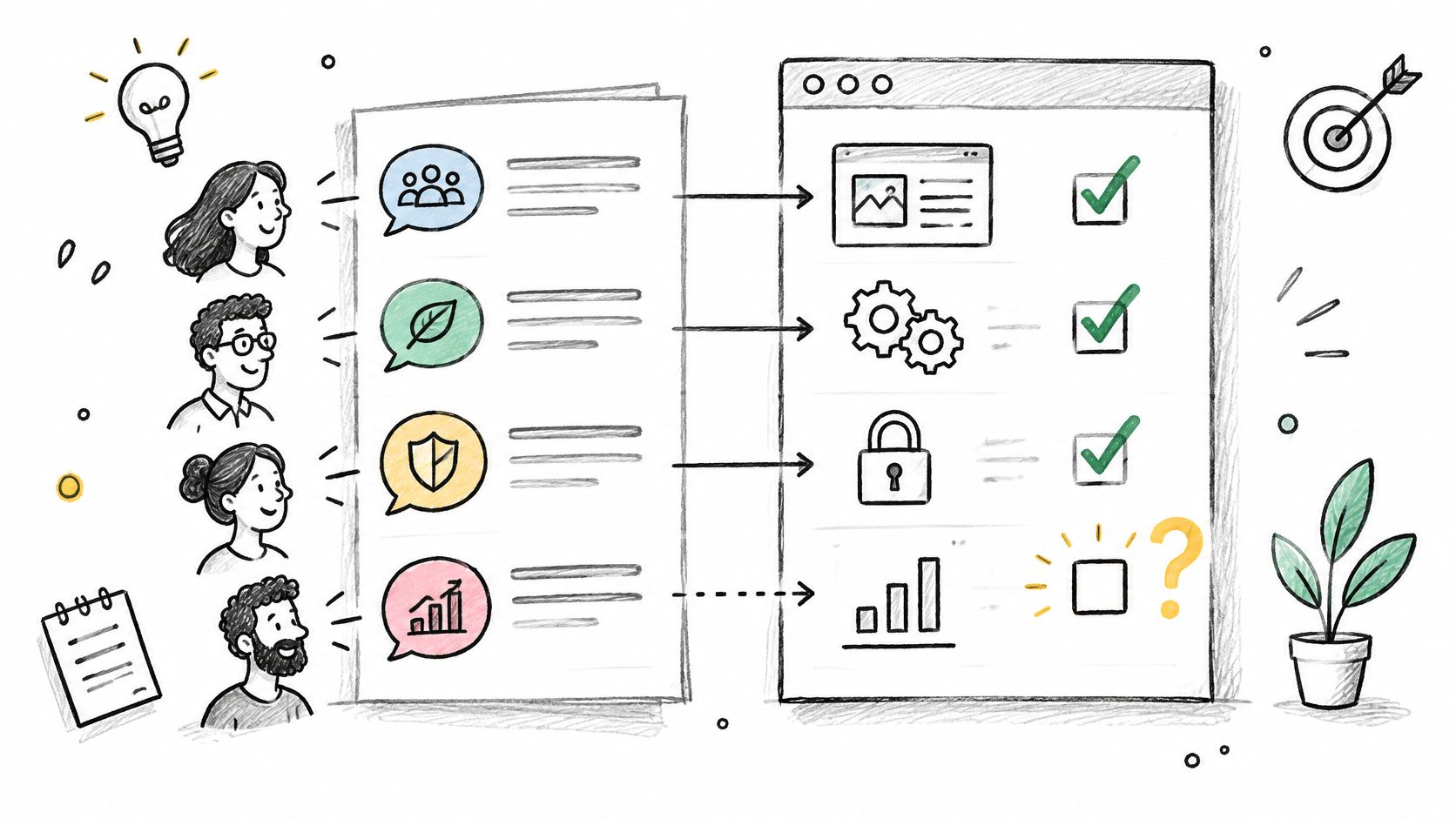
Hypothetical example: you're an SE for a workforce scheduling platform. Four of six requirements show as met. Shift swap approvals show as partially met, with a note that the customer's admin must configure the approval chain. You ask who will own that configuration and when they'll do it.
- Keep labels short: Three or four status options are enough, because more turns the table into debate material.
- Split the audience: Lead with two sentences for the business sponsor, then attach the table for the technical team.
- Mark roadmap clearly: Don't add dates unless product management has approved them in writing.
Use the table as the agenda for your next technical session. That's how you demonstrate to win instead of demoing to impress, and it aligns with how you should choose PreSales training that builds repeatable demo habits across the team.
3. The Thank-You to the Technical Evaluator
The person who decides if you pass the technical gate often didn't run the meeting. That's the security reviewer, the architect, or the IT lead who asked two sharp questions and then went quiet.
Write to them directly. Thank them for a specific question, answer what you parked during the call, and send the artifact they need. Architecture diagrams, data flow documents, and security questionnaire responses beat a product brochure every time.
Hypothetical example: after a demo to a security architect, you thank her for asking how tenant isolation works. You attach the isolation diagram she requested. You propose a 45-minute call with your security team to cover the open question on key management.
Practical rule: Lead with the question they asked, not with your product. Technical evaluators answer specific questions. They ignore general offers of help.
Copy the AE or champion so the work stays visible. Keep a standard pack of security and architecture artifacts ready, so you're not hunting for files for three days. Log every question they asked in your deal notes, because those questions will reappear in the proof of concept. End with one clarifying question, not five. One good question about key rotation, data residency, or identity integration keeps the thread alive and shows you understood the risk they care about.
If you write a generic Thank you for the great time to this person, you've wasted the thread. They don't need warmth. They need evidence.
4. The Executive Summary Follow-Up for Economic Buyers
Executives don't read recaps. They scan for money, risk, and who decides. Your note has to fit that scan in under a minute.
Link the problem you discussed to a business outcome the customer already named, such as cycle time, error rates, or cost of delay. Confirm what you verified technically. Ask one clear question about how they'll evaluate options.
Hypothetical example: after a meeting with a VP of finance, you restate her goal of closing month-end reconciliation two days faster. You confirm the two systems that feed that process. You ask whether the steering committee or the finance leadership team will make the decision.
Keep it tied to what they said
- Use only their metrics: Don't introduce benchmarks or industry figures you can't source and defend.
- Ask about the process: Who signs and by when matters more than whether they liked the demo.
- Coordinate with your AE: Two separate follow-ups to the same executive in one day damages credibility.
Enterprise deals need this discipline because Gartner reports the average enterprise buying group contains five to 11 stakeholders representing an average of five distinct business functions. One executive can't carry consensus alone. Your job, with the AE, is to keep the business case tied to what you confirmed technically. If you need a shared method for that link, use the North Star technical win rate framework.
5. The Proof-of-Concept Kickoff Thank-You
When a customer says yes to a proof of concept, your thank-you becomes the scope document. Treat it that way. A verbal yes with no written criteria is how SEs lose weeks.
Here's the kickoff structure in action.

Hypothetical example: after agreeing to a 30-day pilot, you send a one-page scope note. It lists three success criteria, including invoice import completing for a defined share of sample records in test. It names the customer's data owner and puts the decision meeting on day 35.
- Write testable criteria: The customer should be able to test each one without you in the room.
- Put the decision date first: A POC with no decision date is a research project you're funding.
- Confirm access before day one: Sandbox access and SSO delays kill more pilots than missing features do.
Buyers don't have time for open-ended work, because Gartner research summarized by sales.co states B2B buying groups spend an average of 17% of their buying time meeting potential suppliers. Bound the evaluation. Use a POC success criteria template and structured enablement as a service thinking to keep owners, dates, and evidence in one place.
This short walkthrough shows how to turn that scope note into a working plan.
6. The Short Thank-You After a First Call
After a first call, you haven't earned a demo yet. Don't act like you have. Keep the note brief, name one thing you learned, and propose a discovery next step.
That brevity works in other contexts too. A Science of People guide to texting after a first date presents "Thank you for the great time last night" as a starting point and recommends keeping such texts to approximately 1 to 5 lines. You're not dating the prospect, but the principle holds. Appreciation without pressure leaves room for a next meeting.
Hypothetical example: after a first call with a head of customer support, you thank her for her time. You note that handoffs between tiers are the main concern. You ask for 30 minutes to map the current handoff process before you show anything.
Frame the next meeting as mapping how it works today. That lands better than offering another product tour.
If they push for a demo immediately, agree to a short one only after you've confirmed two or three requirements. No discovery, no demo. Use strong sales discovery questions to earn that session, and keep the email itself clean so it doesn't land in spam. It's worth knowing how to stop email from going to spam in Gmail before you blame the wording for a missing reply.
A long first follow-up reads as a pitch. A short, specific one reads as respect for their time.
7. The Re-Engagement Thank-You for a Stalled Deal
Silence doesn't mean no. It often means your deal lost an internal fight you never saw. Your re-engagement note needs to give the prospect a low-effort way back, or a clean way out.
Thank them for the earlier time. Reference the specific problem they cared about. Offer one relevant reason to talk again, such as a capability change that addresses a stated requirement.
Hypothetical example: six weeks after a demo, you write about their concern with audit logging. You mention a recent change to the logging export. You ask whether the project is still on this year's roadmap or should move to next year's planning.
- Reference their words: A generic just checking in gets ignored because it could go to anyone.
- Offer a clean close: Say you're happy to close the file if priorities changed, and you'll often get a reply.
- Don't invent urgency: Only mention a new capability if it solves a requirement they named.
Consensus work matters here, because in a Gartner survey of 632 B2B buyers, 74% of buyer teams demonstrated unhealthy conflict during the decision process. Your contact may have lost consensus, not interest. Good technique for how to follow up on unanswered emails helps, but a specific, pressure-free question helps more.
8. The Thank-You With a Shared Asset for the Champion to Forward
Your champion has to sell when you're not in the room. Most SEs leave them with nothing but enthusiasm. Don't. Send an asset they can forward without editing.
That asset can be a one-page solution summary, a sample business case template, or a decision checklist. Make it generic enough to share and specific enough to reflect their stated needs. Leave out pricing and unapproved roadmap detail.

Hypothetical example: after a procurement-led evaluation, you send a one-page checklist with the customer's five requirements, a column for internal owners, and a note suggesting the champion share it with IT and finance before the next meeting.
- Build a small library: Keep five to ten reusable templates you can tailor in under 20 minutes.
- Ask how they'll use it: Their answer tells you which stakeholder to target next and what they fear internally.
- Make forwarding easy: Put the context in the asset itself, so it still makes sense three forwards later.
Written gratitude works when it's specific, and research on workplace gratitude links genuine, personalized expressions to people feeling more valued and more engaged. A shared asset proves that specificity. Structured programs like the Trusted Advisor Academy at SE Rockstars teach this asset-based approach because it turns a thank-you into internal selling support.
Which follow-up to send, when, and what it should accomplish
| Item | Best for | Send window | Primary goal | Length guide |
|---|---|---|---|---|
| The Same-Day Recap Email | Meeting or demo follow-up | Within 24 hours | Confirm understanding and schedule a next step | 120–200 words |
| The Post-Demo Requirements Mapping Follow-Up | Technical demo evaluations | After the demo | Map demonstrated capabilities to customer requirements | Summary plus a requirements table |
| The Thank-You to the Technical Evaluator | Security, architecture, or IT reviewers | After the technical meeting | Answer technical questions and share requested artifacts | Short and specific |
| The Executive Summary Follow-Up for Economic Buyers | Executive sponsors and economic buyers | After the executive meeting | Connect the business problem to outcomes and clarify evaluation criteria | Under 120 words |
| The Proof-of-Concept Kickoff Thank-You | Customers starting a proof of concept or pilot | After POC agreement | Confirm scope, owners, success criteria, and decision date | Concise scope confirmation |
| The Short Thank-You After a First Call | Introductory calls before a demo | After the first call | Continue discovery and agree on a discovery-focused next step | Three to five sentences |
| The Re-Engagement Thank-You for a Stalled Deal | Prospects who have gone quiet | After a deal stalls | Invite a clear response and re-qualify the opportunity | Brief, with a clear response option |
| The Thank-You With a Shared Asset for the Champion to Forward | Champions who need to build internal support | After a meeting or demo | Equip the champion to share the solution internally | Short cover note plus a one-page asset |
Pick the Next Step Before You Hit Send
Every template here fails the same way. The next step is vague. Let's touch base next week isn't a next step. It's a hope.
Before you send, name three things in the email itself. Name the decision you want to move, the person who owns it, and the date it should happen. If you can't name all three, you don't have a follow-up. You have a courtesy note, and courtesy notes don't produce technical wins.
Context also changes how gratitude lands. A corpus analysis of 8,729 British and American business emails found 49% of American messages included a thanking expression compared with 31% of British messages. Warmth isn't uniform across markets, relationships, or cultures. Calibrate it. A technical evaluator wants evidence, an economic buyer wants a decision process, and a champion wants something to forward. The same Thank you for the great time line can't do all three jobs.
That's why you should treat every thank-you as a deal artifact. It shows whether your discovery was real. It records what the customer said, what you verified, what remains open, and who does what next. If another SE read your follow-up cold, could they run the next meeting from it? If not, rewrite it.
Watch your closing line too. Clean professional email sign-offs won't save a weak email, but a sloppy sign-off can undercut a strong one. Keep it simple, keep it consistent, and don't let formatting distract from the decision you're asking for.
If you want structured practice on discovery, demos, and POC scoping with feedback on your real deals, the Trusted Advisor Academy runs live Q&A Office Hours with Tim & Jan. You can also book a discovery call to review your current follow-up process and find where deals stall after good meetings. Pick one template from this list, rewrite your next follow-up with a named owner and date, and send it today. Then track whether it produces a meeting, a decision, or a clean no. All three beat silence.
If your follow-ups are polite but your deals still stall, we can help you fix the discovery, demo, and POC habits behind them through the Trusted Advisor Academy, with live practice and ready-to-use assets you apply to active deals. Visit PreSales Unleashed GmbH to see how the program works and join a community of Solution Engineers building toward consistent technical wins.