
Sales enablement is a continuous, cross-functional operating system for content, process, technology, and stakeholder alignment, not a training calendar. Its practical pressure is clear: 55% of organizations say they can't effectively drive go-to-market initiatives, 29% rely on disconnected GTM tools, and 90% either use AI for GTM or plan to, while only 20.8% have reached a more mature unified model.
The popular advice says to build a content library, schedule training, and give sellers better tools. That advice is incomplete. A library doesn't decide whether a Solution Engineer (SE) enters an opportunity before the demo, whether an evaluation has credible success criteria, or whether an Account Executive brings technical discovery into the deal early enough.
For PreSales, enablement is the system that determines whether your team gets useful context or inherits a late-stage rescue job. It shapes discovery quality, demo relevance, POC discipline, technical storytelling, and the reporting that tells leadership whether the team is producing a technical win.
The distinction matters because no discovery, no demo. A polished presentation can't compensate for weak qualification, missing decision criteria, or a POC that has no agreed business outcome. The operating model around the SE decides whether those conditions are addressed before scarce technical capacity gets committed.
What Sales Enablement Actually Means for PreSales
The content-library definition is attractive because it's easy to explain and easy to buy software for. It also leaves out the work that determines whether a PreSales team can influence revenue.
A working definition is more demanding. Sales enablement aligns content, process, technology, and stakeholders around how customers buy, then continually reconfigures those resources as the market, product, and sales motion change. Academic research describes enablement as a dynamic capability that coordinates sales resources across marketing, training, operations, automation, and management to support sales effectiveness and the customer journey (Journal of Strategy and Management research).
For an SE leader, that definition becomes operational when you ask four questions:
- When does PreSales enter the opportunity? Before a demo with buyer context, or after an AE has promised a custom evaluation?
- What qualifies a POC? A real decision process and measurable criteria, or an open-ended request for free consulting?
- How does discovery become a demo? Through an explicit handoff, or through a calendar invitation with no account history?
- What does the team repeat? A certified technical narrative and reusable environment, or whatever an individual SE built last week?
The answer should be visible in the team's behavior. Earlier SE involvement should produce better context. A discovery-to-demo handoff should preserve pain, stakeholders, decision criteria, objections, and the desired technical “wow moment.” A POC should begin only when the commercial and technical conditions justify the capacity.
Practical rule: If enablement doesn't change what an SE does before, during, or after a customer interaction, it's probably content administration rather than enablement.
Training still matters, but training is one layer in the system. A useful PreSales definition helps clarify the broader role, from technical discovery and solution design through validation and the technical win. For teams working on seller-facing video, Unfloppable founder video tips can help improve how expertise is communicated, but presentation quality remains downstream of diagnosis.
Sales enablement is the continuous operating system that gets the right technical people into qualified deals, gives them repeatable ways to execute, and measures whether their work advances the technical win.
How Sales Enablement Became a Real Discipline
In the early version of many B2B SaaS teams, enablement lived in shared drives, old slide decks, product launch emails, and messages sent late at night by an SE who had just discovered a useful answer. Product marketing owned many requests, sales managers passed along whatever worked for one rep, and new hires learned by joining calls.
That model can support a small team. It breaks when the product surface expands, sales coverage grows, and every AE develops a different interpretation of the technical story.
The category formalized during the 2010s. One industry summary reports that fewer than 20% of organizations had sales enablement in 2013, compared with more than 60% by 2019 (Cirrus Insight's sales enablement history and statistics). A separate historical account places the field's early origin story in 1999, identifies a formal definition around 2010, and notes the formation of the Sales Enablement Society in 2016. Gartner also treated sales enablement as a distinct technology category around that period.
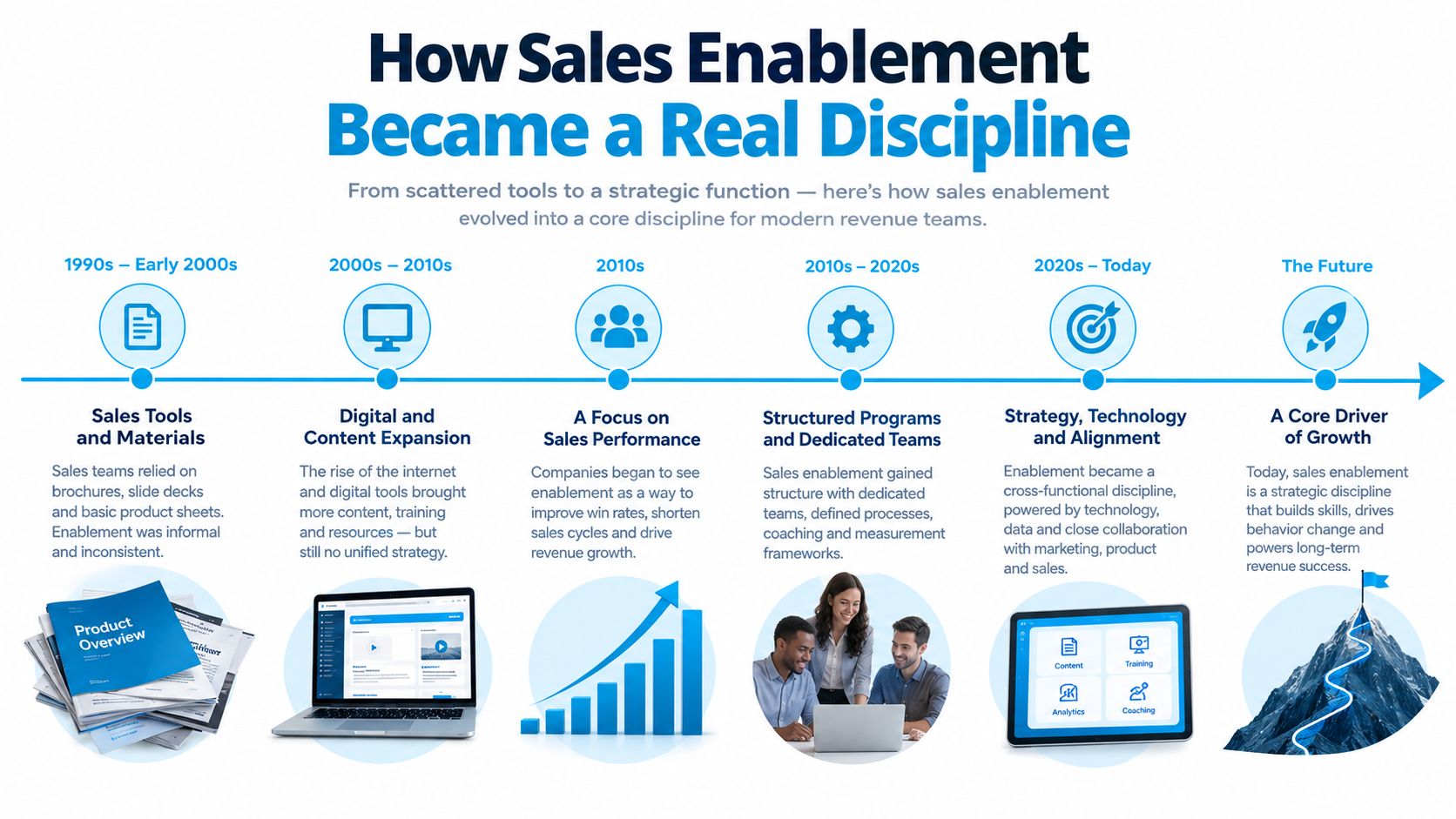
Those milestones describe more than a naming exercise. They show the move from informal collateral-sharing toward dedicated leadership, defined frameworks, technology governance, and repeatable support for customer-facing teams. SaaS companies needed a way to keep messaging, discovery, demos, coaching, and analytics connected as the go-to-market motion became more distributed.
The consequence for PreSales is direct. A team can still operate through heroic SEs, but heroics don't create consistent capacity. A formal enablement discipline gives leaders a way to define how SEs qualify work, prepare for technical conversations, build proof, and report their contribution.
For a practitioner view of how this shift affects technical teams, the state of PreSales enablement discussion offers useful context. The important question isn't whether your company has an enablement title. It's whether your revenue system gives PreSales a repeatable operating model.
The Four Pillars and Where PreSales Fits
Four pillars are useful only when each has a clear job. Otherwise, “content, training, process, and technology” becomes a list that everyone agrees with and nobody owns.
| Pillar | Job To Be Done | PreSales Ownership | Failure Mode |
|---|---|---|---|
| Content | Give teams approved, relevant material for each buyer moment | Maintain discovery question banks, demo storyboards, technical battlecards, architecture references, and POC templates with Product Marketing | SEs build inconsistent assets, repeat weak narratives, or answer technical objections from memory |
| Training | Build and reinforce the skills required in live opportunities | Run demo clinics, objection labs, discovery practice, product certification, and peer review tied to active deals | Onboarding finishes, skills decay, and managers discover gaps only after a customer call |
| Process | Define how work moves through the revenue cycle | Set SE entry criteria, discovery-to-demo handoffs, POC gates, review points, and technical-win definitions | SEs enter late, accept unqualified evaluations, and spend capacity on work Sales hasn't qualified |
| Technology | Make the right information and workflow available at the moment of use | Select and govern conversation intelligence, demo automation, CRM fields, knowledge systems, and POC management tools | Teams buy disconnected tools that create more searching, duplicate data, and poor adoption |
Content must carry technical meaning
A product sheet rarely gives an SE enough to run a serious discovery or handle an architecture objection. The useful artifact is closer to a decision aid: a question sequence, a persona-specific story, a reference architecture, or a list of observable POC outcomes.
Ownership should be shared with Product Marketing, but technical credibility can't be outsourced. If the asset doesn't reflect how buyers validate security, integration, governance, or operational fit, SEs will replace it with personal material.
Training has to reach the call
A course completion record tells you that someone finished a course. It doesn't tell you whether they can isolate a business problem, connect it to technical consequences, or stop a demo when the buyer's criteria have changed.
Use technical sales training resources as a starting point, then build practice around real opportunities. A live demo clinic, recorded roleplay, and post-call review usually expose more than another passive module.
Process protects capacity
Process is where enablement becomes visible to an SE's calendar. A stage gate can require documented pain, stakeholders, decision criteria, technical fit, and a next step before a customized demo. A POC gate can require measurable success criteria, a fixed timeline, a decision process, and executive sponsorship.
Technology should reduce friction
Technology earns its place when it helps an SE retrieve context, prepare faster, personalize proof, or capture learning from the field. A larger stack isn't automatically a better stack. The benchmark evidence points toward stronger outcomes from go-to-market alignment, integrated technology, and full-lifecycle support, with maturity models used to assess how thoroughly enablement is embedded (2021 Sales Enablement Benchmark Report).
Who Owns Enablement Inside a Revenue Team
Ownership fails when everyone is consulted but nobody is accountable. Enablement is a RACI problem before it's a headcount problem.
Marketing often sees enablement as buyer-facing content, personas, campaigns, and messaging. Sales leadership sees it as deal plays, coaching, inspection, and execution. A dedicated enablement team, where one exists, usually coordinates programs, systems, adoption, and measurement. PreSales owns the technical layer, including solution narratives, demo assets, POC standards, and technical qualification.
| Owner | What They Own | Where Handoffs to PreSales Break |
|---|---|---|
| Marketing | Personas, demand content, positioning, competitive messaging | Collateral ignores integration, security, architecture, or technical objections |
| Sales leadership | Deal strategy, stage discipline, coaching, forecast inspection | AEs skip SE-led discovery and request demos without qualification |
| Enablement function | Program design, technology governance, reinforcement, reporting | Tools and courses launch without PreSales representation or workflow testing |
| PreSales | Technical discovery, demos, solution design, POCs, technical proof | SEs inherit assets and systems they weren't trained to use, then create local workarounds |
The seams matter more than the org chart. A marketer can produce accurate positioning that still fails in a technical evaluation. A sales manager can enforce stage progression but allow a rep to pull in an SE after the buyer has already formed an opinion. An enablement manager can launch a platform that no SE uses because it doesn't fit the call-preparation workflow.
Set one accountable owner for each enablement outcome and name the contributors. For example, Sales may own qualified SE entry, PreSales may own POC readiness, Product Marketing may own technical messaging input, and Enablement may own reinforcement and measurement.
The test is simple: ask who can change the behavior, who supplies the asset or training, and who reviews the result. If the answer is “everyone,” the behavior will drift.
Maturity Models and the AI Inflection Point
A maturity model is useful when it describes observable work, not when it gives a team a flattering label. The following five-level model translates enablement into PreSales behavior.
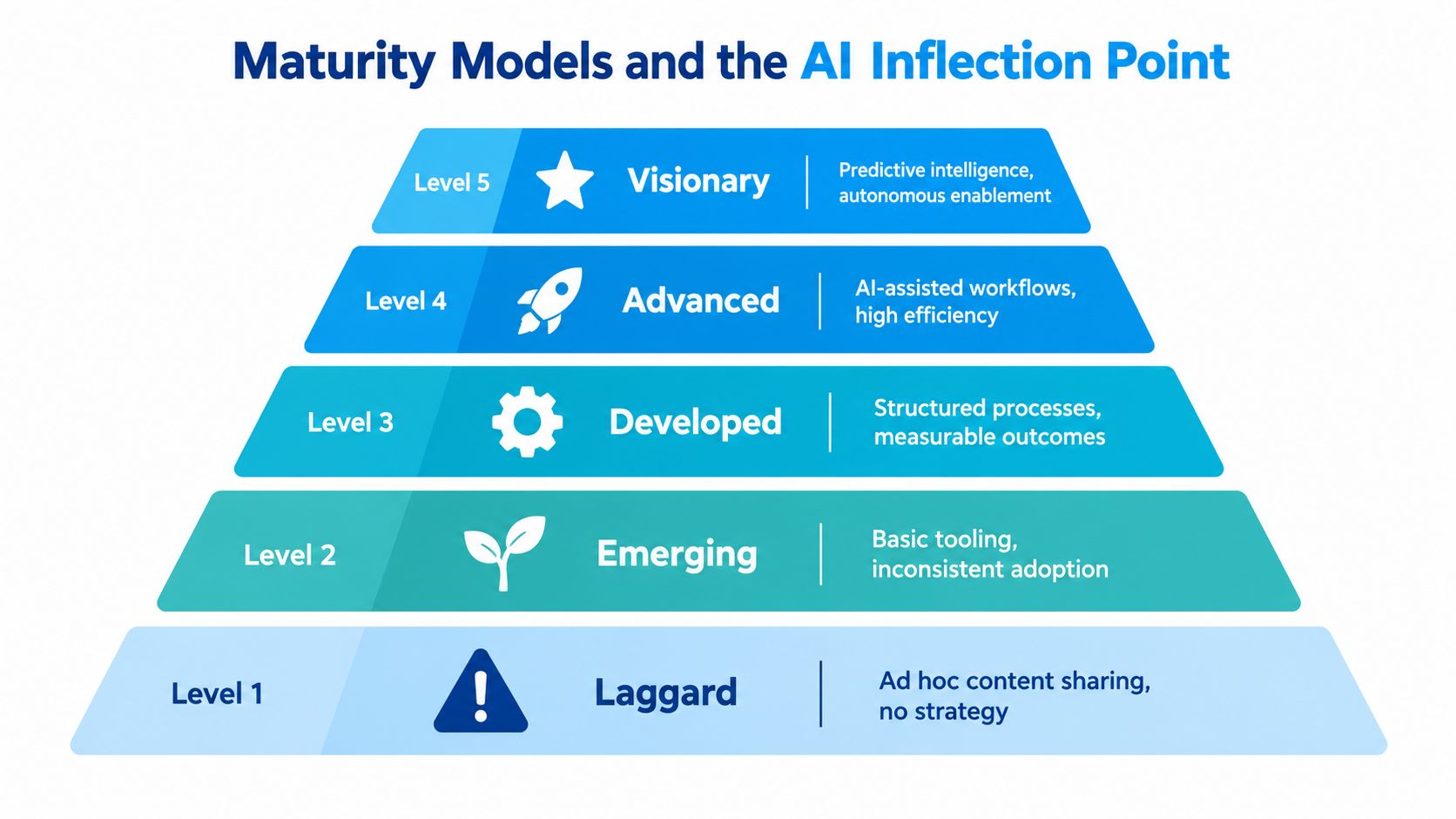
- Laggard means ad hoc content sharing, one-off demo builds, and no agreed technical qualification. The best SE becomes the unofficial system.
- Emerging means basic tooling and inconsistent adoption. Some discovery templates, demo environments, and training exist, but managers don't inspect usage.
- Developed means structured processes and measurable outcomes. Discovery standards, certified demo narratives, POC gates, and win-loss feedback connect.
- Advanced means AI-assisted workflows and high efficiency. Conversation intelligence supports coaching, proposal drafts use approved inputs, and demo personalization follows defined rules.
- Visionary means predictive intelligence and autonomous enablement. The team uses reliable data to identify risk, recommend intervention, and continuously adapt support.
Don't place a team on the curve based on the number of tools it owns. Audit the evidence:
- Reusable environments: Can an SE start from a maintained reference architecture instead of rebuilding the demo?
- Feedback loops: Do lost-deal reviews change a battlecard, discovery question, or POC template?
- Readiness: Can managers observe how a new SE applies the framework in a customer conversation?
- Evaluation control: Does every POC have agreed success criteria and a decision path before kickoff?
AI can help with call summaries, content recommendations, proposal drafting, and personalization. It can't fix undefined qualification, inconsistent CRM data, or a team that doesn't agree on what a technical win means. The latest market research says 90% of organizations either use AI for GTM or plan to, while 20.8% report a more mature unified, AI-powered enablement model (Highspot's State of Sales Enablement 2025). Adoption is widespread, but maturity is uneven.
Audit before automation: If your team is operating at the first or second level, use AI to remove a specific bottleneck. Don't use it to conceal the absence of a process.
Choose the next move by asking one question: what repeated PreSales behavior is currently expensive, inconsistent, or invisible? Fix that behavior first. The resulting data will tell you where automation can add value.
Translating Enablement Into PreSales Behavior
Enablement becomes real at four moments. Each moment has a failure pattern that an SE leader can see without opening a platform dashboard.
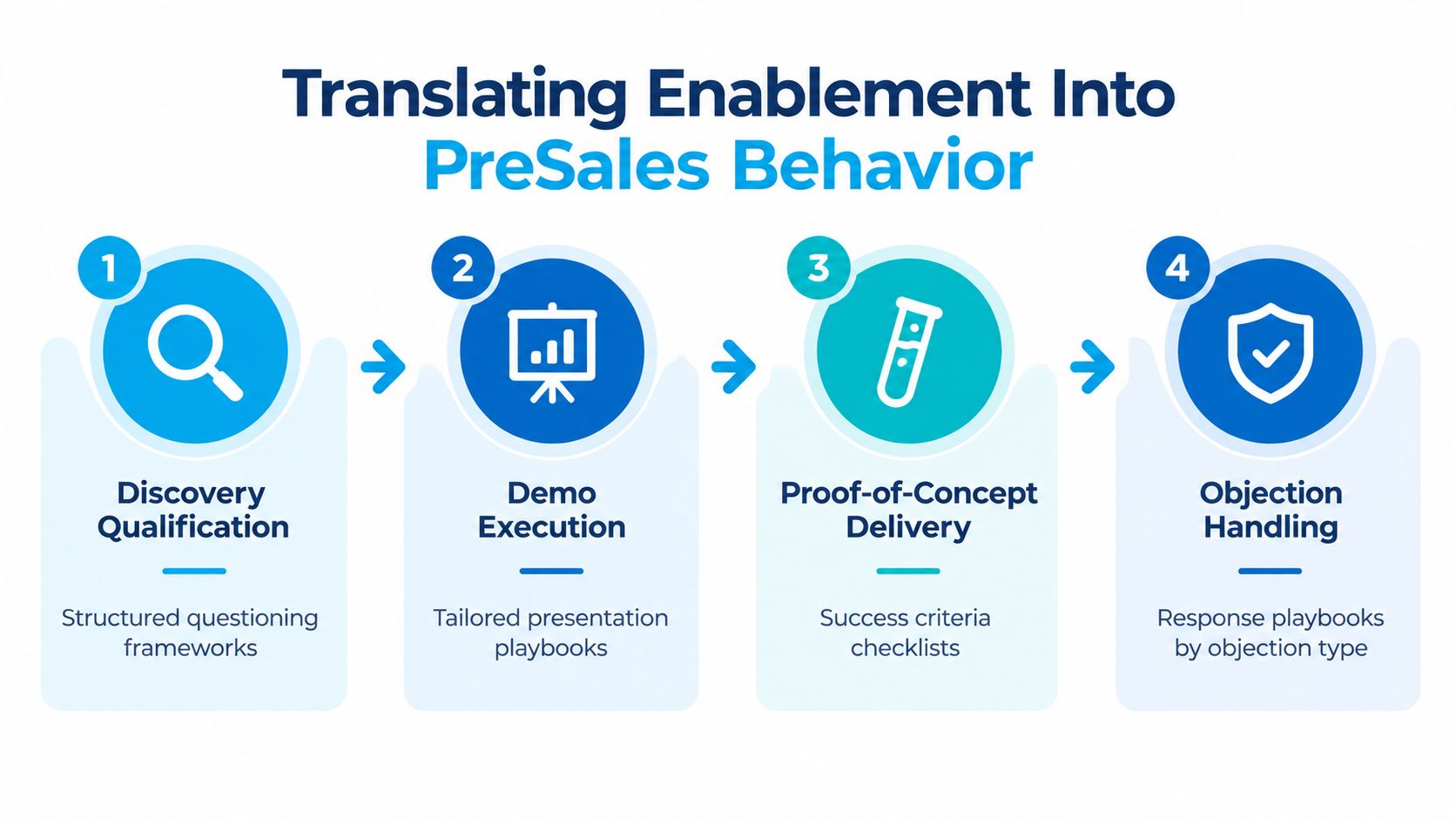
Discovery qualification
Good enablement gives the SE a shared qualification structure, not a script to read. The discovery record should capture the buyer's top pain points, attendees, decision criteria, objections, desired outcome, and the reason the opportunity is active now.
A useful discovery call guide can support that structure. The AE and SE should leave discovery with a mutual understanding of the problem, the people involved, the technical conditions for success, and the next evidence the buyer needs.
Without that information, the demo becomes a product tour.
Demo execution
The demo should follow the buyer's decision path. Use a storyboard that connects persona, pain, workflow, proof, and next question. A technical narrative might move from the operational problem to the architecture, then to the control the buyer needs to validate.
The SE's job isn't to show every feature. It's to make the relevant capability easy for the buyer to assess and difficult to misunderstand.
Proof of concept delivery
A POC needs control before it needs effort. Define 3 to 5 measurable success criteria, a 2 to 4 week timeline, an agreed decision process, and executive sponsor commitment before work starts (Talent Development Association sales enablement glossary).
Those controls protect SE capacity and make coaching possible. If the criteria are vague, no amount of project management will turn the evaluation into credible proof.
Objection handling and technical close
Battlecards should address technical objections by type, such as security, integration, data movement, deployment, governance, and operational ownership. They shouldn't be disguised pricing sheets.
The technical close is the point where the buyer can explain why the solution meets the agreed criteria and what remains to be resolved. Enablement should make that conversation repeatable, with evidence linked to the buyer's decision process.
Here is a practical demonstration of how structured enablement can support PreSales execution:
If you can't identify the behavior your program is changing, the program is theater. The next test is whether your measurement system can see that change.
The KPIs That Actually Move the Technical Win
Training completion, certificate counts, LMS logins, webinar attendance, and asset downloads are activity measures. They can help diagnose reach, but they don't tell an SE leader whether the team is entering the right deals, running credible evaluations, or producing technical wins.
Use a small operating set that follows the buyer journey. The directional benchmarks below are management aims, not universal market standards. Each team should establish a baseline, choose a direction, and inspect the trend against deal quality.
| KPI Category | Metric | What It Predicts | Directional Benchmark | Vanity Counterpart to Retire |
|---|---|---|---|---|
| Access | SE pull-in rate before or at demo one | Whether PreSales enters with enough context to influence technical direction | Move upward while maintaining qualification quality | Training attendance |
| Flow | Discovery-to-demo cycle time | Whether discovery produces an actionable next step without unnecessary delay | Reduce avoidable waiting and rework | LMS logins |
| Readiness | POC qualification score before kickoff | Whether the evaluation has criteria, timeline, decision process, and sponsorship | Increase the share of POCs meeting every required condition | POC template downloads |
| Conversion | POC-to-technical-win conversion | Whether proof maps to the buyer's decision | Improve through better fit, evidence, and close plans | Asset views |
| Capability | Time to first customer call for new SEs | Whether onboarding creates usable behavior | Reduce time without lowering call quality | Certificate count |
| Reuse | Reuse rate of battle-tested demo environments | Whether the team turns learning into repeatable capacity | Increase reuse while retiring stale environments | Number of environments created |
The pull-in rate is especially revealing. A low rate can mean Sales doesn't understand when to involve PreSales, or it can mean the SE team has become a late-stage service desk. Either way, the response isn't “hire more SEs” until you understand the entry pattern.
POC qualification deserves equal scrutiny. A POC that starts with vague success criteria can consume time while producing evidence nobody can use. A clear gate makes it possible to coach the AE, decline unsuitable work, or reshape the evaluation before kickoff.
Review the metrics in a weekly operating rhythm. Pair the numbers with deal inspection, call review, and lost-deal analysis. The technical win rate framework is useful when you need to connect SE activity to the outcome PreSales owns.
Retire dashboards that reward production without consequence. More certificates don't prove technical readiness. More downloads don't prove adoption. More webinars don't prove that an SE changed how they qualify or demonstrate.
A 90-Day Operating Plan SE Leaders Can Run
A quarter is long enough to establish a working cadence and short enough to maintain urgency. Run the plan in three blocks, with a named owner and an observable exit condition for each.
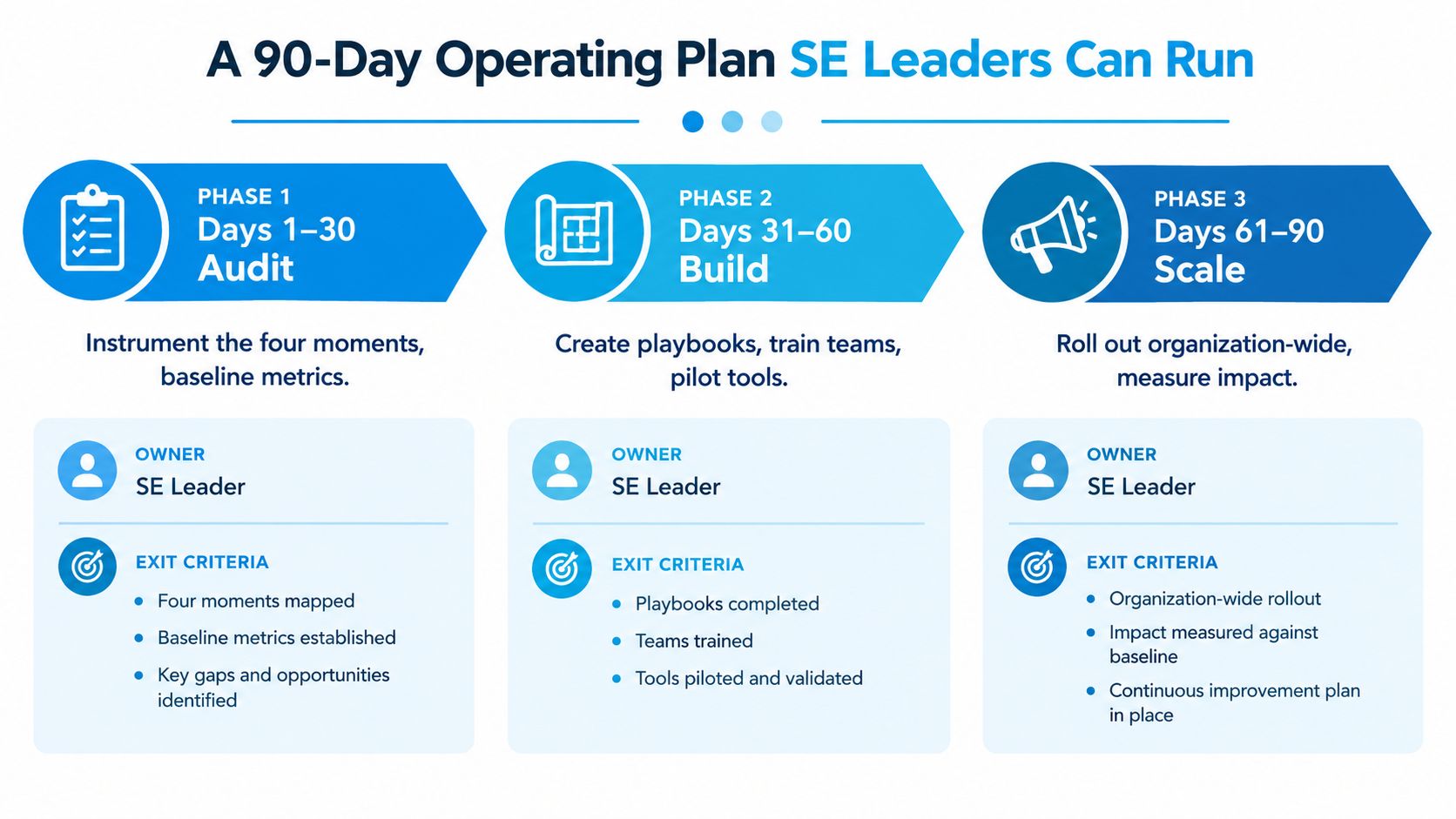
Days 1 to 30 audit
The SE leader owns the baseline. Revenue Operations supplies opportunity and stage data. Frontline managers provide call and deal context.
Deliver these items:
- Instrument the four moments: Record discovery qualification, demo execution, POC readiness, and technical close behavior.
- Audit the pipeline: Review discovery-to-POC movement, late SE pull-in, stalled evaluations, and lost technical decisions.
- Catalog the assets: List every demo environment, POC template, battlecard, architecture reference, and training path in use.
- Interview five lost deals: Ask where technical confidence broke, which objections went unanswered, and when PreSales entered.
The exit criterion is a short baseline that identifies one access problem, one execution problem, and one evaluation problem. Don't produce a large report that nobody uses.
Days 31 to 60 standardize
PreSales owns the operating standards. Sales leadership and Product Marketing review them before launch.
Ship four things:
- A discovery framework with required technical and business fields.
- One reference demo architecture with a clear narrative, supported variations, and maintenance ownership.
- POC entry and exit criteria tied to measurable buyer outcomes and a decision process.
- A weekly practice session that rotates live demos, peer review, objection labs, and failure postmortems.
The exit criterion is field use, not publication. Managers should inspect a sample of opportunities and confirm that the standards appear in the work.
Days 61 to 90 activate
Enablement coordinates reinforcement. SE managers own adoption. Sales leadership reviews the commercial effect.
Create a lightweight community channel for questions, useful recordings, objection patterns, and product changes. Publish the first internal playbook from the standards above. Put SE pull-in rate on the weekly review, then run a retro on the first technical wins and losses.
The exit criterion is a recurring cadence that survives the end of the quarter. That means the playbook has an owner, practice has a calendar, metrics have a review point, and field feedback has a route back into the system.
The habit that separates a learning team from a static one is a recorded internal demo where SEs teach SEs. Review the discovery, the story, the technical proof, and the next step. Repeat it often enough that coaching becomes part of the work rather than a reaction to a missed deal.
PreSales Unleashed GmbH offers the Trusted Advisor Academy, a year-round enablement program for Solution Engineers and SE leaders built around structured content, live practice, deal sparring, and application to discovery, demos, and POCs. Visit PreSales Unleashed GmbH to explore a continuous operating model for developing the behaviors that protect your technical win.