
The popular advice is to put Solution Engineers through a product bootcamp, hand them polished demo scripts, and call the team enabled. That approach produces confident presenters who still struggle when a buyer changes the question, introduces a security constraint, or asks what happens if the problem remains unsolved.
Technical sales training should change deal behavior, not merely deliver content. A strong program gives SEs repeated opportunities to learn, practice, receive coaching, and apply skills on active opportunities. The outcome PreSales owns is the technical win, and no discovery means no demo. Discovery quality, not demo polish, decides whether technical work moves a deal forward.
Technical sellers have been trained as a distinct discipline for nearly a century. Trane's Graduate Training Program, established in 1926, ran for 11 months, combining classroom instruction with an on-the-job mentor. Its curriculum split roughly into one-third technical training, one-third vertical-market and customer decision-point learning, and one-third sales methodology plus interpersonal skills. The historical account of Trane's program shows the point clearly: technical selling has never been only about memorizing product knowledge.
Why Technical Sales Training Is a System, Not a Workshop
A two-day workshop can establish vocabulary, introduce a framework, and create shared expectations. It can't install reliable behavior by itself. The moment a live opportunity becomes stressful, SEs return to whatever they've practiced most often, which is usually feature explanation, reactive demoing, and answering questions before understanding why the buyer is asking.
The retention problem is severe. A cited HBS summary says traditional curriculum-based training can lose more than 80% of taught information within 90 days without reinforcement. Richardson's sales-training sustainment research connects retention to post-training development plans, coaching, refreshers, and individual feedback. That applies directly to SE work, where discovery, demo narrative, and POC judgment only become dependable through repeated use.
Practical rule: If training ends when the workshop ends, you haven't built capability. You've created temporary awareness.
The operating loop
A working system runs alongside the deal cycle:
- Instruction gives the SE a usable model, phrase, checklist, or example.
- Deliberate practice tests that skill through role-play, call replay, or demo rehearsal.
- Manager coaching applies the lesson to the next live opportunities.
- Measurement checks whether the behavior appeared in customer conversations and affected the technical win.
The loop needs all four parts. Content without practice creates recognition, not fluency. Practice without live coaching can produce rehearsed behavior that breaks under buyer pressure. Coaching without measurement becomes personal preference. Measurement without instruction tells you there's a gap but not how to close it.
Treat the team like athletes
Sports teams don't prepare for competition by distributing a playbook and asking players to read it. They run drills, review footage, correct small errors, and repeat the patterns that matter under pressure. SE leaders need the same discipline.
The sunk-cost trap is polished enablement content that nobody uses. A beautiful slide deck about discovery has no value if the SE still launches into a demo after asking two surface-level questions. A script library has no value if it doesn't help the rep adapt when an economic buyer, security lead, or procurement owner enters the conversation.
Technical sales training becomes an operating system when it sets the cadence, behaviors, coaching responsibilities, and evidence used to improve. The curriculum supports the system. It isn't the system.
The Four Pillars of Blended PreSales Enablement
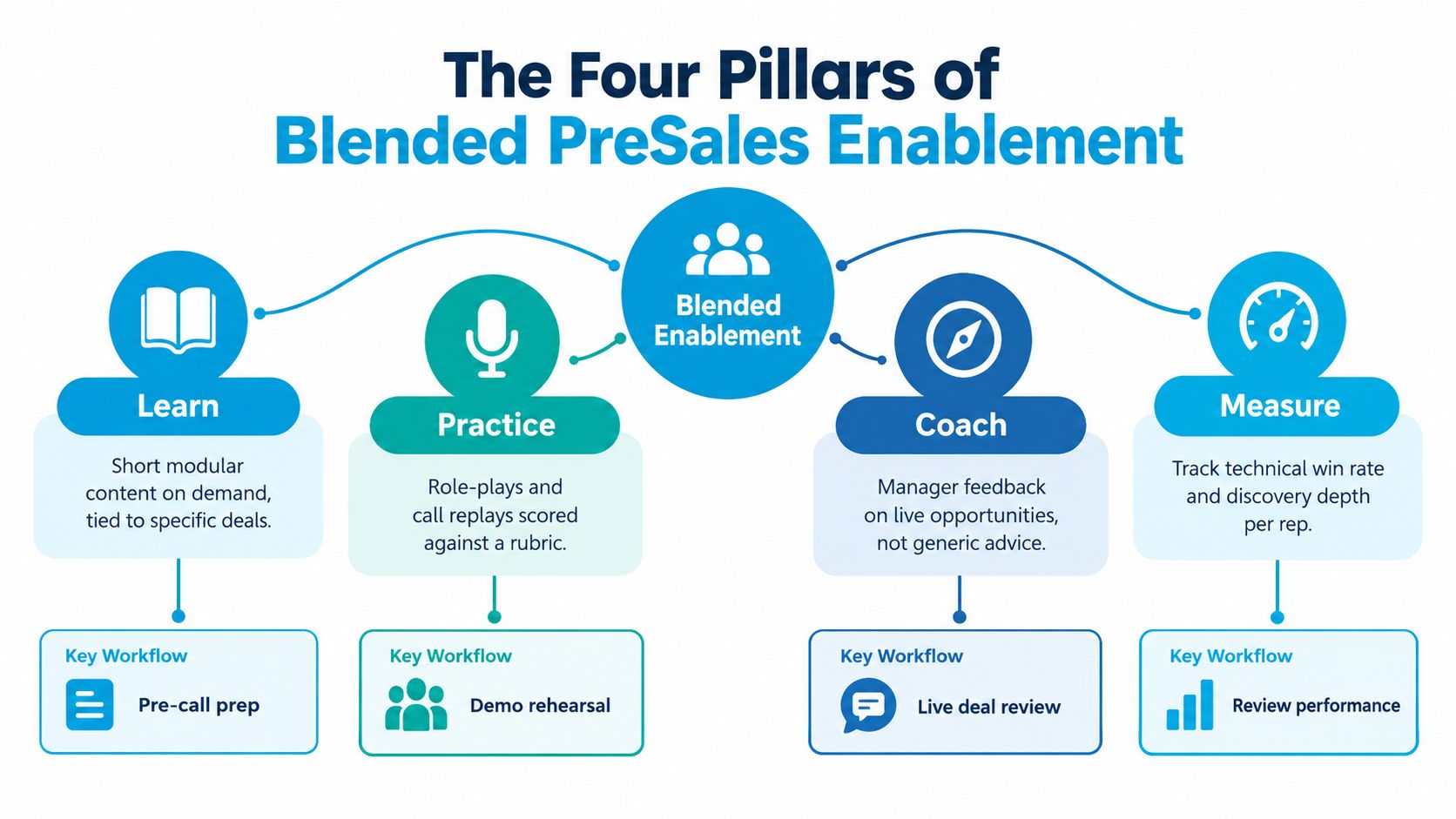
Blended enablement works when every learning activity maps to a real PreSales workflow. The four pillars are Learn, Practice, Coach, and Measure. LearnStream's actionable blended learning tips are useful for designing the mix of self-paced material, live interaction, and application without turning the program into a content library.
Learn
Short, modular lessons should answer a specific question an SE faces before or during a deal. Examples include how to frame an integration risk, how to ask about the economic buyer, or how to explain a product limitation without weakening trust.
On-demand content works best when it's attached to a deal moment. “Discovery fundamentals” is broad. “Questions to ask before agreeing to a custom demo” is immediately usable.
Practice
Practice turns an idea into a behavior. Use role-plays, recorded calls, demo rehearsals, and POC kickoff simulations. Score the exercise against a rubric that names observable actions, such as whether the SE explored business pain, tested technical constraints, or connected a feature to a stated outcome.
The exercise should feel slightly uncomfortable. If the buyer always answers predictably, the SE isn't building adaptive skill.
Coach
Managers should coach the next five deals, not deliver generic advice about becoming more strategic. Feedback needs to point to a specific moment, such as the question the SE skipped, the claim that lacked evidence, or the demo branch that ignored the buyer's stated priority.
Coaching also gives the manager a way to connect training to forecast reality. A skill gap that appears in a role-play should be inspected in live calls soon afterward.
Measure
Completion rates and quiz scores are activity metrics. They don't prove that a technical seller changed how they run discovery or scope a POC.
Measure observable behavior and deal outcomes together. Useful evidence includes discovery depth, the quality of documented technical requirements, POC success criteria, stakeholder coverage, and the technical win rate. If the Measure pillar is missing, the program reverts to workshop logic.
Core Skill Domains Every Solution Engineer Must Build
Many teams overinvest in technical depth because product knowledge is easy to package. Product architecture, integrations, and security requirements can be documented in modules. The harder domains require judgment in conversation, which is why they deserve more practice time.
A capable Solution Engineer (SE) needs six connected domains. They aren't equally important at every stage, but the ranking below reflects their likely effect on the technical win.
| Rank | Skill Domain | Typical Training Investment | Impact on Technical Win |
|---|---|---|---|
| 1 | Discovery and qualification | High practice, call reviews, deal coaching | Determines whether the technical work addresses a real business and buying problem |
| 2 | Demo storytelling | Rehearsal, narrative design, objection drills | Converts discovery into a buyer-specific technical case |
| 3 | POC and proof architecture | Scoping workshops, kickoff simulations, review coaching | Creates a fair evaluation with a clear decision signal |
| 4 | Stakeholder navigation and business acumen | Persona drills, value translation, account mapping | Connects technical capability to economic and operational outcomes |
| 5 | Technical depth | Product labs, architecture reviews, implementation scenarios | Builds credibility and prevents avoidable technical risk |
| 6 | Competitive positioning | Deal reviews, battlecards, comparison practice | Helps the SE differentiate once the buyer's needs and criteria are understood |
Discovery comes first
Discovery should cover business pain, the technical environment, the decision process, the competitive situation, and urgency. That means asking what systems the buyer uses, how integrations work, who the economic buyer is, whether procurement or an RFP is involved, and what happens if the problem stays unresolved. This presales discovery guidance provides a practical question set for that work.
Technical discovery then verifies architecture, data flow, integration needs, security and compliance requirements, and product red lines that could block adoption. The technical discovery guide from DemoDazzle is a useful reference for turning those requirements into demo and evaluation decisions.
Translate capability into economics
A technically strong SE explains how the system works. A commercially effective SE explains why that design matters to the business, then adapts the explanation for IT, finance, procurement, and executive stakeholders.
That translation skill deserves direct practice. Ask the SE to explain the same capability to a security architect, a CFO, and a procurement lead. The architecture stays consistent. The language, risk framing, and value case should change.
For a useful overview of the role itself, GENTY recruitment's guide to solution engineers helps clarify how technical credibility, customer communication, and commercial participation fit together.
How Discovery, Demo, and POC Skills Get Taught in Practice
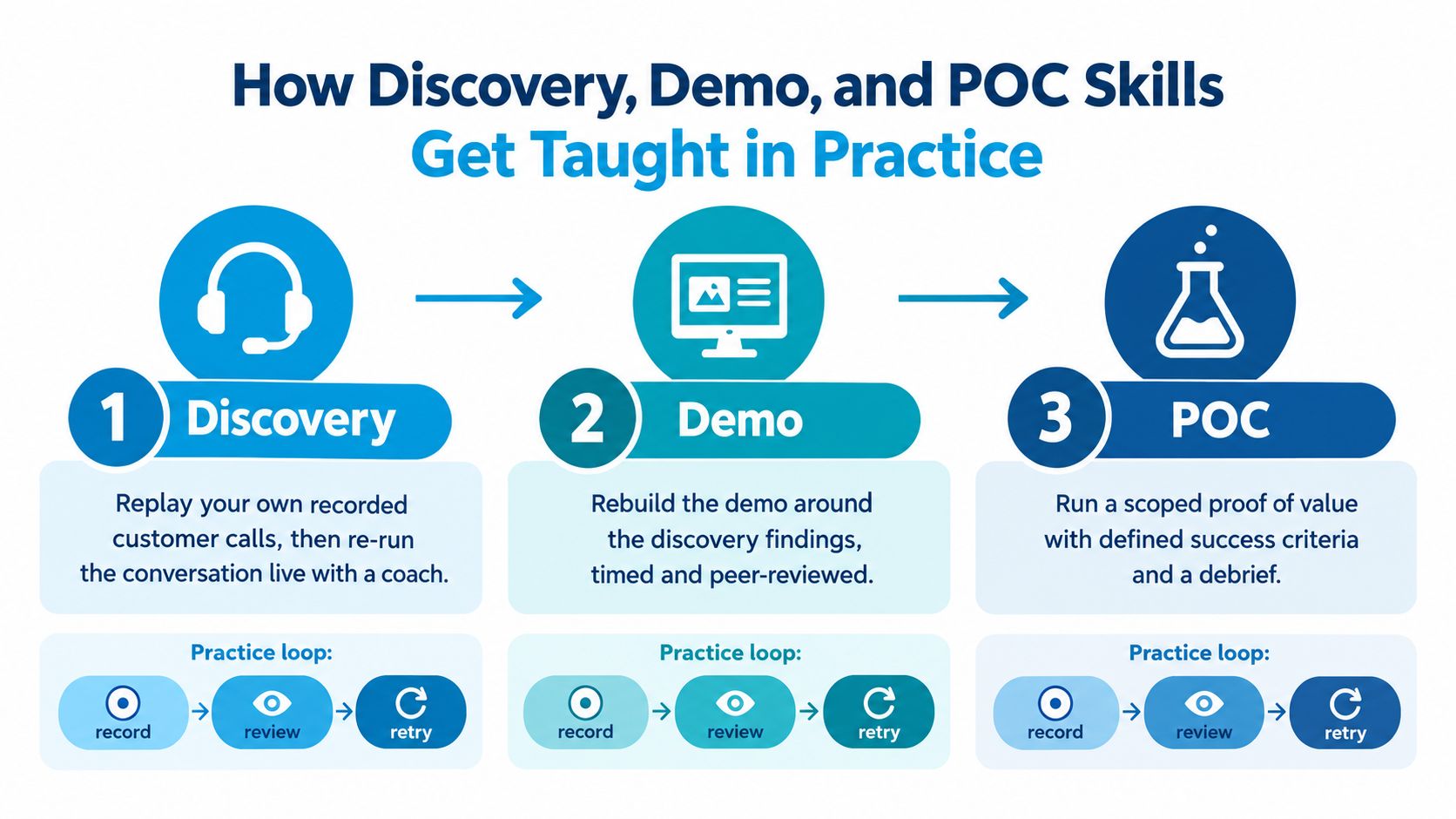
Skill practice should follow the order in which buyers experience the deal. Start with discovery, use its findings to build the demo, then turn the agreed outcomes into a controlled proof. Training that teaches these activities as separate subjects misses the handoffs between them.
Discovery practice
Begin with a recorded customer call. The SE should mark every question, identify where the buyer offered a useful clue, and note where the conversation moved toward a demo too early. Self-review is more productive when the rep has a defined rubric rather than a vague instruction to “be more consultative.”
Then rerun the conversation. A peer or coach plays the buyer and introduces incomplete answers, competing priorities, or an unexpected stakeholder. The SE practices surfacing pain, testing the cost of inaction, clarifying decision criteria, and confirming urgency before proposing a technical path.
Demo practice
The first part of the demo deserves more attention than the click path. The SE should rehearse a concise opening that reflects the buyer's language, states the relevant business problem, and sets an agreed agenda.
Use a neutral demo environment so the rep can't hide behind perfect data or a memorized sequence. Introduce branches such as an integration question, a security concern, or a request to see a feature that wasn't planned. Score the SE on narrative control, listening, relevance, and recovery, not on how many screens they visit.
SEs who need a focused drill can use this guide to demo skills training as a reference for structuring practice around real presentation behavior.
POC practice
A proof of concept should begin with written success criteria, a defined timeline, named owners on both sides, and weekly check-ins. One source recommends keeping most software POCs to four weeks maximum and including a midpoint review. This POC guidance offers a practical structure for exposing blockers before the final decision.
Train the POC through a kickoff simulation, a stakeholder review, and a debrief. The SE should explain what will be tested, what won't be tested, how evidence will be captured, and what decision follows from each result. That is proof architecture, not product demonstration.
Workshops vs Continuous Enablement
Workshops are useful for alignment. They introduce a new product, establish shared language, and give a team a common starting point. The mistake is treating that starting point as a finished training program.
| Two-Day Workshop | Continuous Blended Enablement |
|---|---|
| Concentrates learning into an event | Spreads learning across the deal cycle |
| Relies heavily on presentation and handouts | Uses modules, role-plays, call reviews, and coaching |
| Measures attendance and completion | Measures observable behavior and technical wins |
| Creates a shared baseline | Builds individual capability over repeated cycles |
| Often sits outside live selling | Runs inside active opportunities |
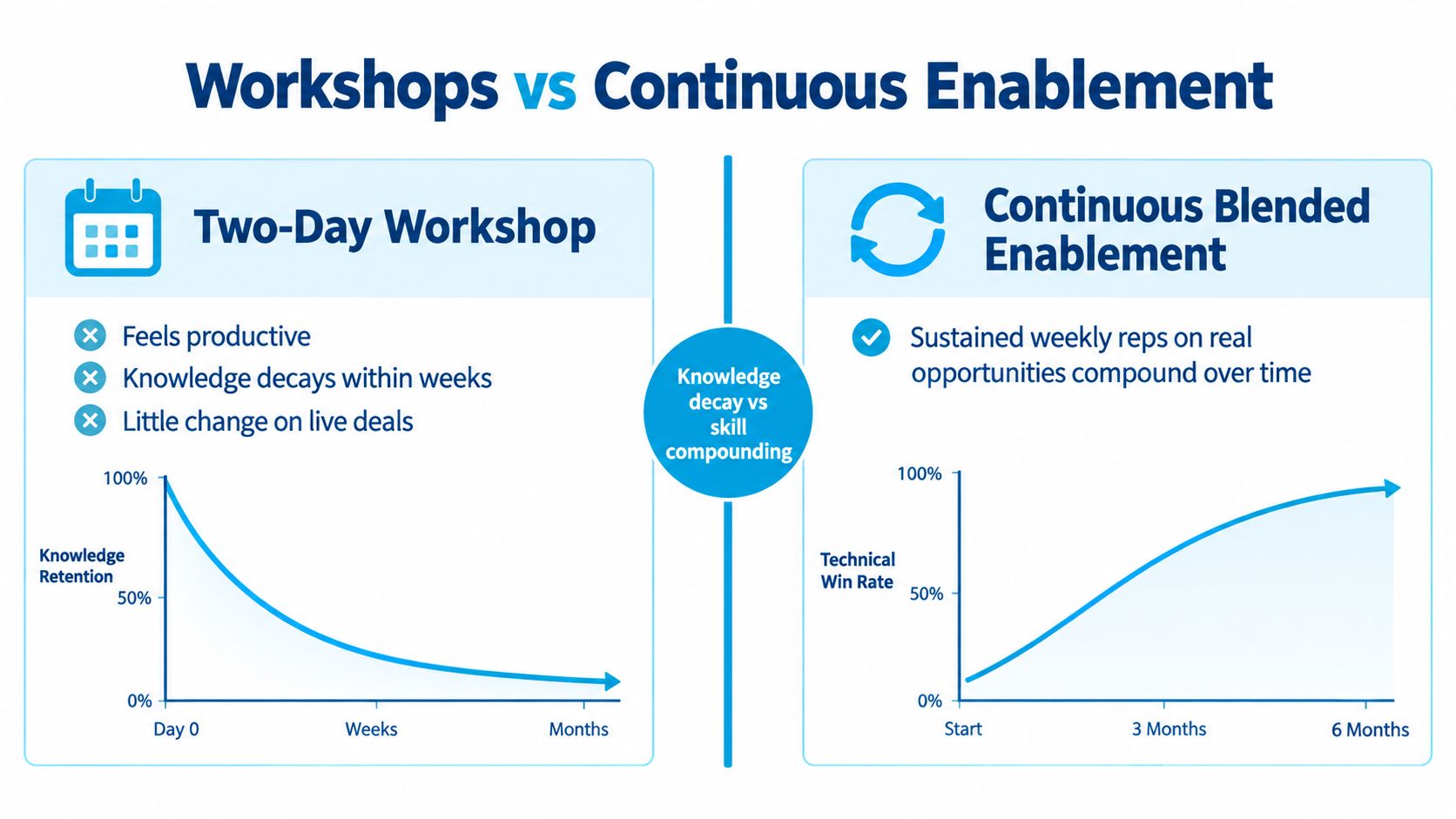
Distributed practice is a better fit for complex SE skills than compressed instruction. A meta-analysis covering 317 experiments and 839 tests found that distributed practice is more effective than massed practice, with spacing intervals widening as the desired retention horizon grows. The analysis of spacing effects supports a cadence that revisits discovery, demo storytelling, and objection handling over time.
Continuous enablement can include:
- Self-paced modules: Give SEs concise preparation before a call, demo, or POC milestone.
- Weekly role-plays: Rehearse the behavior that the current pipeline exposes as weak.
- Live deal coaching: Review actual opportunities and define the next behavior to test.
- Monthly call reviews: Inspect whether the practice is appearing in customer conversations.
- Quarterly assessments: Revisit competency against deal-stage expectations.
A workshop creates a burst of attention. Continuous enablement creates repeated retrieval, feedback, and application. That difference matters because deal pressure always wins unless the program reinforces a better response inside the work itself.
Teams looking for a practical cadence can use this guide to a spaced-repetition schedule when designing refreshers around active opportunities.
A Quarter in the Life of an SE on a Real Program
Consider a representative SE entering a structured quarterly development cycle. The program doesn't remove the rep from live selling. Each milestone attaches a new skill to real customer work.
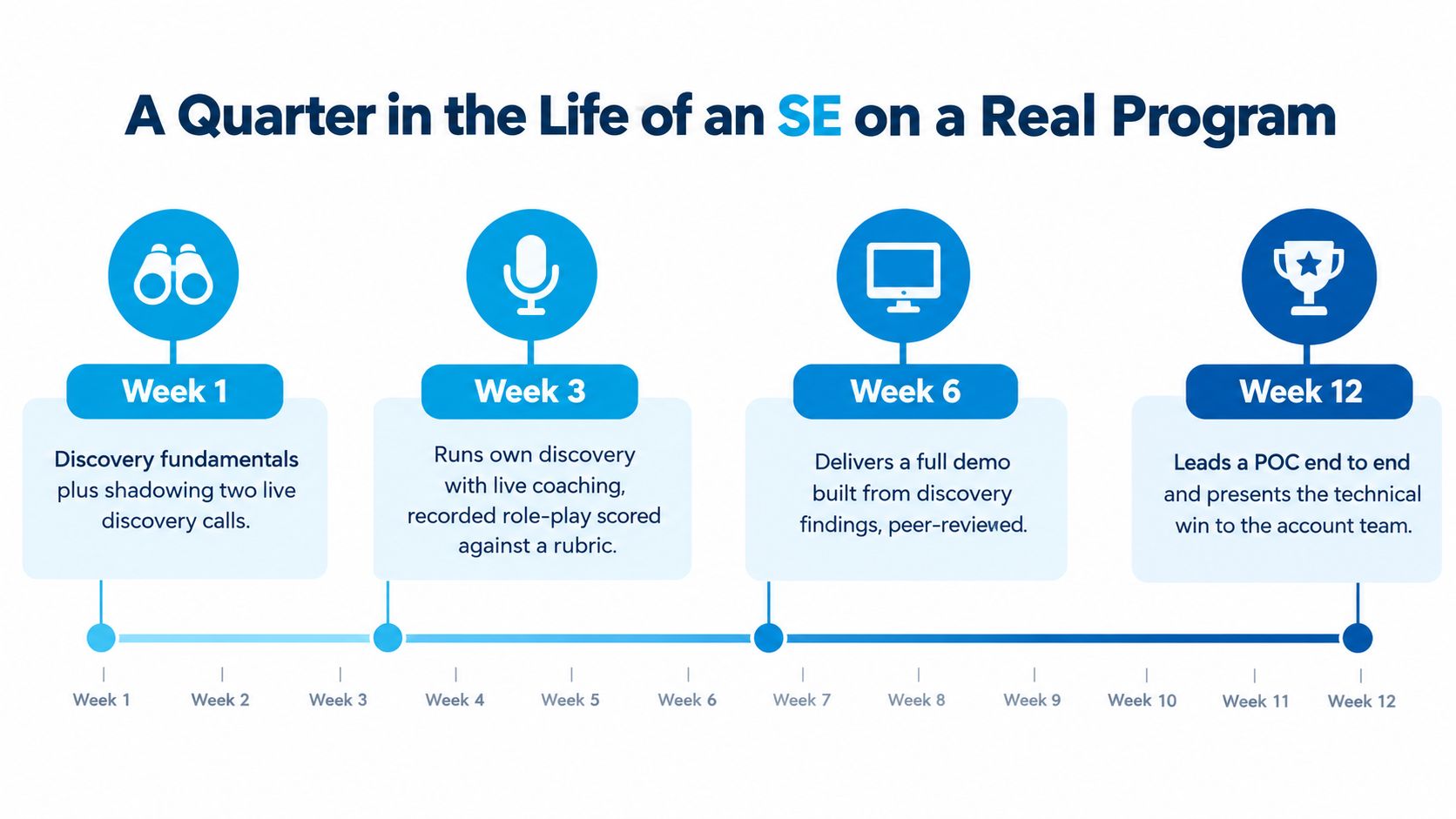
In week one, the SE learns the discovery framework and shadows two live discovery calls. The review focuses on what the senior SE asked, what they left alone, and how they decided whether a demo was warranted.
By week three, the SE runs discovery with live coaching. The call is followed by a recorded role-play scored against a rubric. The coach doesn't say “ask better questions.” They identify whether the SE uncovered business pain, technical constraints, decision ownership, and urgency.
Month two shifts to the demo
The SE builds a timed demo from discovery findings rather than from a standard feature tour. A senior SE introduces three live objections, and the review examines whether the rep listens, clarifies, and returns to the buyer's stated decision criteria.
The certification standard should be behavioral. Can the SE change the path without losing the story? Can they explain a limitation? Can they connect technical detail to the outcome the buyer said mattered?
A useful onboarding reference is this sales onboarding program guide, particularly for teams that need to connect formal onboarding with field execution.
The final phase adds POC ownership. The SE defines success criteria, names owners, runs kickoff, conducts weekly stakeholder reviews, and documents the evidence required for a decision. A coach watches the operating rhythm rather than taking over the work.
The quarter closes with a deal review involving peers and the SE leader. They diagnose the technical win on a real opportunity, then set two measurable behavior targets for the next 90 days. The cycle repeats, with each pass tied to sharper execution rather than another content completion badge.
What SE Leaders Need to Run Training That Sticks
The SE leader should own technical sales training. L&D can provide delivery expertise, product marketing can supply accurate materials, and sales leadership can set commercial priorities. But the person closest to technical win decisions must decide which behaviors matter, how they'll be practiced, and whether they appear in live deals.
A program needs operating rhythms, not occasional enthusiasm.
Weekly deal review
Use the weekly review to inspect skill gaps inside active opportunities. Ask:
- Discovery evidence: What buyer problem has the SE confirmed, and what remains assumed?
- Technical fit: Which architecture, integration, security, or compliance constraint could block adoption?
- Stakeholder coverage: Who can approve, block, influence, or fund the decision?
- Next behavior: What will the SE do differently on the next customer interaction?
The artifact is a short coaching record tied to the opportunity. It should name the behavior, the next call where it will be tested, and the evidence the manager expects to see.
Monthly enablement clinic
Choose one live scenario, such as an executive demo, a security objection, or a POC midpoint review. One SE runs the scenario while peers critique the customer relevance, technical clarity, stakeholder framing, and recovery under pressure.
The clinic should produce an improved talk track, question set, or decision checklist. If it ends with discussion but no reusable artifact, the team has held a meeting rather than built enablement.
Quarterly competency assessment
Assess skills against deal-stage performance, not abstract knowledge. A discovery competency should show up in discovery notes, stakeholder alignment, and demo qualification. A POC competency should show up in written success criteria, ownership, cadence, and decision evidence.
The assessment should produce a personal development plan with a small number of behaviors. Avoid scoring every possible skill at once. Leaders need a clear view of the next constraint on performance.
Rolling call and demo library
Tag recorded demos and calls by persona, objection, deal stage, and skill. The library should contain examples of recovery and judgment, not only polished top-performer performances. A perfect demo teaches less than a strong response to a difficult buyer interruption if the team is learning how to adapt.
The metrics should connect consumption to application. Track whether the rep used the skill in a live opportunity, whether the manager coached it, and whether technical win evidence improved over time.
Choosing or Building a Technical Sales Training Program
Choose a program based on operating capacity, not on how impressive the curriculum looks. The right question isn't whether the vendor has enough modules. It's whether your team can turn those modules into repeated practice, coaching, and evidence from live deals.
Start with three questions:
- Do you have a documented competency model? If not, begin with the behaviors expected at discovery, demo, POC, and technical close stages.
- Can the SE leader dedicate six hours a week to designing and running enablement? If not, a fully internal academy may become another abandoned initiative.
- Do you have a measurement loop connected to deal data? If not, define technical win evidence before selecting content.
The answers point toward three practical paths:
- Vendor-led: Use an external program when you need structure, expertise, and recurring practice without building the operating system internally.
- Hybrid: Combine external content and frameworks with internal deal coaching, product labs, and manager-led assessments.
- In-house academy: Build internally when leadership has the time, coaching skill, documented standards, and reporting discipline to sustain it.
The global sales training market was valued at $40.3 billion in 2022 and is projected to grow at a 6.2% compound annual growth rate from 2023 to 2030, according to the cited market overview. That investment only matters when training changes what SEs do with buyers. This week, audit one recent discovery call, one demo, and one POC, then choose whether your gap is content, practice, coaching, or measurement.
PreSales Unleashed GmbH offers the Trusted Advisor Academy, a year-round PreSales program combining on-demand lessons, live practice, deal sparring, role-plays, and coaching for active opportunities. If your team needs technical sales training that connects discovery, demos, POCs, and technical win measurement, visit PreSales Unleashed GmbH to review the program and start a capability conversation.