
The advice you hear most about developing Solution Engineers is to get them into a community. A Slack channel, a monthly peer call, a forum where people trade demo war stories. It costs nothing to set up, so it spreads quickly, and six months later the channel is quiet and nobody can say whether it changed a single call.
That advice mistakes the container for the mechanism. Community-based education programs are a studied model with a specific design, and the evidence points at repeated practice with correction on real work, not at belonging to a group. The group is how the practice happens. It's not why it works.
A community is a delivery mechanism for practice. It isn't a substitute for it.
What Community-Based Education Programs Are
Community-based education programs are learning offers run close to the people who use them. Local members design or adapt the content, the group manages how it runs, and the curriculum answers the needs of that place rather than a national syllabus.
The model's roots are in second-chance schooling. Community learning centres grew from efforts to give literacy, vocational and life-skills education to youth and adults who had missed primary or secondary school. UNESCO's review of community learning centres shows how far that spread: centres operate in more than 24 Asia-Pacific countries and 10 Arabic-speaking countries, with an estimated total above 170,000 centres across Asia and the Pacific.
The format is small by design. This is what a learning circle looks like in practice.

Three features define the model, and each one has a counterpart in a PreSales team:
- Content adapted to local conditions. UNESCO describes centres that communities manage themselves, adjusting activities to local economic, social and environmental needs.
- Participants teach and support one another. The expertise sits in the room, not only at the front of it.
- It complements formal systems rather than replacing them. Community learning sits alongside schooling and employment, filling what those systems don't reach.
Take a hypothetical neighborhood group that wants a flood-readiness class. The community-based version doesn't import a national emergency curriculum wholesale. It starts from the drainage problems on those streets, uses materials residents already have, and builds the drill around routes people walk. That habit is the transferable part.
Community-based means locally owned and locally adapted. Free and informal are not the definition, and that distinction governs every choice that follows.
How Community Programs Differ From Classroom and Workshop Training
The three formats look interchangeable on a calendar invite. They behave very differently when you ask what a learner can do six weeks later.
| Dimension | Community-based program | Classroom course | One-off workshop |
|---|---|---|---|
| Who designs the content | Local group adapts it to real work | Instructor or institution sets it | Presenter or vendor sets it |
| Schedule | Recurring over months | Fixed term or modules | Single event or one day |
| Source of feedback | Peers and facilitators on live work | Instructor and graded tasks | Often none after the session |
| Learner role | Contributes and teaches peers | Receives instruction | Listens and takes notes |
| How success is judged | Observed behavior and peer review | Test or assignment results | Satisfaction scores |
| Durability of learning | Builds through repeated practice | Depends on course follow-up | Fades without reinforcement |
What each row means in practice
The first row decides who owns relevance. A classroom course fixes the content up front and asks the learner to absorb it. A community program lets the group adapt the material to the work in front of them, so the agenda shifts as deals shift.
The second row decides whether learning survives a busy month. One event compresses everything into a day and then trusts memory. A fixed-term course spreads exposure but still ends. A community program keeps resurfacing the skill while the participant is applying it.
Feedback is where most programs fail. A peer or facilitator commenting on a live call corrects the specific thing that went wrong in a specific conversation. A graded assignment confirms you can answer questions about discovery. It doesn't tell you whether you asked a good one.
The learner role then flips from consumer to contributor, and teaching forces precision. Success follows from that: observed behavior and peer review, not a satisfaction score collected while the room is warm. Durability is the payoff, because repetition is the only mechanism in the table that holds a skill in place after kickoff enthusiasm fades.
The trade-offs you're accepting
Community formats cost more than they look. Someone has to hold the group together, participants give up an hour every week, and a group with no purpose drifts into a support forum within a month. A course or workshop is easier to schedule and easier to cancel.
Rule of thumb: use a community format when the skill has to show up in daily work and the group faces the same problem. Use a course when the content is fixed and foundational. Book a workshop when awareness is all you need.
What the Research Says Community Learning Delivers
The strongest result in the community-learning literature is about people, not money. A systematic review of 122 community-based learning studies, covering multiple regions and delivery models, found the most consistent gains in personal and social outcomes: self-efficacy, agency, self-regulation, teamwork, leadership, trust and civic engagement.
Vocational outcomes were more conditional. Employability, entrepreneurship and financial-literacy gains were stronger when programs combined mentoring, market linkages and authentic work-based projects, and weaker when delivery cycles were short or employers stayed out of the process.
| Outcome type | Examples | Strength of evidence | When it shows |
|---|---|---|---|
| Personal and social | Self-efficacy, agency, self-regulation, teamwork, leadership, trust, civic engagement | Most consistent gains across the review | Within the program cycle |
| Vocational | Employability, entrepreneurship, financial literacy | Conditional on mentoring, market linkages, real work projects and employer involvement | Longer, depends on delivery design |
| Proximal PreSales | Confidence, behavior in live calls, peer collaboration | Inferred for PreSales; the review didn't test this setting | First, within weeks |
| Distal PreSales | Technical win rate, pipeline, revenue | Inferred; affected by factors a program doesn't control | Quarters, not weeks |
Where the evidence is strong and where it thins out
The review separates proximal outcomes, meaning confidence, behavioral practice and peer collaboration, from distal ones such as employment or revenue, and recommends measuring both. Read that as guidance on promises. An SE program can credibly claim it will change how a Solution Engineer opens a discovery call, because that's the kind of outcome the evidence supports. It can't credibly claim a revenue number, because revenue depends on pricing, competition, procurement and timing that no peer group controls.
Three checks before you write the program charter:
- Name the outcome you're promising. Confidence and live-call behavior, or pipeline. Pick one as primary and be honest about which is which.
- Confirm the program carries real work and outside feedback. The vocational gains appeared where mentoring, market linkages and authentic projects were present. Strip those out and you're left with the weaker version of the format.
- Stop the claim where the evidence stops. "Better discovery conversations in eight weeks" is defensible. "Higher win rate" belongs in a hypothesis, not a slide.
For an SE team, that ordering is freeing. The part you control is the practice, and the practice is what the review says reliably moves.
Design Principles for a Working Community Program
A recurring meeting is only the container. To make community learning useful on real deals, give participants a clear practice to improve and a facilitator who keeps the work focused.
The checklist below turns purpose, rhythm, anchor and cost into practical design decisions.
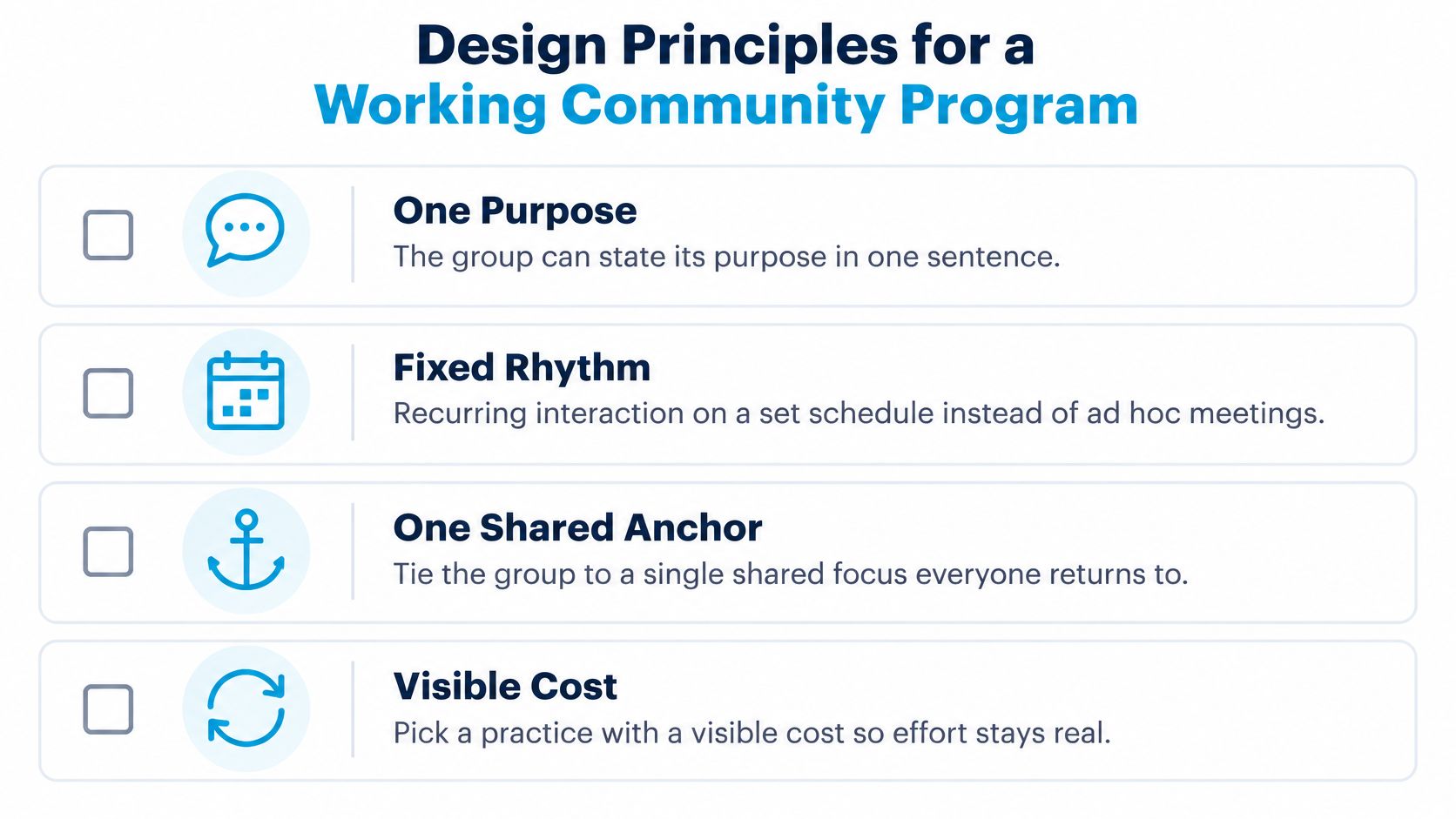
The seven-point checklist
- One purpose, one sentence. State what participants should do differently at work. “Improve how we scope POCs” gives the facilitator a way to choose relevant discussions and redirect unrelated ones.
- A fixed rhythm. Put recurring sessions in the diary so participation does not depend on someone arranging a meeting during a difficult week. Treat the schedule like a standing practice slot.
- One shared anchor with a visible cost. Choose a practice such as opening discovery calls or scoping a POC plan. Make the consequence of poor execution explicit, so participants understand why that practice deserves attention.
- Small working groups. Evidence-based professional-learning guidance from CALPRO describes an implementation using teams of three to ten members, with partner teams in different locations comparing how the same lesson went. Use that range as a starting point for participation, rather than a proven optimum for SE teams.
- Cross-group comparison. Have groups compare the same method across different accounts. Differences can expose contextual factors worth examining, but agreement between groups does not establish that the method caused an improvement.
- Every discussion tied to the target practice. An Institute of Education Sciences review reported changes toward student-centered teaching, cited a meta-analysis of five studies finding a small, statistically significant achievement effect, and described an evaluation where pedagogical knowledge improved but subject-matter knowledge did not. For SE leaders, the design lesson is specificity: keep discussion focused on the knowledge and practice you intend to develop.
- Structure for the facilitator. Define responsibilities, supervision and training. Give the facilitator a clear remit to keep discussion relevant and feedback focused on the shared practice.
What to leave out
- Long reading lists. Keep preparation tied to the target practice; reading completion alone does not show application.
- Open membership with no practice focus. Make the working purpose clear to anyone joining, so networking does not displace practice.
- A community that exists only as a chat channel. Use chat to support the work, while keeping an artifact participants can review, such as a POC plan.
For session design, the guide to sales enablement training explains how to sequence content against live practice.
How Peer Learning Turns Into Practice Change
The common mistake is treating peer learning as a conversation format. In PreSales, its real value is as a behavior-change mechanism. The mechanism is called spaced practice, and it is narrower than often assumed. Spaced practice means repeated encounters with the same content, deliberately separated by gaps of time. It is not repetition packed into one session, and it is not rereading notes. The strongest design combines low-complexity tasks first, progressively longer intervals between reviews, and performance feedback after each attempt. the Johns Hopkins evidence portfolio on spaced practice sets out that pattern clearly.
Those three design choices translate straight into a group rhythm.
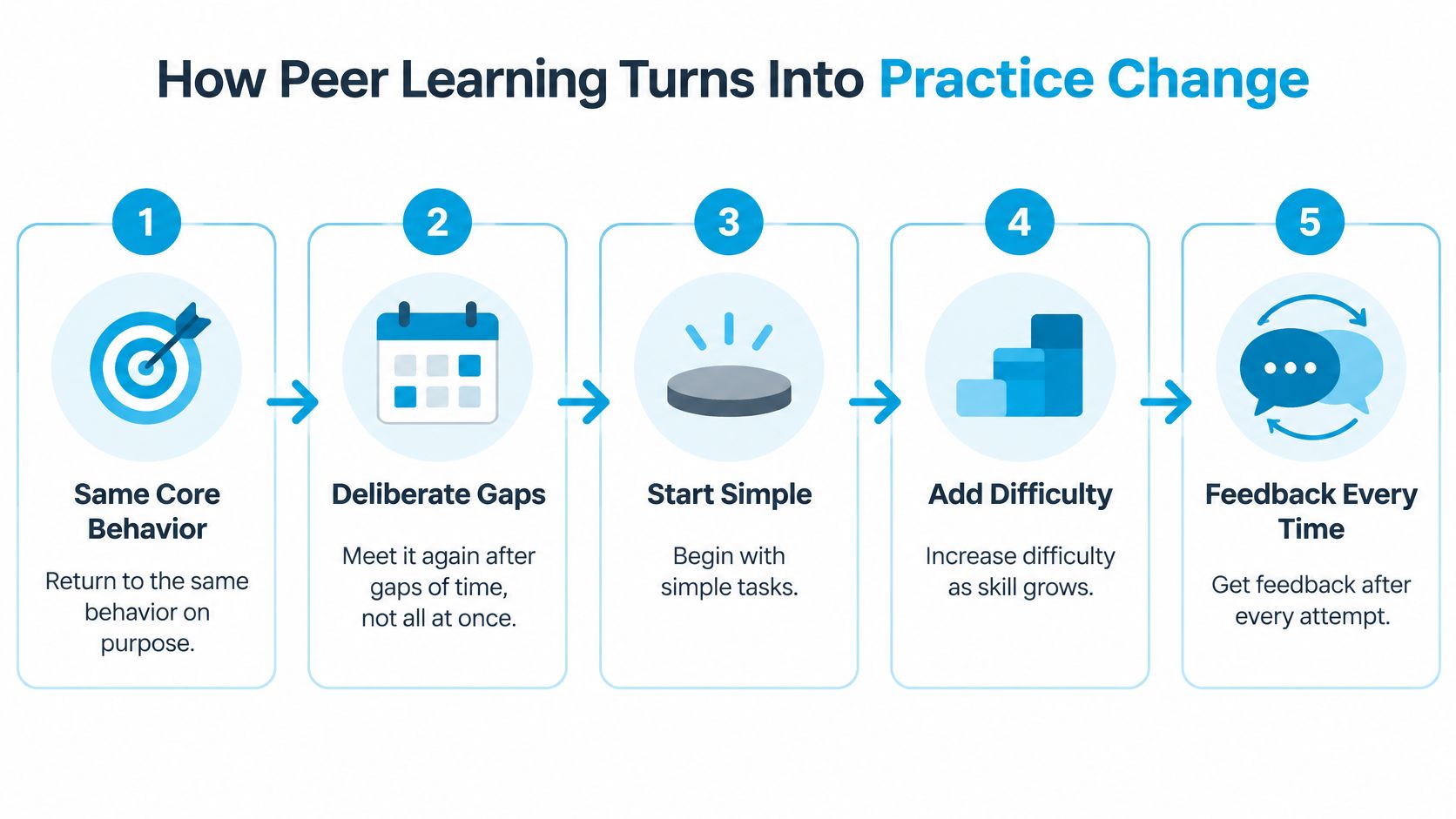
The cycle, step by step
- Pick one behavior. Framing a discovery question with the Pain Chain Framework, or opening a demo with the customer's stated problem.
- Attempt it on a real deal. Roleplays have a place, especially in the TRAIN pillar, where roleplays with expert feedback and pitch practice happen in a safe environment. The next test is the live call.
- Bring the attempt to the group. Give two minutes of context, then specific feedback on what question landed and what got skipped.
- Retry it on a different deal. Use a different account or stakeholder, with the same behavior, so the learner adapts instead of replaying a line.
- Revisit after a gap. Two or three weeks later, run the behavior again and compare the two attempts.
The group adds exposure, variety and correction. An SE who rehearses alone practices the version of the question they already believe in. An SE who brings it to peers hears where it sounded like an interrogation, where it missed the systemic problem, and where a stakeholder had already shifted the conversation.
That is the practical difference between practice and performance support. A lesson can explain the Discovery module, a video platform can show the model, and a badge can mark participation. Practice change happens when the SE tries the framing on a deal, receives feedback, and tries again with better judgment. The community works like a mirror with several angles. One peer notices the wording, another notices the stakeholder reaction, and another notices that the question skipped the business problem behind the requirement.
Here's how the cycle runs in a live session.
The caution that matters
A review of communities of practice in higher education reports that participation has been associated with increased professional learning and improved teaching practices, but it also cautions that empirical evidence remains scarce. That limit matters. A community is not effective because members exchange advice. It needs a defined purpose, recurring interaction, a shared practice problem and a way to see whether behavior changed.
The test of a peer group is the next real call, not the end-of-session survey.
Take a hypothetical new SE with three years of enterprise experience and a gap in pain qualification. She completes an assessment at onboarding, gets a personalized learning path aimed at Discovery and POC Management, and joins a weekly group where every member brings one live call. In an Enablement-as-a-Service program, new SEs start that continuous rhythm as soon as they join instead of waiting for a workshop cohort. The onboarding assessment sets the learning path. By week six, she has attempted the same framing on several accounts and heard different versions from colleagues. The result you want is a completed pattern of behavior: the framing shows up in her next real call, with less prompting and better questions.
For group design that supports that outcome, see why PreSales leaders need a peer group.
Measuring Whether the Program Changes Behavior
Rank measures before you pick one. The list below runs from weakest to strongest evidence that behavior changed.
| Measure | What it shows | Main limit | When to collect |
|---|---|---|---|
| Attendance and satisfaction | Participation and perceived value | Says little about behavior change | Every session |
| Pre and post knowledge check | Knowledge gain on the target topic | Knowledge doesn't guarantee use on the job | Start and end of each cycle |
| Observed live practice | Whether the skill appears in a real call or demo | Needs a rubric and a trained observer | Weekly or per session |
| Delayed follow-up review | Whether the behavior persists over time | Takes longer to collect | Several weeks after the cycle ends |
| Deal outcome metrics | Movement in technical win rate and pipeline | Confounded by many other factors | Quarterly |
Why attendance numbers mislead
Attendance and satisfaction are necessary and insufficient. A global systematic review of 67 school-based peer-education studies found that 35 studies (52.2%) reported effectiveness for peer learners, 8 (11.9%) reported mixed findings and 24 (35.8%) found limited or no evidence. Knowledge improvement was the most common positive result. Evidence for durable behavior change was weaker.
That gap should shape your scorecard. Run pre and post checks so you know the material landed, then add what the knowledge check can't tell you: an observed call scored against a rubric, a delayed follow-up several weeks later, and a comparison group if you can get one.
Fidelity checks belong here too. Confirm the program ran as designed before you interpret any result, because a weak outcome from a program that lost its facilitator, its rhythm or half its members tells you nothing about the model.
Deal outcomes deserve their own caution. Technical win rate moves for reasons a peer group doesn't touch: deal size, competitive pressure, a champion changing jobs. Treat it as a trend indicator, not proof, and choose the metric deliberately. This piece on the north star technical win rate covers how to select and read that number.
The two measures to start with
Start with observed practice on live work and a delayed follow-up review. The first tells you whether the skill shows up; the second tells you whether it stayed.
Everything else is context. If the observed call improves and the follow-up six weeks later holds, expand. If the observed call improves and the follow-up flattens, the problem is your reinforcement rhythm, not your content. For the manager side of that loop, this guide to sales coaching for managers covers how to run feedback so it changes the next call.
Start a Peer Learning Program This Quarter
Three moves this week, before you write a charter or pick a platform.
- Pick one practice with a visible cost. Use the discovery call guide to choose the stage that's costing you most right now, whether that's opening, pain qualification or next-step agreement. One stage, not three.
- Run one observed live call as a baseline. Score it with the same rubric you'll use at the follow-up, or the comparison later means nothing.
- Form one group and commit to a full cycle. Three to ten people, a fixed weekly slot, one practice. Change nothing until the cycle ends.
A hypothetical team of eight SEs might pick pain qualification, score a baseline call at two out of five, and meet every Thursday for twelve weeks with one live call per person per session. That's the whole program. The design work is in the constraint, not the content library.
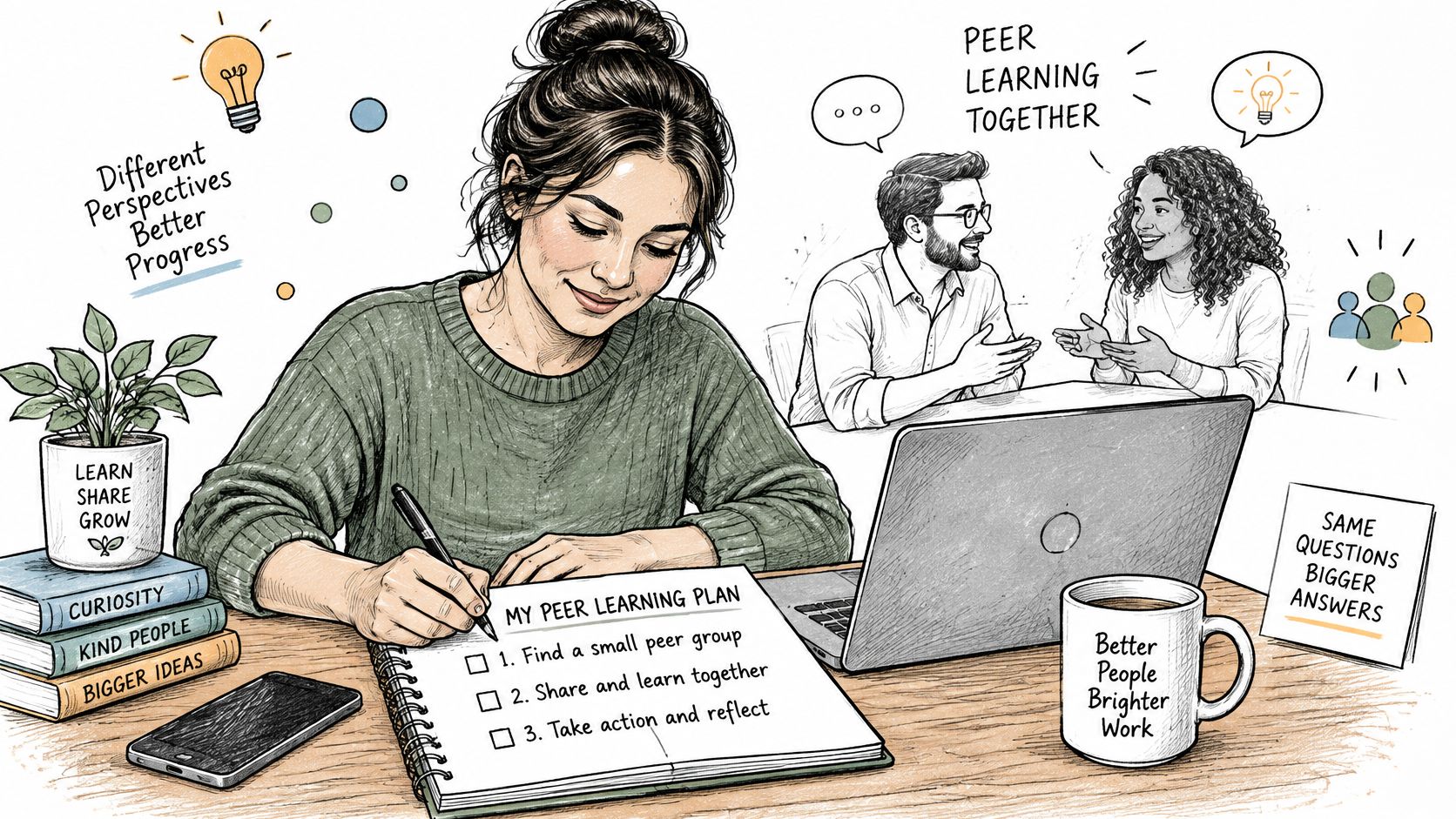
Build it or join one
Building internally gives you control over schedule, facilitators and practice focus. It also puts the setup work on your team, and the first cycle usually lands on whoever has the most energy rather than whoever has the time.
Joining an existing program trades some of that control for a rhythm that already runs across the year and for comparison with peers at other companies. Check the practice focus before you commit, because a group working on demo craft won't fix a discovery problem.
Two routes a PreSales leader can weigh against the checklist in this guide: the Enablement-as-a-Service program behind the Trusted Advisor Academy, which runs weekly touchpoints over a year with new content each quarter, and the PreSales community, which builds in cross-company benchmarking and tooling reviews.
One practice, one group, one quarter. Let the first observed call after that cycle decide whether you expand.
PreSales Unleashed GmbH runs the Trusted Advisor Academy, a twelve-month program built on exactly this mechanism: weekly live practice on live deals, on-demand lessons you can apply the same week, and a community of more than 100 SEs comparing notes across companies. If you'd rather test the model than debate it, take one real discovery call to your first session and see what the group does with it. Visit PreSales Unleashed GmbH to see how the Academy fits a team that wants behavior change it can point at.