
Most advice about sales coaching for managers starts with “coach more often.” That's incomplete. If your weekly one-to-one is mostly forecast accuracy, deal strategy, CRM hygiene, and next steps, you're running a deal review with a coaching label.
For Solution Engineers, that mistake is expensive. The technical win depends on behaviors you can observe: whether an SE connects business impact before technical depth, whether a demo answers the buyer's problem, and whether a POC has mutual success criteria. Those behaviors don't change because a manager asks, “How's the deal going?”
A useful coaching system separates pipeline inspection from behavior change. You inspect evidence, ask the SE to diagnose the moment, rehearse a better move, and follow up in a real customer interaction. The operating model below is designed for SE and AE dynamics, where technical judgment, discovery, demo control, and evaluation discipline decide whether an opportunity advances.
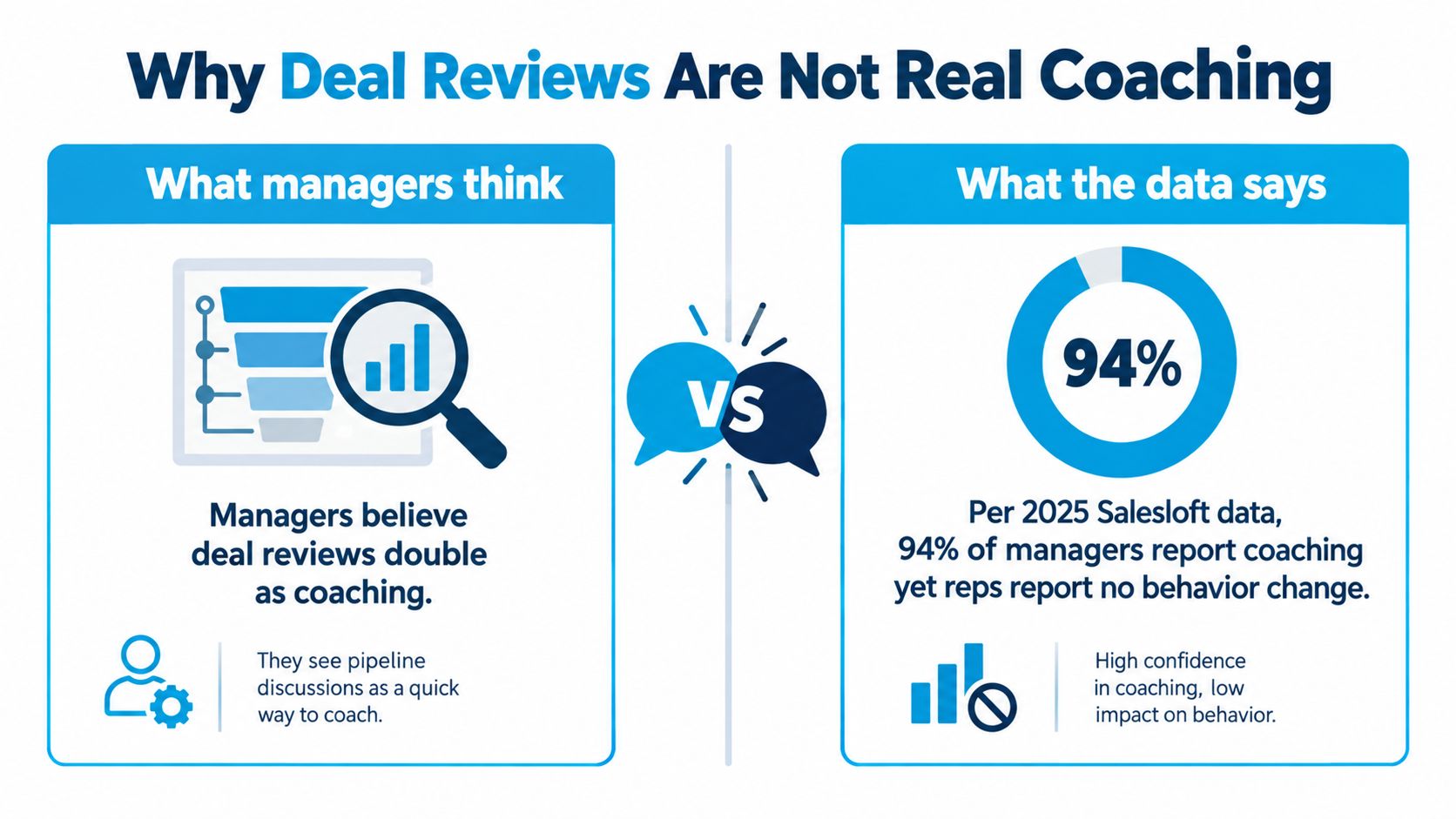
Why Deal Reviews Are Not Real Coaching
The most common coaching failure is also the easiest to miss. A manager leaves a one-to-one believing they helped. The SE leaves with updated deal notes, a clearer forecast, and no specific behavior to apply on the next call.
The perception gap is documented. In a 2025 Salesloft survey, 94% of managers said coaching was part of their process, while 53% of sellers reported receiving coaching only quarterly or less, 37% rarely or never received personalized feedback, and only 21% considered their coaching effective. Salesloft's research on 2025 skill gaps frames the issue clearly: scheduling conversations isn't the same as delivering individualized coaching.
The difference is observable
A deal review answers questions such as:
- What changed: Has the buyer confirmed the timeline?
- What's blocked: Is procurement slowing the opportunity?
- What's next: Has the AE scheduled the technical validation?
- What's at risk: Are the decision process and competition understood?
Those questions matter. They don't coach an SE.
Coaching starts with one observable behavior tied to a live opportunity. You listen to a discovery recording, inspect the CRM opportunity, or review customer feedback. Then you ask the SE to explain what they noticed before you offer an opinion. The output is narrow: one behavior change and one measurable action before the next relevant interaction.
Practical rule: If the meeting ends without a behavior, an action, and a follow-up date, it was a review, not coaching.
This distinction matters in PreSales because technical competence can hide weak selling behavior. An SE may explain architecture accurately while missing business impact. They may deliver a polished demo that never answers the buyer's stated problem. They may agree to a POC without written success criteria because they want to be helpful.
Audit your own one-to-ones
Take the last few manager-SE meetings and classify every agenda item as either deal inspection or behavior coaching. If most of the time went to forecast, status, and internal coordination, don't add more meetings yet. Change the purpose of the existing time.
A manager should leave the deal review with a decision and the coaching conversation with a test. For example: “On the next discovery call, ask the economic-impact question before explaining the integration.” That's concrete enough to observe and specific enough to revisit.
The Weekly and Monthly Coaching Operating Model
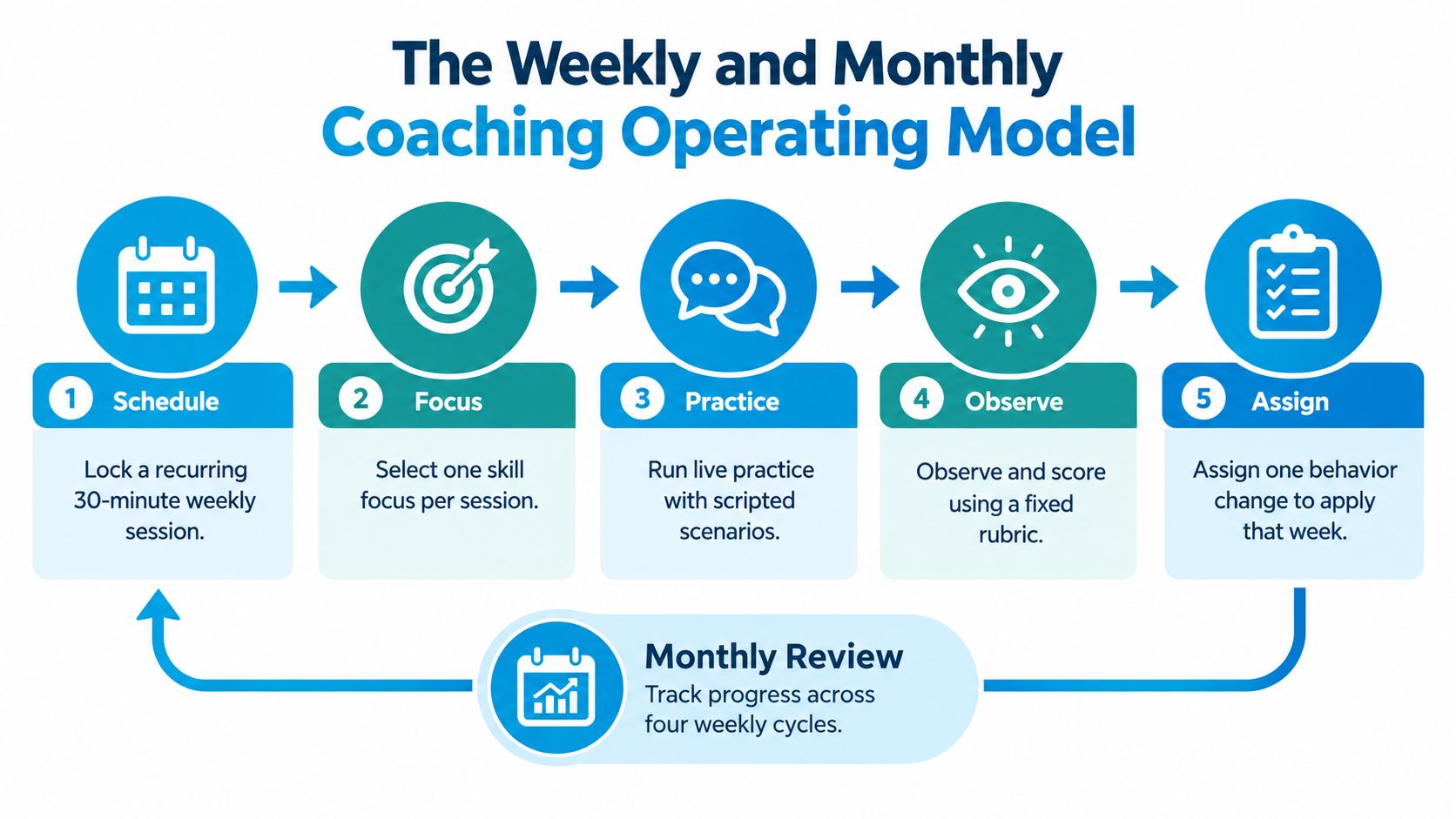
Protect a recurring 30-minute weekly coaching session for each SE. Keep pipeline inspection elsewhere. Mixing the two invites urgent deal noise to consume the entire conversation.
The weekly session follows five moves:
- Select one behavior. Choose qualification, discovery, proposal design, demo navigation, technical validation, or POC discipline. Never coach an entire methodology in one sitting.
- Inspect evidence. Bring a call recording, CRM opportunity data, or customer feedback. Work from what happened, not from memory.
- Ask for self-diagnosis. Start with, “What did you notice?” Then ask what the buyer did immediately afterward.
- Demonstrate and rehearse. The manager models a stronger response. The SE practices it against a realistic buyer reaction.
- Commit to one change. Write the behavior, the next opportunity where it applies, and the follow-up date.
A peer-reviewed sales-management paper on feedback and role-modeling identifies quality feedback and imitative role-modeling as central manager practices. Advice alone is weak. Demonstration followed by rehearsal gives the SE something they can reproduce under pressure.
Use the monthly review for patterns
Run a monthly performance review across the weekly cycles. Don't replay every conversation. Look for recurring patterns across SEs and opportunities:
- Discovery questions stay technical and never reach business impact.
- Demos follow a product sequence instead of the buyer's priorities.
- POCs start before stakeholders agree on measurable success.
- Managers give feedback but don't document whether the SE applied it.
The monthly review should produce a team-level decision, such as adding a discovery role-play, changing the observation rubric, or pairing an AE and SE for deal sparring. It should not replace the weekly behavior loop.
For managers building the wider operating rhythm, this playbook for orchestrating a PreSales team provides useful context on direction, cadence, and coverage. For broader leadership development, the benefits of manager training programs are a helpful reference when you're deciding how to prepare managers to coach rather than inspect.
A manager who wants to improve should put the first session on the calendar, choose one live opportunity, and bring one piece of evidence. Don't wait for a perfect scorecard.
What to Coach by Deal Stage
Coaching changes by stage because the buyer's risk changes by stage. Discovery creates relevance. The demo proves relevance. The POC tests whether the proposed solution can meet agreed success criteria.
Use this table to keep the coaching target narrow:
| Stage | Observable Behavior | Evidence to Inspect | Self-Diagnosis Prompt | Common Manager Mistake |
|---|---|---|---|---|
| Discovery | Connects business impact before technical depth | Call recording, discovery notes, stakeholder map | “Where did you establish why this problem matters before discussing how the product works?” | Coaching the SE to ask more questions without examining question quality |
| Demo | Answers the buyer's problem instead of performing the product | Recording, agenda, buyer questions, follow-up notes | “Which part of the demo directly answered the buyer's stated priority?” | Reviewing feature coverage or delivery polish instead of buyer relevance |
| POC | Uses a mutual evaluation plan with written success criteria | POC plan, technical requirements, stakeholder confirmation | “Could the buyer and our team describe success in the same words?” | Treating technical completion as proof of a technical win |
Discovery
Coach the moment before the SE goes technical. Did they establish the business consequence, affected stakeholders, and desired change? A technically accurate question can still be weak if it doesn't reveal why the buyer should act.
Use the discovery call guide to make the review specific. For deal qualification, the MEDDPICC guide for Solution Engineers helps connect technical evidence to the wider buying process. The manager's job is to make those ideas visible in a real call, not to quiz the SE on terminology.
Demo and POC
A demo should answer a buyer problem, not reward the SE for covering screens. Ask the SE to identify the buyer statement that justified each part of the flow. If they can't, the demo probably drifted into product performance.
POC coaching needs even more discipline. Inspect whether the plan names the buyer's success criteria, owners, dependencies, and decision path. If the SE is carrying an open-ended technical experiment, coach them to stop and renegotiate the evaluation.
The outcome PreSales owns is the technical win, not a flawless presentation. That means stage coaching must always connect behavior to opportunity progression.
Live Practice Facilitation and Observation Templates
Live practice only works when the manager observes the same things every time. A loose role-play produces opinions. A fixed observation template produces evidence.
Start before the call or rehearsal.
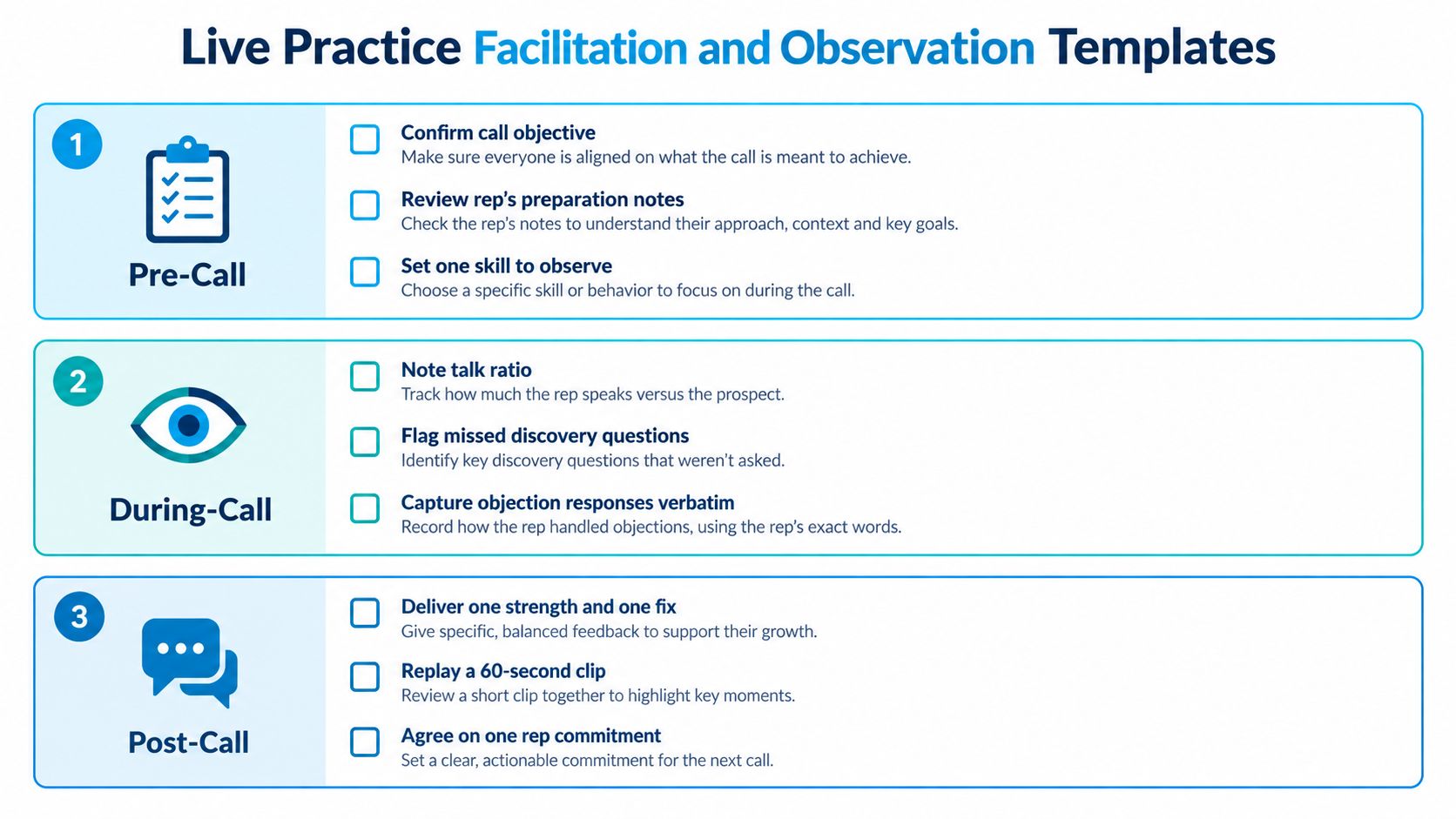
Pre-call checklist
Ask the SE to write three lines:
- Call objective: What must be true by the end?
- Buyer hypothesis: What problem, impact, or concern are you testing?
- Skill focus: What single behavior will the manager observe?
If the SE says the objective is “run a good demo,” stop there. Rewrite it as a buyer outcome, such as confirming whether a specific workflow addresses the stated operational problem. The skill focus might be asking one business-impact question before showing the technical path.
During the interaction
The manager shouldn't interrupt unless the session is explicitly a live coaching exercise. Capture two timestamps:
- Strong moment: Where did the SE use the target behavior effectively?
- Default behavior: Where did the SE revert to the old habit?
Add the buyer response beside each timestamp. “SE explained the integration clearly” is incomplete. “SE explained the integration before confirming the business impact, and the buyer asked for a feature list” gives you something to coach.
Post-call debrief
The SE speaks first. Ask:
- “What outcome did you get?”
- “Where did you use the behavior we selected?”
- “Where did you revert to your default?”
- “What will you repeat on the next call?”
Then give one strength and one correction. Role-model the correction, have the SE repeat it, and agree on the next live opportunity where you'll look for it.
Sample phrasing:
Manager: “At 18:40, you answered the architecture question before confirming what risk the buyer was trying to reduce. What did you notice?”
SE: “I went straight to the technical answer.”
Manager: “Right. Next time, ask, ‘What decision will this answer help you make?’ Let's rehearse that twice, then use it in the next validation call.”
This is feedback the SE can apply. “Be more consultative” isn't.
A short recording review can support the conversation, but don't turn playback into passive viewing. Pause at the exact moment, ask for diagnosis, demonstrate the alternative, and test it immediately.
KPI Architecture That Proves Coaching Works
Most coaching dashboards count activity. They show completed sessions, attended workshops, and submitted forms. Those figures can confirm that a program exists. They can't prove that an SE changed behavior.
Use two layers.
Leading indicators show whether the loop is working
Track the artifacts already created during coaching:
- Coaching completion: Did the scheduled session happen with evidence attached?
- Behavior adoption: Did the SE apply the agreed behavior in a relevant customer interaction?
- Qualified-opportunity rate: Are opportunities entering technical work with clearer qualification?
- Stage conversion: Are opportunities progressing after the coached behavior appears?
The manager should record the observed behavior, agreed change, evidence source, and follow-up date. A structured-coaching report found that 72.8% of effective companies used coaching when knowledge transfer was important to job success, compared with 40.4% of ineffective companies. The structured sales-coaching process report also emphasizes accurate performance records and comparison with defined standards.
Lagging indicators confirm commercial impact
Pair those leading measures with:
- Technical win rate
- Quota attainment
- Forecast accuracy
- Opportunity progression
Don't coach directly to the lagging number. If technical win rate drops, you still need to identify the behavior that contributed to the miss. A revenue result is too late and too broad to tell an SE what to do differently on Thursday.
Measurement rule: Record the behavior first, then track the business result. Otherwise, you're explaining outcomes without learning from causes.
A dashboard should let a CRO see both sides: whether managers are completing meaningful coaching and whether coached behaviors appear in live opportunities. Sales reporting for SMEs offers useful context for organizing performance data and insights without reducing the review to a single number.
For practical examples of reporting structures, KPI reporting examples can help you turn coaching records into a repeatable leadership view. Keep the dashboard small. If managers can't maintain the evidence, the measurement system becomes another deal-review burden.
What AI Handles and What the Manager Owns
AI shouldn't replace the manager in sales coaching. It should remove repetitive observation work so the manager can spend more time on judgment, rehearsal, and difficult conversations.
A 2025 experimental study involving 244 and 310 sales professionals found that concrete, low-level guidance from a manager improved sellers' self-efficacy and willingness to use the coaching. The same style was less effective when delivered by AI because participants perceived AI as more distant. The study details support augmentation, not substitution.
| Coaching Task | AI Suitable | Human Required | Escalation Criterion |
|---|---|---|---|
| Find missed discovery questions | Yes, as a first-pass call analysis | Interpret whether the missed question mattered to the buyer | Escalate when the call involves sensitive customer or performance context |
| Summarize recurring call patterns | Yes, across recordings and notes | Select the one pattern worth coaching | Escalate when the summary conflicts with customer evidence |
| Suggest role-play prompts | Yes, for routine practice | Adapt the scenario to the account and SE's judgment gap | Escalate when the practice involves executive politics or trust risk |
| Flag POC-plan gaps | Yes, against defined fields and criteria | Decide whether the evaluation should proceed | Escalate when success criteria or ownership remain disputed |
| Deliver consequential performance feedback | No | Manager owns the conversation and follow-up | Escalate through the people-management process when required |
Set boundaries before connecting tools
Get consent for recording and analysis. Define who can access transcripts, how long they're retained, and which decisions may not rely on automated scoring alone. Tell SEs what the system measures and what it doesn't measure.
Don't reward shallow metrics. Talk-time, keyword density, script adherence, or the number of questions asked can all be useful signals, but none proves buyer relevance. An SE can ask many questions and still fail to uncover business impact. An SE can follow a demo script and still miss the decision criteria.
For PreSales leaders, AI may flag that a demo skipped a technical validation question or that a mutual action plan has no owner. The manager still decides whether the omission changed the deal and how to coach the SE without taking over the opportunity. AI in B2B sales is a leadership job, not a PreSales side project is the right operating stance.
A 90-Day Rollout and the Signal That Coaching Is Working
Don't redesign every manager ritual at once. Pilot the operating model, prove that the evidence is useful, and expand only after managers can sustain the behavior loop.
Days 1 to 30
Choose two pilot SEs. Lock the weekly session, separate it from pipeline inspection, and use one observation template. Start with live opportunities, not generic training scenarios.
The manager should document:
- The selected behavior
- The evidence reviewed
- The SE's self-diagnosis
- The demonstrated alternative
- The next action and follow-up date
Days 31 to 60
Add the KPI dashboard and stage-specific coaching focus. Review whether managers are tracking behavior adoption, qualified-opportunity rate, and stage conversion alongside technical win rate and forecast accuracy.
Use the team's evidence to identify one recurring gap. If discovery is weak, run a targeted practice session. If POCs drift, inspect evaluation plans. Don't respond to every problem with another workshop.
Days 61 to 90
Introduce live practice sessions across the team and add an AI-assisted call-summary layer if privacy, consent, and access rules are already defined. AI should surface patterns for managers to inspect, not issue final judgments about SE performance.
The single strongest signal is simple: an SE uses the agreed behavior in a real customer interaction without being prompted and can explain why it changed the conversation or outcome. That proves transfer. Attendance doesn't.
Know when coaching has reverted
You're back to deal reviews when:
- One-to-ones contain status updates but no observable behavior
- The manager never follows up on the agreed change
- Call recordings show no movement week over week
- The SE can repeat the coaching language but can't apply it live
Managers who want a clearer view of the role can use what a Solution Engineer does as a baseline for role expectations. When you evaluate training options, how to choose PreSales training helps separate isolated instruction from programs that include practice, reinforcement, and manager systems.
PreSales Unleashed GmbH offers the Trusted Advisor Academy for ongoing Solution Engineer development and the Trusted Leader Academy for SE managers, with structured content, live practice, coaching systems, and operating rhythms tied to active deals. Use the program if you need to systematize the manager side as well as individual SE capability.
The fix for weak sales coaching for managers isn't another calendar invite. On Monday morning, separate the pipeline review, choose one behavior from one live deal, inspect the evidence, ask the SE to diagnose it, rehearse the stronger move, and schedule the follow-up. That's how you turn coaching from a claimed activity into a field behavior.
PreSales Unleashed GmbH helps B2B SaaS teams build Solution Engineer capability through the Trusted Advisor Academy and gives SE leaders practical coaching systems through the Trusted Leader Academy. Visit PreSales Unleashed GmbH to see how structured practice, feedback, and deal-based enablement can support your coaching rhythm.