
In this hypothetical scenario, your SE team finishes a discovery workshop, returns to active deals, and opens the next customer calls exactly as before: a quick introduction, a product overview, then a screen share. The popular advice is to improve the course or add more content. You should first question whether anyone designed what happens after the workshop.
Why Most Sales Enablement Training Fades Before the Next Deal
Content delivered, attendance logged, behavior unchanged. That's the pattern to look for when training feels productive but customer conversations don't change.
For an experienced Solution Engineer (SE), knowing a discovery framework isn't the same as using it when an account executive promises a demo before you've met the buyer. You need to recognize the moment, negotiate the agenda, and ask a useful question without turning the call into an interrogation. A slide explaining discovery doesn't rehearse that decision.
The missing piece is repeated application
Start with a firm operating principle: no discovery, no demo. Discovery quality, not demo polish, decides deals. Your discovery call approach should establish the buyer's problem, business impact, and decision criteria before you choose what to demonstrate.
That doesn't mean refusing every meeting with incomplete information. It means using the opening conversation to earn the context you need rather than accepting a feature tour as the default.
Train the decision an SE must make under pressure, not merely the framework they should remember.
A practical spaced repetition schedule gives you a way to revisit that decision across different buyer situations. Repeating the same presentation isn't enough. The SE needs another attempt, a different objection, and feedback about what changed.
Start with a module audit
You need clear answers to three questions: what belongs in the program, which delivery model fits your team's workload, and what evidence would justify continuing it. Components, delivery choices, coaching, measurement, and a bounded team experiment should all support that decision.
Audit a current module before buying another:
- Practice: Does the SE rehearse the behavior before a customer call?
- Application: Is there a named live opportunity where they'll use it?
- Evidence: Will anyone inspect something beyond attendance?
If those answers aren't explicit, fix the transfer mechanism before expanding the curriculum.
What Sales Enablement Training Includes and Who Owns It
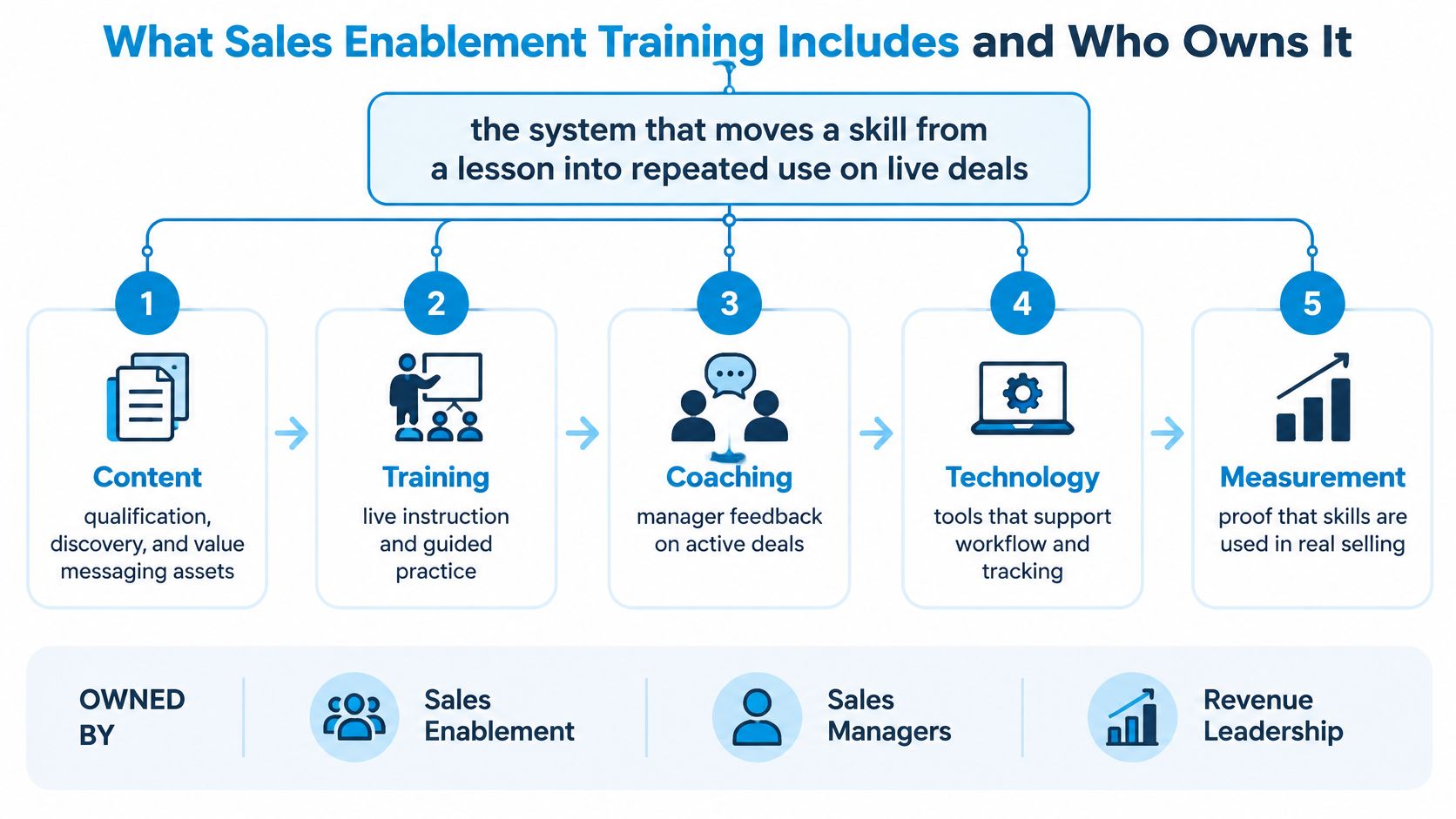
Sales enablement training is the system that moves a skill from a lesson into repeated use on live deals. In PreSales, that system should help you reach the technical win while protecting engineering capacity from poorly qualified work.
The components and their owners need to connect.
Build the complete operating system
-
Content comes first, but it needs a job. Put qualification criteria in a Qualification Playbook, discovery frameworks in a Discovery Playbook, and demo narratives in a Demo Playbook. Each should tell the SE when to act, what to ask, and what evidence to capture. If you use MEDDPICC, translate it into SE-specific qualification responsibilities, rather than another acronym test.
-
Practice happens before the next customer call. Use mock discovery calls and roleplays based on a current opportunity. Give the buyer a plausible reason to resist, such as wanting to see the product before discussing business impact.
-
Coaching examines actual execution. An SE manager or senior SE reviews a real call or demo against defined behaviors. Feedback should identify the moment to change and give the SE a better move to rehearse.
-
Tools and job aids support execution. Mutual evaluation plan templates, POC exit checklists, and discovery scorecards should sit with the opportunity. A template that nobody uses during deal preparation is inventory, not enablement.
-
Measurement connects actions to results. Track leading indicators such as early SE involvement alongside lagging indicators such as technical win rate and POC conversion. Assign ownership for definitions before collecting results.
Think of a flight simulator: a simulator without a debrief builds little judgment, and a debrief without simulator time has nothing to review. Practice and coaching need each other.
Assign owners, not volunteers
The Sales Management Association found that organizations with a formally named enablement function were 29% more effective at training salespeople than organizations without one. That finding is correlational, not proof that naming a function causes the improvement.
Who owns each component
| Component | Typical Owner | Evidence It Works |
|---|---|---|
| Content | Enablement function with SE managers as contributors | Playbook used on live discovery calls |
| Practice | SE managers and senior SEs | Roleplays logged before customer calls |
| Coaching | SE managers | Reviewed recordings scored against defined behaviors |
| Tools and job aids | Enablement function | Templates attached to live opportunities |
| Measurement | Enablement function with sales operations | Behavior and outcome trends by team |
| Deal handoffs | Account executives | Early SE involvement recorded in the CRM |
Account executives own the handoff because an SE can't correct late involvement alone. Revenue leadership must support the entry criteria and give managers room to coach.
Use a five-point readiness checklist: content, practice, coaching, tools, and measurement. Award a point for each only when it's written down, owned, and used on live deals. An impressive content library doesn't compensate for missing coaching.
Delivery Models Compared for PreSales Teams
Delivery models compared on field repetition and fit
| Model | How It Runs | Strength | Main Risk |
|---|---|---|---|
| Two-day workshop | One block of instructor-led sessions | Strong shared start and cohort energy | Skills fade without follow-up on live deals |
| Self-paced content library | Courses, videos and playbooks on demand | Low-cost to scale and reuse | Completion without practice or feedback |
| Blended with live practice | On-demand lessons plus recurring live sessions | Rehearsal and feedback tied to real use | Needs facilitator and manager time |
| Continuous program | Weekly training, coaching and deal sparring over months | Repetition tied to active opportunities | Requires sustained scheduling commitment |
Choose the delivery model around field repetition, not the presentation format you prefer. A workshop can establish shared language. A library can answer a question during preparation. Neither automatically supplies observation and correction.
Match the format to the constraint
A two-day workshop makes sense when you need everyone to learn a new method together. Its weakness is the return to normal work: unless managers have reserved follow-up time, the workshop becomes a completed event rather than a changed routine.
A self-paced library fits uneven schedules and different experience levels. An experienced SE can review evaluation planning without sitting through product basics. But course completion tells you little about whether that SE can negotiate exit criteria with a reluctant buyer.
Blended delivery separates explanation from rehearsal. You can assign a short lesson before a facilitated session, then spend the live time handling buyer resistance, reviewing call excerpts, or improving a current demo opening.
Continuous delivery gives you room to adapt the practice to deals as they develop. The scheduling commitment is real, though. You need a protected cadence and a rule for handling urgent customer conflicts, or recurring sessions become optional whenever pipeline pressure rises.
Design for the calendar you actually have
A multi-day block takes an engineer away from demo preparation, technical validation, and active POCs. Short recurring sessions can fit around that work, provided the practice uses an opportunity the SE already needs to advance.
When the problem is the discovery handoff, include account executives in the cohort. Have the AE rehearse the introduction and context transfer while the SE practices extending discovery. Training only the receiving role leaves the upstream behavior untouched.
For outside support, use this guide to choosing PreSales training to assess the repetition schedule, manager workload, and live-deal application. SE Rockstars is an example of the continuous format through Enablement-as-a-Service and the Trusted Advisor Academy: it trains Solution Engineers and the people who lead them every single week instead of in a two-day workshop.
Selection rule: Pick the model that gives your team the most useful rehearsals on live opportunities per month, then add content around it.
Count a rehearsal only when the participant attempts a behavior and receives actionable feedback. Watching someone else present isn't the same thing.
Reinforcement and Coaching That Keep Skills in Use
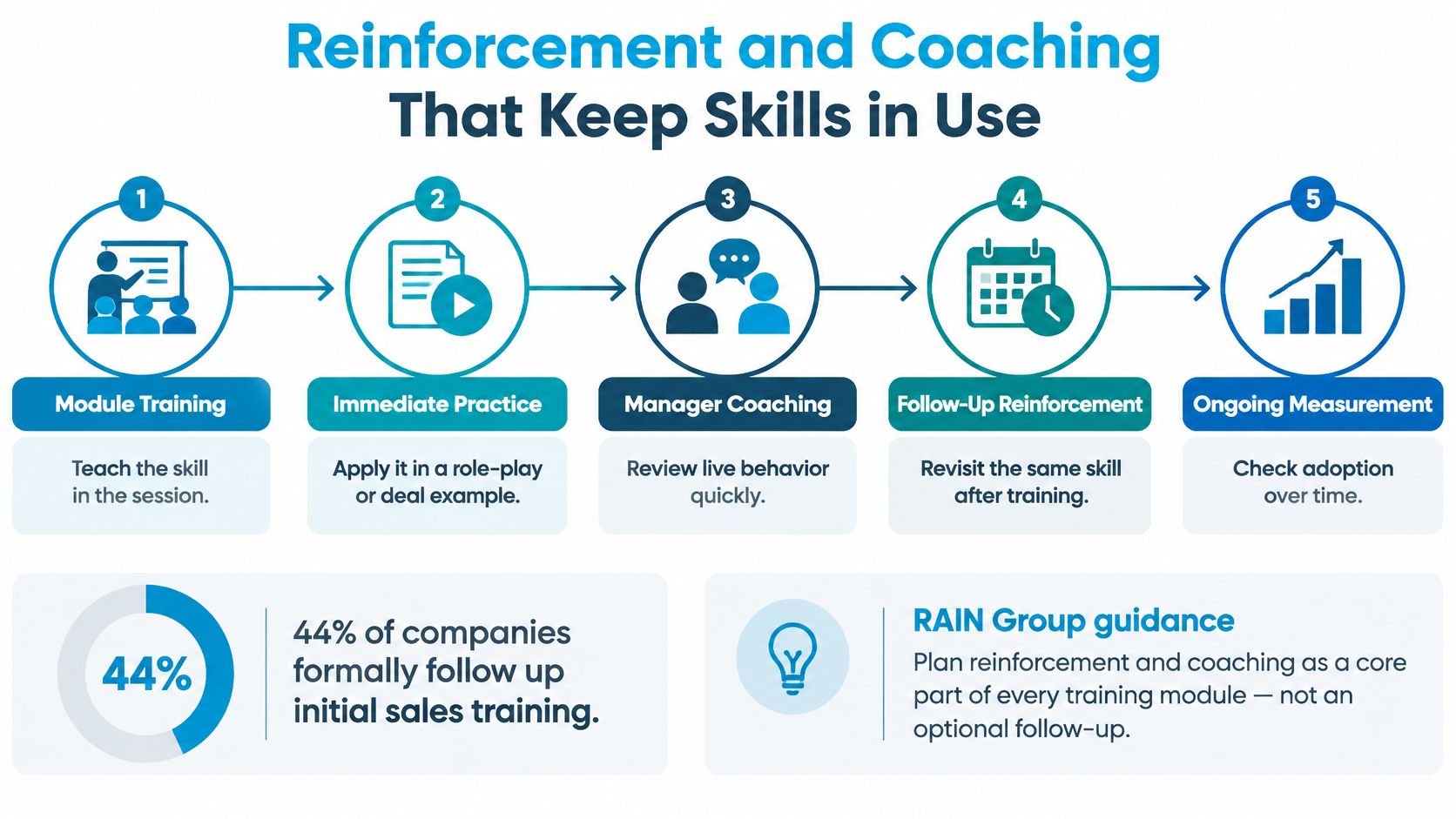
Every module needs a scheduled reinforcement plan before delivery. If the follow-up is optional, you're asking busy SEs and managers to invent it while handling customer work.
The following figures come from a vendor-published guide, not universal causal evidence: RAIN Group's sales-training guide reports that 44% of companies formally reinforce initial training, companies that reinforce it have 20% more salespeople achieving quota, and up to 77% of learning is forgotten within six days without reinforcement. Treat those figures as support for planned follow-through, not a forecast of your team's results.
Attach the following cadence to the module invitation and manager checklist.
Use a repeatable reinforcement sequence
-
Schedule a roleplay within one week. As a practical starting cadence, rehearse the skill before the next relevant customer conversation. Use the participant's deal context so they must choose a response rather than recite the lesson.
-
Apply it on a live opportunity and save the artifact. For discovery, capture business pain, decision criteria, or technical success conditions in the opportunity record. The artifact gives the manager something specific to inspect and the AE something useful for the next conversation.
-
Review a real recording at the next interval. Have the manager examine the relevant call or demo segment, rather than defaulting to a full-recording review. Ask the SE to identify where their intended approach differed from what they did.
-
Score the behavior against defined criteria. Replace vague labels such as good discovery with observable actions, such as confirming the consequence of the current workflow and asking the buyer to validate it. Record the evidence behind the rating.
-
Repeat with longer spacing. After the SE demonstrates the behavior, revisit it in a different buyer situation and widen the interval. If execution breaks down, shorten the interval and rehearse the difficult moment again.
Make the manager the reinforcing voice
The manager should reinforce the same language the facilitator taught. If training asks SEs to qualify evaluations but managers praise every new POC without inspecting qualification, the team receives conflicting instructions.
A useful sales-coaching routine for managers reserves review capacity and keeps coaching separate from a status update. The conversation should finish with a behavior to attempt, not merely a revised close date.
Two slips deserve attention. Coaching only when a deal is in trouble makes feedback feel like an escalation, while scorecards without defined criteria turn assessment into personal preference.
Use behavioral anchors instead. For business impact, distinguish between asking about impact, recording an unverified assumption, and obtaining buyer confirmation. Managers should compare their ratings on the same call excerpt before using the rubric across the team.
Run a 30-day test on a module. Count the practice attempts, live applications, and completed feedback conversations, then inspect whether the intended behavior appeared. If reviews never happened, fix the coaching capacity before rewriting the lesson.
Measuring Training Beyond Course Completion
Attendance answers whether people showed up. It doesn't tell you whether an SE asked a better follow-up question, narrowed a demo to the buyer's priorities, or stopped an evaluation with no agreed success conditions.
Keep completion data, but don't confuse it with evidence of field capability.
Four measurement levels for SE training
| Level | Example Measure | Question It Answers |
|---|---|---|
| Activity | Sessions attended, roleplays completed, manager reviews logged | Did people take part? |
| Learning | Knowledge checks, recall of qualification criteria | Did they understand the method? |
| Behavior | Discovery scorecard ratings, demo relevance on live calls, POC exit criteria written before the pilot | Are they applying it on deals? |
| Outcome | Technical win rate, POC conversion, sales cycle length, share of opportunities disqualified early | Is the deal result changing? |
Use commercial evidence with the right scope
A 2017 RAIN Group Center for Sales Research study, analyzing responses from 472 sellers and executives, found that organizations rating their training most effective reported an average win rate of 58%, versus 47% for lower-rated organizations, an 11-percentage-point gap. The related CSO Insights study described in that same publication, covering more than 2,000 companies, also linked training that exceeded expectations with higher win rates and quota attainment.
These are correlations across sales organizations broadly, not SE-specific proof. They provide a business benchmark, but they don't establish that your discovery module caused an outcome change.
For a broader evaluation structure, Tutorial AI's training evaluation guide for L&D teams is a useful resource for connecting participation, learning, application, and results. Your PreSales implementation still needs opportunity-level evidence.
Establish the baseline before delivery
Choose a small set of behaviors that the module can reasonably affect. For example, use discovery scorecard ratings, buyer-confirmed success conditions, and POC exit criteria documented before a pilot begins.
Review existing opportunities before training, then sample comparable opportunity types afterward. Keep segment, deal stage, product complexity, and evaluator definitions consistent enough that the comparison means something.
Define technical win rate separately from commercial win rate. Record whether the buyer accepted the solution's technical fit against agreed criteria, even if procurement, budget, or another commercial issue prevented a purchase. Use a shared sales engineer KPI framework so managers don't apply different denominators.
Never report an outcome gain without a behavior baseline behind it.
Separate low adoption from low impact. If managers didn't review calls, you haven't tested the complete training system. Our EaaS program includes a monthly adoption report showing the team's manager engagement, which helps make that distinction visible.
If adoption is strong but behavior hasn't changed, inspect the practice and feedback. If behavior improves but deal outcomes don't, examine opportunity mix, observation time, and whether you targeted the right skill. Don't keep a weak module just because participants liked it.
Hypothetical Team Plans and the 90-Day Decision
Each plan should address a specific operating problem, not a general desire for better SEs. Team size matters less than where the current deal process breaks.
Use the team comparison as a prompt to examine handoffs and alignment.
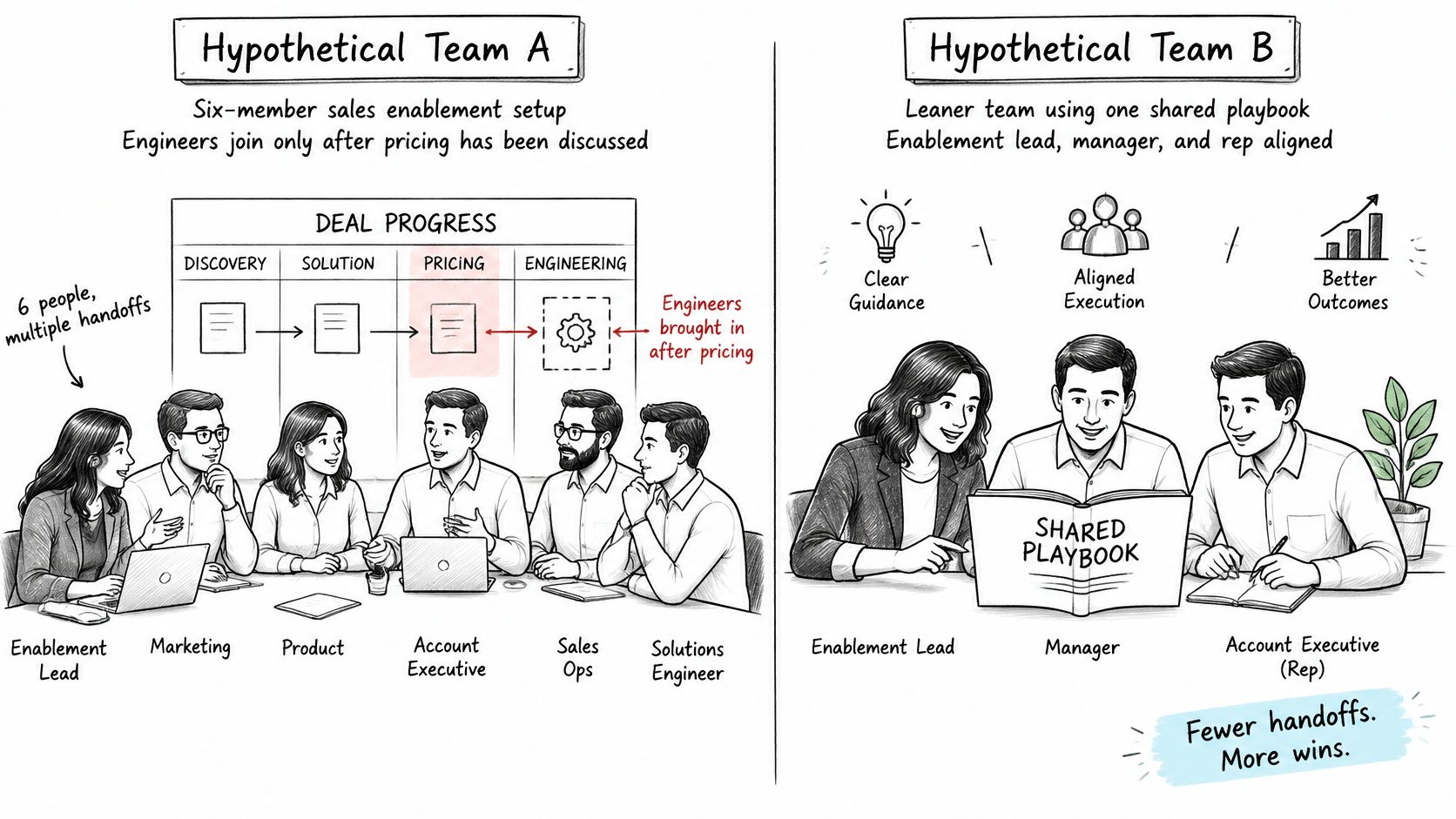
Setup A fixes late involvement
Hypothetical setup: A six-SE team gets involved only after account executives have discussed pricing. Plan: Run a discovery module, a weekly roleplay, and two recorded discovery-call reviews per SE each month.
Measure: Early SE involvement, using an agreed CRM milestone. Trade-off: Accept fewer demos in exchange for better discovery, rather than rewarding the team for maintaining demo volume.
Setup B reduces unqualified evaluations
Hypothetical setup: A twelve-SE team delivers strong demos but accepts too many unqualified proofs of concept. Plan: Teach qualification, document disqualification criteria, and require agreed POC exit criteria before any pilot starts.
Measure: The share of opportunities disqualified before technical work. Trade-off: The team must be willing to challenge an evaluation request, even when an AE sees it as deal progress.
Use the accompanying video as another discussion prompt, then translate the discussion into an owned action.
Setup C establishes a coaching routine
Hypothetical setup: A newly promoted SE manager has no coaching routine. Plan: Introduce a coaching rubric, a monthly deal-sparring session, and a monthly adoption check.
Measure: Scorecard ratings on live calls. Trade-off: Reserve manager time for development instead of allowing every team conversation to become pipeline inspection.
Write a four-line plan for a module:
- First roleplay date: Put it on the calendar.
- Live opportunity: Name where the skill will be applied.
- Manager review date: Assign the reviewer.
- Behavior measure: Specify what should move within 90 days.
For outside structure, consider the Trusted Advisor Academy; if discovery is your starting problem, book a discovery call. At day 90, compare the evidence with the baseline and make an explicit decision: keep, change, or stop the module.
PreSales Unleashed GmbH offers the Trusted Advisor Academy and runs Enablement-as-a-Service, a continuous subscription program that develops PreSales teams over months. Visit PreSales Unleashed GmbH to discuss a training system built around your team's live opportunities, manager coaching, and measurable progress toward the technical win.