
The most popular advice for aspiring PreSales directors is to become a better coach, hire strong people, and build executive presence. That advice skips the harder question: what work should your team accept, and what evidence should justify doing it? You can coach excellent Solution Engineers into exhaustion if account executives control demand without qualification rules.
The director seat requires you to make those rules explicit. Coverage, technical exit criteria, and AE-SE ownership boundaries determine whether your team advances qualified deals or spends its calendar producing convincing demonstrations for buyers who aren't ready to decide.
What a Director of Sales Engineering Owns and the Skills It Takes
A Director of Sales Engineering leads the Solution Engineer (SE) team and owns how technical work reaches deals, not the demonstrations themselves. You decide when SEs engage, what evidence they collect, how they develop, and where scarce technical capacity goes.
Think of it as managing airspace. Each SE flies an individual approach, adapting to the customer and conditions. The director sets the rules and spacing so the team doesn't depend on emergency intervention to get every deal across the line.
Director accountabilities by area
| Area | What the director owns | What it looks like in practice |
|---|---|---|
| Coaching | Team skill in discovery, demos, and POCs | Deal sparring and call reviews every week |
| Stage expectations | Standards for each technical stage | Written exit criteria for discovery, demo, validation, and POC |
| Recruiting and onboarding | Hiring plan and ramp time for new SEs | Scorecards weighted toward discovery skill and a fixed onboarding path |
| Deal reviews | Technical status in forecast meetings | Opportunities marked not forecast-ready when validation is incomplete |
| Resource allocation | Which SE covers which region and motion | Coverage split across new business, expansion, partner, and public-sector deals |
These are operating responsibilities, not administrative leftovers. CoreView's Director, Sales Engineering EMEA role description explicitly includes coaching, technical-win execution, recruiting, deal reviews, and regional resource allocation across those selling motions.
Set the standard before improving delivery
No discovery, no demo. Discovery quality decides deals, so a director who measures presentation polish measures the wrong thing. A fluent demonstration can't compensate for an unknown decision process or an integration requirement nobody tested.
Your team's outcome is the technical win: the customer's explicit confirmation that the proposed solution satisfies documented technical requirements, architecture constraints, security controls, and integration needs. Reprise's guide to measuring SE impact makes that outcome, rather than demo volume, the basis for managing technical progress.
That distinction changes coaching. Instead of asking whether the SE delivered a persuasive story, ask which customer requirement the demonstration tested and what the customer confirmed afterward. If there's no answer, the next coaching session should address discovery, not slide design.
Build the skills you'll use daily
The skills that matter most are practical, and their order matters:
- Discovery standards. Define a qualified technical requirement: a customer problem, its consequence, a constraint, and an agreed way to test the proposed answer. Enforce that standard in deal reviews.
- Coaching through practice. Use deal sparring, call reviews, and roleplays. Ask the SE to retry the difficult question rather than listen to a lecture about asking better questions.
- Influence with AEs. Agree who owns qualification, what triggers SE involvement, and where each person's ownership ends. Don't rely on personal chemistry to resolve resource disputes.
- Cross-functional alignment. Give product, security, legal, and customer success a clear escalation path. Separate a product limitation from a contractual commitment or implementation risk.
- Hiring for discovery quality. Test how candidates investigate an unclear customer problem before judging their presentation. Nexus IT group's role description can help you define responsibilities when you hire SaaS sales engineers, but your interview scorecard should test the behaviors your team needs.
Leadership in PreSales is a role change, not a promotion.
The trap is staying the team's best presenter. You take the difficult meetings, rescue weak discovery, and become the bottleneck while everyone else learns to escalate.
Give up some hands-on work deliberately. If you're still separating leadership from individual contribution, review what a sales engineer does and identify which responsibilities must now belong to someone else.
For a self-check, list the three decisions you made last week that changed a deal's technical path. If the list is empty, you're still managing as a senior SE.
Team Structure and SE Coverage Ratios
One universal SE-to-AE ratio is the wrong starting point. Coverage should follow qualified technical workload, not the number of sellers requesting support.
Sales engineering analytics guidance from GTM Operations Academy places enterprise coverage at roughly one SE for two to three AEs, reflecting the additional work involved in security reviews, architecture, integrations, and proof-of-concept management. Treat that as a directional benchmark, not permission to copy another organization's staffing plan.
In a hypothetical team of six enterprise AEs, two to three SEs might be a reasonable starting assumption. But if half the pipeline consists of familiar expansion work that a shared pool can handle, a dedicated pairing model could strand capacity while specialists remain overloaded.
Build a demand-capacity model
Use your opportunity records and calendar history to replace assumptions with a working model:
- Forecast qualified demand. Include opportunities with an identified technical problem, stakeholder access, and an evaluation plan. Don't count every CRM opportunity as equally entitled to SE time.
- Assign effort bands. Estimate discovery, demonstration, validation, and POC effort separately. Include preparation, follow-up, internal coordination, and specialist involvement.
- Convert effort into required hours. Place the work in the period when customers expect it, rather than spreading it evenly across the quarter.
- Compare demand with productive capacity. Reserve time for coaching, enablement, product feedback, leave, and operational work before promising customer coverage.
When required hours exceed capacity, constrain unbounded demos and POCs before adding headcount. Prioritize expected value, access to technical stakeholders, and a defined customer decision.
Capacity rule: Don't staff an unlimited service queue. Decide which work deserves entry first.
Account for upstream changes too. If sales plans to hire sdrs through a recruiting service such as LatHire, distinguish additional prospecting activity from qualified technical demand before changing the SE plan. More meetings don't automatically justify more technical evaluations.
Choose a team shape that matches the work
Use named AE pods when account context and technical continuity matter. Use a shared pool for repeatable expansion requests, with a clear intake owner and escalation route.
For specialists, decide whether sales, product, engineering, or customer success owns their reporting line, then document allocation authority. Otherwise, several teams can promise the same person's time.
The practical challenge in scaling a sales engineering team from 3 to 30 is preserving clear decisions as informal coordination stops being sufficient. A larger organization needs explicit intake and priority rules, not just more layers of approval.
Metrics a CRO Will Check Before Trusting the Forecast
Demo counts tell a CRO that your team was busy. They don't establish that customers resolved technical risk or moved closer to a purchase. Manage to the technical win, and use activity records to explain effort rather than claim success.
Keep the reporting set small enough that you can inspect the underlying opportunities. Every metric needs a definition, a denominator where applicable, an owner, and a CRM record that another leader can challenge.
Metrics to report and how to read them
| Metric | What it measures | Trap to avoid |
|---|---|---|
| Technical win rate | Share of evaluated opportunities where the customer confirms technical requirements are met | Counting demos instead of confirmed requirements |
| ARR influence | Revenue on deals with documented SE involvement | Weak CRM fields make the number unreliable |
| POC conversion | Share of proofs of concept that move to commercial close | Open-ended POCs with no exit criteria |
| Cycle time | Days from qualified opportunity to technical validation | Comparing SE and non-SE deals without segmentation |
| SE utilization | Share of SE hours spent on qualified opportunities | Counting coaching and enablement as idle time |
Separate contribution from attribution
ARR influence describes involvement. It doesn't prove that the SE caused the revenue.
Compare SE-involved and non-SE-involved opportunities only after segmenting by deal size, market, product, and stage. Otherwise, differences in opportunity selection can distort the comparison because SEs often take the larger or more complex deals. Clean CRM fields are necessary for credibility, but clean fields alone don't establish causation.
RevSpire's independent review of sales-enablement evidence states that no independent study measures revenue attributable to enablement per sales representative across companies. Don't replace that missing evidence with an impressive-looking multiplier.
Track observable behavior instead: discovery completion, proof-of-value outcomes, stage progression, and capacity consumed. Connect those observations to opportunity results without presenting correlation as causal proof.
Make the report useful in a revenue meeting
Revenue Nomad's discussion of data-driven decision making for CROs is useful context for framing the conversation around commercial decisions. Bring an explanation of what changed and what action you recommend, not a dashboard tour.
For example, if technical validation slows while utilization rises, inspect the queue before celebrating demand. The decision might be to narrow evaluation scope, resolve a recurring product gap, or stop accepting poorly qualified work.
Use the sales engineer KPI guide to sharpen metric definitions, then agree how you'll handle deferred decisions, disqualified opportunities, and incomplete evaluations. Don't let the team change classifications merely to improve the chart.
The reporting rule is one page, five metrics, reviewed monthly with the CRO. Each definition should be clear enough for the CRO to challenge and stable enough to support meaningful comparisons.
How to Run a Weekly Technical Forecast Review
A technical forecast review should produce decisions, not a round of optimistic deal summaries. Open the CRM record, inspect the evidence, and leave each opportunity with a clear status and next action.
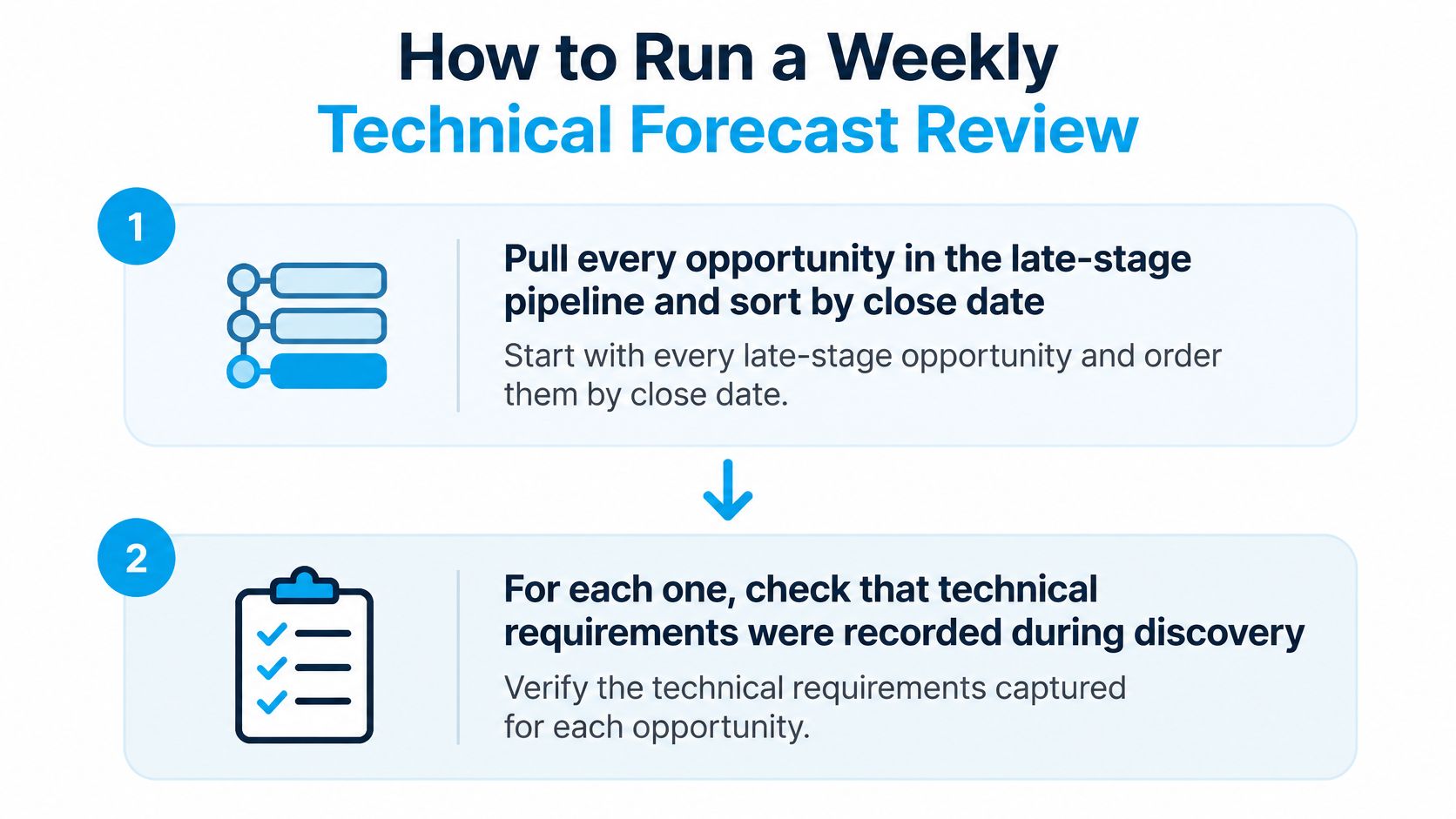
Use this process visual as the starting check, then carry the review through customer approval, business value, and evaluation closure.
Inspect evidence before accepting confidence
-
Pull every late-stage opportunity and sort by close date. Start with the complete late-stage pipeline so the team can see competing commitments and approaching decisions. The common slip is discussing only the deals the AE or SE chooses to raise.
-
Check the requirements captured during discovery. Each requirement needs an owner and a validation method so another person can understand what remains to be proven. The common slip is accepting a feature list or discovery-call transcript as a usable evaluation plan.
-
Confirm written approval from technical stakeholders. Store the customer's confirmation in the opportunity record, with any conditions or exceptions attached. The common slip is accepting a verbal technical yes when the customer hasn't agreed that the evaluation is complete.
-
Verify that the Economic Buyer validated the impact metrics. MEDDICC's Economic Buyer guidance identifies this stakeholder as the person with authority to approve or stop the purchase, making their agreement on measurable value necessary before procurement. The common slip is treating the Champion's enthusiasm as equivalent purchasing authority.
-
Mark incomplete technical validation as not forecast-ready. Strong buyer intent doesn't remove an unresolved security control or untested integration, so record the blocker and the person responsible for resolving it. The common slip is letting a commercial close date override missing technical evidence.
-
Set explicit exit criteria for every open POC. Record scope, success measures, an end date, and a decision owner so the customer and SE know what completion means. The common slip is extending the evaluation because someone requested another test without explaining how it affects the decision.
-
Log the outcome and next action. Update technical status, outstanding risk, ownership, and the evidence required for progression so the next review starts from the same record. The common slip is keeping the forecast in meeting notes or private messages.
Keep disagreement visible
Don't force a single blended opinion when the AE and SE assess a deal differently. Record commercial confidence and technical readiness separately, then name the action that would resolve the difference.
A useful review ends with fewer ambiguities, not necessarily more green statuses. If a deal's technical status can't be read from the CRM in under a minute, the review hasn't done its job.
Diagnosing Staffing, Qualification or Process Problems
Treating every performance problem as a headcount shortage is expensive and often premature. Diagnose before you hire. A team can lack capacity, accept the wrong demand, or waste capacity through unclear evaluation processes, and those problems require different fixes.
In the NAASE survey report, 50% of respondents cited workload and time pressure, while another 50% cited insufficient discovery or qualification from account executives. Those complaints can coexist: an overloaded calendar doesn't prove the work on it deserved SE involvement.
Symptoms, likely causes and first checks
| Symptom | Likely root cause | First check |
|---|---|---|
| SE hours run out before the quarter does | Staffing or unqualified demand | Compare required hours with capacity from the coverage model |
| Demos repeat with no buying decision | Weak discovery or qualification | Review five recent discovery calls for documented requirements |
| Deals reach POC and stall | Open-ended evaluation plans | Check POC exit criteria and end dates |
| AEs and SEs disagree on ownership | Missing operating rules in tight pairings | Write ownership boundaries for qualification and follow-up |
| Forecast surprises late in the quarter | Technical validation not tracked | Run the weekly technical forecast review |
Test the cause before selecting the fix
Start with a sample of five recent discovery calls. Check whether the team documented customer requirements, business consequences, technical stakeholders, and the reason for the next engagement. If those are missing, more SEs will increase delivery capacity without repairing qualification.
Then compare required hours with available capacity and inspect every open proof's exit criteria. Distinguish work that's necessary from work continuing because nobody owns the stop decision.
Tight AE-SE pairings still need explicit operating rules. Familiarity can hide disagreement about who qualifies an opportunity, who schedules technical work, and who tells the buyer that an evaluation request falls outside scope.
Fix qualification before adding capacity. More SEs can't repair an unqualified pipeline.
If qualified demand still exceeds capacity after you remove avoidable work, you have a defensible hiring case. Show the missing skills, the timing of demand, and the customer commitments you can't support, rather than relying on a general claim that everyone is busy.
Protect the work that improves the team
Maximum seller coverage isn't the same as an effective operating model. Filling every available hour with customer meetings removes the time SEs need to improve skills, coach peers, and give product teams usable feedback.
Make that trade-off visible to sales leadership. If you borrow protected time for a strategic deal, name what you're postponing and restore it deliberately. Otherwise, temporary exceptions become the staffing model, and your strongest SEs carry the cost.
Plan Your Move Into the Director Seat
There is no straight path into PreSales, and there's no single credential that proves you're ready to lead it. A useful practitioner pattern is increasing responsibility for other people's decisions, rather than larger accounts or more difficult demos.
The route below describes scope to build, not a mandatory sequence of titles. Your organization may combine stages or give you leadership responsibilities before changing your job title.
Look for the signal at each stage
-
Senior SE. You're known for discovery depth across accounts, not only product expertise. You can explain why an opportunity needs a particular technical evaluation and recognize when the proposed work won't help the buyer decide.
-
Lead or principal SE. Other SEs ask for your judgment, and you contribute to coaching and deal staffing. Your signal is that colleagues make better decisions after working with you, rather than handing difficult work over.
-
First formal leadership role. You run a pod or regional subteam and become accountable for expectations, feedback, and resource choices. You need evidence that your coaching changes behavior and that you can address weak performance without taking over every deal.
-
Director. You own the team's operating model and report to a CRO or equivalent revenue leader. You're expected to explain capacity, technical risk, hiring needs, and trade-offs in terms that support commercial decisions.
The sales engineer career guide can help you compare possible moves without treating management as the only worthwhile destination. If you need the wider functional context, the PreSales overview clarifies how the work fits around sales and the customer decision.
Build evidence rather than collecting responsibilities
Map your gaps. Discovery depth across industries, operating-model design, hiring and coaching evidence, and comfort reporting to a CRO are different capabilities. Being strong in one doesn't excuse avoiding another.
You don't need the director title to demonstrate director-level judgment. Write a proposed intake policy with your manager, facilitate a technical-risk discussion, or coach an SE through a discovery problem without joining the next customer call yourself.
For practical development, the Trusted Advisor Academy offers structured learning and live practice tied to active opportunities. Teams that want to discuss their operating challenges can use the discovery-call option for an initial conversation.
Choose one director-level change for the next 30 days. Write the coverage model, introduce the technical forecast review, or establish exit criteria for every open POC. Agree the scope with your manager and capture the decisions it changes.
Don't submit a collection of polished templates as proof of readiness. Show which work the team stopped accepting, which risks became visible earlier, or which decisions an SE could make without escalation. That's evidence you're building a team that can operate without you in every meeting.
PreSales Unleashed GmbH offers ongoing PreSales training, coaching, and live deal sparring for Solution Engineers and their leaders. Visit PreSales Unleashed GmbH to develop the discovery standards, coaching habits, and operating systems your team needs before its next increase in demand.