
The most popular advice about a sales engineer career is also the least useful: learn the product, improve your demos, wait for a senior title. That model treats PreSales as a technical ladder. In B2B SaaS, the people who progress tend to do something harder. They expand from technical execution into business influence, deal strategy, cross-functional leadership, and measurable commercial impact.
Your career won't advance because you can fit more features into a demo. It advances when account executives, buyers, product teams, and leaders trust you to improve the quality of a decision. No discovery, no demo is more than a presentation rule. It's a career rule. Discovery quality, not demo polish, decides whether you're seen as a technical resource or a business partner.
The Sales Engineer Career Myth You Need to Unlearn
A sales engineer career does not follow a reliable ladder. Junior SE, senior SE, principal SE, and management may appear in that order on an org chart, but titles are a poor measure of progress. The actual shift is from executing demos to influencing business decisions, which makes career growth a capability expansion rather than a vertical climb.
Early on, you demonstrate product fluency, credible demos, technical answers, and effective support for the account executive. Progress comes from handling problems that cannot be solved with product knowledge alone: diagnosing the buyer's situation, testing technical fit, shaping an evaluation, and influencing deal direction before a demo is scheduled.
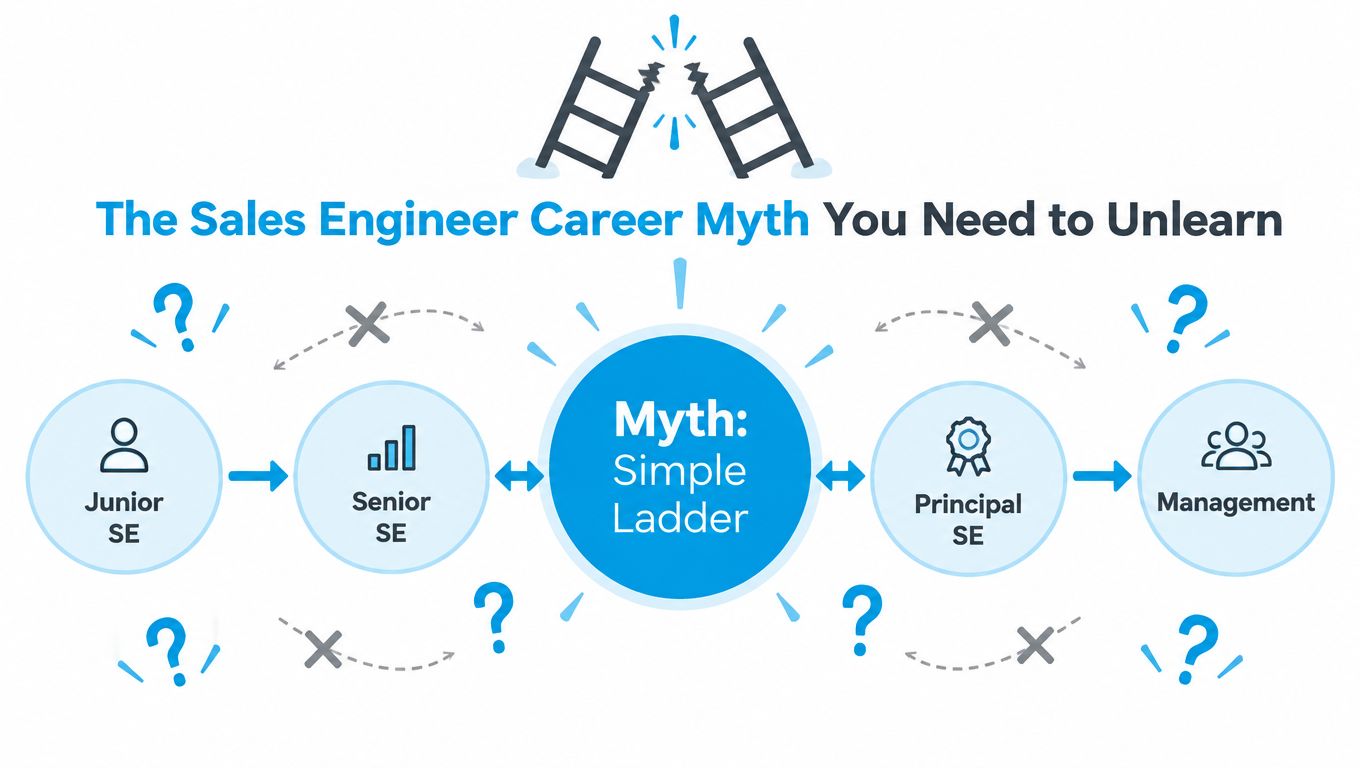
Progression means expanding your operating range
A strong senior SE handles more ambiguity, not merely more opportunities. They can start with an incomplete technical brief, identify missing decision criteria, align the AE on a credible plan, and choose whether the next step should be a demo, POC, security review, or executive discussion.
That broader range develops across four dimensions:
- Buyer influence: Connect technical capability to the buyer's business problem, priorities, and decision process.
- Deal judgment: Decide which requests merit SE capacity and which create activity without a credible path to a technical win.
- Cross-functional leadership: Coordinate product, engineering, customer success, security, and implementation while keeping ownership clear.
- Operating discipline: Build repeatable discovery, demo, POC, and forecasting practices that improve team performance.
BLS data cited in the next section indicates that sales engineers typically need a bachelor's degree, while related work experience usually is not required. The outlook also projects 3% employment growth from 2025 to 2035, or about 1,400 additional jobs, roughly matching the average for occupations. A positive market helps, but it does not distinguish one SE from another. Evidence of better judgment does.
Career rule: Ask, “What business problem can I solve now that I could not solve a year ago?” Titles tend to follow that answer.
Stop using demo volume as your career scorecard
Demo execution matters, but it has a ceiling. If every opportunity depends on your personal intervention, your impact remains limited by your calendar. Increase your value by making your judgment reusable through discovery plans, evaluation criteria, qualification standards, technical mutual action plans, and clear handoffs.
Describe advancement in terms of outcomes rather than activity. Explain how you improved technical qualification, reduced avoidable POCs, clarified evaluation criteria, or helped the team identify technical risk earlier. A new title may come later. The capability has to come first.
Entry Requirements and Core Competencies
A technical degree may open the door to a Solution Engineer (SE) interview, but it does not prove you can do the job. Hiring teams need evidence that you can connect technical detail to a buyer's decision. Product and domain fluency establish credibility. Clear communication keeps a conversation focused on business outcomes instead of turning every meeting into a feature lecture.
The Bureau of Labor Statistics profile for sales engineers lists a bachelor's degree as the typical entry-level education and says related work experience is usually not required. That creates an entry point for candidates from engineering, IT, customer success, implementation, support, or account executive roles. It also raises the importance of practical evidence. A degree shows preparation. It does not show that you can run PreSales work.
The four workstreams that prove readiness
A useful certification framework groups PreSales work into discovery, demos, proposals or RFPs, and proofs of concept or pilots. The Certified Sales Engineer framework describes the role through observable activities rather than vague personal traits.
Discovery sets the direction. Examine the current stack, integration requirements, stakeholders, constraints, and success criteria. The question is whether the product can support the buyer's required outcome, not whether it can be displayed convincingly. A practical guide to what a sales engineer does provides useful context for these responsibilities.
Demos should answer a decision question. Show how the product fits an existing workflow, meets a security requirement, or supports a measurable operational outcome. A polished presentation without a clear evaluation purpose rarely advances a deal.
Proposals and RFPs expose judgment. Classify each response accurately: supported today, possible through configuration, requiring validation, or unsuitable for commitment without product or engineering review. Credibility suffers when an SE treats every request as a promise.
POCs and pilots require control before technical work begins. Define the evaluation question, evidence required, owners, timeline, and exit criteria. Without those boundaries, a POC can become unpaid implementation and leave the buyer without a clear basis for a decision.
What to demonstrate before you have the title
Hiring managers can assess capability through work samples. Prepare a discovery plan for a hypothetical buyer, a short problem-led demo, an objection-handling script, and a POC evaluation plan. These artifacts reveal more than a résumé full of product names and tools.
Explain one technical concept for three audiences: an executive, a practitioner, and an implementation stakeholder. That translation shows whether you understand both the technology and the commercial decision around it.
Career progress starts with capability expansion. The shift is from executing demos to shaping decisions, managing technical risk, and making sound judgment reusable across opportunities. Titles may change later, but that broader influence is what separates a capable SE from a dependable one.
The Two Career Paths, Individual Contributor and Leadership
The individual contributor and leadership tracks share a foundation, but they reward different daily behavior. A principal SE isn't a manager without direct reports. A manager isn't necessarily a better principal SE. Each path demands a distinct form of influence.
The individual contributor path
The IC path can move from junior SE to senior SE, principal SE, and staff SE, depending on the company's leveling system. At each stage, the work should become more complex and more influential.
| Level | What strong performance looks like |
|---|---|
| Junior SE | Learns the product, prepares well, runs focused demos, and documents technical risk. |
| Senior SE | Leads discovery, shapes evaluations, handles complex objections, and improves deal strategy with the AE. |
| Principal SE | Influences strategic opportunities, coaches peers, handles difficult technical decisions, and creates reusable practices. |
| Staff SE | Defines how the function operates across teams, connects technical wins to business outcomes, and shapes executive-level decisions. |
The senior-to-principal transition is where many careers stall. You can be the person everyone calls for the hardest demo and still lack evidence of broader influence. At the principal level, your value includes the decisions you help others make and the systems you create so the team doesn't depend on your personal availability.
The leadership path
Leadership changes the unit of work from your opportunities to the team's capacity. A first-line manager coaches discovery, reviews deal strategy, manages staffing, and creates operating rhythms with sales leadership. A director or head of solution engineering also shapes hiring, segmentation, coverage, enablement, forecasting, and executive communication.
The differences become clearer in practice:
- IC question: How do I improve the technical win on this opportunity?
- Leader question: How do I help the team produce more consistent technical wins without adding unnecessary effort?
- IC output: A strong discovery plan, demo, POC, or technical close.
- Leader output: A repeatable standard that helps multiple SEs produce those outcomes.
Your résumé should reflect that change in scope. Resources on impact-driven sales resume examples can help you describe coaching, operating improvements, and commercial influence instead of listing responsibilities.
Moving between tracks is possible, but don't treat management as the automatic reward for being a top IC. The transition requires a different identity, and companies often get it wrong when they promote a high performer without defining the coaching and operating work that follows. The discussion in what companies get wrong about the first-line leader promotion is relevant because strong individual execution doesn't automatically create strong people leadership.
Skills That Actually Move the Career Forward
Technical knowledge gets you hired. Business influence gets you promoted. Product expertise remains necessary, but it stops being distinctive when every capable SE can handle the interface, explain the architecture, and answer standard security questions.
A 2025 survey of more than 400 solutions engineers found that 90% rated communication as the most critical skill, 72% rated agility highly, and 80% said AI would be important or very important in their jobs in 2025, according to Reprise's 2025 SE career guide. Those figures point toward a practical conclusion: the high-value SE is becoming a translator, strategist, and force multiplier.
Business translation
Business translation means turning a technical capability into a decision that a buyer can defend internally. Don't stop at “the platform integrates with your systems.” Explain what the integration changes, who benefits, what risk it removes, and what evidence the buying group needs.
Use a simple discipline in discovery:
- Identify the current workflow and the cost of leaving it unchanged.
- Connect the relevant product capability to that workflow.
- Confirm the buyer's success criteria in their own language.
- Agree on the evidence that would support a technical win.
This is why the discovery call guide for PreSales matters more to career progression than another product badge. It gives you a way to shape the conversation before product presentation begins.
Deal strategy
Strong SEs understand deal mechanics without pretending to own the AE's role. You should know the technical champion, economic buyer, decision process, competition, paper process, compelling event, and technical risks. Frameworks such as MEDDPICC for Solution Engineers help connect technical activity to the wider opportunity.
A pain-led demo can lift demo-to-close conversion by 15% to 25% and reduce time to close by 20% to 30%, according to the Rework guide to demo design around buyer pain. Treat those figures as a reason to change demo design, not as a promise for every team. The underlying practice is sound: show less, connect more directly to the buyer's unresolved problem, and make the next decision easier.
AI fluency belongs here too. Use AI to prepare discovery hypotheses, summarize calls, generate objection maps, compare evaluation criteria, and draft follow-up questions. Keep human judgment over accuracy, confidentiality, and deal strategy. For practitioners building a public professional voice, personal branding for sales professionals offers context on communicating expertise without reducing your value to product promotion.
The career shift is visible in how you spend preparation time. Less effort goes into polishing every click path. More goes into understanding stakeholders, anticipating objections, and creating evidence for a technical win.
The Hidden Career Trap, Becoming a Reactive Demo Machine
High performers often become victims of their own reliability. The AE knows you'll accept the late request, rebuild the demo, answer the RFP, join the extra call, and rescue the POC. Your calendar fills, your reputation grows, and your career remains stuck because activity has replaced visible impact.
Industry reporting from the Sales Engineering Society notes that 50% of respondents in a 2025 sales engineering signals survey cited workload and time pressure as a top challenge. The same report identifies AE and SE alignment, plus AI and rapidly changing technology, as additional pressure points. The report on why sales engineers are feeling more pressure describes a problem most career guides avoid: capacity management is part of senior-level performance.
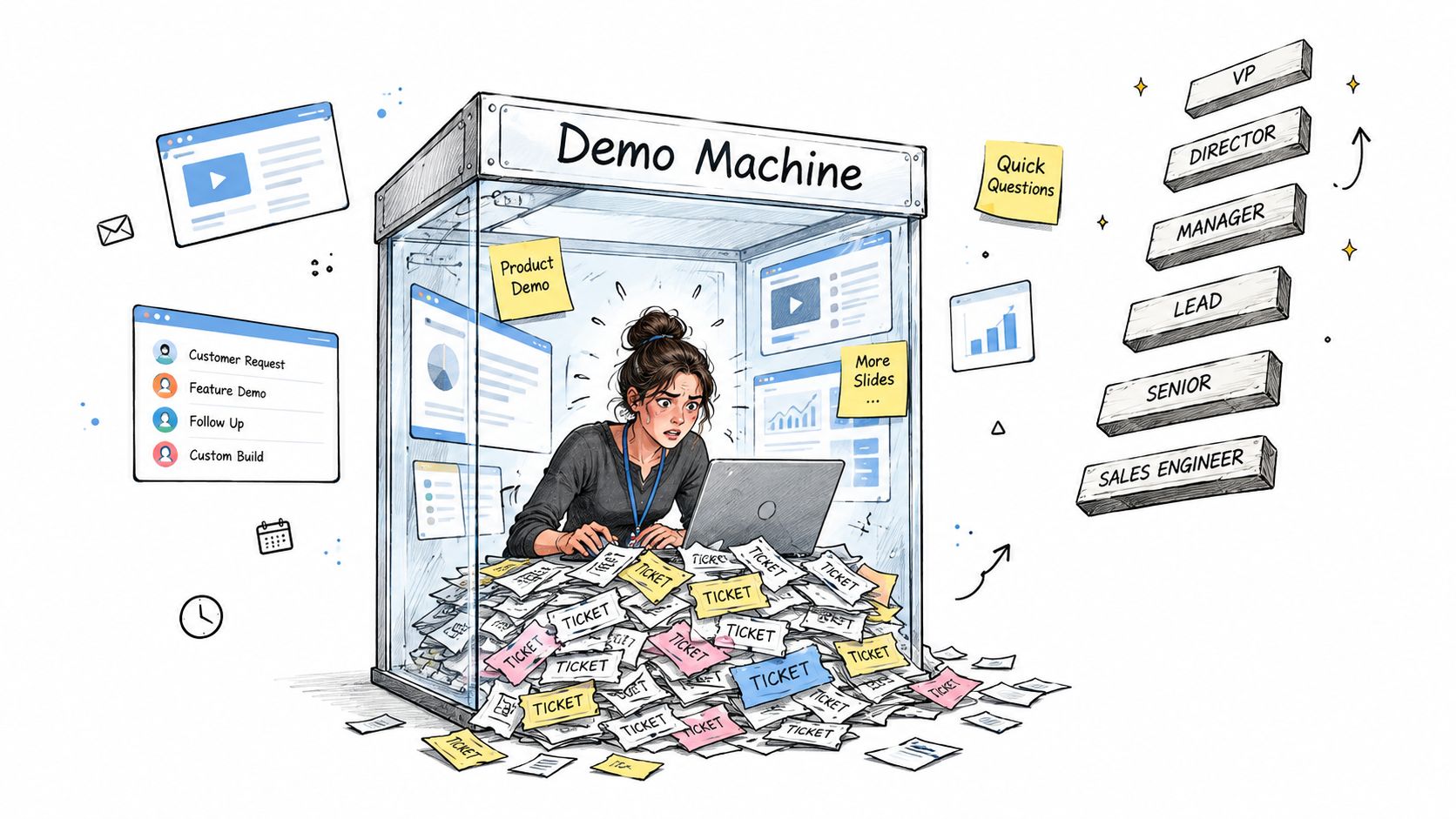
Replace busyness with technical influence
You need a way to distinguish work that supports a real technical win from work that merely creates motion. Start with a request filter:
- Decision relevance: Which buyer decision will this work influence?
- Qualification quality: Do we understand the pain, stakeholders, requirements, and evaluation path?
- Reuse potential: Can the output support other deals or improve the team's process?
- Capacity cost: What higher-value work will this request displace?
- Exit condition: What happens after the demo, response, or POC?
A low-value RFP isn't harmless. It consumes technical capacity that could support a qualified opportunity, and it teaches the sales team that SE time is available without qualification. Saying no doesn't mean refusing to help. It means proposing a narrower response, a qualification call, a standard asset, or a clear condition for deeper involvement.
Boundary to practice: “I can support this once we confirm the technical decision, stakeholders, and evaluation criteria. Without those inputs, a custom demo would create activity but not useful evidence.”
Measure the work leaders can defend
Technical forecasting is becoming a more important capability because sales teams need technical inputs that add nuance to opportunity forecasts. Track the signals your leadership can act on, such as discovery completeness, technical risk, POC status, evaluation progress, and technical win rate.
The North Star technical win rate framework can help you create a clearer view of technical influence. Don't claim that a single metric explains revenue. Use a small set of measures that show whether SE involvement improves opportunity quality and buyer confidence.
The goal isn't to do less work at any cost. It's to reserve deep work for opportunities where your judgment can change the outcome. A reactive demo machine proves endurance. A senior SE proves prioritization.
Certifications, Training, and Acceleration Tactics
Training improves a sales engineer career only when it changes behavior on live opportunities. A certificate can provide vocabulary and structure, but it cannot replace discovery practice, deal reviews, objection handling, or feedback from someone willing to challenge your assumptions. Choose training to close a specific capability gap, especially the shift from demo execution to business influence.
Use this test before committing time to a program:
- Application: Can you apply the framework to an active opportunity this week?
- Practice: Will someone observe your calls, demos, or deal plans?
- Reinforcement: Does the program revisit the skill after the initial lesson?
- Evidence: Can you show a manager how your behavior or technical win process changed?
- Fit: Does it match your current level and intended path, IC or leadership?
Certification frameworks such as the Certified Sales Engineer credential can structure work across discovery, demos, proposals or RFPs, and POCs or pilots. A badge matters when it supports better judgment in those activities. It has limited value when it becomes a substitute for practicing an uncomfortable skill.
Build a personal playbook
A useful playbook contains working assets, not notes that stay unopened. Keep a discovery question bank, qualification checklist, technical risk register, demo narrative templates, POC entry and exit criteria, objection patterns, and post-call review prompts.
Review it after meaningful opportunities. Record what the buyer asked, where the deal slowed, which assumption proved wrong, and what you would change next time. The result is evidence of judgment that transfers across products and employers. It also shows whether your capability is expanding beyond running effective demos.
Delivery varies by program. The guide to choosing PreSales training helps compare workshops, coaching, communities, and longer enablement programs. Compare options in the guide to the best sales training programs before choosing a format. People moving into management can pair SE-specific development with manager training from Productivity Radar focused on coaching and operating skills.
PreSales Unleashed GmbH offers the Trusted Advisor Academy, a 12-month program for Solution Engineers and SE leaders with on-demand lessons, live practice, templates, personalized learning paths, and community support across discovery, demos, sales alignment, and POC management. Its practical distinction is continuity: development stays connected to active deals rather than ending with a workshop.