
Most discovery advice tells you to ask more questions. Bring a longer checklist, cover every topic, and qualification will take care of itself. That advice produces calls that touch twelve topics and settle none of them.
Weak technical wins rarely come from a missing question. They come from the right question asked in the wrong order: impact before current state, stakeholder map before pain, demo scheduling before decision criteria. By the time the call ends, you have a page of answers and no evidence.
The pressure is real. In 2024, 81% of B2B buyers had selected a preferred vendor before speaking with a sales representative, according to 6sense's survey of 2,509 recent B2B buyers. That preference formed before your call, from sources you didn't control. Discovery isn't a blank-slate interview. It's a correction exercise, and the order you correct things in decides whether you leave with a technical win or a demo booking.
Each of the eight discovery examples below pairs a question sequence with two things most frameworks leave out: the signal that tells you to keep digging or stop, and the exact point where the answer should change your demo or proof of concept plan. If you want the pipeline-level version of the same logic, this guide on how to build a pipeline of ready-to-buy prospects covers the AE side.
1. Current-State Workflow Questions
Current state is the cheapest place to start and the one most SEs skip in favor of pain. You can't map a product to an environment nobody has described out loud. Until someone walks you through how the work runs today, you don't know whether integrations, data volume or security constraints will block the solution before you get near a demo.
Buyers do their own homework first. In 2024, 75% of B2B buyers preferred gathering product information independently, and 57% purchased a software tool without meeting the vendor's sales team, according to HubSpot's survey of 422 U.S. B2B purchasing decision-makers. The prospect arrives with a theory about their own process. Your questions exist to test it.
The sequence
- Open on the workflow: "Walk me through what happens between the moment a ticket is logged and the moment it reaches the field team."
- Follow one handoff: "Who picks it up next, in which tool, and how do they know it's theirs?"
- Find the manual step: "Where does somebody copy, paste or re-key something?"
- Size it: "How many of these per week, and what happens when that export fails?"
Hypothetical example: a regional operations director answers the first question with a nightly CSV export into a spreadsheet. That export, not the analytics feature on your roadmap slide, becomes the centerpiece of the demo.
Keep going or stop
Keep going while the prospect names systems, people and handoffs without prompting. Write every system name down; that list is your integration checklist. Stop when the answer sounds like a slide: tidy, sequential, missing the awkward step. You're talking to the owner of the narrative, not the person who runs the process, and the next call needs the operator in the room.
Confirm the current state back in one sentence before you propose anything. "So the handoff happens by email at the end of each day?"
The same question lands differently by role. An engineer gives you system names and a data volume. A finance lead gives you a headcount and a reconciliation cost. An executive sponsor gives you "we can't scale past forty customers." Only one of those three answers tells you where the demo starts.
2. Pain Funnel Questions
Sandler's pain funnel starts broad and narrows in steps: the challenge, what it looks like, how often it happens, what it costs, how it lands on the people involved. The goal isn't to extract a confession. It's to get the problem said in the prospect's own words, so that when you play it back in the demo, the need feels self-generated rather than pitched.
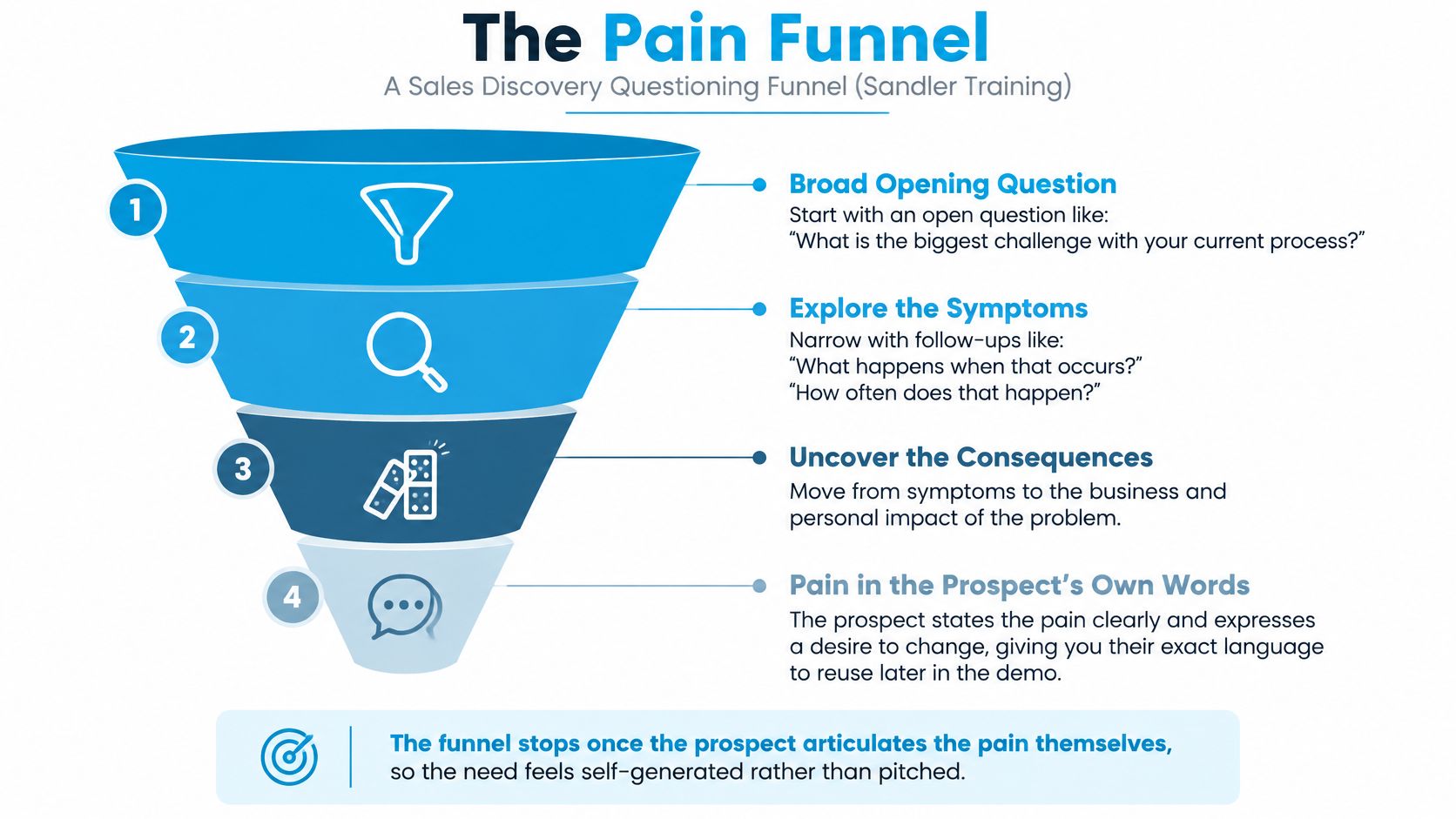
The gap this closes is organizational, not personal. In 2013, the Aberdeen Group surveyed 206 sales organizations and found the two most cited barriers to meeting sales goals were the inability to identify the most likely buyers, cited by 48%, and insufficient knowledge of prospective buyers' business needs, cited by 46%. Both are funnel failures. Neither gets fixed by a better demo.
Hypothetical example: you ask a finance manager what the biggest challenge with month-end close is. "It takes too long." Four questions later you know the close runs eight days, two analysts reconcile most of it by hand, and the CFO has asked twice this year for it to be faster. That's a demo you can build in an afternoon.
Keep going or stop
Keep going while every answer adds a number, a frequency or a name. Stop when the pain stays a category ("reporting is painful") instead of an event. Don't rescue the prospect by pitching. If they can't describe a specific instance of the problem, that's a qualification signal, not a reason to talk faster.
Push one question past the point where it feels answered. The cost usually sits in the answer to the question you were about to skip.
3. SPIN Implication and Need-Payoff Questions
SPIN Selling comes from Neil Rackham's 1988 book and separates questions into Situation, Problem, Implication and Need-Payoff. Situation and Problem questions establish facts. Implication questions explore consequences, and Need-Payoff questions ask the prospect to describe what solving the problem would be worth. For an SE, the last two are where a technical gap turns into a business case the economic buyer can act on.
The sequence
- Problem: "So approvals take three days?"
- Implication: "What does that delay do to your customer commitments?"
- Implication, deeper: "Which renewals slipped because of it?"
- Need-Payoff: "If approvals took hours instead of days, how would that change your renewal forecast?"
Hypothetical example: the prospect says two renewals slipped last quarter. You didn't have to invent the business case. They built it in one answer, and you can quote them in the demo.
Harvard Business School's 2024 work on selling treats discovery and qualification as decisions taken upstream of the close, and ties outcomes to continuous improvement through training, reviews and performance management (HBS). That's the argument for writing three implication questions before each call instead of improvising them in the room.
Keep going or stop
Keep going when the prospect volunteers a consequence you didn't ask for. Stop when implications come back as agreement without detail ("yeah, it's a problem"). Agreement is cheap. Evidence isn't. Run these in roleplay, because the pattern of a good implication question is a skill you drill, not a phrase you recall; the mechanics of need-based selling reward that rehearsal.
4. Impact and Cost-of-Inaction Questions
Every B2B purchase competes with the status quo, and the status quo usually wins on inertia. Impact questions put a business consequence on the problem: revenue delayed, cost absorbed, risk accepted, hours lost. Cost-of-inaction questions push the same logic twelve months forward and ask what happens if nobody acts.
The sequence
- "What does that cost you per month, roughly?"
- "If nothing changes by the next budget cycle, what breaks first?"
- "Who absorbs that cost today?"
- "What would you stop funding to pay for this instead?"
Hypothetical example: you ask a head of support what the queue costs over twelve months in escalations and staff time. The answer is a range, not a figure, and the champion refines it with finance before the economic buyer review. A range the buyer owns beats a precise number they disown.
Urgency has a measurable effect on the shape of the deal. A consultative-selling case study of an industrial manufacturer reported revenue growth of 20% and a cut in sales-cycle duration from 52 to 28 days after the company adopted a more rigorous, discovery-led sales process, per Ahead of Sales. Cycle time moves when urgency gets documented. It doesn't move because the demo got prettier.
Keep going or stop
Keep going when the prospect reaches for a range without hedging, and ask who would validate the number. That validator is often your economic buyer. Stop when the answer is "hard to say" and nobody in the room owns a figure. You're talking to an influencer, not the person who feels the cost.
Cost of inaction is a question you ask twice. Once early, to test whether the pain has weight. Once late, to confirm the number survived contact with finance.
The answer changes by role. An engineer counts hours per week. A finance lead converts those hours to a loaded cost. An executive sponsor converts them into deferred revenue or churn risk. Collect all three versions and your business case has three sources instead of one.
5. MEDDPICC Qualification Questions
MEDDPICC gives discovery an information model instead of a loose list: Metrics, Economic buyer, Decision criteria, Decision process, Paper process, Identify pain, Champion and Competition (MEDDICC). Treat every letter as evidence to uncover, not a field to fill from assumption. "Security is important" isn't a decision criterion until the buyer names the controls, the approvers and the pass/fail test.
Four questions that carry most of the weight
- Economic buyer: "Who signs off on the budget if the pilot succeeds?"
- Decision criteria: "What would the evaluation committee need to see to choose us over the current vendor?"
- Paper process: "Walk me through what happens between 'we've chosen' and 'we can start'."
- Champion: "Who inside this company would push for it when the committee pushes back?"
Hypothetical example: the answers show the demo is premature. Nobody has met the economic buyer, and the criteria are still "best fit". You move the demo and book a criteria session instead. That deal got saved by asking, not by presenting.
Close rates make the stakes plain. A 2025 qualification benchmark found highly qualified opportunities closed at 50%, compared with 8% for poorly qualified opportunities. The difference isn't sales skill. It's whether discovery produced evidence you could point at.
Keep going or stop
Keep going while the prospect can name approvers, steps and dates without checking with anyone. Stop when every answer routes back through your contact ("I'll confirm with them"). That pattern means you have a coach, not a champion, and no amount of technical work will fix it.
Mark each letter known, partially known or unknown after every call, then review the gaps with your AE before you commit demo time.
If your AE works from a BANT checklist, know how BANT and MEDDIC compare in practice before you argue about which fields matter. The framework is a deal-review tool, not a script for the prospect.
6. Success Criteria and Technical Win Questions
Success criteria questions ask the prospect to define a good outcome before you present anything. That's the shortest route to the technical win, the outcome PreSales owns, because it turns the demo into an agreed test rather than a performance.

The sequence
- "If we ran a two-week pilot, what would you need to see to recommend moving forward?"
- "Which of those are pass/fail, and which are preferences?"
- "How does each one get tested, and who signs off on the test?"
- "What would make you say no?"
Hypothetical example: a platform lead names sub-second query response on the existing data volume, single sign-on through the corporate identity provider, and an audit log export. Those three become the pilot's acceptance criteria and the demo's agenda, in that order.
Feature fit alone loses deals. MEDDICC separates decision criteria into technical, economic and relationship categories, with economic criteria covering payback, total cost of ownership and implementation time (decision criteria guide). Your evaluation plan should say which owner tests which criterion, with what evidence, by what date.
Governance criteria belong on the list too. Nearly half of European B2B buyers needed clarification about AI model training, data storage, privacy and security, according to 6sense's research on European buying journeys. If your plan doesn't test those, security review will test them later, without a demo to help. Start from these technical discovery questions when you build the list.
Keep going or stop
Keep going when criteria arrive with owners and dates attached. Stop when everything is a must-have. A list where nothing is negotiable means nobody has thought about trade-offs, and the evaluation will drift until it stalls. Track the technical win as a number in pipeline reviews; the North Star technical win rate framework shows how to report it.
Put the criteria in a follow-up email the same day. A short written list prevents the disagreement you'd otherwise have in week three.
7. Stakeholder and Buying Process Questions
Assume the buyer is a group. Gartner's 2017 Digital B2B Buyer Survey of 750 B2B buyers found the median buying group included six to 10 decision makers, and each participant had gathered four or five pieces of information independently before the group aligned (Gartner). Your main contact is one input into that group, not the buyer.
The sequence
- "Who else needs to review the architecture before a decision?"
- "What does each of them need to see?"
- "Who can say no even if everyone else says yes?"
- "What's the sequence between technical approval and signature?"
Hypothetical example: the first question surfaces a security review that needs a completed questionnaire and a 30-day lead time. You start the questionnaire during the technical evaluation instead of after the proposal, and the deal keeps its date.
Keep going or stop
Keep going when the prospect names people and what each one is protecting or improving. Stop when you get "it's just me and my boss" on a deal that will need security, legal and procurement. Someone hasn't done the mapping, or you're being kept deliberately small.
Ask who has blocked a decision like this before. The answer usually identifies the real risk faster than any org chart.
Write the output as a stakeholder map: role, business concern, influence, success measure, unresolved objection. That map drives multi-threaded discovery and stops a technically correct demo from missing finance, security and the executive sponsor. Plan the engagement of every stakeholder you haven't met through the champion, not around them.
8. Trigger Event and Why-Now Questions
If nothing changed, nothing gets bought. Trigger questions find what changed. Why-now questions test whether budget and urgency followed the change, because plenty of deals have a real problem and no reason to solve it this year.

The sequence
- "What happened this year that made this a priority?"
- "What's the deadline, and what happens if you miss it?"
- "Whose budget is it, and is it already allocated?"
- "What did you try before this?"
Hypothetical example: a VP of engineering says a board-mandated security review has a fixed deadline. You narrow the proof of concept to the controls under review and get the security stakeholder into the first session rather than the last.
The trigger itself has changed for a lot of buyers. In a 2025 study, 60% of surveyed US B2B buyers had used AI somewhere in their purchasing journey, including 35% during discovery, per the Google B2B Buyer Journey report. That makes "What did the AI recommendation lead you to believe?" a legitimate why-now question, and it tells you which assumptions you'll be correcting in the first ten minutes.
Keep going or stop
Keep going when you hear a date with a consequence attached, and record it in the CRM so the AE and you share the same urgency. Stop when there's no trigger at all. Treat the deal as exploratory, cap your demo and pilot investment, and wait for a reason to appear.
Confirm the deadline and what happens if it slips. A date without a consequence is a wish.
How the eight discovery approaches compare
| Item | Best for | Question style | Deal stage | Main risk |
|---|---|---|---|---|
| Current-State Workflow Questions | Mapping workflows and technical constraints | Open prompts about processes, systems, and handoffs | Early discovery | Can become an unfocused system inventory |
| Pain Funnel Questions | Turning vague concerns into clear pain | Broad questions narrowed through follow-ups | Discovery | Can feel repetitive or leave impact abstract |
| SPIN Implication and Need-Payoff Questions | Connecting problems to business value | Explore consequences, then ask about benefits of solving them | After the problem is established | Can feel formulaic or confrontational |
| Impact and Cost-of-Inaction Questions | Building a business case for change | Quantify impact and explore the cost of doing nothing | After pain is identified | Buyers may feel pressured to estimate |
| MEDDPICC Qualification Questions | Testing deal viability and exposing gaps | Structured questions across qualification areas | Throughout qualification | Can become a checklist or create friction |
| Success Criteria and Technical Win Questions | Defining measurable evaluation outcomes | Ask what must be demonstrated and who will judge it | Before a demo, pilot, or proof of concept | Criteria may change or be unclear early on |
| Stakeholder and Buying Process Questions | Mapping decision-makers, approvals, and steps | Ask who is involved and how the purchase proceeds | Mid-discovery through evaluation | Buyers may resist sharing process details |
| Trigger Event and Why-Now Questions | Testing urgency, funding, and timing | Ask what changed, why now, and what deadlines matter | Early discovery and qualification | Urgency may fade or lack budget support |
Turn These Discovery Examples Into Your Next Call
Pick one question type from this list and use it in your next call before you build anything. Write the answer down in the prospect's words, decide whether it changes your demo or proof of concept plan, and bring the notes to your AE. That single loop, repeated on live deals, does more for your technical win rate than another hour of demo polish.
The order matters more than the coverage. If you only fix one habit, fix the habit of asking stakeholder and decision criteria questions before you agree to a demo date. Most of the stalled evaluations I've seen didn't fail on product capability. They failed because the SE learned in week four what a workflow question would have surfaced in call one.
Practice is the part most training skips. Reading a framework doesn't change how you ask the second follow-up under pressure, and that second follow-up is where the cost, the deadline and the actual approver usually live. You need reps with feedback on your own calls, on your own opportunities, with someone who will tell you where you stopped digging.
That's what the Trusted Advisor Academy at https://www.serockstars.com/ is built around: weekly live practice, roleplays with feedback, and deal sparring where you bring an active opportunity and pressure-test it. A free discovery call at https://www.serockstars.com/discovery-call is the fastest way to see whether it fits how your team already sells.
PreSales Unleashed GmbH runs the Trusted Advisor Academy, a 12-month program built on the three pillars of Learn, Train and Adapt, with personalized learning paths for Discovery, Demo, Sales Alignment and POC Management. Members apply frameworks to their current deals and get feedback on their own discovery calls, demos and POCs, alongside weekly live sessions that include deal sparring on real opportunities. If you want that kind of structured practice behind your next call, visit PreSales Unleashed GmbH and book the free discovery call.