
Most technically sound deals don't lose to a better product. They lose to an assumption nobody tested. An integration that turns out to be a nightly CSV drop. A security report that doesn't exist yet. A platform architect who never joined a call and blocks the deal in the final review.
Your buyers have already done the reading. The 6sense buyer experience report found that 96% of buyers keep up with their category between active evaluations, and 71% begin an evaluation with at least two vendor preferences already represented somewhere in the buying group. Around 60% of the buying journey happens in the selection phase, while stakeholders argue internally about category value and preferred vendors.
So discovery is no longer market education or basic requirements collection. It's assumption testing, gap finding, and consensus building, done by the one person in the room who can answer technical questions credibly.
No discovery, no demo. The eight technical discovery questions below pay for themselves because each one maps to a specific way enterprise deals die. Every entry covers what to listen for, where it usually goes wrong, and how to carry the answer into your demo and proof of concept. Treat them the way you'd treat project discovery phases and deliverables on an implementation project: each question has an output, not just an answer.
1. Walk me through how data moves between your systems today
Start with one record, not the architecture. Ask the prospect to trace a single opportunity, order, or ticket from the system that creates it, through whatever transforms it, to the tool that consumes it, then to the point where somebody stops trusting the data. That path is your integration scope.
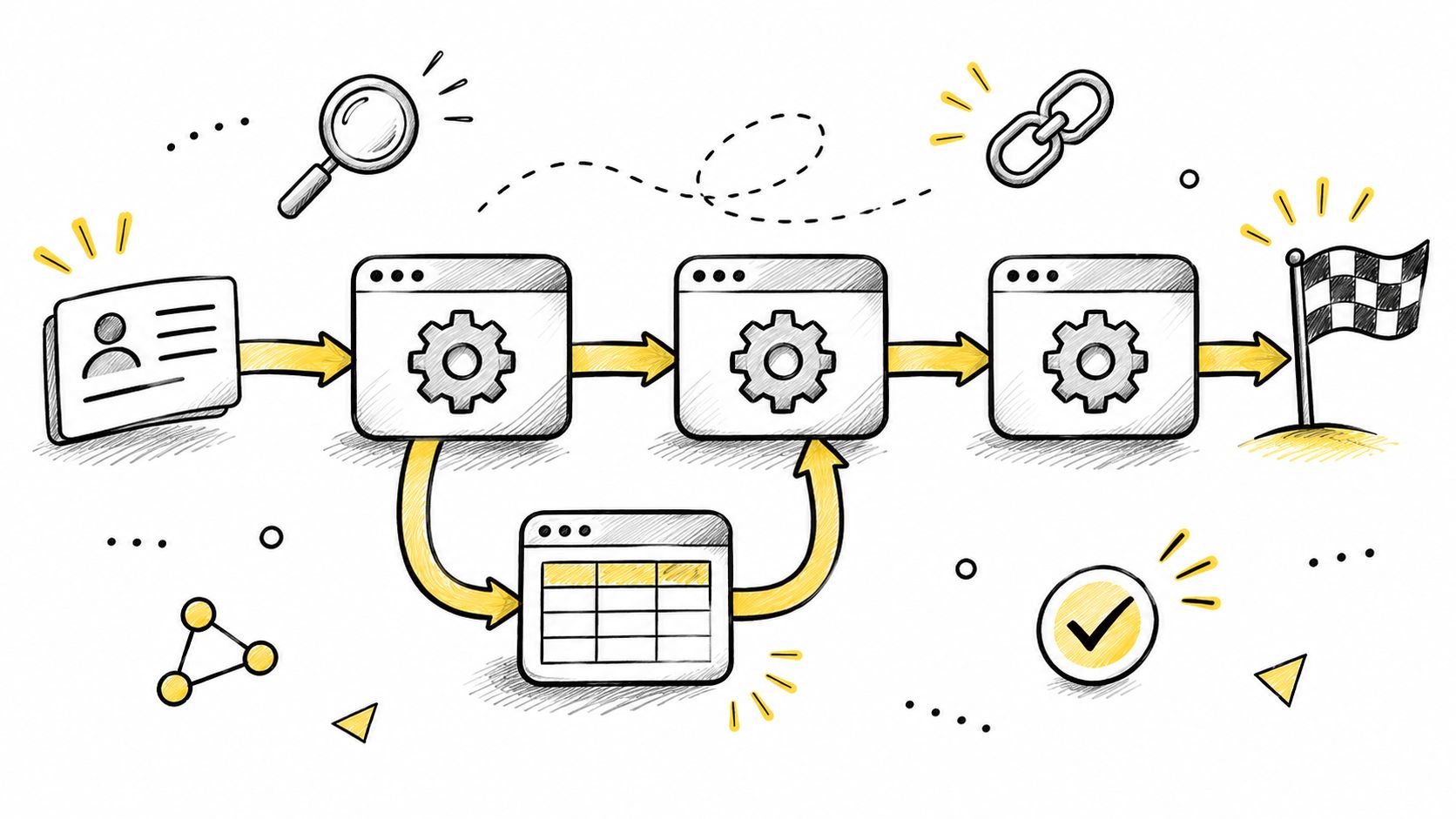
If a connector doesn't exist, you learn it in week one instead of week six with a go-live date already on the calendar. Most failed implementations trace back to an integration assumption nobody tested, and the SE who hears the actual flow early scopes middleware and API work realistically instead of promising a clean sync that never existed.
Practical rule: if you can't draw the flow on a whiteboard together, you can't scope it.
What to listen for
Listen for the verbs and the workarounds. "Salesforce pushes opportunities to the ERP every night" sounds clean until you ask what happens to records that fail validation. In a hypothetical RevOps conversation, tracing that flow reveals a manual CSV step the nightly job never covered. The SE who catches it folds the gap into the pilot rather than discovering it in UAT.
Thorough current-state work is measurable. RAIN Group's research on top-performing sellers reports that 58% effectively lead a thorough needs discovery, 60% change buyer thinking about needs, and 63% communicate strong, defensible ROI cases. Current-state architecture is one of five categories worth scoring on every call, next to business impact, required capabilities, the evaluation plan, and stakeholder alignment.
- Follow one record end to end before asking about the whole estate.
- Ask direction. One-way and bidirectional integrations change your design materially.
- Write down system names and methods so you never ask twice.
If you'd rather see the conversation modeled than described, this walkthrough is a reasonable reference for structuring questions around a live deal.
2. What does your data look like, how much of it is there, and who may touch it?

Sample data flatters every product. Real data exposes it. This question covers the object model, volume, sensitivity, residency, and access rules in one pass, and it's the fastest way to learn whether your demo survives contact with the prospect's environment.
Ask for object types first: accounts, transactions, tickets, assets, documents. Then order of magnitude on counts, then growth. A platform that's comfortable at tens of thousands of records can behave very differently at hundreds of millions, and you want to know which side of that line the evaluation sits on before you promise a live demo on production-like data.
The constraints that move timelines
Classification, residency, and retention rules decide whether the deal needs a data processing agreement or a specific hosting region. Both take time to arrange, and both hurt to discover during security review.
Say a fintech prospect mentions in passing that customer records must stay in the EU. The SE confirms the hosting option before the demo, and the deal avoids a late-stage rejection that had nothing to do with features.
- Ask for ranges first. Refine only if the deal progresses.
- Find the classification owner. That person belongs in the technical evaluation.
- Record residency and retention rules verbatim. They come back in the security questionnaire.
- Choose the POC data set now. The answer decides what the pilot runs on.
Keep a data readiness checklist open during the call so nothing gets skipped when the conversation speeds up.
3. How do identity, access, and single sign-on work in your environment today?
Identity slows down more technically sound deals than any missing feature. Ask how users are provisioned, how they authenticate, how roles and permissions are defined, and which identity provider holds the source of truth.
You're not auditing them. You're finding out whether the product has to support SAML or OIDC single sign-on, automated provisioning over SCIM, role-based access tied to directory groups, or all three. The answers shape the implementation plan, the licensing model, and the admin training you'll deliver after go-live.
Borrow the enforcement sequence
The NIST guidance on zero trust architecture lays out a sequence worth copying in miniature: inventory existing resources, formulate access policies that support real business use cases, verify enforcement, then keep monitoring whether observed traffic matches policy. Turned into discovery questions, that becomes: which identities, devices, applications, and data need access? What policy decides whether access is allowed? What test proves the control works for unmanaged devices and unauthorized users, not only for the happy path?
Identity questions aren't a security audit. They're an implementation plan arriving with better timing.
Say a prospect runs a SAML identity provider and says contractors must be deprovisioned inside a fixed window. The SE checks whether the integration supports automated deprovisioning, flags the gap early, and the team agrees on a workaround before the proposal goes out.
- Invite the identity administrator to the session, not just the project lead.
- Map user groups to your permission model on a shared screen while you talk.
- Separate required from preferred, because procurement treats them differently.
- Ask about access reviews if the customer runs one, since your product may need to support it.
If you want a broader structure for the whole conversation, the discovery call guide covers the sequencing.
4. What would a technical win look like at the end of this evaluation?
This question separates discovery from pitching. Ask the prospect to define success in measurable, technical terms before a demo or proof of concept begins. The answer becomes your test plan, your scorecard, and the definition of the technical win: technical stakeholders agree the solution meets requirements and the path to implementation is credible.
Without written criteria, evaluations drift into open-ended exploration. Buyers loop through six decision jobs, from problem identification to consensus creation, instead of moving in a straight line, and Gartner's B2B buying journey research reports that 75% of B2B buyers prefer a rep-free experience while still valuing access to technical experts at key moments. The practical output is a buyer-owned evaluation map: each requirement tied to a business outcome, a proof method, an accountable stakeholder, and a decision date.
Ask it as a test, not a wish list
"How will you know this worked?" produces short, specific answers. "What are your requirements?" produces a long list nobody can score.

Hypothetically, a head of engineering says the tool must process a daily file of a given size inside a fixed window and produce a report the finance team can audit. Those three conditions go into the POC plan and get confirmed in writing before any build work starts.
- Use the prospect's words and read them back for confirmation.
- Flag roadmap dependencies as risks, never as commitments.
- Reuse the same criteria at the closing review so the decision gets measured against what was agreed.
Running that plan well is its own discipline, and POC project management is where most technical wins are secured or lost.
5. What are you replacing, and which existing processes must keep working?
Every SaaS purchase competes with the status quo, and the status quo hides in tools, spreadsheets, scripts, and habits nobody documented. Ask what solves the problem today, what gets retired, and which downstream processes depend on the current setup.
MEDDPICC's decision criteria guidance gives you a frame: the buyer scores you against alternatives, and doing nothing is one of them. The framework splits criteria into technical, economic, and relationship categories, and the weighting shifts by organization and by stakeholder. Status quo questions sit in all three.
Hunt for the hidden dependency
The fastest way in is counterfactual. Ask what would break first if the current tool disappeared tomorrow, which surfaces dependencies faster than a checklist sprint.
Hypothetically, a prospect plans to replace a spreadsheet-based forecast. Mid-conversation, an SE learns that a regional sales director pulls one column from that sheet every week for a board pack. That column becomes a required output in the pilot, and the go-live plan keeps the old sheet alive for one parallel cycle.
- Ask who built the current process and whether that person is still at the company.
- Plan the parallel run deliberately instead of treating it as a failure of the new system.
- Record downstream dependencies in the same document as the success criteria.
If you're newer to the framework, MEDDPICC for Solution Engineers shows how criteria fit the rest of qualification. Retirement projects also carry their own sequencing, and Continuum Solutions' cloud migration guide for Australian businesses illustrates the dependency mapping that work requires. The same logic applies when you pull an internal tool out of production.
6. What will your security and compliance review require, and how long does it usually take?
Security review is often the longest single step in an enterprise deal, and it's invisible to you until the security team appears. Ask the prospect to map it: which questionnaires, certifications, penetration test reports, architecture diagrams, and data processing terms the team expects, who approves each one, and what their normal cycle time looks like.
You're not answering the questionnaire on this call. You're making the technical plan and the commercial timeline agree.
Cycles got longer even as buyers research faster. The Starr Conspiracy's 2025 B2B buyer journey trends brief notes that enterprise sales cycles increased 24% from 2022 to 2024 while individual buyer research time fell 18%, with consensus and procurement named as key drivers. Security and procurement reviews are where that extra time goes.
Shorten the review before it starts
- Get the review path in writing after the call so the champion can confirm it internally.
- Ask whether security has approved a similar vendor before. Prior approval shortens the cycle considerably.
- Keep a standard document pack ready so you respond in days rather than weeks.
- Bring in your own security contact early when the requirements are unusual.
Hypothetically, a prospect's procurement page lists a standard questionnaire and an independent audit report. The SE pulls the questionnaire early, finds the required report isn't published yet, and the team adjusts the close plan before the forecast is committed.
Most of this is a document exercise. Structuring RFP requirements so you can answer from evidence is the difference between a two-week review and a six-week one.
7. Who will own this after go-live, and how much capacity do they have?
Plenty of technically strong deals go sideways after signature because nobody on the customer side owns the product day to day. Ask who administers it, who maintains integrations, who handles escalations, and how much time those people can realistically give.
The answer sizes onboarding, training, and professional services. It also tells you whether the account needs a managed service or a heavier success plan, and whether your champion has the bandwidth to drive adoption or only the enthusiasm.
Connect ownership to authority
Ownership without authority is a support ticket generator. MEDDPICC's definition of the economic buyer describes the role as the person with overall authority in the buying decision, someone who can approve when others object or reject when others support, and notes the role can sit with a committee or board. It also lists three questions that role tends to ask: what it costs, how quickly the organization realizes value, and how easy it is for users to adopt. Your day-to-day owner has to be able to answer the third one.
Say a prospect names a single administrator who already runs three other systems. The SE proposes shared ownership in the implementation plan and a managed onboarding option. The customer accepts, because someone finally named the constraint out loud.
- Ask it in future tense. "Once this is live, who checks it every week?"
- Test for authority, not reporting. Can the owner change a process?
- Pass the answer to customer success in the handover notes.
- Revisit at the POC review, since staffing changes mid-evaluation.
8. Who else must be satisfied technically before you sign, and how will we test it?
Technical buyers rarely sit in one role. An enterprise decision pulls in an architect, a platform engineer, a security lead, a data team, and an end-user group. Any of them can stall a deal the business sponsor already loves.
Gartner's buyer enablement research puts the median B2B buying group at six to ten decision makers, each independently gathering four or five pieces of information. Use that as a prompt to check stakeholder coverage, not as a qualification threshold.
The information ecosystem is part of the evaluation
Assumptions arrive before you do. Docket's analysis of B2B tech marketing notes buyers use an average of seven information sources, that 45% use generative AI during research, and that 69% prefer to validate AI-generated insights with a sales rep. Three questions earn their place in every late-stage call as a result: which claims or assumptions shaped the shortlist, what security or procurement needs to see before the business case is credible, and who can veto this even if the technical evaluation succeeds.

Say an enterprise architect has never joined a call. The SE asks the champion for thirty minutes of architecture review before the POC. That conversation surfaces a requirement that would have blocked signature two weeks later.
- Ask who can say no, and who can say yes but cannot sign.
- Tie each stakeholder to a specific test or artifact so no requirement floats unowned.
- Update the map after every session, not only at the start.
The POC success criteria template gives every stakeholder requirement a home.
The 8 Technical Discovery Questions at a Glance
| Question Focus | Deal Risk It Prevents | Best Asked During | Stakeholder It Reaches |
|---|---|---|---|
| How data moves between systems today | Hidden integration dependencies and scope creep | Early technical discovery | Technical champion, systems or integration owner |
| Data shape, volume, sensitivity, residency, and access | Production-scale, privacy, or compliance blockers | Early discovery, before demo or proof of concept | Data owner, security team, or data protection officer |
| Identity, access, and single sign-on requirements | Identity feature gaps and implementation delays | Technical discovery, before demo or proposal | IT administrator or identity provider owner |
| Measurable criteria for a technical win | Open-ended evaluations and unclear sign-off | Before demo or proof of concept | Technical approver and economic buyer |
| What will be replaced and which processes must continue | Broken dependencies, migration issues, and adoption resistance | Discovery and migration planning | Current system owner and affected process users |
| Security and compliance review requirements and timing | Late-stage review delays and missed close dates | Early discovery, before setting the close plan | Security, compliance, or procurement team |
| Post-launch ownership and available capacity | Weak adoption and an unsupported implementation | Discovery and implementation planning | Future administrator and operational owner |
| Technical stakeholders, their requirements, and how to test them | Late-stage technical vetoes and incomplete evaluations | Before technical sessions or proof of concept | Technical champion, architects, security, and platform teams |
Turn These Questions Into a Habit, Not a Checklist
Reading eight questions takes minutes. Asking them well while a solution architect watches you and a champion checks the clock takes reps.
Structured questioning is trainable, and the effects last. A controlled 12-week study published in the Journal of Educational and Social Research split 60 third-year education students into two groups of 30 and taught one cohort with Socratic questioning instead of lectures. The reported effect sizes were .361 for overall epistemic curiosity, .426 for total historical empathy, and .288 for behavioral empathy, and the gains were still visible at follow-up. The mechanism is unglamorous: you get better at asking because you practice asking, not because you memorized a question list.
Volume isn't the answer either. Trackpoint's summary of Gong's 2025 analysis of 326,000 sales calls found sellers on won deals asked an average of 15 to 16 questions per call, against about 20 on lost deals. Fewer, sharper questions beat a longer interrogation every time.
That's why PreSales Unleashed GmbH built the Trusted Advisor Academy around application rather than theory. Members bring live deals into sessions and get feedback on their own discovery calls, demos, and POCs, which is a different exercise from watching someone else's polished call replay. If your team tracks the technical win rate as a north star metric, discovery quality is the input that moves it.
So pick one question from this list you've never asked cleanly. Use it on your next call. Write down what changed in the answers, and bring that note to your next deal review. If you want structured practice with peers and coaching, start with the free discovery call at the SE Rockstars discovery call. It costs nothing and requires no commitment.
No discovery, no demo. The SEs who win technically are the ones who ask better questions first.
PreSales Unleashed GmbH runs the Trusted Advisor Academy, a 12-month program where Solution Engineers practice discovery, demos, POC management, and value articulation against their own active deals, with weekly live sessions and more than 100 ready-to-use assets. Every question in this article has a practice routine behind it, and the team will pressure-test a live opportunity with you. Visit PreSales Unleashed GmbH to book the free discovery call and see how the program fits your team.