
The most popular advice about mastering technical sales is still "get better at the demo." Tighten the click path. Memorize the happy path. Add one more screen so nobody asks a question you cannot answer. That advice trains the wrong muscle.
Buyers already arrive with a shortlist, a stack of architecture notes, and an AI summary that may have flattened your limits into a feature bullet. A polished demo cannot repair a discovery that never named the problem, the owner, or the decision the meeting is supposed to change. Discovery quality, not demo polish, decides deals. No discovery, no demo.
If you are a Solution Engineer (SE) in B2B SaaS, the outcome you own is the technical win: technical evaluators and business sponsors agree the solution fits, and the evaluation criteria are met. Demo theater can win applause. It rarely wins that agreement.
The Six Competencies Behind Technical Sales Mastery
Six competencies produce a technical win, and the order is not optional. Discovery comes first because everything else is a translation of what you heard. Demo design, sales alignment, POC management, value articulation, and content legibility fail in predictable ways when discovery was thin. If you are still mapping where this work sits next to the AE, the guide to what PreSales is is the clean starting point.
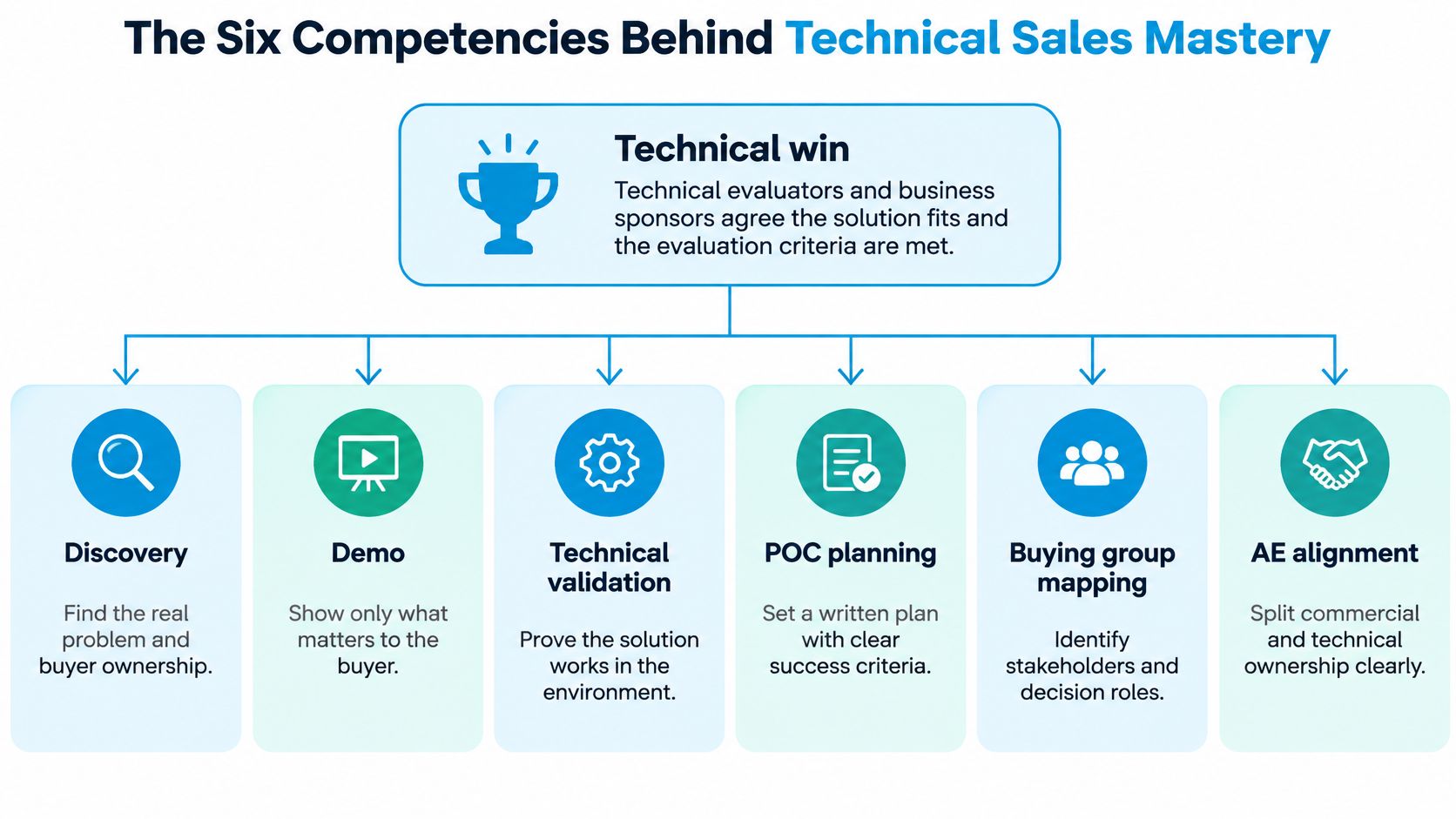
| Competency | What strong SEs do | Evidence the skill is improving | Warning sign |
|---|---|---|---|
| Discovery | Tests workflow-level assumptions before any demo | Demo scope written from confirmed criteria | Demo requested before the problem or its owner is named |
| Demo design | Shows only the workflows tied to buyer criteria | Buyer names the next step during the session | Demo built from the feature list instead of the discovery notes |
| Sales alignment | Agrees roles, milestones and next steps with the AE | Shared plan with dated actions on both sides | AE and SE describe the same deal differently in forecast reviews |
| POC management | Runs proofs against written success criteria | Signed evaluation plan with thresholds and owners | Thresholds written after results arrive |
| Value articulation | Turns technical capability into business consequence | Buyer restates the impact in their own terms | Buyer praises features but cannot name the outcome |
| Content legibility | Keeps architecture, limits and claims consistent across demo, docs and AI summaries | No conflicting answers across channels | Two teams give different answers about the same integration |
Content legibility is the newer bar. Buyers research vendors with AI tools before they speak to anyone. IDC reports that 68% of buyers frequently use AI to compare products and features, 46% use tools such as ChatGPT or Gemini to evaluate vendors, and only 33% rely on the vendor salesperson as an active evaluation source. Architecture notes, comparison pages, and security evidence have to survive summarization. If two pages disagree about an integration, the summary will pick one, and you will spend the first call correcting a claim you never made.
Practical rule: Find the row where your last ten deals stalled. That row is where practice pays off first. The 30-day routine at the end of this guide is built for that choice.
How to Run Discovery That Earns the Demo
No discovery, no demo. A demo request without a named problem, a relevant stakeholder, and a next decision is a request to spend scarce time producing content. Salesforce's current State of Sales reporting puts sellers at 40% of their time selling, with the remaining 60% on non-selling work such as data entry, prospecting, planning, quote creation, training, and administration. That split is not an SE benchmark. It is a capacity warning. Salesforce's seventh State of Sales report surveyed 4,050 sales professionals across 22 countries in August and September 2025 and found the same 40% selling share. Protect the hours you still control.
The full question set lives in the discovery questions guide. The sequence below is the gate.
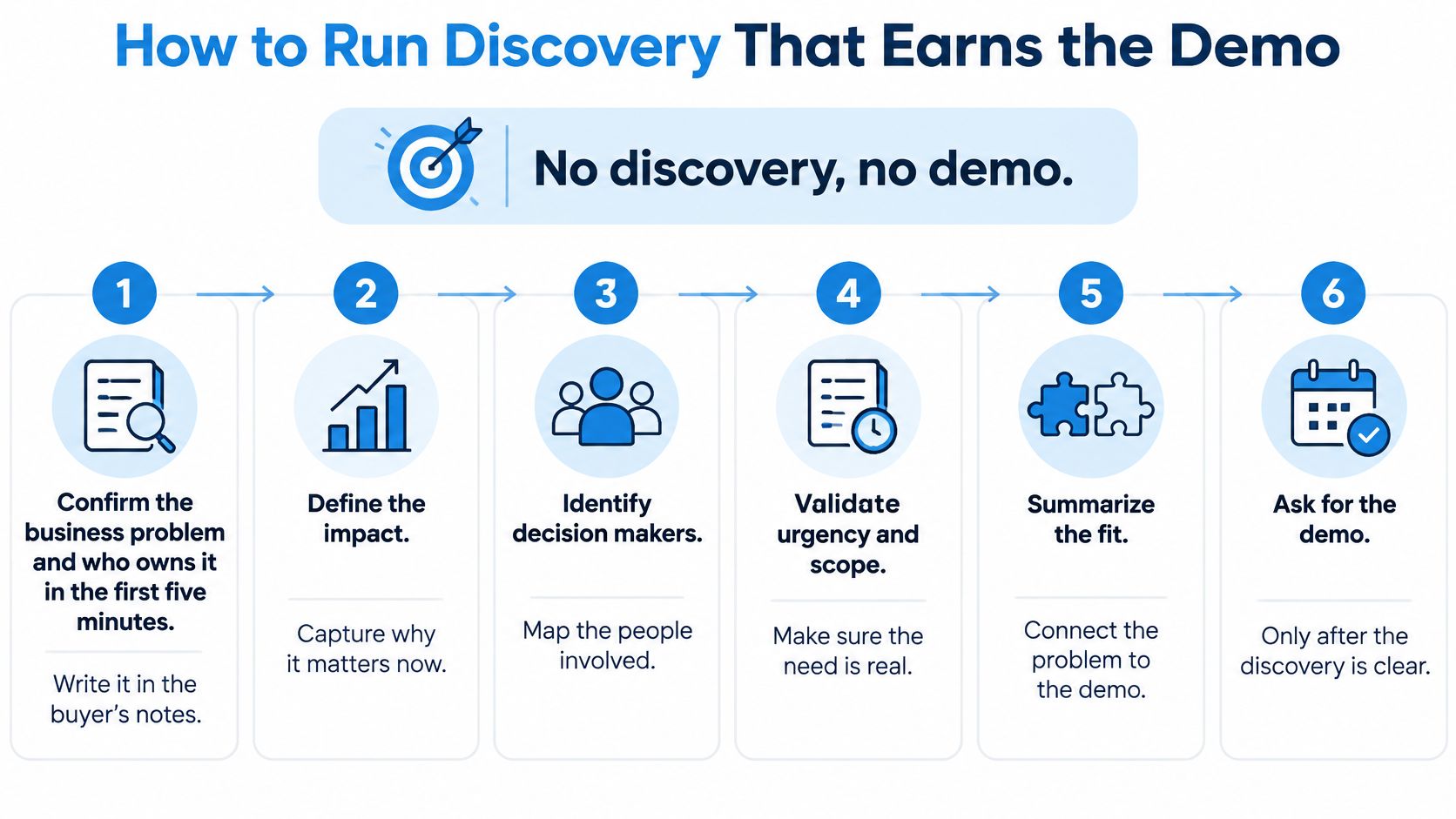
- Confirm the business problem and who owns it in the first five minutes. Write it in the buyer's words, not your product language. The slip is accepting a feature list as requirements. A list of "must haves" is a wish, not a problem.
- Map the current workflow with the person who runs it. The sponsor who booked the meeting often describes a process they no longer touch. You want the operator who feels the delay.
- Test the technical boundaries. Ask for transaction volume, integration dependencies, security controls, and latency tolerance. Generic "we need it to scale" answers are not boundaries.
- Ask who owns the process after go-live. That owner decides adoption. Skipping this question leaves you optimizing for a champion who will not run the tool on Monday.
- Agree the decision criteria and the date of the next decision. If the criteria are still "see if we like it," you do not have an evaluation. You have a tour.
- Write the demo or POC scope from those answers. Label every item as standard, configurable, custom, or out of scope before you open the environment.
The call test
If the buyer cannot name a decision the demo will inform, the demo waits. Decline the session, or shrink it to a fifteen-minute problem check. Reusable templates make that refusal normal instead of personal. You are not being difficult. You are refusing to turn PreSales into unscoped support.
Say a security lead forwards a one-line request: "Can you demo SSO next Tuesday?" You reply with the problem, the owner, and the decision date. If those three come back blank, you send a short written brief and hold the calendar. Average SEs fill the slot. Strong ones protect it.
Demo Formats Compared and When Each Fits
The format follows discovery. Picking a format because it looks impressive, or because the AE promised "a full product walkthrough," is how feature objections get invented in the room.
| Format | Best for | Buyer signal to watch | Main risk |
|---|---|---|---|
| Feature tour | Early exploration with a broad audience | Questions limited to roadmap or pricing scope | Spends time on capabilities no criterion needs and invites feature objections |
| Scenario demo | Confirmed use case with a named workflow owner | Buyer corrects the workflow on screen | Fails if the scenario was assumed rather than confirmed in discovery |
| Proof-driven walkthrough | Late evaluation with a technical evaluator | Evaluator asks for test data, thresholds or configuration detail | Slides into an open-ended POC without an evaluation plan |
| Executive summary demo | Economic buyer with a short window | Sponsor restates the business outcome in their own words | Hides integration limits unless a technical session follows |
A feature tour is honest only when the room is still exploring. Watch the questions. Roadmap and pricing questions mean you are entertaining, not evaluating. Stop adding screens.
A scenario demo works when a named owner has already described the workflow. The useful signal is a correction: "We don't do it that way, we batch at 4 p.m." That correction is better than silence. If you invented the scenario, the correction becomes distrust.
A proof-driven walkthrough is for a technical evaluator who wants numbers. When they ask for test data or configuration detail, answer, then stop. If you keep going, you have started a POC without a plan.
An executive summary demo is a short argument, not a product class. The sponsor should be able to restate the outcome. Integration limits still have to be named, or the next technical session will look like you hid them.
Two rules for every format
Show only workflows tied to criteria you confirmed. State known limitations before the buyer finds them. When you expose a failure mode, name the limit, show the workaround, and tie the choice back to their criteria. Confidence comes from the decision, not from a perfect path.
More patterns sit in these demo examples.
Hypothetical: a logistics team spends three hours a day reconciling shipments. The scenario demo shows only that reconciliation. On screen you label the core match as standard, the exception queue as configurable, and the ERP connector as configurable with a named owner on their side. A custom data model is marked out of scope. You say the connector does not support their legacy flat file without that owner. The buyer either accepts the owner or you stop. After any demo, ask one check: did the buyer confirm a criterion or name a next step? If neither happened, the format was wrong or the discovery was.
Aligning With the AE and Mapping the Buying Group
One technical narrative fails in an enterprise deal because the room is not one person. Salesforce reports that the average enterprise B2B deal involves about 10 stakeholders across the buying committee and may run for 6–18 months. The person on your discovery call is a slice of that committee. A late objection often comes from someone who was never in the first meeting.
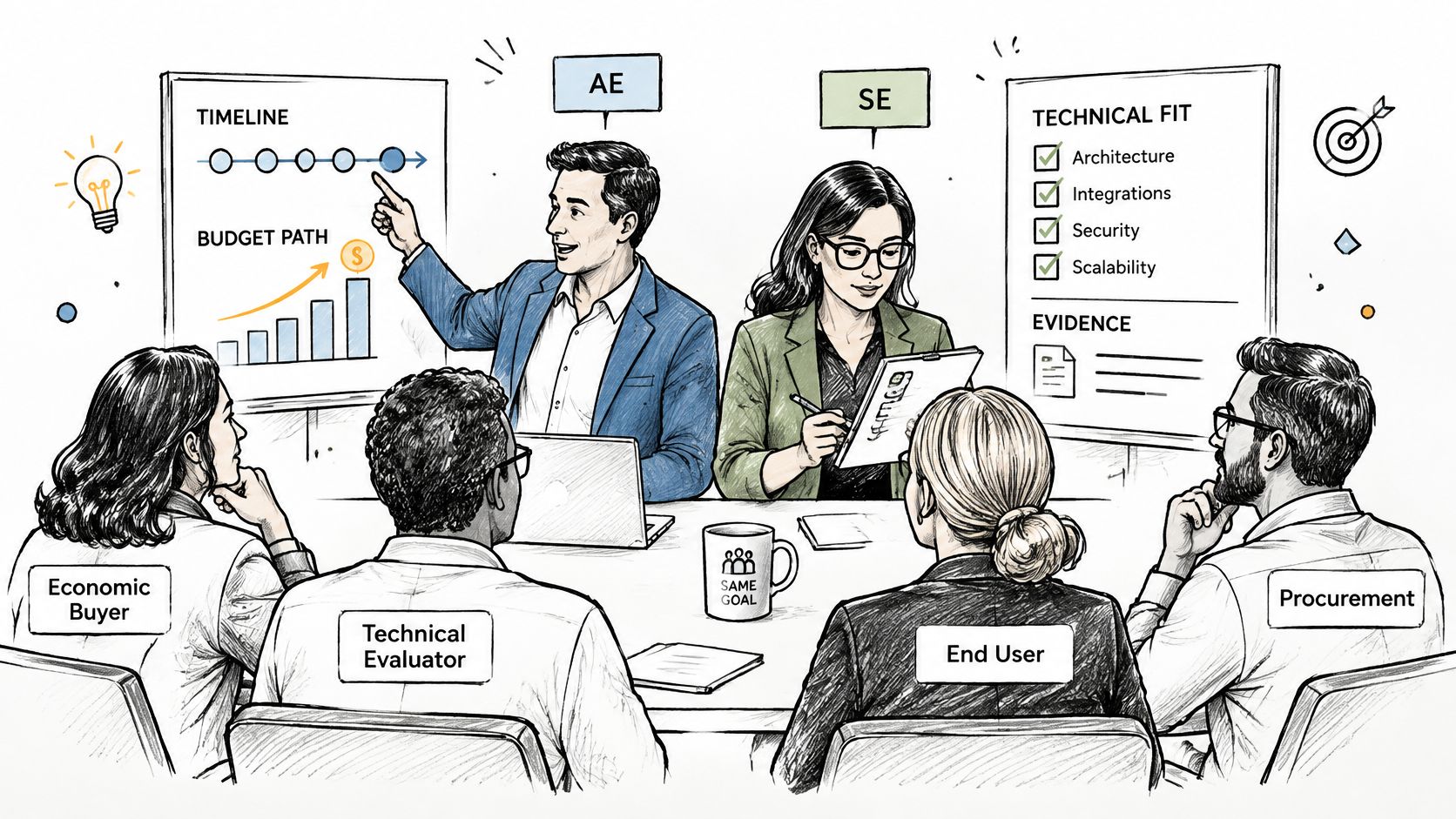
Split the work on purpose. The AE owns the commercial path, the timeline, and the budget conversation. You own technical validation and the evidence that the solution fits. Before a joint call, agree which questions each of you asks, and who answers which technical objection. If you both answer architecture, the buyer hears two products.
What each role has to validate
- Technical evaluators: architecture, integration, and whether the design matches their environment.
- Business sponsors: the outcome, the risk if they do nothing, and whether the change is worth the disruption.
- Security and legal: data handling, residency, and contract exposure.
- Procurement: terms, process, and whether the evaluation followed their rules.
- Operational users: daily fit, including the steps you skipped because they looked minor in a demo.
MEDDPICC for Solution Engineers is the fuller method behind the map. The field habit is smaller. Keep a stakeholder map in the opportunity record. After every meeting, update who was there, what they still need to validate, and the open question attached to their name.
Hypothetical: a security architect joins in week eleven and asks about data residency. Nobody raised it in discovery because the initial contact had no security role. The deal does not stall because the product lacks an answer. It stalls because the map had a blank where that role should have been, and eleven weeks of context now has to be rebuilt for one person.
A forecast review where you and the AE tell different stories is not a messaging problem. It is an unowned stakeholder.
How to Run a POC Without Open-Ended Drift
A POC without a written plan converts your time into unmeasured support. Gartner reports that self-service digital purchases are 1.65 times more likely to produce buyer regret than traditional rep-led purchases, while rep-assisted digital paths reduce regret by half. Buyers are also 2.8 times more likely to complete a high-quality deal when they perceive strong consistency between supplier information and seller explanations. Your demo, your diagram, and your POC plan have to say the same thing about architecture, integrations, security, deployment, and performance.
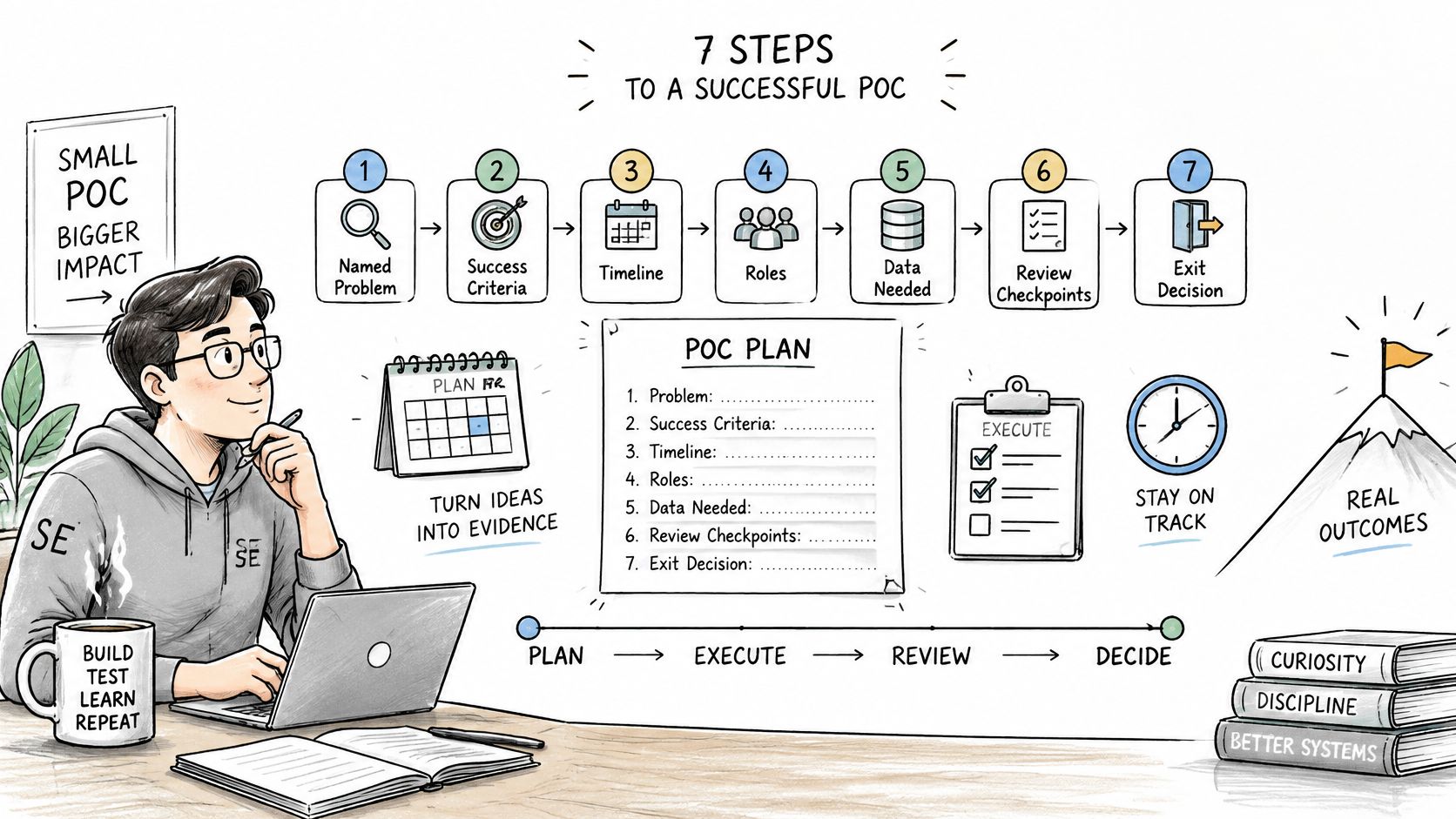
Keep one maintained record of solution diagrams, supported configurations, benchmark conditions, reference architectures, and qualification boundaries. Every team reads from that record. A side deck that "simplifies" a limit is how the 2.8 times consistency advantage gets thrown away.
The POC plan template is the one-page version of the steps below.
- Confirm the POC is justified. You need a named problem, an owner, and a decision date. Without those, you are running a lab for a maybe.
- Write a one-page scope. List in-scope and out-of-scope capabilities. Expansion is the usual failure, because nobody owns the exit.
- Define test data, environment, and configuration assumptions. Check that every claim matches the demo and the solution diagram. A benchmark with unnamed hardware is not a result.
- Set acceptance thresholds before you start. Use numbers. The failure mode is writing thresholds after the results arrive so the POC "passes."
- Assign owners and dates for buyer tasks and vendor tasks. An unowned task is a slip you will discover in week three.
- Agree the decision rule. Which results mean go, no-go, or revise. "We'll know it when we see it" is not a rule.
- Schedule checkpoints and log every deviation from scope. A logged deviation can be refused. An unlogged one becomes the new plan.
AI features and the security clock
For any AI-enabled feature, write test cases before day one for data provenance, known model limitations, privacy and data handling, integration behavior, and audit logs. Each test gets an acceptance threshold. Name the limit in the demo of that feature, show the workaround, and let the threshold decide. Start the security review in week one. IT-security review is a frequent source of purchase delay, and a packet that arrives in the last week is a pause you scheduled yourself.
This short walkthrough shows how a written evaluation plan keeps a proof from drifting:
At the midpoint, a healthy POC looks boring. The buyer reviews results against thresholds, not impressions. If the meeting is still "how does it feel," you do not have a proof. You have a second demo with extra meetings.
Measuring Technical Win Rate and SE Impact
Activity counts flatter the wrong behavior. SE impact needs measures that separate a leading signal from a lagging one, and a shared definition with the AE so the CRM and the review use the same words. A fuller treatment of the north-star metric is in technical win rate.
| Metric | How to calculate it | What it reveals | Common misread |
|---|---|---|---|
| Technical win rate | Technical wins divided by opportunities with SE involvement | Whether technical validation holds up to the buyer's criteria | Counting wins on deals that were never properly qualified |
| Documented success criteria rate | Opportunities with written criteria before the demo, divided by all opportunities | Quality of discovery | Treating an unsigned criteria list as agreed |
| Demo-to-POC conversion | POCs started divided by demos delivered | Whether demos create real evaluation intent | Blaming demo quality when the audience lacked authority |
| POC completion against schedule | POCs finished by the agreed date divided by POCs started | Execution discipline | Penalizing a valid no-go decision as a failed POC |
| Loss reason mix | Lost deals tagged as qualification, value, product gap or execution, divided by all losses | Where the technical process breaks | Tagging almost every loss as a product gap |
Read them by segment
A blended number hides the cause. Review each metric by segment and use case. Losses cluster. Poor qualification, weak value articulation, a real product gap, and inconsistent execution do not look the same once you split the book.
Hypothetical: a team sees a low demo-to-POC rate and rewrites the demo script. On review, most of those demos went to end users with no budget authority. The problem sits in who was invited, not in the click path. Fixing the script would have burned another month.
A POC that ends in a documented no-go is a valid outcome. Count it as completion when the decision rule was followed. Punishing that result teaches SEs to avoid hard thresholds.
Start with two metrics you can calculate this month from the CRM. Agree the definitions with the AE in writing before you publish a number. An unsigned criteria list is not "documented." A win on a deal that skipped qualification is not a technical win.
Pick One Competency to Practice This Quarter
You will not raise all six competencies in a quarter, and trying to is how practice stays vague. Use the warning-sign column as the menu. Choose the competency where recent deals stalled. One stalled pattern, practiced on purpose, beats a general "get better at technical sales" goal.
There is no straight path into PreSales. Skill, not a job title, is what earns trust, and deliberate practice is how that skill gets built. A 30-day routine is short enough to finish and specific enough to see.
- Week one. Re-listen to two discovery calls. Write down the workflow-level questions you skipped, especially volume, integrations, security controls, latency, and who owns the process after go-live.
- Week two. Rebuild one demo from its discovery notes. Cut every screen that serves no confirmed criterion. If the notes cannot support a scenario, the demo was early.
- Week three. Draft a POC plan with thresholds and owners. Test it on one active evaluation. If the buyer will not sign the decision rule, you do not have a POC yet.
- Week four. Check one architecture diagram against its public description. Correct every contradiction before an AI summary does it for a buyer.
The Trusted Advisor Academy covers discovery, demos, sales alignment, POC management, and value articulation, with practice tied to active deals rather than a one-off workshop. If you want to compare how programs are built, review the PreSales training guide. If you already know the weak competency and want to talk it through, book a discovery call. Pick the row, run the four weeks, and judge the next deal by whether the buyer can restate the outcome and the limit in their own words.
PreSales Unleashed GmbH trains Solution Engineers through the Trusted Advisor Academy, with practice on discovery, demos, sales alignment, POC management, and the technical win. If your deals stall on thin discovery or drifting proofs, that is the work the program is built around. Visit PreSales Unleashed GmbH to see how the Academy fits the competency you chose.