
You have a buyer who wants a proof of concept, an Account Executive who wants it started Monday, and no written agreement on what success looks like. The environment isn't ready, the data owner is on leave, and the decision date is a vague promise to regroup later. That's how a two-week test turns into six weeks of unpaid implementation work.
You don't fix that with more demo polish. You fix it with a proof of concept plan template that forces a decision. Every field in it should change what happens next. If a field changes nothing, delete it.
Proof of Concept Plan Template at a Glance
Copy this table into a shared document and treat it as the working plan, not as paperwork you fill in after kickoff. All entries in the third column are hypothetical and show the level of detail you should require.
| Field | What you write | Hypothetical entry |
|---|---|---|
| Business problem | The buyer pain in their words, tied to a metric | Tier-1 agents lose about 20 minutes per ticket switching between three systems |
| Hypothesis | One testable statement with a user, an action and a number | Tier-1 agents resolve billing tickets on one screen, cutting handle time by 15% |
| Scope in | Named workflows, users and data sample | Billing ticket workflow, five Tier-1 agents, 200 anonymized tickets |
| Scope out | What the POC will not test | No production rollout, no custom reporting, no SSO migration |
| Integrations | Systems touched and their delivery risk | CRM read and write (high risk), data warehouse export (low risk) |
| Success criteria | Each criterion with threshold, evidence and owner | Handle time at least 15% faster than baseline, evidence from ticket logs, owner is buyer operations lead |
| Metrics | Measures, collection method and evidence source | Median handle time from ticketing system logs |
| Timeline | Start date, checkpoints and decision date | Start June 2, mid-point check June 9, decision meeting June 16 |
| Roles | One named owner for each decision and task | Buyer IT owns the security review, the SE owns test scripts |
| Risks | Known unknowns with owner and fallback | SSO access may slip, owner is buyer IT, fallback is local accounts with approval |
| Post-POC path | What happens on pass, revise or fail | Pass means pilot with named business owner, revise means one retest cycle by a set date, fail means stop and log reasons |
| Decision record | Sign-off, date and residual risks | Signed by the economic buyer and the technical owner |
Why the fields are in this order
The first two rows state the problem and hypothesis. The next three draw the test boundary. The middle block builds the decision machinery, covering criteria, metrics, timeline, roles and risks. The last two rows record the outcome, so the plan doesn't end at a verdict with no owner.
That order matters in startups too, where teams often need to validate demand before seeking funding rather than build first and justify later. In a B2B SaaS deal, the same discipline protects your time. If you want to see how bounded tests differ from open-ended trials, work through these POC examples before you adapt the table.
A plan for a two to six week POC should fit on two pages. If one field needs more room, your scope is too big and the scope rows need another cut. Fill in the business problem and hypothesis before any technical work starts. No discovery, no demo, and no POC either.
How to Define the Hypothesis and Scope
Start with the decision the POC will feed, not the feature list. The NASA systems engineering guidance defines a PoC as an analytical and experimental demonstration of a hardware or software concept that may or may not become part of a later operational system, typically testing only parts of a complete system in a test environment. Use that boundary. You're proving one claim, not enterprise readiness.
The visual below summarizes the sequence before the detailed steps.
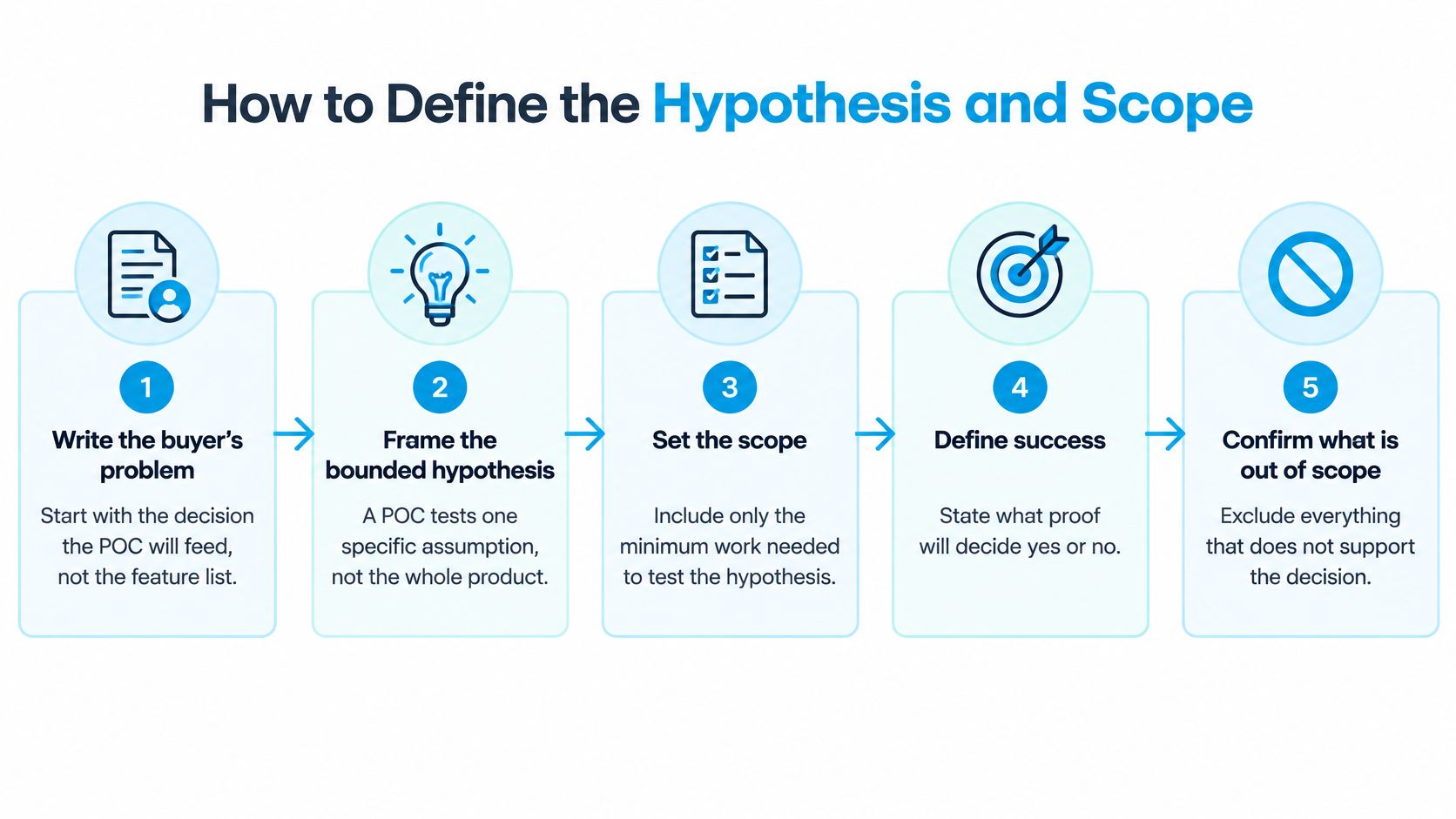
- Write the buyer's problem in their words. Attach the metric it moves, because a pain without a number can't produce a threshold. Hypothetical example, Tier-1 agents spend 20 minutes per ticket switching between three systems.
- Turn it into one hypothesis. Name the user, the action and the number, so the statement can fail. Strong discovery questions make this easier, which is why it's worth sharpening your sales discovery questions before you draft it.
- List scope in. Name one or two high-value workflows, the users who run them and the data sample size, because representative work beats broad coverage.
- List scope out explicitly. Exclude production rollout, full data migration, reporting and unrelated business units, because silence invites scope creep.
- Name the riskiest integrations. Pick the one or two with the highest delivery risk, not every connector on the vendor's list, because those decide whether deployment is realistic.
- Define the evidence. State whether validation comes from a test log, a reviewer scorecard or a signed sample audit, because opinions don't close a gate. QA teams face the same issue when they measure test automation success with KPIs instead of relying on activity counts.
- Write the decision authority. Name who says yes, no or revise, because a result without a decision owner drifts.
Scope test: Could someone who missed kickoff tell from this page what passes and what fails?
The common slip happens mid-test, when a buyer asks for a second workflow because the first one looks good. Don't absorb it without notice. Either log it for the pilot or trade it against existing scope with written sign-off. An out-of-scope list signed in week one gives you something to point to.
Build a Timeline for a 2 to 6 Week POC
Build backward from the decision meeting, and book that meeting before the POC starts. The table below is a planning pattern, not a benchmark. Durations are hypothetical, because real timing depends on how fast the buyer grants data access and approvals.
The timeline graphic shows how the phases compress or expand by duration.
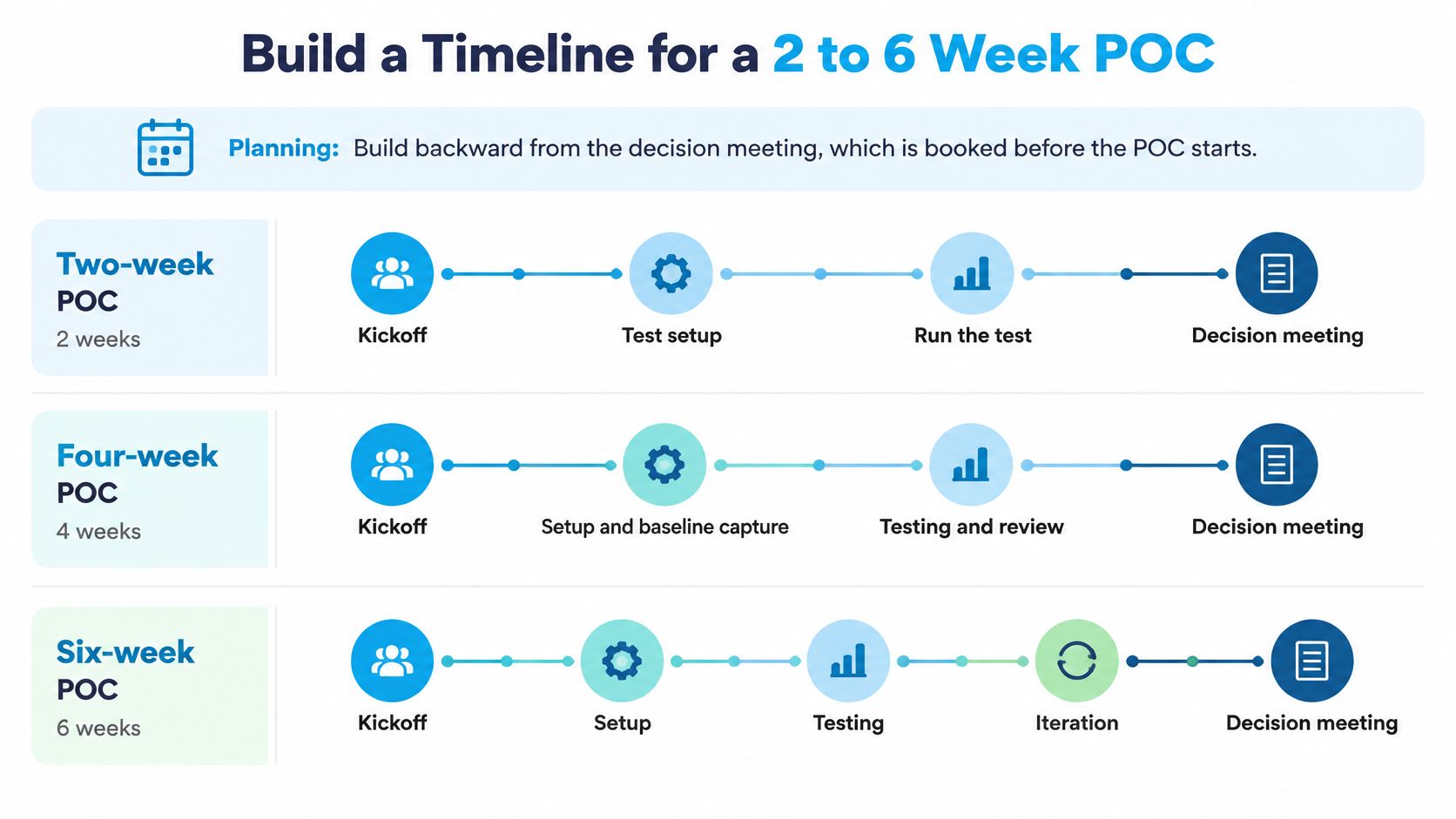
| Phase | 2-week POC | 4-week POC | 6-week POC |
|---|---|---|---|
| Scope and hypothesis sign-off | Days 1-2 | Week 1 | Week 1 |
| Baseline measurement | Before day 1 | Before week 1 | Before week 1 |
| Environment and data access | Days 1-4 | Week 1 | Weeks 1-2 |
| Core scenario testing | Days 5-8 | Weeks 2-3 | Weeks 2-4 |
| Evidence review and mid-point check | Day 7 | Week 2 | Week 3 |
| Failure and integration tests | Day 9 | Week 3 | Weeks 4-5 |
| Decision meeting | End of week 2 | End of week 4 | End of week 6 |
Five readiness gates before day one
Give each checkpoint a date and an owner. Don't treat them as admin tasks you can chase later.
- Data access and permissions review: Confirm who can see, export and delete the test data.
- Integration dependencies: Confirm credentials, endpoints and change windows for each in-scope system.
- Single sign-on verification: Test login with a buyer account, not a vendor demo account.
- Accessibility review: Check the user-facing screens the testers will use.
- Security review owner: Name the person who can approve or block the test environment.
Baseline measurement is a pre-start row, so it must be complete before the first test runs. Without it, you'll argue about improvement at the decision meeting with nothing to compare against.
Where timelines actually slip
Data access is the most common delay, followed by security approval. That's why both get their own checkpoint instead of hiding inside setup. Treat each gate seriously. If one is still open at the mid-point check, shrink the scope rather than moving the decision date.
Include one deliberate failure test for each critical integration. Take the connection down on purpose, record what users see, and time the recovery. A workflow that only works when everything else works hasn't proven much.
For a two-week POC, cut scope to one workflow and one integration. Don't squeeze four weeks of work into fourteen days and call the result a fair test. The decision meeting needs a calendar slot, written exit criteria and a named signer before day one.
Roles and Responsibilities That Keep the POC Moving
One name per decision. A committee can't sign off, and a shared inbox can't own a delay. If two people think they own the same gate, neither of them does.
- Executive sponsor: Owns funding for the next step, signs the final decision, delivers the go, revise or stop call in the decision meeting.
- Economic buyer: Owns the business problem, signs the threshold that justifies spend, delivers written confirmation that the metric matters.
- Buyer technical owner or IT security: Owns the security review, access and integration approvals, signs the environment approval, delivers the approval record.
- Data owner: Owns the sample, signs the data-handling terms, delivers a representative data set by the agreed date.
- Business owner: Owns the user tests, signs the adoption evidence, delivers completed test sessions with named users.
- Solution Engineer (SE): Owns the test scripts and scenario runs, signs the evidence pack as accurate, delivers logs, scorecards and the residual risk list.
- Account Executive: Owns the commercial path, signs the pilot proposal, delivers pricing process steps and procurement dates without inventing commitments the POC hasn't earned.
- Vendor project lead: Owns the timeline and decision log, signs the weekly status record, delivers checkpoint notes with owners and dates.
Who owns the verdict
Hold this line. The SE owns the proof, the buyer owns the verdict. If you grade your own test, the buyer has no reason to trust the result, and you have no protection when they dispute it later.
That split confuses new team members, especially when PreSales, sales and delivery overlap. Point them to this explanation of what a Sales Engineer does so the SE role stays clear. You're there to run a fair test and produce evidence that supports a technical win, not to act as free implementation labor.
If a role has no deliverable and no signature, it's an attendee, not an owner.
Check the list at kickoff and ask one blunt question. Who can stop this POC, and who can approve the pilot? If nobody in the room can answer, pause and find those people before you build anything.
Write Success Criteria Before Day One
Most weak POCs end with the same verdict, the team liked it. That's not a criterion. It's a mood, and it won't survive a budget review.
The image below shows the kind of working session you need, where criteria get argued before anyone touches the product.
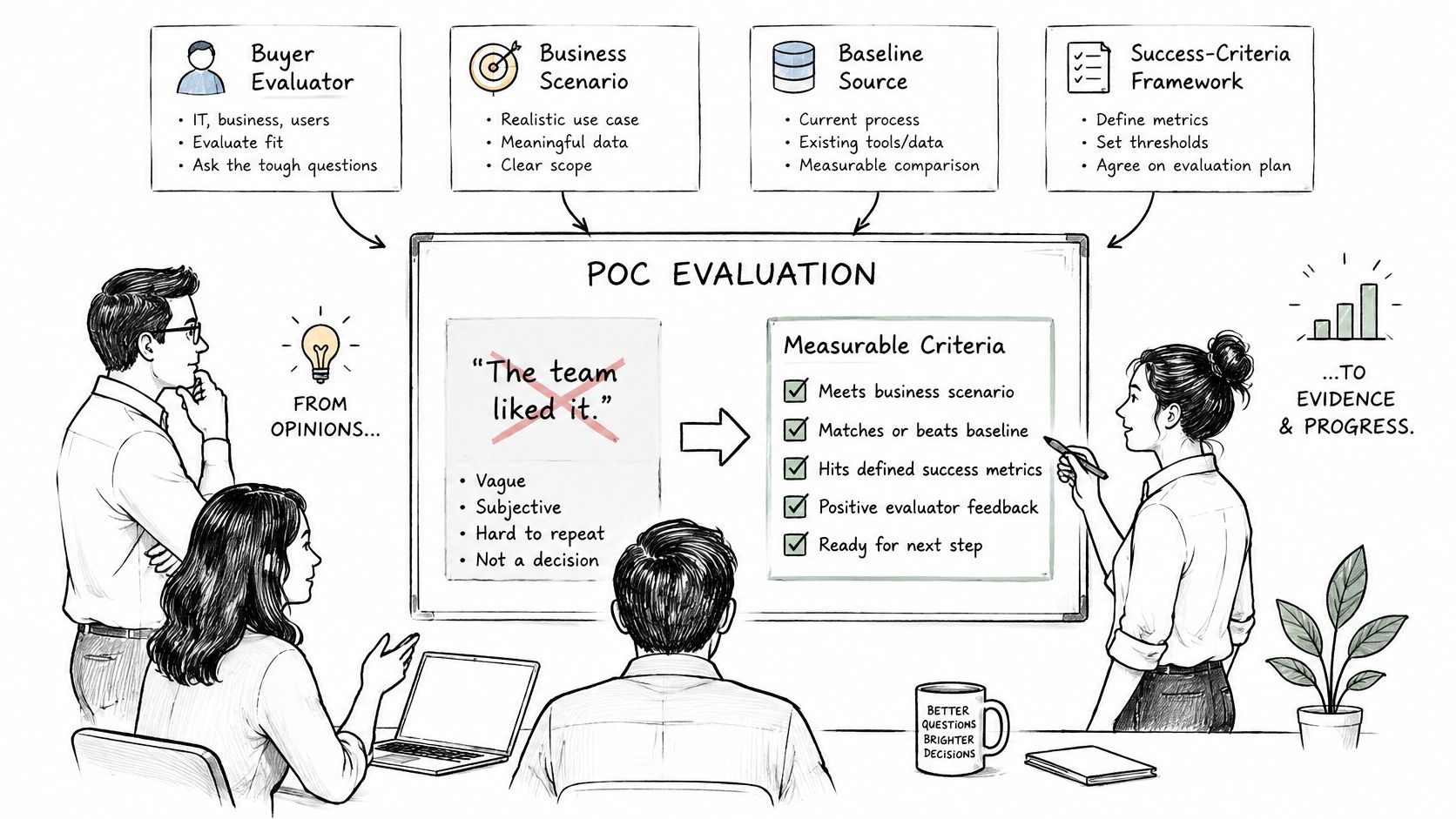
The UK Government test-and-learn guidance says to document the test aim, assumptions and hypotheses, testing methods, success measures, risks and ethical considerations, and decisions that will follow. It also says decision criteria should be set early, before findings are available. That timing is the whole point, because criteria written after results arrive will always bend toward the results.
One criterion written in full
Here's a hypothetical criterion with every required field.
- Buyer evaluator: Operations lead for Tier-1 support
- Business scenario: Resolve a billing ticket without leaving one screen
- Baseline source: Ticketing system logs from the prior four weeks
- Measurement window: Five working days of scripted test runs
- Test data: 200 anonymized billing tickets approved by the data owner
- Target: Median handle time down 20% against baseline
- Minimum acceptable threshold: Median handle time down 15% against baseline
- Evidence artifact: Exported ticket logs plus evaluator scorecard, signed by the operations lead
Each field removes an argument later. The evaluator stops disputes about who judges. The baseline source stops cherry-picking. The minimum threshold tells you when a partial win still justifies a pilot. The evidence artifact tells you what must exist on paper, not just on a call. If you want a related view on structuring pilot evaluation, this breakdown on how to evaluate B2B sales pilot success covers similar ground from the pilot side.
Gates are not preferences
Split criteria into two groups. Gates are pass or fail, covering security, privacy, required integrations and regulatory constraints. Preferences can be weighted, covering speed, error-message quality and user effort.
A high weighted score must not compensate for a failed gate. If audit logging doesn't meet the buyer's requirement, a fast workflow doesn't rescue the deal. Write that rule into the plan, because someone will try to average it away at the decision meeting.
The video below walks through evaluation planning in a PreSales context, so watch it before you lock your criteria format.
Add the counterfactual check
Technical feasibility doesn't prove economic value. Compare the test result against the current process on labor hours, cycle time, error rates, implementation cost and ongoing operating cost. If the new workflow saves ten minutes per ticket but adds a manual review step, say so plainly.
Attach a decision consequence to every criterion. Pass means pilot, partial means retest by a set date, fail means stop. A result that changes nothing isn't a criterion. For more on tying this discipline to the outcome PreSales owns, read the guide on the North Star technical win rate.
Get every criterion agreed in writing before the first test runs. A criterion changed mid-test isn't an edit. It's a new hypothesis, and it needs a new sign-off.
KPI Tracking Across Seven Dimensions
A single pass or fail label hides trade-offs. A solution can hit a speed target and still fail accuracy, usability or trust, and you'll only learn that if you track dimensions separately.
The NIST pilot-evaluation model covers efficiency, effort, accuracy, confidence, answer or report quality, and cognitive workload, including time spent searching and reading, evidence used in analysis, user confidence ratings and NASA-TLX cognitive-workload ratings. Adapt that spread to a SaaS POC with four fields per row, the dimension, the measurement method, the evidence you keep and the acceptance threshold. Thresholds below are hypothetical and must be set with the buyer.
| Dimension | Measurement method | Evidence to keep | Example threshold |
|---|---|---|---|
| Capability | Scripted test of the core workflow | Pass or fail log for each test case | All scripted cases pass, zero gate failures |
| Efficiency | Timing from system logs against baseline | Baseline and test-run exports | Handle time down 15% against baseline |
| Accuracy | Sample audit of outputs by buyer reviewers | Reviewer scorecards | At least 95% of sampled outputs rated correct |
| Usability | Timed tasks with buyer end users | Session notes and task times | Two of three users complete the task unaided |
| Operability | Deliberate failure on each critical integration | Incident log and recovery time | Recovery within the window agreed in week one |
| Changeability | Buyer admin makes a configuration change without vendor help | Change log with time stamps | Change completed in one working session |
| Adoption and trust | Usage data and a short confidence survey | Usage export and survey results | Active use by the agreed share of pilot users, confidence at or above the agreed rating |
Three tracking rules
First, capture the baseline before day one. Use the same method you'll repeat at each checkpoint, so the comparison stays like for like. If baseline handle time comes from system logs, test handle time comes from system logs too, not from stopwatches and memory. These KPI reporting examples show how to present that comparison without burying the reader in charts.
Second, separate direct measures from subjective ones. Log timings and task completion are direct. Confidence ratings and reviewer scores are subjective, and they're still useful, but they need a named validator. Record who validated each result in the evidence pack, because an anonymous score won't hold up when the economic buyer pushes back.
Third, review the matrix weekly with the business owner. Log any metric moving against its threshold, with a date and an owner for the response. Put that review in the timeline as a recurring checkpoint. If the decision meeting is the first time anyone sees the matrix, you've wasted the early warning it was built to give you.
Tracking rule: A metric without a baseline, an owner and a review date is decoration.
That quarterly discipline matters after the deal too. PreSales Unleashed GmbH builds a business case with every EaaS customer, baselines the relevant KPIs, and re-measures the same metrics each quarter. Apply the same habit inside a POC, on a weekly cycle, and the decision meeting becomes a review of evidence you've already agreed on rather than a debate about impressions.
Watch for the pattern where one dimension improves by damaging another. Faster handling with worse accuracy isn't progress. Strong adoption with weak operability means users like a system the buyer can't run. The matrix exists so you can name those trade-offs early, while you can still adjust scope, fix an integration or stop.
Lock the Go, Revise or Stop Decision Before Launch
Your proof of concept plan template must make three outcomes possible from the start. Write the trigger for each one before launch, while everyone can still think clearly.
- Stop: A must-have gate fails and the fix sits outside the agreed scope.
- Revise and retest: The hypothesis is close, but one threshold or integration needs another cycle with a date and a named owner.
- Proceed to a pilot: All gates pass and every residual risk has an owner.
Build in the right to stop early
Structure the POC so you can pull the plug instead of running the full scope out of politeness. The Academy teaches structuring POCs so SEs can pull the plug after 2 weeks if a POC is not working. That only works if the mid-point check has real authority and the exit criteria were signed in advance.
I would rather stop a failing POC in week two with a clean evidence record than drag it to week six and lose the account's trust. A managed stop preserves the relationship. A slow collapse doesn't. Say clearly what was tested, what failed, what would need to change, and who owns that change.
Revise needs discipline too. One retest cycle, one named owner, one date. If the revision needs new data, a new integration or a new user group, that's a new plan, not an extension. Price your time accordingly and get the revised criteria signed again.
A pass starts a pilot, not a rollout
Most free templates stop at the verdict. Yours shouldn't. Write the post-POC path into the template before launch, so the decision meeting ends with a next owner instead of applause.
- Named business owner: The person accountable for pilot adoption and results.
- Production-like data plan: What data the pilot uses, who approves it and how it's handled.
- Pilot exit date: The date the pilot itself faces a go, revise or stop decision.
- Unanswered questions: A written list, each with an owner and a due date.
- Production architecture: What changes between the test environment and the live one.
- Integration and data-readiness checks: The gates that were out of POC scope but block deployment.
- Security and governance approvals: The reviewers who haven't signed yet.
- Support ownership: Who users call, who fixes incidents and who owns vendor escalation.
- User adoption plan: Training, communications and workflow ownership for pilot users.
- Budget and procurement path: The approval steps and dates that follow a pilot pass.
Track those items separately, because one successful scenario doesn't prove operational ownership. Users can love a workflow that security hasn't approved, that support can't staff, or that procurement can't fund this quarter. Your job is to surface that gap while it's still cheap.
Write the closure report like a decision record
The closure report lists residual risks with owners rather than declaring success from one good scenario. Include what was tested, what wasn't tested, which gates passed, which preferences scored well, and which questions remain open. Attach the evidence artifacts, not summaries of them.
Then state the decision in one sentence. Proceed to pilot with a named owner and exit date, revise and retest by a set date, or stop for stated reasons. Get the economic buyer and technical owner to sign it. If they won't sign, you don't have a decision yet.
Apply the template to a live deal next, because a plan you've never used under pressure is just a document. In the Trusted Advisor Academy, members apply frameworks to their current deals and receive feedback on their own discovery calls, demos and POCs, which is where weak criteria and missing owners get caught early. If your team wants the plan reviewed before kickoff, book a discovery call and bring the draft with the decision date already filled in.
A POC without a written decision is not finished.
If your POCs keep drifting past their decision dates, bring one live plan to PreSales Unleashed GmbH and get it pressure-tested before kickoff. The Trusted Advisor Academy gives Solution Engineers structured practice on discovery, demos and POC management, with feedback tied to active deals. Start with your next POC plan and leave with owners, thresholds and a decision date you can defend.