
You've got a technical discovery call on the calendar. The account looks promising, the AE wants a demo, and the prospect has mentioned a few requirements that sound familiar. Ten minutes before the meeting, you open the CRM, skim the company website, and search for a slide that might fit. The call starts with a polished introduction, then drifts toward features because nobody has agreed on what the buyer needs to prove.
That meeting probably won't fail because your product is weak. It will fail because the team entered without a shared hypothesis, a qualification threshold, or a clear technical outcome. Pre call planning is where you decide whether a call should produce discovery, a demo, a workshop, or no further SE involvement at all.
The Case for Structured Pre Call Planning
A rushed technical call usually follows a predictable pattern. The AE provides a broad account summary, the SE asks what the prospect wants to see, and the buyer names a feature or integration. The SE responds with a tour of relevant functionality. Everyone leaves with more information, but nobody can explain what changed, what problem is confirmed, or why the next meeting should happen.
That isn't discovery-led selling. It's controlled improvisation.
A pre-call plan should protect the technical win, not create another administrative artifact. The plan gives you a point of view, but it also gives you a way to test that point of view. You should know what you believe about the account, what evidence supports that belief, what could disprove it, and what decision the call must enable.
Research from Anaplan found that only 40% of sales organizations were effective overall at planning, while early planners were at least twice as likely to plan effectively as late-planning peers. In five of the eight planning disciplines examined, early planners were more than three times as likely to be effective, and organizations effective overall in sales planning were more than four times as likely to achieve their sales objectives. The research covers sales planning broadly, not pre-call planning alone, but the operating lesson applies directly to PreSales teams: preparation done early and on time creates better conditions for execution. (Anaplan sales-planning findings)
Preparation changes the conversation
Without a plan, the buyer controls the meeting through whichever topic appears first. That can be useful when the topic reveals a serious business problem, but it can also pull you into an unbounded technical discussion. A buyer's request for a feature demo may hide an adoption issue, an approval concern, a security blocker, or no active project at all.
With a plan, you can acknowledge the request and still diagnose the reason behind it. You might ask what decision the feature will support, who needs to trust the result, how the current process works, and what evidence would make the evaluation credible.
The distinction matters because no discovery, no demo. Demo polish can't rescue a call where the team hasn't established a problem, an audience, and a reason to act. Strong sales enablement practices reinforce this behavior by connecting preparation, execution, and review instead of treating each call as an isolated event.
A useful external reference is the insights from TheContentMap team, particularly when you need to think about how business context should shape a message. The same principle applies to technical conversations. Relevance isn't a few personalized opening lines. It's the connection between the buyer's situation, the problem you want to test, and the evidence required for a technical win.
Building Your Pre Call Plan From Research to Hypothesis
Research becomes useful only when it changes what you'll ask or demonstrate. A company profile copied into the CRM won't guide a conversation. A hypothesis log will.
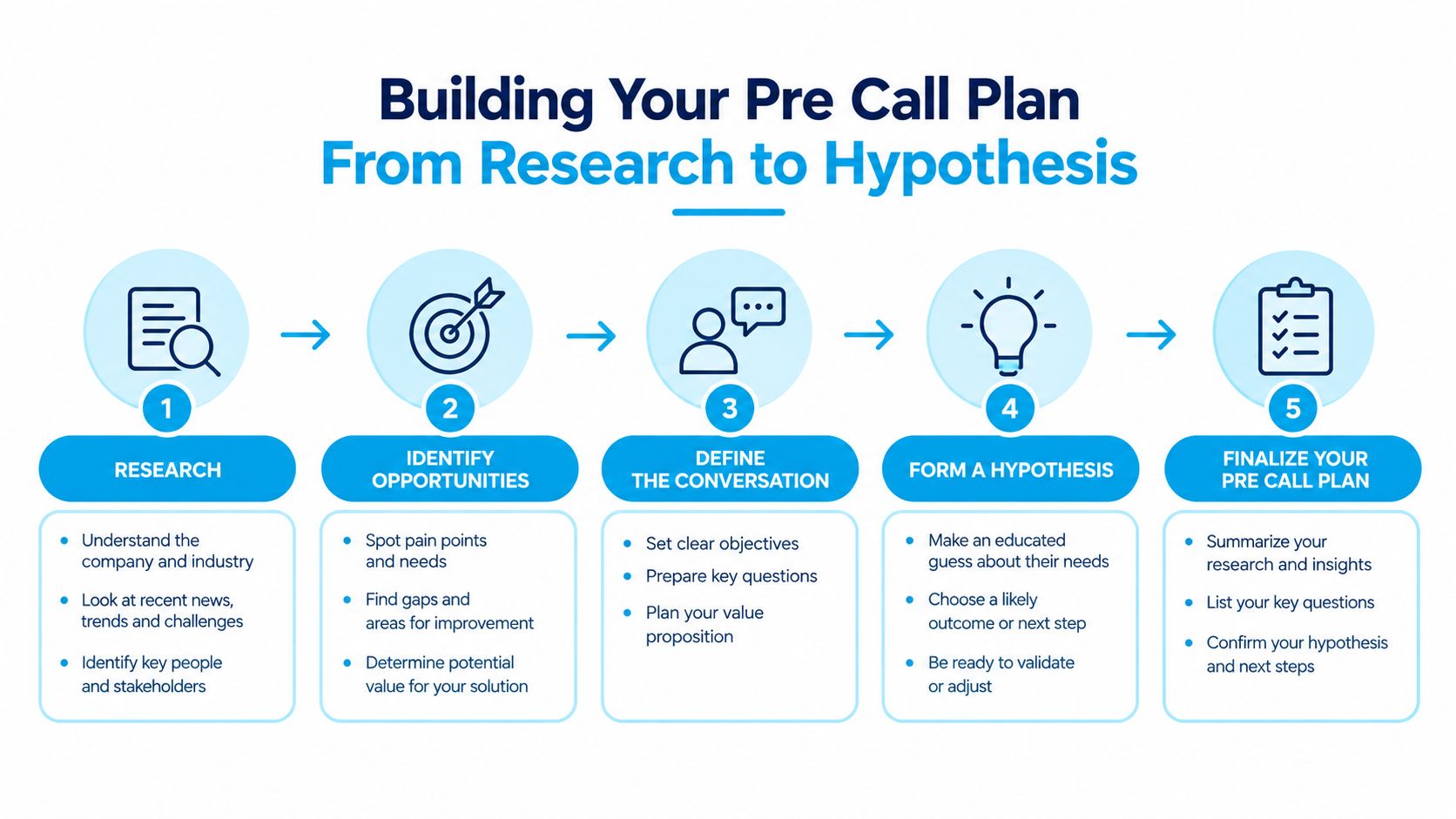
Use five preparation phases.
1. Establish the business context
Review the company's operating model, strategic priorities, recent business triggers, likely operational pressure, and existing technology. Look for information that affects the problem you may solve, such as a new product line, organizational change, expansion into a new market, or a shift in operating responsibility.
Don't turn this into a research archive. Record only findings that could affect the conversation, then state the implication beside each finding.
| Research finding | Possible implication | Question to test |
|---|---|---|
| The team is consolidating systems | Integration and migration risk may matter | “Which systems need to remain connected during the change?” |
| A new function owns the process | Authority and workflow may have shifted | “Who now owns the outcome and the approval?” |
| The buyer mentions a specific feature | The request may represent a larger business concern | “What decision would this capability help you make?” |
2. Map the people, not only the account
Identify every known attendee, their responsibilities, likely priorities, and influence on the decision. Then list the stakeholders who aren't present but may affect technical approval, security, procurement, finance, operations, or executive sponsorship.
A complex B2B buying group typically includes six to 10 decision-makers, according to a publicly reported Gartner benchmark. More recent reporting cited by the same source says groups can range from five to 16 people and span as many as four functions, so treat the figure as a planning signal rather than a fixed rule. (B2B buying committee benchmarks)
3. Write two or three testable hypotheses
For each hypothesis, capture four items:
- Business belief: What problem may exist?
- Open question: What will you ask to validate or reject it?
- Possible implication: What would the answer change?
- Evidence threshold: What must be true before you recommend a demo, workshop, proof of concept, or pilot?
For example, a hypothesis might be that inconsistent data access is slowing an operational process. The question should explore how the process works today. The implication might involve ownership, integration, or governance. The evidence threshold could require confirmation of the affected workflow, the measurable business consequence, and the stakeholder responsible for fixing it.
4. Build a branching discovery guide
Prepare enough questions to respond intelligently without turning discovery into an interrogation. Analysis of more than 326,000 sales calls found that successful discovery conversations averaged about 57% seller talk time, compared with roughly 62% for unsuccessful calls. Winning calls also tended to use approximately 15 to 16 questions, while around 20 questions was associated with a more interrogative interaction. (Discovery call analysis from Prospeo)
Prepare 10 to 15 questions, then use only the ones that follow naturally from the buyer's answers. Your guide should move from current state to impact, stakeholders, urgency, decision criteria, and next action. It shouldn't force the buyer through a qualification script.
5. Audit assumptions before finalizing
AI-assisted buyers may arrive with a polished understanding of your category before speaking with you. Reported buyer research says 94% of B2B buyers use large language models during the buying process, 89% purchase solutions containing AI features, and 83% define purchase requirements mostly or fully before speaking with sales. The same source reports that 62% need sellers to clarify AI capabilities and 58% engage vendors earlier to obtain those answers. (B2B buying behavior research from Corporate Visions)
Treat those figures as a reason to validate assumptions, not as permission to create generic personalization. Add an assumption audit to your plan:
- What may the buyer have learned from an AI-generated summary?
- Which claims can you verify?
- What important context may be missing?
- What one disconfirming question could expose a wrong premise?
- Can you explain capability, limitation, data handling, and implementation reality in business language?
Resources such as SigOS research planning can help teams organize research before it becomes scattered notes. For a practical conversation structure, use the discovery call guide, then adapt it to the hypotheses and proof thresholds for the opportunity.
Aligning With Your AE and Defining Roles
An SE and AE can research the same account and still prepare for different meetings. The AE may want to establish commercial urgency. The SE may want to validate architecture. The buyer experiences those as one conversation, so private preparation gaps become visible as mixed signals.
Run a short pre-call huddle with a written outcome. Don't settle for “learn more” or “give them an overview.” Define the decision the team wants the buyer to make by the end of the meeting.
Assign ownership before the buyer joins
The AE should typically lead commercial context, business impact, economic outcomes, and approval authority. The SE should lead technical discovery, constraints, risk, implementation reality, and the evidence required for a technical win. Those boundaries don't prevent collaboration. They stop both people from answering the same question in different ways.
Use a simple role map:
| Call responsibility | AE | Solution Engineer |
|---|---|---|
| Opening and agenda | Lead | Support |
| Business problem and urgency | Lead | Connect technical impact |
| Current technical environment | Support | Lead |
| Stakeholder and approval map | Lead | Identify technical influencers |
| Product demonstration | Frame value | Demonstrate only validated workflows |
| Evaluation criteria | Confirm commercial and decision needs | Define technical tests and evidence |
| Next step | Secure commitment | Specify proof, owners, and prerequisites |
Assign a hypothesis to each known stakeholder. An operations leader may care about process change. A security stakeholder may care about risk and data handling. An executive sponsor may care about the business outcome. A technical evaluator may care about architecture and implementation effort.
Keep value and validation connected
RAIN Group reports that buyers cite focusing on value at 96%, collaborating with buyers at 93%, and educating buyers with new ideas at 92% as seller-controlled factors that influence purchase decisions. The same research reports that 58% of buyer meetings with sellers don't provide value. (RAIN Group buyer research)
Use those findings as a design test for the call. The AE shouldn't ask the SE to carry the entire business case, and the SE shouldn't reduce technical discovery to a list of requirements. Prepare one business value hypothesis, one relevant insight, and a set of questions that lets the buyer confirm, reject, or refine both.
Practical rule: If the AE can't state why the problem matters and the SE can't state what technical evidence would prove fit, the team isn't ready to invite the buyer.
The most common misalignment is over-presentation. The AE asks for a quick demo, the SE shows everything related to the prospect's stated interest, and neither person confirms what the audience needs to decide. Agree on the stop conditions before the call. If discovery reveals no meaningful problem, don't force a demo. If the buyer confirms a problem but lacks the right stakeholders, make access part of the next step.
Qualification Strategies and Opportunity Triage
Technical capacity is finite, so not every meeting deserves the same preparation depth. A named account with a confirmed business problem, active evaluation, and access to technical stakeholders deserves a different plan from an inbound feature request with no owner or decision date.
Classify the opportunity before committing demo, workshop, or POC resources.
| Opportunity condition | Planning posture | SE commitment |
|---|---|---|
| Confirmed problem, affected team, active project | Build a hypothesis-led discovery plan | Prepare targeted questions and proof path |
| Clear problem, unclear authority or timing | Use the call to expose buying-process gaps | Avoid custom demo work until access improves |
| Feature request without business impact | Diagnose the reason behind the request | No product tour by default |
| RFP with fixed requirements and no discovery access | Test fit and evaluation control | Decline or limit technical response |
| POC request without success metrics | Define evidence and exit conditions first | Do not enter an open-ended pilot |
Set a do-not-proceed threshold
Your plan should state what must be true before the opportunity receives deeper SE support. Confirm:
- Fit: The customer resembles the type of account your solution can serve.
- Problem: A business or operational issue is clear enough to investigate.
- Environment: The relevant technical context and constraints are known.
- Evaluation: The buyer can explain what will be tested and how it will be judged.
- Authority: The team can reach economic, technical, security, and operational influencers.
- Timing: There is a reason to act and a dated decision process.
- Proof path: The next technical activity has an owner, scope, and outcome.
Prospeo's sales-call planning benchmark reports that opportunities closed within 50 days achieved a 47% win rate, while opportunities extending beyond that period fell below 20%. The figures aren't a universal forecast for every sales motion, but they support a practical discipline: record dated next steps, ownership, and decision conditions instead of allowing an evaluation to drift. (Sales call planning benchmark)
A useful overview of lead qualification from Cyndra reinforces the same operating principle. Qualification isn't a formality completed before the “real” work begins. It determines where specialist time can produce a credible technical win.
Use MEDDPICC for Solution Engineers to structure the gaps, but don't turn the framework into a questionnaire. A prospect who can't confirm the problem, compelling event, required stakeholders, or evaluation outcome should be recycled or disqualified, not rewarded with a custom technical project.
Managing Logistics and Setting Expectations
Good preparation can still be wasted by poor meeting mechanics. An absent technical stakeholder, an inaccessible environment, or an agenda that says “product overview” can pull the conversation away from the outcome you planned.
Complete the logistical work before the call clock starts.
Confirm the operating conditions
Check the attendee list and role of each person. Confirm who owns the business problem, who will evaluate the technology, and who can explain the decision process. If a required stakeholder can't attend, decide whether the call still has a useful objective or should be rescheduled.
Then verify the practical details:
- Access: Open the demo environment, sandbox, recording, architecture diagram, and relevant security material.
- Environment: Test the meeting platform, audio, screen sharing, and any customer-specific configuration.
- Ownership: Assign who opens, who asks which questions, who demonstrates, and who captures commitments.
- Timing: Know the available meeting time and the single outcome that matters most.
- Fallback: Prepare a discussion-led version of the call if the demo environment fails.
Send a focused pre-read
A pre-read should reduce uncertainty, not make the buyer complete your preparation. Include the proposed agenda, the business question you want to examine, the areas where technical context would help, and the decision or next step you hope to establish.
Avoid sending a feature catalog. It encourages the buyer to select disconnected capabilities before you've understood the workflow. A better agenda might read:
- Confirm the current process and business impact.
- Explore the technical environment and constraints.
- Test the evaluation criteria.
- Agree on the evidence and stakeholders required for the next step.
Share that agenda with the AE first, then with the prospect when appropriate. The AE can check commercial alignment, while the prospect gets a clear reason to attend and an opportunity to correct the premise.
Last-minute changes are normal. If a new attendee joins, ask what they need to decide and update the stakeholder map. If the meeting shifts from discovery to demo, preserve the discovery objective and demonstrate only the workflow connected to a confirmed question. Rescheduling shouldn't erase the plan. Update the assumptions, attendees, and desired outcome before the new invite goes out.
Measuring Success and Reviewing Outcomes
A completed agenda isn't evidence of a successful technical call. A buyer can sit through every planned slide and still lack a reason to continue. Judge the meeting by what it produced.
A strong outcome usually includes four elements:
- A quantified problem statement: The buyer has described the affected process and its business consequence in concrete terms.
- Stakeholder clarity: You know who owns the outcome, who validates the technology, who manages risk, and who can approve or block progress.
- Buying-process gaps: You understand what remains unknown about timing, criteria, authority, procurement, security, or internal alignment.
- A mutually agreed next action: The next meeting, test, workshop, or decision has an owner and a date.
The call can also succeed by disqualifying the opportunity. Learning that there is no active problem, no access to the buying group, or no credible evaluation path protects capacity and keeps the forecast honest.
Compare the plan with reality
Immediately after the call, review each hypothesis. Mark it as confirmed, rejected, modified, or untested. Record the buyer's language, but separate direct evidence from your interpretation. Then update the opportunity record so the next AE or SE doesn't repeat the same questions.
Use a short review table:
| Review question | What to record |
|---|---|
| Which assumption was wrong? | The evidence that changed your view |
| Which question created useful detail? | The answer and its business implication |
| Where did the conversation stall? | Missing stakeholder, unclear value, technical risk, or weak urgency |
| What proof is now required? | Demonstration, architecture review, security validation, or POC test |
| What could we have avoided? | Irrelevant slides, premature solutioning, or unsupported claims |
Analysis of the call should influence the next plan, not become a retrospective exercise that disappears into a notes folder. If buyers repeatedly ask about data handling, add that concern to the assumption audit. If technical discussions keep expanding without a decision, tighten the exit criteria. If the AE and SE repeatedly interrupt each other, redesign the role map.
Track technical progress through the quality of decisions, not the amount of content delivered. The technical win is the buyer's confidence that the solution fits the problem, the environment, and the path to implementation. A repeatable review habit makes that standard visible across the PreSales team and gives leaders better evidence than demo volume alone.
PreSales Unleashed GmbH helps Solution Engineers and PreSales leaders build repeatable discovery, sales-alignment, demo, and POC practices through the Trusted Advisor Academy, live practice, templates, and coaching tied to active opportunities. Visit PreSales Unleashed GmbH to apply a structured pre call planning approach to your next technical call.