
The most popular advice about solution engineer certification is to pick a respected badge and start studying. That's backward. Start with the capability you need to prove, then choose an assessment that can verify it. A certificate belongs on your resume only when you can explain what you did to earn it and why that evidence matters to the role.
Why the Solution Engineer Certification Question Is the Wrong One
A Solution Engineer (SE) doesn't need a universal professional license to practice. UniSQ's solutions-engineer career guidance describes optional, platform-related certifications alongside technical knowledge, customer-facing ability, communication, proposals, and cross-functional work. That's a useful distinction: a credential can support your candidacy without establishing your readiness to own a customer evaluation.
The profession is substantial, but its dedicated credentialing infrastructure is relatively young. The North American Association of Sales Engineers estimates approximately 67,000 sales engineers and 130,000 technical sales representatives in the United States and records its founding in May 2020. Don't mistake a newer professional-certification movement for a long-established licensing system.
Define the claim before judging the badge
A solution engineer certification is an issuing organization's statement that you met its requirements. Those requirements might involve documented experience, an examination, observed performance, or some combination.
The important question is what the issuer verified. Passing a platform exam doesn't establish that you can challenge an unqualified proof of concept. A manager's sign-off doesn't establish transferable expertise unless another employer can inspect the assessment.
When reviewing a certification line on a resume, I'd investigate:
- Assessment scope. Did the candidate demonstrate platform knowledge, PreSales judgment, or both?
- Evidence quality. Can they explain the work, constraints, decisions, and feedback behind the credential?
- Role relevance. Does that evidence match the buyers, architecture, and sales motion they'll face?
Hire for the work you need done
Ask a candidate to explain a customer problem before opening their demo. Ask what they ruled out, which assumptions remained untested, and how the buyer would decide whether the solution worked.
Those answers give you something a badge alone can't: a view of their reasoning.
Hiring rule: Treat certification as a prompt for investigation, not a substitute for it.
For career planning, replace “Which badge is best?” with a more useful question: Which credential fits my next role, and what additional evidence will make the claim believable? For a PreSales leader, the equivalent question is whether your internal certification would withstand scrutiny from someone outside your team.
The Three Credential Models You Will Actually Meet
Classify the assessment before comparing providers. For buying decisions, distinguish credentials based on professional experience, credentials tied to a platform, and certifications your employer owns.
| Credential model | Assessment logic | Effort to investigate | Main limitation |
|---|---|---|---|
| Vendor-neutral, experience-based | Reviews documented professional practice | Eligibility, application evidence, references | Recognition of experience isn't direct observation |
| Vendor-specific | Validates knowledge within a technology ecosystem | Current syllabus, labs, prerequisites, exam preparation | Platform depth doesn't establish selling judgment |
| Internal company certification | Assesses readiness for your company's sales motion | Rehearsal, work samples, assessor feedback | Limited portability without inspectable evidence |
Experience-based versus platform-based credentials
Experience-based credentials fit practitioners who already have relevant work to document. Your effort goes into establishing eligibility and presenting evidence, rather than necessarily preparing for a knowledge exam. Check whether the issuer reviews employment history, references, work samples, or observed performance. Those aren't interchangeable.
Vendor credentials fit an SE whose technical credibility depends on a particular ecosystem. Preparation should follow the actual assessment requirements and your existing skill gaps, not a generic study-time estimate.
Their scope is also their trade-off. Knowing a platform's integration patterns may help you design a credible solution, but you still need to establish whether the customer should evaluate that solution at all.
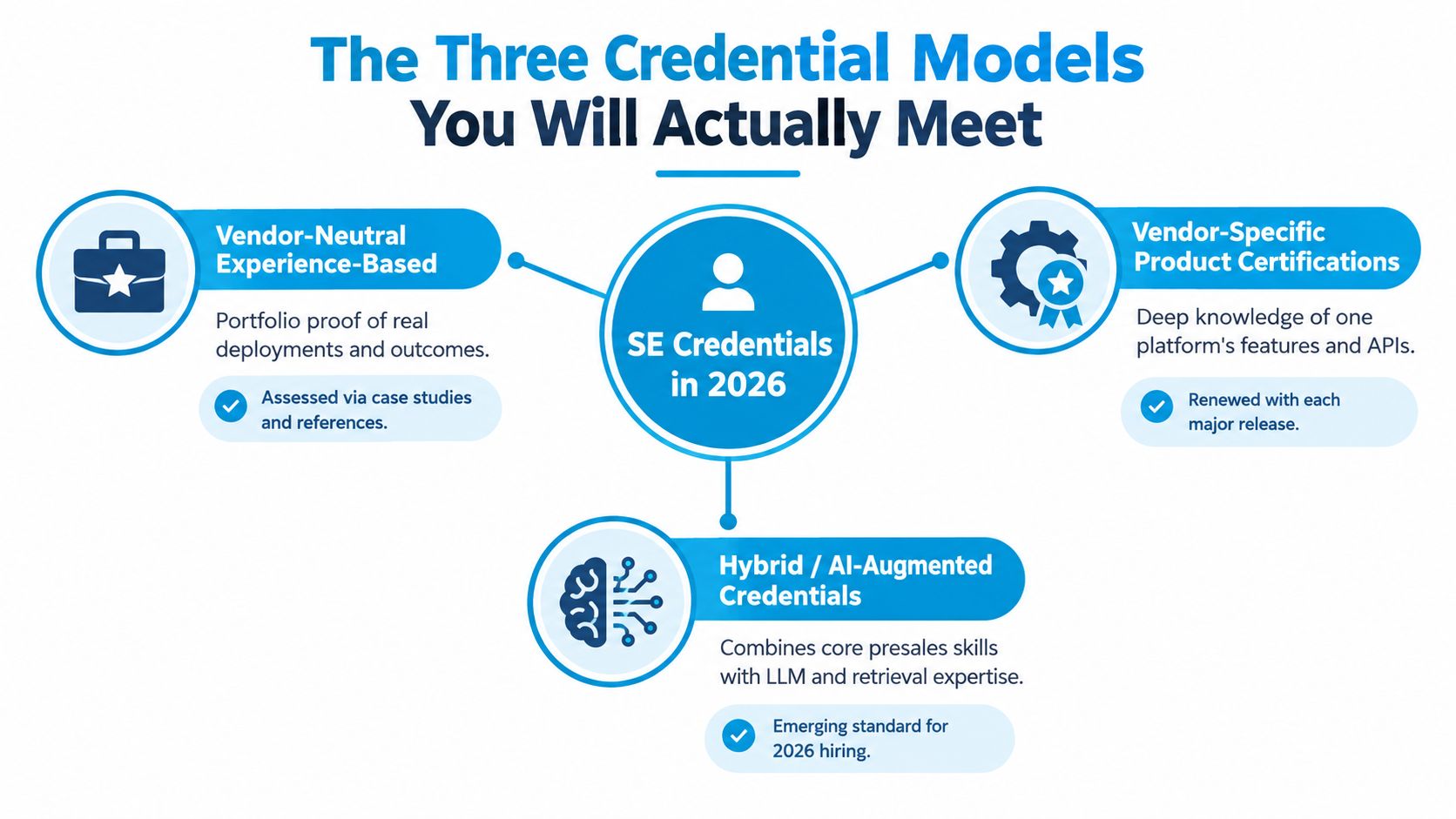
Treat hybrid AI-augmented skills as a specialization across credential models, not a separate guarantee of assessment quality. A curriculum can combine AI implementation and PreSales skills while still assessing them poorly. Likewise, don't assume every vendor credential renews with each product release; check the issuer's policy.
Internal credentials need an external explanation
An internal certification should answer a narrow operational question: Can this SE perform the assigned work without creating unacceptable customer or deal risk?
Its strength is relevance. You can test your discovery standards, competitive positioning, security boundaries, and evaluation process. Its weakness is portability: another employer may have no idea what “advanced certified” means.
Publish the scope and let candidates retain sanitized evidence where confidentiality permits. A written rubric is more useful than a decorative badge.
When comparing professional-development options beyond PreSales, Ekipa's training paths for Agile coaches offer an adjacent resource to examine. Keep the distinction clear: a learning pathway, an assessment, and a professional designation answer different questions. Evaluate each separately.
Comparing the Named Certifications a Solution Engineer Will See
Don't rank these options on a single prestige ladder. They assess different things, and the strongest choice depends on the claim you need to make.
Solution Engineer Certification Options Compared
| Credential | Assessment Type | Typical Prep | Recertification | Best Signal |
|---|---|---|---|---|
| NAASE Certified Sales Engineer (CSE) | Experience-based application and review | Assemble qualifying experience and documentation | Standard certificate valid indefinitely | Established, transferable professional practice |
| SME Certified Manufacturing Technology Sales Engineer (CMTSE) | Multiple-choice examination | Official e-learning and study-guide preparation | Confirm current issuer policy | Knowledge of a defined manufacturing sales-engineering syllabus |
| ITSA CTSP | Study guide followed by certification examination | Review the framework and identify knowledge gaps | Confirm current issuer policy | Business-facing PreSales knowledge |
| Vendor platform certifications | Credential-specific assessment | Follow the selected credential's current requirements | Varies by credential | Expertise within the relevant platform ecosystem |
Match each option to its intended purpose
Choose NAASE CSE when you need recognition of established practice. NAASE's CSE requirements specify eligibility paths of 4 years of relevant experience without formal education, 3 years with a relevant degree, or 2 years with strong relevant education. The same page describes review rather than a conventional written exam, a typical 1–3 business-day formal review, and a standard certificate that remains valid indefinitely.
That makes CSE a reasonable option for an experienced practitioner documenting professional standing. It doesn't replace a hiring exercise that tests how you handle an unfamiliar buyer situation.
Choose CMTSE when manufacturing technology is your actual market. SME's CMTSE examination guidance describes a three-hour examination with 150 multiple-choice questions, drawn directly from its study guide. SME advises approximately two months for e-learning organized across 13 chapters.
The defined syllabus is useful when you want a knowledge standard. For a B2B SaaS SE outside manufacturing, however, subject relevance should outweigh the appeal of adding another credential.
Consider CTSP when you need a business-facing PreSales syllabus. ITSA's presales certification framework includes solution positioning, value-based selling, technical communication, customer presentations, stakeholder engagement, and commercial awareness. Its published pathway uses a study guide followed by an examination.
That scope is relevant, but don't assume examination coverage means live performance was observed. Ask how candidates demonstrate judgment and whether assessors inspect practical work.
Choose a vendor credential when your deals depend on that platform. Confirm the precise syllabus, prerequisites, assessment format, and refresh rules before committing. Don't buy preparation for an impressive-sounding credential that rarely appears in your customer conversations.
If compensation influences your choice, you can compare IT cert salaries through HiredBySkill as a separate research step. Don't treat a salary comparison as proof that earning a certificate causes higher pay; use relevant job requirements and assessment fit to make the decision.
What a Credible PreSales Certification Should Actually Measure
No discovery, no demo. Make that an assessment rule, not a slogan. Discovery quality, not demo polish, should determine whether a candidate has earned the right to recommend and demonstrate a solution.
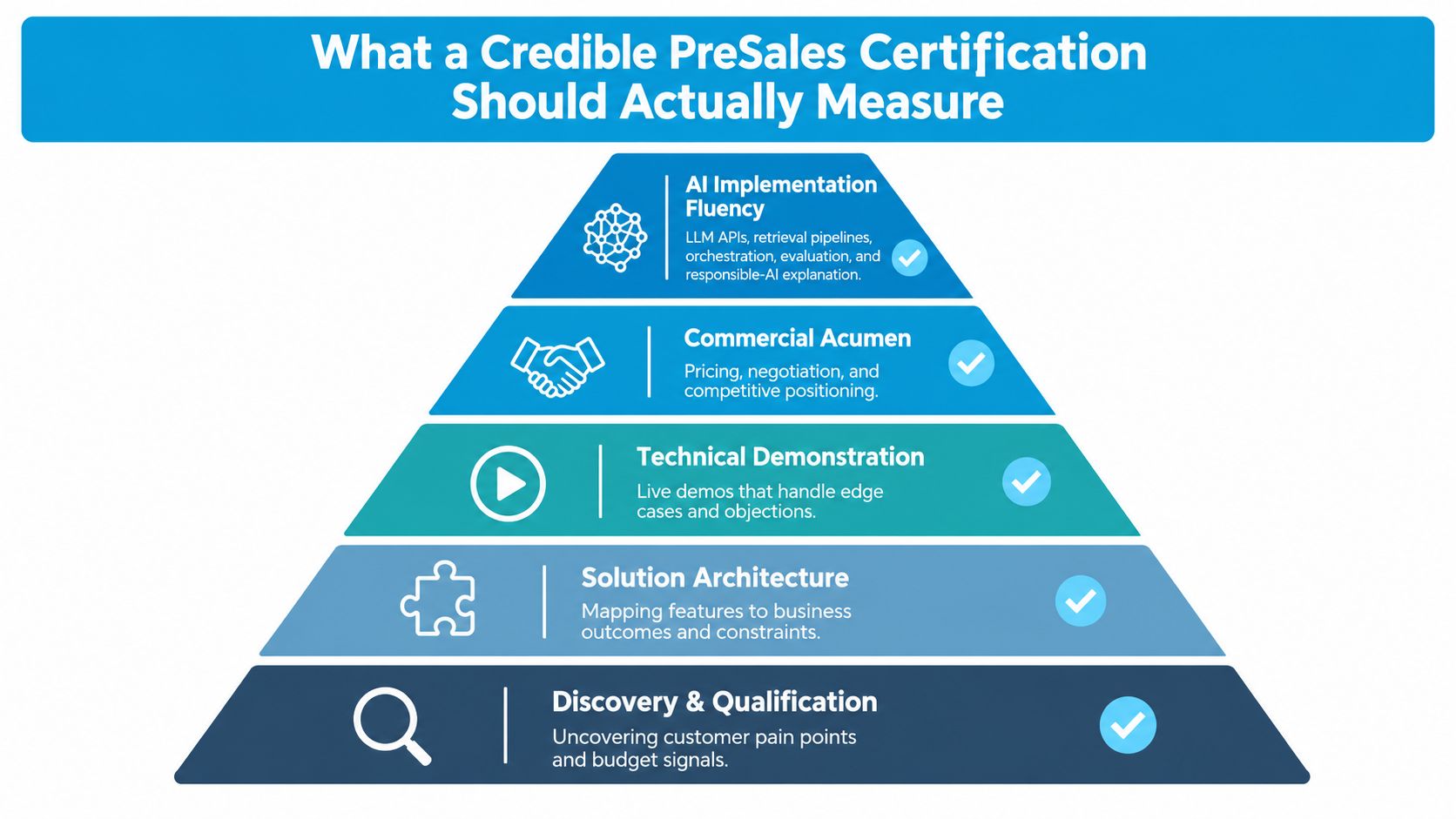
The research on future skills in sales engineering identifies a broad competency profile spanning technical acumen, sales and negotiation, commercial thinking, communication, empathy, adaptability, and complexity management. My recommendation is to translate those dimensions into observable work, rather than adding more knowledge questions.
Require evidence across the customer evaluation
Use a role-specific assessment map:
| Competency | Evidence to inspect | Passing behavior |
|---|---|---|
| Discovery | Recorded roleplay and written synthesis | Establishes the problem, impact, stakeholders, constraints, and decision process |
| Solution mapping | Architecture recommendation | Connects design choices to validated requirements and trade-offs |
| Business value | Customer-facing value summary | Distinguishes confirmed inputs from assumptions |
| Demo design | Tailored demonstration | Proves relevant workflows and checks customer understanding |
| Objection handling | Live challenge scenario | Investigates the concern and answers within known boundaries |
| Evaluation governance | Mutual evaluation plan | Defines success criteria, owners, scope, and decision conditions |
| Executive communication | Concise decision brief | Explains business consequences without hiding technical risk |
For a practical starting point, use the discovery call guide to define the inputs a candidate must establish. Apply demo skills training only after those inputs justify the demonstration.
Score behavior, not confidence
Write behavioral anchors before assessing candidates. “Strong discovery” is too subjective; “confirms the operational consequence of the stated problem and tests who owns it” gives assessors something observable.
Have assessors independently score the same sample, then compare their reasoning. Disagreement can expose an unclear rubric rather than a weak candidate.
A polished presentation shouldn't compensate for an unsupported architecture recommendation or an evaluation with no decision criteria.
Set separate passing requirements for critical competencies. Otherwise, an average score can conceal a gap that would derail a live opportunity.
If you need a broader perspective on documenting job-specific behaviors, Turn On Work's resource on how to map frontline worker skills is an adjacent reference. Keep the application specific to PreSales: certify the work your SEs must perform, not a generic list of desirable traits.
Building an Internal Certification That Sticks
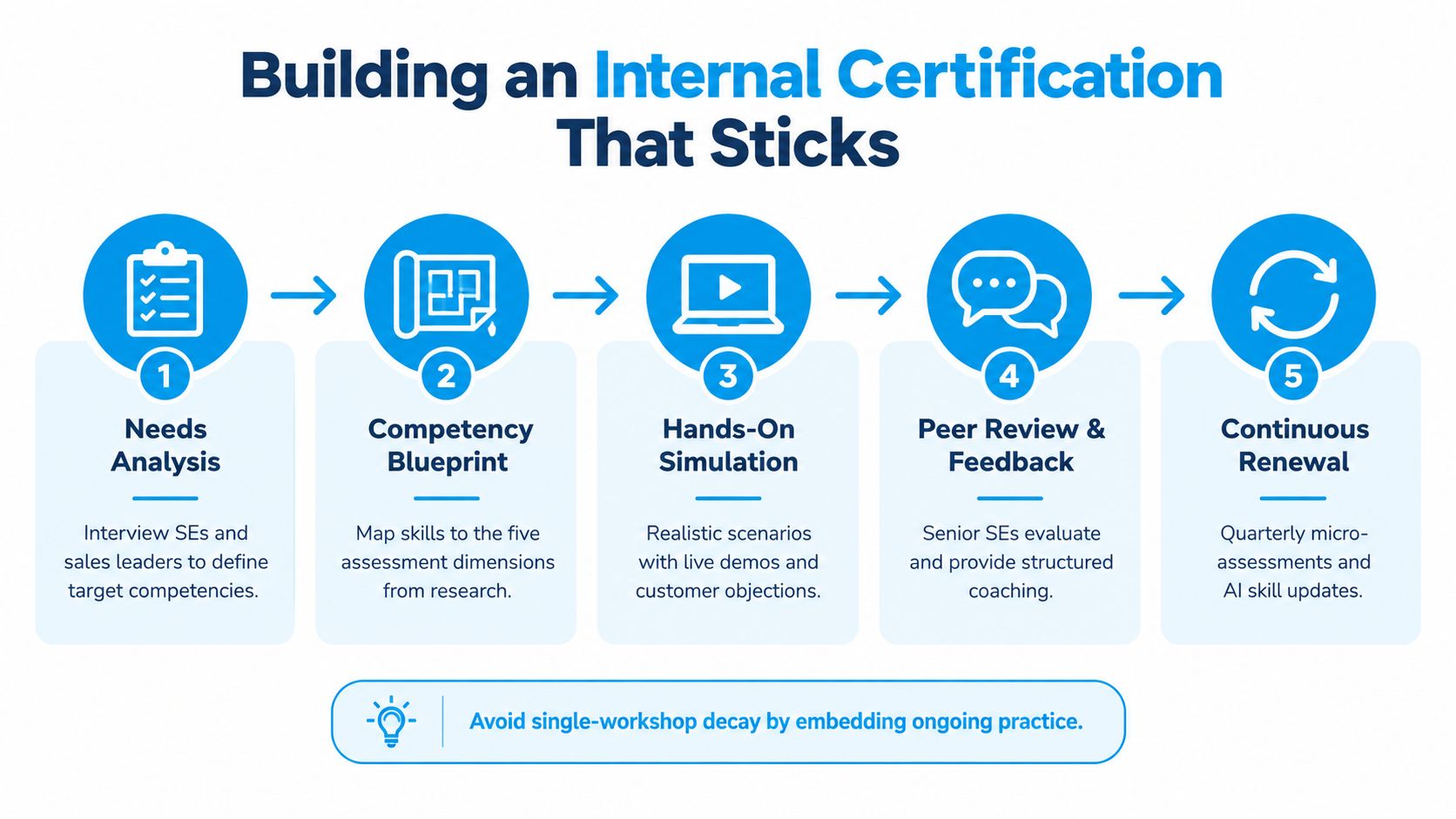
Don't design your program around graduation day. Design it around what an SE must still be able to do after the workshop, when a buyer changes scope and the account executive wants a demo tomorrow.
A Frontiers in Education meta-analysis covering 242 studies, 1,619 effects, and 169,179 participants identifies distributed practice and practice testing among the strongest-supported learning techniques. That supports recurring retrieval and application, not a claim that certification alone improves revenue.
Put the program into the manager's calendar
The following is a proposed operating schedule, not a research-derived duration requirement. Use a twelve-week development block, with a final retention checkpoint after it:
- Establish the baseline. Record a discovery simulation, inspect a written recommendation, and identify the candidate's highest-risk gaps. Don't assign identical remedial work to everyone.
- Run weekly deal-based roleplays. Use sanitized situations from recorded opportunities. Rotate buyer roles and introduce constraints the candidate hasn't rehearsed.
- Hold monthly demo critiques. Require a discovery summary before the demo. Review whether the SE proved the customer's requirements, not whether every screen transition looked smooth.
- Reassess at 30, 60, and 90 days. Change the scenario while keeping the competency standard stable. Include the final checkpoint after the initial development block.
- Attach coaching to active work. Ask the SE to apply feedback to an upcoming customer interaction, then return with evidence of what changed.
Use a spaced repetition schedule to plan retrieval and rehearsal between formal reviews. Short practice should require an answer or decision, not passive content consumption.
Separate learning evidence from business outcomes
Track whether candidates can reproduce the behavior later. Separately, monitor discovery completeness, demo-to-next-step conversion, POC cycle time, and technical win rate.
Define those measures before comparing results. For example, a shorter POC isn't automatically better if the customer never reached an agreed decision.
The technical win rate guide is useful for clarifying the outcome PreSales owns. Don't confuse a technical win with a closed commercial deal, and don't attribute every movement in the metric to training.
Before signing off, require:
- An assessment record containing scored work samples and assessor comments.
- A development record showing feedback, practice, and subsequent application.
- A retention check using an unfamiliar scenario.
- A scope statement explaining what the certification does and doesn't authorize.
Protect customer confidentiality throughout. Redact sensitive information and obtain appropriate permission before retaining recordings or sharing them with peers.
Why Most Certifications Are Already Out of Date and What to Do About It
A certificate can remain valid while its holder's evidence becomes dated. That's the problem to manage: administrative validity and current capability are different judgments.
For AI-facing roles, AI solutions-engineer role guidance highlights implementation skills such as LLM APIs, retrieval pipelines, orchestration, evaluation, and explaining model behavior. If those responsibilities appear in your target role, a general platform badge won't answer every question the hiring manager should ask.

Reassess the decisions your customers need
For an AI opportunity, I'd require the candidate to defend an evaluation plan. Which task is being assessed? What constitutes an unacceptable answer? Which data can the system access, and what happens when a tool call fails?
Then test the commercial consequences. Ask the SE to explain total cost of ownership, usage assumptions, latency trade-offs, identity boundaries, observability, and adoption risk. Treat these as recommended assessment requirements, not capabilities automatically established by an AI credential.
A convincing answer distinguishes what the SE has tested from what they merely expect to work.
Buy a maintenance policy, not a permanent promise
Before enrolling, ask the issuer:
- Versioning. Which syllabus version will appear on the credential?
- Refresh triggers. What changes require reassessment?
- Expiration. Does validity end, and what must the holder do next?
- Evidence currency. Can an employer distinguish recent practical work from an old pass?
I recommend an annual personal reassessment, plus targeted updates when your responsibilities or architecture change. That's a maintenance recommendation, not a universal certification rule.
Keep the renewal proportionate. You don't need to repeat an entire program because a product interface changed; you do need fresh evidence when you start advising customers on unfamiliar security, evaluation, or deployment decisions.
Maintenance test: If you wouldn't trust an old work sample to support today's recommendation, don't trust the badge alone.
Which Solution Engineer Certification Path Fits Your Situation
Choose the smallest credential mix that addresses your actual gap. Collecting overlapping badges takes time you could spend producing stronger evidence.
| Your situation | Recommended path | What to produce next |
|---|---|---|
| New SE building a career base | Relevant platform learning plus supervised role practice | A discovery recording and a defensible solution recommendation |
| Experienced practitioner signaling senior credibility | Consider an experience-based credential, supported by sanitized work | A portfolio explaining difficult decisions and evaluation outcomes |
| PreSales manager building a program | Internal performance certification with calibrated assessors | A competency map, scoring rubric, and reassessment calendar |
| Revenue leader evaluating enablement | Fund recurring practice with explicit operational measures | A measurement plan separating behavior change from deal outcomes |
Make the next commitment concrete
For a newer SE, don't start with an experience credential you can't substantiate. Find the platform knowledge your role requires, then ask your manager which customer-facing responsibilities you must demonstrate before operating independently.
For an experienced SE, make your judgment inspectable. A concise, sanitized architecture decision with rejected alternatives can support a more useful hiring conversation than another undifferentiated completion badge.
For managers and revenue leaders, forward how to choose PreSales training to the person approving the investment. Agree on the assessment standard before choosing the delivery format or provider.
Your next actions should be practical:
- Name the gap. Write down the behavior or technical capability you need to prove.
- Inspect the assessment. Ask for the syllabus, rubric, evidence requirements, and renewal policy.
- Schedule rehearsal. Find peers who will challenge your reasoning, including through the PreSales community, and put practice on the calendar.
Choose the credential that supports your next responsibility. Build the evidence that lets someone else verify you're ready.
PreSales Unleashed GmbH offers the Trusted Advisor Academy, combining structured learning, live practice, and application to active deals for SEs and SE leaders. Visit PreSales Unleashed GmbH to explore a continuous-practice approach, and bring the capability gap you want to close so you can assess the program against your certification goals.