
The most popular advice about the solutions selling methodology is to ask better questions, uncover pain, and tailor the pitch. That's necessary, but it misses the part that makes or breaks complex deals: solutions selling isn't a pitch technique. It's an operating model that the AE and Solution Engineer (SE) run together, from qualification through technical validation and delivery.
When teams borrow the vocabulary but skip the discipline, they get polished demos built on untested assumptions and proofs of concept that never reach a commercial decision. In PreSales, the outcome you own is the technical win. Discovery quality, not demo polish, decides whether you earn it.
Why Solutions Selling Is Misunderstood in PreSales
A polished demo can still lose a complex deal. When several stakeholders, technical dependencies, integration risks, and extended evaluation cycles shape the decision, presenting features before establishing the buying conditions leaves the team guessing.
Solutions selling often gets reduced to “understand the pain, then show the product.” That shorthand skips the work that determines whether technical effort is worthwhile: clarifying the business problem, identifying who it affects, agreeing how the buyer will assess a solution, and checking whether the organization can implement it. Without that discipline, consultative language sits on top of generic demos and POCs with no clear decision criteria.
Working definition: Solutions selling is a joint AE-SE discipline for diagnosing a business problem, validating the buying conditions, and proving that a proposed solution can meet the customer's decision criteria.
The SE's job is to test the opportunity, make requirements explicit, and turn technical validation into evidence for a decision. If discovery has not established what the buyer is solving or how they will evaluate it, the demo is premature. This is an operating model for the team, not a presentation routine for the AE.
The broader Solution Engineer's responsibilities include translating business needs into technical requirements and surfacing constraints early. That translation matters when buyers arrive with AI-generated research or use AI tools to compare options. Teams can use 1chat privacy-first AI chat to start a focused discussion about privacy expectations, while still validating the buyer's actual requirements directly.
Set a shared rule with your AE: no discovery, no demo. Keep discovery focused, but require enough evidence to justify the technical work that follows. That means recording the problem, affected stakeholders, evaluation criteria, and implementation constraints before committing to a custom demo or POC. A tighter process may delay the first presentation, but it reduces wasted engineering time and gives the buyer a clearer basis for a decision.
The SPIN Roots Every SE Should Know
Neil Rackham's SPIN Selling, published in 1988, grew out of research that compared observable seller behaviors in successful and unsuccessful business-to-business calls. Rackham and his research team analyzed more than 35,000 sales calls over a 12-year period, involving more than 10,000 salespeople across over 20 countries (overview of SPIN Selling's research and methodology). The central lesson was practical: complex, high-value sales call for a different approach from transactional selling. Purposeful questions help buyers examine the problem and its consequences before a seller proposes a fix.
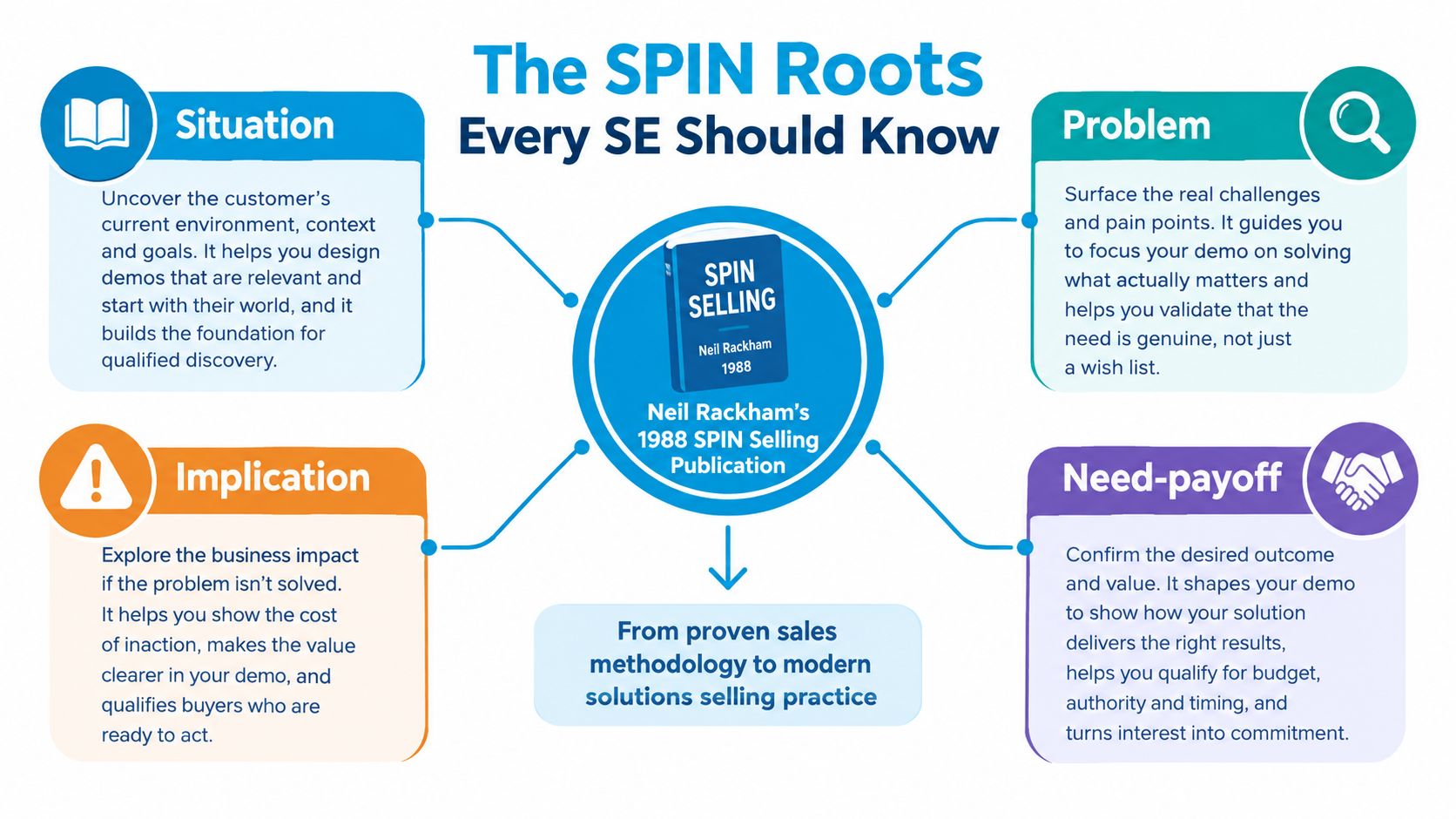
SPIN stands for Situation, Problem, Implication, and Need-payoff. Treat the sequence as a diagnostic progression, not a checklist to rattle through.
| Question type | What you learn as an SE |
|---|---|
| Situation | The buyer's current process, systems, and operating context. |
| Problem | Where the buyer experiences friction, dissatisfaction, or unmet needs. |
| Implication | What the problem affects if it remains unresolved. |
| Need-payoff | How the buyer describes the value of fixing it. |
The most important distinction is between an implied need and an explicit need. “Our workflow is slow” describes dissatisfaction. It doesn't yet say what the delay costs or what the buyer wants to change. Follow up: What does the delay affect? Does it create rework or missed opportunities? What would improve if the process changed? That development turns a surface-level complaint into a buyer-articulated outcome (SPIN Selling chapter on needs and questions).
Don't jump from a stated problem to a product demonstration. Develop the consequences first, then connect the buyer's own value language to the proposed solution.
On a discovery call, Situation questions establish the current state. Problem questions locate friction. Implication questions test its significance. Need-payoff questions give the buyer room to explain why resolving it matters. The SPIN Selling framework and its four question types offer a useful reference, but the discipline is yours: the demo should answer a need the buyer has developed, not just match a feature to a complaint.
The Four Operational Stages of Solutions Selling
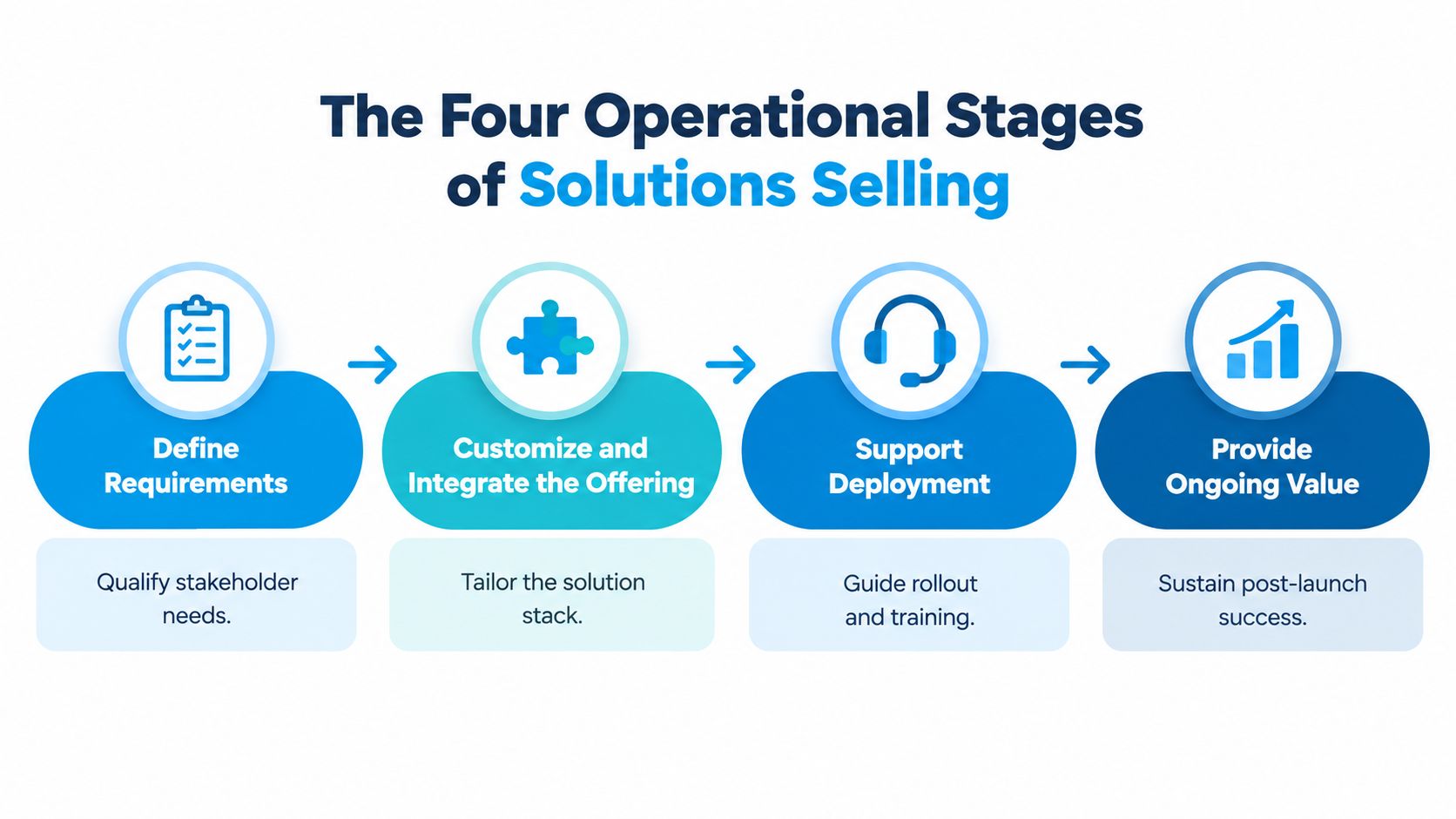
Treat solutions selling as a four-stage relational operating model, not as a pre-sales sequence that ends when the contract is signed. Each stage depends on the quality of the work before it. Weak requirements produce a poor fit; poor fit creates implementation friction; friction undermines adoption and outcomes.
| Stage | SE deliverable | Failure if skipped |
|---|---|---|
| Define requirements | A documented current state, business impact, target capabilities, stakeholders, constraints, deployment assumptions, and success measures. | The team mistakes symptoms for requirements and qualifies a solution that doesn't fit. |
| Customize and integrate the offering | A proposed solution design tied to required capabilities, integrations, and observable acceptance criteria. | The demo or POC proves an isolated feature rather than the buyer's intended outcome. |
| Support deployment | A clear handoff covering responsibilities, technical dependencies, and rollout assumptions. | Sales promises and implementation reality diverge. |
| Provide post-deployment support | Agreed success measures and a way for customer-facing teams to check outcomes after launch. | Nobody confirms whether the promised business and technical results materialized. |
The first stage is where the AE and SE create a shared record. Capture the buyer's current process, the consequences of the problem, the target state, integration constraints, stakeholder roles, and how success will be assessed. Then use that record to shape the solution and decide what a demo or POC must prove.
This is also a capacity control. An opportunity record with evidence-based requirements supports a real go/no-go decision. Without it, SEs can spend significant effort customizing for an assumption or validating an undefined goal. Use entry and exit criteria for PreSales engagements to make the handoffs and decision points explicit.
Deployment and post-deployment work aren't administrative afterthoughts. They test whether the design can operate in the customer's environment and whether the outcome can be verified after launch. Keep the four stages visible in your deal process, and identify where your team most often loses requirements, ownership, or proof of value.
How SEs Run Discovery, Demo, and POC as One Motion
Discovery, demo, and proof of concept should be one connected motion. If the opportunity record doesn't inform the demo, the demo is likely generic. If the demo doesn't clarify what the POC must prove, the POC can turn into unpaid consulting with no agreed decision at the end.
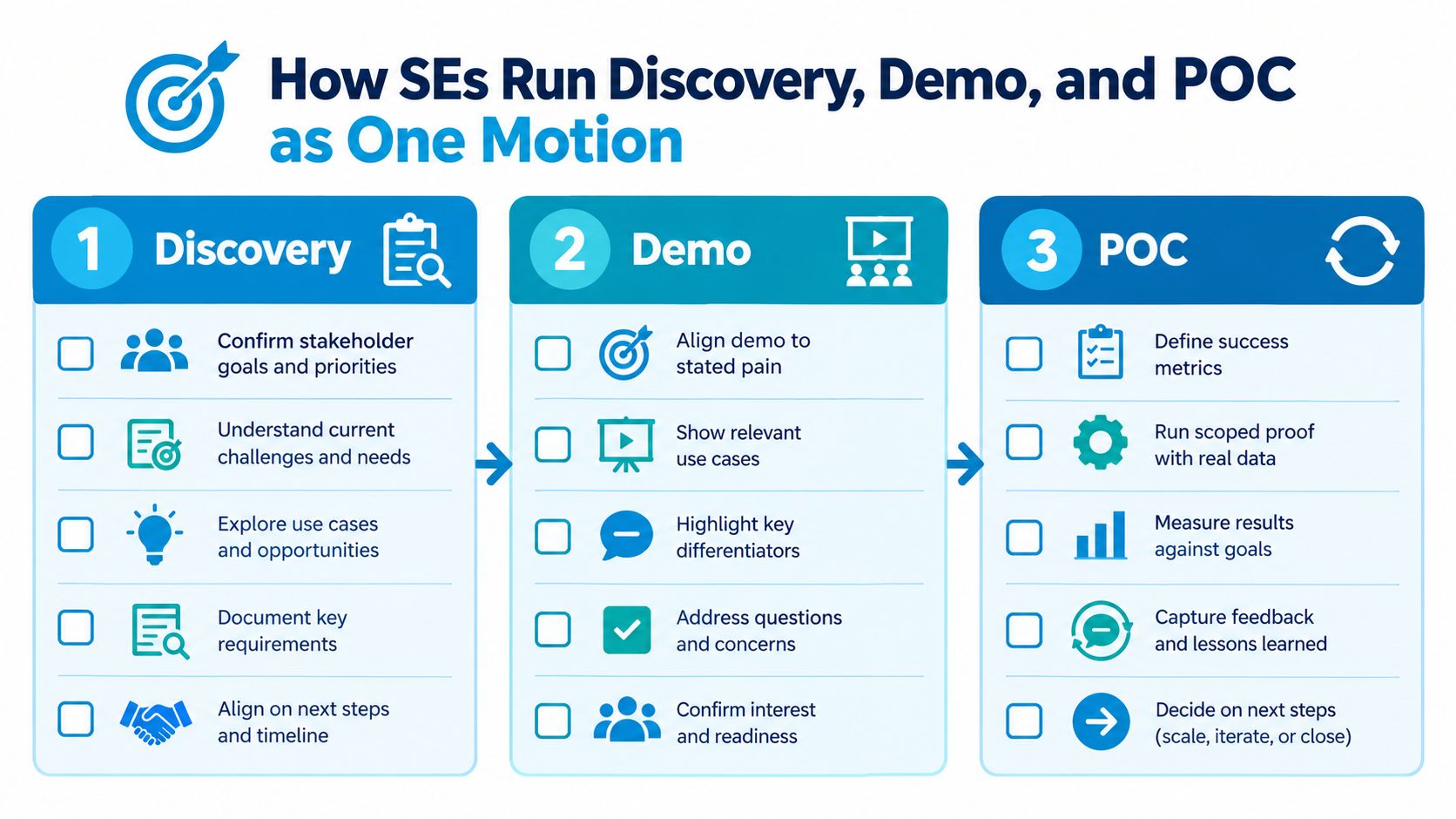
After discovery, your opportunity record should identify the business problem, measurable consequence, priority, affected stakeholders, decision process, decision criteria, economic buyer, timing, and agreed next step. Each item needs evidence from the customer, not an internal guess. For example, a technical preference isn't a decision criterion unless the buying team confirms how it will influence selection.
Use that record to design the demo around what the buyer needs to judge. If the buyer's criteria include a workflow, an integration, and a security requirement, plan the demonstration and technical follow-up around those criteria. Don't fill the agenda with capabilities just because they're easy to show.
A helpful companion for product teams formalizing how they assess customer needs is this guide for seed-stage product teams. For the live sales conversation, use the discovery call guide for Solution Engineers to prepare questions and keep the discussion tied to an outcome.
Put a decision behind every POC
Before a POC begins, agree on an evaluation plan that names:
- Hypotheses: What the customer expects the solution to demonstrate.
- Test data and responsibilities: What the customer provides and who does the work.
- Timeline and success thresholds: How long the evaluation runs and what counts as a pass.
- Commercial decision: What the buyer will do if the evidence meets the agreed criteria.
The plan should also make disqualification possible. If the customer can't provide necessary data, access, ownership, or a decision path, don't treat that as a minor scheduling issue. Reassess the opportunity before committing more SE capacity. A scoped POC that ends in a decision is useful, even when that decision is no-go. An open-ended trial that produces activity without resolution isn't.
Solutions Selling Compared With Challenger and MEDDPICC
These methods should not compete for ownership of the deal. Solutions selling gives the SE team an operating model for diagnosing needs and validating fit. Challenger helps shape the buyer's view and guide action. MEDDPICC exposes qualification gaps. Run them together, with discovery evidence driving technical work rather than treating demo polish as the path to a technical win.
| Method | What it optimizes for | Primary artifact | How an SE uses it |
|---|---|---|---|
| Solutions selling | Diagnosing the buyer's problem and shaping a fit-for-purpose solution. | Requirements and value-validation record. | Connect discovery to solution design, demo, deployment, and outcome validation. |
| Challenger | Reframing the buyer's thinking and guiding the commercial process. | Stakeholder-specific insight and agreed next steps. | Teach with technical evidence, tailor proof to each role, and set clear evaluation commitments. |
| MEDDPICC | Qualification across value, people, decision mechanics, and competition. | Deal evidence mapped to its named criteria. | Track gaps across discovery, technical validation, security, and POC planning. |
Challenger's behaviors are Teach, Tailor, and Take Control. Teach with relevant evidence that changes how the buyer sees the business issue. Tailor proof for the economic buyer, technical team, and users, since each group weighs different risks. Take Control by testing timelines and ending demos, pilots, and architecture reviews with an agreed next step (description of the Challenger approach).
MEDDPICC stands for Metrics, Economic Buyer, Decision Criteria, Decision Process, Paper Process, Identify Pain, Champion, and Competition. It makes deal uncertainty visible: how the buyer will measure value, who approves spending, how the decision gets made, how procurement and security proceed, and whether an advocate can advance the deal internally. For SEs, that means technical work must produce evidence tied to a deal requirement, not activity that sits apart from qualification. Use your team's MEDDPICC qualification guide for Solution Engineers to connect those criteria to technical validation.
A practical division of labor keeps the methods useful without creating duplicate process. Run solutions selling as the team's operating model, apply Challenger behaviors in discovery and demos, and use MEDDPICC to qualify each opportunity. Keep the questions and controls that prevent weak evaluations; remove steps that merely repeat work.
When the Buyer Arrives Pre-Loaded by AI
The old discovery opening assumes the seller gets to shape the buyer's first understanding of the problem. That assumption is increasingly unreliable. Responsive's 2025 B2B buyer survey reports that 90% of B2B buyers research before first contact, and almost two-thirds use generative AI at least as much as traditional search. In the same survey, 60% of more than 1,000 B2B software buyers said they already use AI in sales processes, while more than 30% do not. Adoption is uneven, so don't assume every buyer arrives with the same tools or confidence.

A buyer may bring a shortlist, requirements, or an architectural claim generated with AI. Some may be accurate. Others may be incomplete, disconnected from the buyer's environment, or based on an assumption that nobody has checked. Starting with broad introductory questions can waste time if the buyer has already done that work.
Audit the research trail before repeating discovery
Ask what informed the shortlist and which requirements are firm versus provisional. Then test the assumptions against business outcomes, existing architecture, integration constraints, security needs, and the way the buying group will make a decision. Correct an error by showing the reasoning and evidence, not by dismissing the buyer's research.
Make technical evidence easy to inspect and reuse. Keep requirements, architecture assumptions, limitations, evaluation criteria, and results clear enough for stakeholders to review without relying on a polished presentation. That helps the buyer compare the solution on substance and gives AI tools less room to turn ambiguous claims into false certainty.
The seller's role hasn't disappeared. The entry point has changed. Start by auditing what the buyer believes, then use discovery to distinguish verified requirements from AI-generated hypotheses. That protects trust while keeping the conversation grounded in the customer's actual operating conditions.
Building a PreSales Operating Model Around the Technical Win
A PreSales operating model should measure progress toward the technical win, not count activity for its own sake. A full SE calendar says little about deal quality. Track whether qualified opportunities enter the motion, demos and POCs stay anchored to buyer criteria, and evaluations end with a documented decision and a credible path to value.
Integration and value realization need clear ownership. Demandbase's 2025 B2B Buyer Report identifies alignment across 7–10 stakeholders and integration in crowded technology stacks as buying barriers. The report says 77% of buyers prioritize integration capabilities over standalone features, and 72% of purchases involve complex multi-stakeholder groups. Set the baseline metric, accountable owner, technical dependencies, adoption assumptions, validation milestones, and conditions that would disqualify the deal. A persuasive demo or ROI model cannot replace that agreement.
Use a short scorecard to test whether the operating model is working:
- Opportunity record completeness: Are the business problem, decision criteria, stakeholders, and next step grounded in buyer evidence?
- Demo-to-POC progression: Does the demo justify an evaluation, or send the buyer into an unfocused trial?
- POC pass rate against documented criteria: Were success thresholds agreed before testing?
- POCs ending in a commercial decision: Does each evaluation conclude with a decision, including a documented no-go?
Review evidence, not stage labels. When a POC lacks access, ownership, or an agreed success measure, the leader should help the team stop, re-scope, or disqualify the work. Leaving it to continue by default consumes SE capacity without improving the buyer's decision.
For team-wide implementation, align responsibilities, qualification, and reporting with the PreSales role guide, MEDDPICC resources for Solution Engineers, and the technical win rate framework.
Putting It to Work This Week
Start with three open opportunities. Audit each against the falsifiable opportunity record: problem, impact, stakeholders, decision criteria, economic buyer, timing, and next step. Pick the deal with the weakest discovery and rebuild its demo around the buyer's stated decision criteria. Before the next POC starts, add a written evaluation plan with responsibilities, thresholds, and the commercial decision that follows success.
The recurring mistake is polishing a demo before the discovery is honest. Don't spend another hour refining a storyline that hasn't earned its place. Discovery quality, not demo polish, decides deals.
Book a discovery call review to pressure-test your questions and opportunity record. Then explore the Trusted Advisor Academy for ongoing practice, live deal sparring, and the playbooks, KPI tools, and evaluation templates that help you apply the method to active opportunities.
PreSales Unleashed GmbH offers the Trusted Advisor Academy, a year-round program with structured learning, live practice, and tools for discovery, demo, and POC management. If you want to install solutions selling as an operating model rather than a script, visit PreSales Unleashed GmbH and explore the program.